Categories
Excerpt

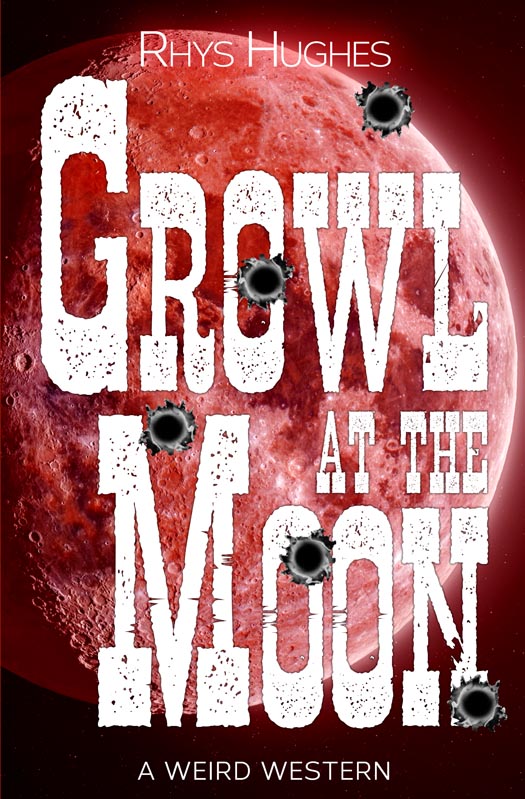
Growl at the Moon by Rhys Hughes

Title: Growl at the Moon, a Weird Western

Author: Rhys Hughes

Publisher: Telos Publishing Ltd

1.

She rode to the crest of the hillock and looked down. The other rider was a pale shadow on the trail below and in the moonlight his shadow was even paler than he was. That was because of the mica in the rocks which gleamed, glittered and shone and turned the landscape into something ethereal and strange. With a low snarl, she spurred her horse forwards.

She zigzagged down the slope and still the other rider didn’t hear her. Was he engrossed in his private thoughts? That must be the answer. Her Winchester was cradled in her arms and her low snarl turned into a stealthy laugh. Her prey seemed oddly incautious, but this was to her advantage. At the base of the slope, she spurred her mount to a fast canter.

The other rider finally became aware that something was behind him. As he turned in his saddle, she raised the rifle and aimed at his face. She slowed in order to be sure of hitting him square.

“Hey, what’s this?” he cried in astonishment.

His head, which was that of a giant rabbit, bobbed up and down, his nose twitched and his long ears undulated.

“Howdy, pard,” she said, and then she added, “I guess you think I’m just a bandit, some unwashed desperado who wants your money. But that’s not true at all. My name is Jalamity Kane and I’m hunting all the men who are part animal. I know what it means that you’re a man-rabbit, it means that you studied with a shaman, one of the Mojave wizards.”

“Well, yes I did,” answered the other rider.

“I make the same speech every time I find one of you people. When I was younger and full of hope and desire, I also sought out a shaman to study with. I found one. Seven years in a subterranean cavern, putting myself through horrid exercises, expanding my mind! But it didn’t work, I didn’t acquire the power. I failed and my soul became bitter. It’s not nice to be bitter and that’s especially true when I look upon your sweet little visage. Gonna blow a hole right through it. Say your final prayers, bunny boy!”

The other rider raised a paw to remonstrate with her but it was too late. Her finger squeezed the trigger and the canyon echoed with the shot. He slumped in the saddle and his horse bolted. He didn’t fall off but remained in place, his feet held by the stirrups. Jalamity watched him vanish into the crystalline darkness. She said to herself, “I’ll destroy all of you. I have no interest in money. I have no interest in anything, only in slaying every cat-man, owl-man, worm-man and cougar-man in the land. You’ll see!”

It was her mission in life. A cruel and futile mission, but a mission all the same, and a gal’s gotta have a mission.

2.

Jalamity was in position to ambush her next victim. She squatted in the shallow pit she had dug. The dry plain extended all around here, as flat as a tune played on a badly-maintained piano in a rotten old saloon somewhere in the worst kind of decayed ghost town where the railroad was supposed to come but didn’t. She had constructed her own cover because there was no natural cover available in the geography of the bland landscape.

The rider was a puff of dust at the limits of her vision. It was early evening and he was evidently trying to cover as many miles as possible before night fell and she chuckled at the malevolent thought that he was hurrying to his doom, a circumstance he would soon be aware of. The Winchester was firm in his grasp and she chewed a stick of licorice root.

This wasn’t European licorice or Glycyrrhiza glabra which also grew in a few places in a few states, having been brought over by settlers, but the harsher Glycyrrhiza lepidota that the Zuni people had liked to chomp as a medicine. Not that Jalamity needed a cure for anything. She just liked to chew on something at the end of a day and she hated tobacco.

She waited patiently as the cloud of beige dust that was the rider expanded in size and took on more of a familiar shape. His horse was tiring a little and his pace was slowing. As he approached, she saw that he wore a hood. All of these fools liked to cover their telltale faces!

She stood up straight, rising out of the pit like a snake about to strike, and strike she would, by which we mean attack and not cease working because of dissatisfaction with pay. She cared nothing for wealth. No ordinary bandit, this Jalamity, half woman and half man, the product of seven years’ meditation that hadn’t worked out the way she’d wanted.

“Hey, what’s this?” he cried in astonishment.

His head, which was that of a giant squirrel, bobbed up and down, his nose twitched and his jaws chattered.

“Howdy, pard,” she said, and then she added, “I guess you think I’m just a bandit, some unwashed desperado who wants your money. But that’s not true at all. My name is Jalamity Kane and I’m hunting all the men who are part animal. I know what it means that you’re a man-squirrel, it means that you studied with a shaman, one of the Mojave wizards.”

It was the same speech, or nearly the same speech as before. It was a short speech but one she had made dozens of times. Very few people ever got to hear it more than once, apart from herself.

An occasional victim escaped her, but it was such a rare event that in terms of statistics it counted for nothing at all.

Jalamity was now reaching the end of the speech. “Gonna blow a hole right through ya. Say goodbye, squirrel boy!”

The other rider raised a paw to remonstrate with her but it was too late. Her finger squeezed the trigger and the plains absorbed the sound of the shot. First he slumped in the saddle and then he fell off. His horse didn’t bolt but remained where it was, looking confused. One day, Jalamity knew, she would meet a man who was half horse. What would the horse he rode on do then? Would he regard Jamality as an enemy of all horses and try to kick her? She had no idea. It was a riddle that only the future could solve.

Most horses didn’t care about their riders but that one might be different. It was better to wait to find out the answer for sure. Speculation was a waste of her time. She climbed out of the pit, moved to the side, leaned over and reached out with her hands and jerked her wrists.

An unseen blanket came up in her fingers. Her horse was beneath it, lying on its side, and now it got clumsily to its hooves. She had covered it with a sheet and covered the sheet with sand and gravel and grit so that it resembled only the smallest of humps in the almost featureless plain. There had been nowhere else to hide it. She could have dug a pit, as she had for herself, but that would have been very hard work. Alternatively, she could have covered herself with a sheet too, but that would have restricted her visibility. Everything had worked out for the best. The squirrel-man was dead.

And now she had his horse as well. She could maybe use his horse as some part of a trap for her next victim. Killing these beasts was her mission in life. A cruel and futile mission, as we already have been told, but yes, a mission all the same, and a gal’s gotta have a mission.

About the Book

Bill Bones was a normal human being until he studied under a Mojave Shaman and was transformed into a man-dog called The Growl. Now, driven by a keen sense of justice, The Growl is on the hunt for the villains who killed his boss, newspaperman Ridley Smart … and he’ll stop at nothing!

Crossing the deserts and forests of the American continent, The Growl searches for the men he must kill. Along the way he meets more beast-men, more magicians, the avenger Jalamity Kane who is seeking to rid the world of the beast menace, and other dangerous characters, from the artificial to the wild, from the robotic to the demonic.

In the deft hands of Rhys Hughes, this inventive tale becomes a masterpiece of twists and turns … exploring and questioning our definitions of humanity, discovering the very meaning of what life and reality might be.

About the Author

Rhys Hughes is a writer of Fantastika and Speculative Fiction.

His earliest surviving short story dates from 1989, and since that time he has embarked on an ambitious project of writing a story cycle consisting of exactly 1000 linked tales. Recently, he decided to give this cycle the overall name of PANDORA’S BLUFF. The reference is to the box of troubles in the old myth. Each tale is a trouble, but hope can be found within them all.

His favourite fiction writers are Italo Calvino, Stanislaw Lem, Boris Vian, Flann O’Brien, Alasdair Gray and Donald Barthelme, all of whom have a well-developed sense of irony and a powerful imagination. He particularly enjoys literature that combines humour with seriousness, and that fuses the emotional with the intellectual, the profound with the light-hearted, the spontaneous with the precise.

His first book was published in 1995 and sold slowly but it seemed to strike a chord with some people. His subsequent books sold more strongly as my reputation gradually increased. He is regarded as a “cult author” by some and though pleased with that description, he obviously wants to reach out to a wider audience!

PLEASE NOTE: ARTICLES CAN ONLY BE REPRODUCED IN OTHER SITES WITH DUE ACKNOWLEDGEMENT TO BORDERLESS JOURNAL

Click here to access the Borderless anthology, Monalisa No Longer Smiles

Click here to access Monalisa No Longer Smiles on Amazon International
Categories
Excerpt

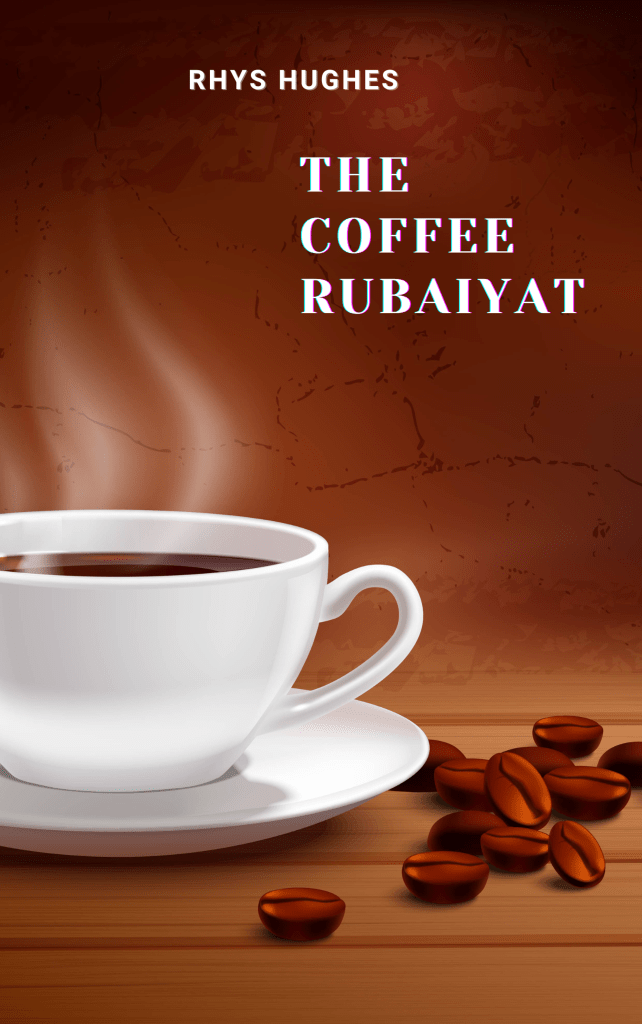
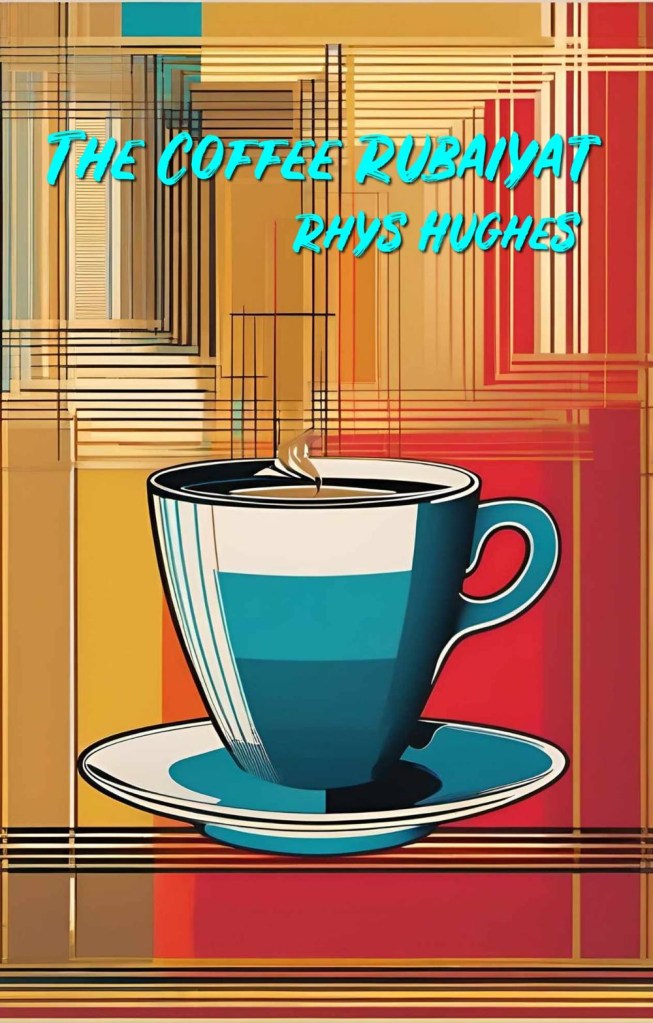
The Coffee Rubaiyat

Title: The Coffee Rubaiyat

Author: Rhys Hughes

Publisher: Alien Buddha Press

Introduction

The famous old poem called The Rubaiyat of Omar Khayyam is known to many through the translation Edward FitzGerald published in 1859. His first edition, a selection of 75 quatrains, is considered the best. He revised the quatrains several times, losing poetic force each time he did so.

His translations are regarded as highly inaccurate anyway, but they are musical, evocative and wistful, and I like them very much. They are among my favourite poems and I once resolved to learn them all by heart.

As it happens, I failed in that attempt, mainly through laziness, which is appropriate really, for FitzGerald himself was an especially lazy man, who wrote and did very little in his life.

The quatrains are all about the joys of wine. At any time of the day or night wine is good to drink. That is the essential message.

I have heard it said that Omar Khayyam’s wine is actually a metaphor, perhaps for God or enlightenment, but personally I find the idea unconvincing. Or rather, I lack the scholarly insight to feel the truth of that interpretation.

The verses seem to be about real wine, the kind that can get you drunk, though I am willing to entertain the notion that I am missing the point. At the very least they can be plausibly quoted in connection with real wine, and I have used them to justify drinking an extra glass, for yes, Omar is keen to insist that more is better than less, indulgence superior to restraint.

But although I am fond of wine, I am fonder of coffee by far. I can easily live without wine, but only with difficulty live without coffee.

Thus, I decided to write a Coffee Rubaiyat, matching FitzGerald’s first edition quatrain for quatrain but making mine all about coffee.

I daydream that copies of my slim collection will one day be found in the coffee shops of the world. If the cappuccino fits, wear it. So say I.

And now it is time for a coffee break and I shall say no more.

Rhys Hughes, June 2023

The Coffee Rubaiyat


I.

Awake! for the alarm clock next to the bed
Is ringing the bells that can wake the dead:
And Lo! The ruby rays of the rising sun
colour the espresso machine a pinkish red.

II.

Dreaming when Dawn’s Left Hand was in the Sky
I turned to Dawn with a very deep sigh,
“Crikey, dear, that’s a massive hand you’ve got.
Why not get out of bed and bring me coffee—a lot?”

III.

And, as the Cock crew, those who stood before
The coffee shop shouted—“Open then the door.
We all rather fancy a round of cappuccinos
Before grappling with our foes upon the floor.”


IV.

Now the New Year reviving caffeine desires,
The thoughtful soul to the kitchen retires,
Where the white froth on the large cappuccino
Flows out, and steam from the kettle perspires.

V.

Biscuits indeed are gone with all their crumbs,
And Sinbad is reduced to sucking his thumbs;
But still the coffee bush her lovely beans yields,
And still the waiter with our beverages comes.

VI.

And Dawn’s lips are coffee smeared; but in divine
Extra-strong roast, sighing, “The coffee’s all mine!
Cream but no sugar!”—the fox cries to the toad
But those dregs have gone cold and that’s not fine.


VII.

Come, fill the mug, and into the boiling kettle
Pour more pure water to cool the red-hot metal.
Strange folks prefer fashionable herbal teas
To sip—and Heck! They include leaves of nettle.

VIII.

And smells—a thousand aromas within one year
Wafted—and a thousand had no aroma to revere:
And this first breakfast time that brings burnt toast
Shall smear Sinbad’s ear on the sheer frontier.

IX.

Come with Coffee Khayyam and leave the lot
of juice bars and water bottles forgot:
Let gym instructors rant about overconsumption
Or doctors cry Enough—heed them not.


X.

With me at the quiet table of a terrace café
That divides the indolent from those gone astray,
Where one may slurp and dribble in peace
And pity the pedestrians who hurry on their way.

About the Book:

Settle into the enchanting rhythm of this coffee-themed adaptation of the classic Rubaiyat of Omar Khayyam, as each stanza awakens the senses with witty, humorous, and thought-provoking reflections on the joys and quirks of coffee culture.

The Coffee Rubaiyat embraces the essence of morning awakenings, midday pick-me-ups, and contemplative sips, all while exploring the comical and heart-warming encounters that revolve around this beloved brew.

This collection celebrates the endless nuances and pleasures that coffee brings. Coffee lovers, literature enthusiasts, and anyone with a penchant for the art of the bean will relish in the fusion of two worlds – the timeless verses of Omar Khayyam and the contemporary charm of Rhys Hughes.

A delightful literary adventure that will leave you yearning for another sip.

About the Author

Rhys Hughes is a writer of Fantastika and Speculative Fiction.

His earliest surviving short story dates from 1989, and since that time he has embarked on an ambitious project of writing a story cycle consisting of exactly 1000 linked tales. Recently, he decided to give this cycle the overall name of PANDORA’S BLUFF. The reference is to the box of troubles in the old myth. Each tale is a trouble, but hope can be found within them all.

His favourite fiction writers are Italo Calvino, Stanislaw Lem, Boris Vian, Flann O’Brien, Alasdair Gray and Donald Barthelme, all of whom have a well-developed sense of irony and a powerful imagination. He particularly enjoys literature that combines humour with seriousness, and that fuses the emotional with the intellectual, the profound with the light-hearted, the spontaneous with the precise.

His first book was published in 1995 and sold slowly but it seemed to strike a chord with some people. His subsequent books sold more strongly as my reputation gradually increased. He is regarded as a “cult author” by some and though pleased with that description, he obviously wants to reach out to a wider audience!

PLEASE NOTE: ARTICLES CAN ONLY BE REPRODUCED IN OTHER SITES WITH DUE ACKNOWLEDGEMENT TO BORDERLESS JOURNAL

Click here to access the Borderless anthology, Monalisa No Longer Smiles

Click here to access Monalisa No Longer Smiles on Kindle Amazon International

Categories
Excerpt

The Wistful Wanderings of Perceval Pitthelm

Title: The Wistful Wanderings of Perceval Pitthelm

Author: Rhys Hughes

Publisher: Telos Publishing

There is a shop somewhere in this town that sells bittersweet longing and I decided to seek it out and buy enough for the afternoon and perhaps the evening too. I wandered the streets of Figueira da Foz and if I happened to meet a stranger I asked them for directions, but no one knew where it was, though most had heard of it.

My yearning to find and enter that shop grew steadily more intense, and it now occurred to me that I already had what I wanted, a bittersweet longing for the building and the product sold by its keeper to his clients. But this simply wasn’t sufficient.

Perceval Pitthelm is my name and I’m sure you already knew this and I am English and a writer of adventure novels. I came to Portugal because I had been told it was a more tranquil land than my own in which to write a new book. This turned out not to be quite true. Nonetheless I was fairly satisfied with my circumstances.

I was a little lonely, indeed, but my health had improved. Originally, I planned to stay three months, but I now felt I would be here until the day of my death. Of course, that day might come with any particular sunrise. It could even be today. Fate likes to take us by surprise and teach us useless lessons. Who can say why this is?

At last, purely by chance, I found the shop at the far end of a dark and narrow alley that went nowhere else. The low doorway was covered by a curtain that I realised was a ragged flag and it tickled the nape of my neck as I stooped to pass under. I emerged in shadows and it required a minute for my eyes to adjust to the gloom.

Then I saw I wasn’t alone and that a man was sitting on a chair behind a long counter on which stood rows of oddly shaped jars and bottles. His teeth shone faintly behind a wide but unjustified smile. Most illumination came from the vessels in front of him, an eerie phosphorescence of many shifting colours. I took a step closer.

‘There is bittersweet longing in the glass containers?’

He nodded slowly. ‘Correct.’

‘I didn’t realise it came in liquid form.’

‘You can freeze it if you wish, then it will turn solid. You may heat it over a flame and inhale the vapour. But at room temperature it is a liquid that emits the glow of its own sad craving.’

‘Shall I drink it neat?’

‘Not if you are unaccustomed to it.’

‘I am English, you see.’

‘Of course you are. Drink it mixed with tea. ‘Saudade’ in its raw form is too potent for you. The effects are dramatic. All day and night you will stand on the shore waiting for something you may not even recognise if it arrives. Your hair will grow long in hours and float in the wind, whipping your face and urging it to gallop off your head, even if there is no wind at the time. So many tears will stream from your eyes that your cheeks must go mad from the excess of salt.’

‘I’ve never had mad cheeks! My features are sane.’

‘Keep it that way, Senhor.’

‘Yet I wish to taste bittersweet longing …’

He sighed deeply and said:

‘I understand and I won’t try to discourage you, but imbibe it slowly, a few drops only. This stuff is lethal. Mad cheeks have been responsible for much mischief in the past.’

I was intrigued and asked him to cite examples.

‘Well,’ he continued, ‘there was once a man named Dom Daniel and he drank against my advice half a bottle of distilled saudade and went off to stand on the beach, to weep, wait and gaze at sea, and his cheeks went mad and began swelling with delusions of grandeur and they became too big for his face and gravity tore them off. The tide dragged them far out and he assumed they were lost forever. Back home he walked, ashamed to own a face without cheeks and dreading the anger of his wife when she found out, but those lost cheeks of his didn’t drown or sink to the bottom. They kept riding the currents.’

‘And were washed up on a remote island?’

‘Indeed, Senhor! How did you guess? On an island off the coast of far distant Brazil they reached a new shore and they took root in the sand and grew into cheek trees, extremely tall and festooned with cheeks for leaves and those cheeks blushed deeply like overripe fruits and they were visible to the crews of passing caravels.’

‘Do they still sail caravels in Brazil?’ I asked.

He shrugged. ‘Why not?’

‘We are living in the modern era, that’s why.’

‘Oh no, Senhor! Oh no!’

‘What did I say wrong? What is my blunder?’

‘Saudade doesn’t permit one to remain in the present. It takes us back, my friend, to a time that perhaps never was real but has been lodged in our hearts since we were children, to a time and to places from that time. The magical lands that filled our daydreams, those visions of wonder and marvels, those gentle golden easy places, when we knew that travel was a miracle that would take us there one day, always one day, one day, yes, but never now, never soon. We just had to wait to grow up and the power would be ours. But we did grow up and nothing was as simple or fine as it should have been. The lands were gone, we couldn’t locate them on any map, for we had forgotten to look into our hearts, where they really were, slumbering and fading all the while.’

‘But what happened to those giant cheek trees?’

‘Nothing at all, Senhor.’

‘Didn’t anyone climb them?’

‘To pluck unripe cheeks, you mean? No! The cheeks blushed and the blushes were visible for many leagues across the ocean. Burning blushes that pulsed in the night like lighthouse beams. How do you think it made sailors feel? Sure, they could navigate using the blushes, but cheeks will respond to other cheeks like brothers.’

‘And also like lovers?’

‘Exactly that way! You are no fool, my friend. I knew it before and I know it again. The cheeks of the cheek trees blushed and the cheeks of the sailors blushed in sympathy. How embarrassing for grown men! How humiliating that must be in front of their comrades, all together with their scarlet cheeks pulsing and burning!’

‘And they began to avoid that island, to sail far around it, to take long detours out on the open ocean?’

‘You are perceptive. And saudade was to blame.’

‘The tale is intriguing.’

‘This really happened,’ he told me, and he sighed again, ‘so take care if you sip saudade, even if you dilute it with tea. This isn’t fake stuff, the bittersweet longing of actors in films.’

‘I listen. I have no desire to lose my cheeks.’

‘Oh Senhor! This stuff is intoxicating and throbs your soul as well as your heart. It must be swallowed only in drops. As for cheeks, they are perilous and weird, but let me tell you something. Knees are worse, much worse. Knees! Bear this in mind.’

I said farewell to Old Rogerio, for I already knew his name and in fact had spoken to him at length before. But saudade cares not for precision. It prefers the vagueness that frames a longing. One must never be quite sure what exactly one is yearning for…

About the Book:

Writer, explorer, inventor, fantastist … join Perceval Pitthelm as he takes you on a journey in the township of Kionga, self-propelled on a pair of massive, mechanical kangaroo legs. His stories may be wild, but his adventures are even wilder. In a riot of imagination and literary sleight of hand, Rhys Hughes presents an old-style adventure set in East Africa, Brazil and the Sahara Desert in this novel. We’re talking Philip José Farmer crossed with H Bedford-Jones meeting James Hilton by way of Karel Čapek (in his War with the Newts phase). And with hefty chunks of Flann O’Brien and Boris Vian thrown in for good measure!

About the Author

Rhys Hughes has been writing fiction from an early age. His first book was published in 1995 and since that time he has published fifty other books, nine hundred short stories and many articles and poems, and his work has been translated into ten languages. He graduated as an engineer but currently works as a tutor of mathematics. Having lived in Britain, Spain and Kenya, he is now planning to move to India. His poetry tends to be humorous light verse and offbeat lyrical fantasy, influenced mainly by Don MarquisOgden NashEdward Lear, Richard Brautigan, Ivor Cutler and Spike Milligan.

PLEASE NOTE: ARTICLES CAN ONLY BE REPRODUCED IN OTHER SITES WITH DUE ACKNOWLEDGEMENT TO BORDERLESS JOURNAL

Click here to access the Borderless anthology, Monalisa No Longer Smiles

Click here to access Monalisa No Longer Smiles on Kindle Amazon International

Categories
Interview

Rhys Hughes Unbounded

In conversation with Rhys Hughes

I have always wanted to interview Ruskin Bond who lives in Landour, near the hill-station of Mussoorie in India. Bond, now 87, grew up in Dehradun, tried a stint in England and returned to the country that had nurtured him to write stories that make us laugh and yet bring out the flavours of love and kindness in the Himalayas. Sadly, no one seems to be able to get me an online interview with him. So, I did the next best thing…

I interviewed Rhys Hughes.

Rhys Hughes in Srilanka

You have to see it from my perspective, here was a humourist migrating from UK to India, just like Bond. Both their names begin with R — Ruskin wrote of monkeys conducting a fashion parade in colourful pyjamas borrowed from him, perhaps permanently and Rhys wants to interview a monkey who took a bottle of coconut oil from his current home. Only, Hughes’ monkey happens to be in Sri Lanka and Bond’s monkeys were in India. In fact, I told Hughes he could be the next Bond and could perhaps get into an apprenticeship. He has the basic compassion and humour in his writing that endears Bond to so many hearts. However, Hughes has not made it across to India as yet. He waits on the lush shores of Sri Lanka to make a landfall on the Coromandel Coast or … maybe the Himalayas… as the pandemic continues to upheave in tsunami-like waves. Maybe, Rhys Hughes will become the Ruskin Bond of Sri Lanka! Let us tread into the world of Hughes to check out what he thinks.

Tell us since when have you been writing? What gets your muse going?

I began writing when I was six years old or so. My earliest stories were inspired by films and comics I enjoyed and mostly were about monsters, adventures, space travel, robots, dinosaurs and ghosts. I doubt if any of them made much sense.

The first short story I wrote with a plot I remember was about a man who jumps off a cliff so that he will turn into a ghost and can create mischief in his village, which he does, but the twist is that he survives the fall and only thinks he is a ghost. The enraged villagers chase him back over the same cliff, and he isn’t frightened because he believes he can float on air, but he can’t and this time he doesn’t survive. I was about ten years old when I wrote that. But I didn’t begin writing short stories in earnest until I was fourteen. That was the real beginning of my writing career. I have been writing regularly ever since. I don’t require prompting to write these days. It has become a habit, a reflex, something I just do. I still write about the same old things as always, monsters, adventures, space travel, etc, but I have added a few more themes since I was a young child and my style has improved considerably. At least I hope it has!

That story you wrote as a ten-year-old definitely has potential! And we enjoy your writing as we read it now.  Now tell us why do you write?

Ideas come unbidden into my mind and they won’t leave me alone unless I put them into stories. The moment I embody these ideas in a work of fiction they stop bothering me. I get ideas all the time, especially when I am walking or travelling somewhere, but also in the middle of the night. I try to make notes so I can use them later but sometimes I neglect to note them down and I forget them. Then the ideas go away temporarily but return days, weeks, months or years later and bother me again. Only when I pin them down into a narrative of some kind will they go away forever. So writing is a compulsion for me as well as a voluntary activity. It wasn’t always like this.

In the beginning I found it difficult to come up with original ideas. I had to work hard at it. I would say that most of my ideas back then were fairly ordinary ones and only occasionally truly original. But I persisted and exercised my mind, and just like muscles do, the parts of my mind responsible for the invention of original ideas got bigger and stronger, and now the ideas come without effort. As it happens, not all these ideas turn out to be as original as I like to think they are. Sometimes I get excited that I have come up with a totally new concept only to later discover that some other author beat me to it years ago. But I do believe that originality is possible.

The oft-repeated maxim that there are no new ideas simply isn’t true. If originality is impossible, how were any ideas generated in the first place? I don’t mean to say that originality is the ultimate objective of writing, of course not, there are a great many other reasons to write, but I am talking about it from my own particular point of view. And all I am really saying here is that practice is the most important thing, the only essential thing. I write a lot and the very act of writing regularly seems to make writing in the future easier and smoother.

What is your favourite genre for writing and for reading?

The genre question is a difficult one to answer but I am going to say that if I had to choose only one genre to describe my own writing I would answer “comedy”. This doesn’t mean that everything I write is comedic, but a large percentage of it certainly is. And I don’t necessarily mean laugh-out-loud comedy but other types of comedy too, whether subtle irony, philosophical farce, absurdist and surrealist works. There are many grades of comedy, from wit to parody, and I enjoy most of them. When it comes to reading, I still have a focus on comedy, I suppose, but I will read very sober and serious works too. If I made a list of my favourite works of fiction, comedic works would be at the top of the list.

Broadly speaking there are two types of humorous literature, one in which incidents are funny and one in which it is the telling that is comic. Writers who combine both types tend to win my deepest admiration. Yet quite a few of my favourite books have no comedy in them at all, neither in subject nor in style, for example The Adventures and Misadventures of Maqroll by Alvaro Mutis ( 1993, translated by Edith Grossman, 2002) which is a sequence of tropical and troubling narratives, often sombre in tone, that nonetheless remains an enthralling and uplifting read.

Which writers have influenced your work? Are you influenced by other art forms?

I wanted to become a professional writer because of Robert Louis Stevenson. It was Treasure Island (1883) that opened the gates into the entire world of literature for me. I still admire him hugely but I have had much bigger influences since then. Delving deeper into the novels and short stories that were available to me, I was lucky enough to find authors who resonated with some deep part of my being and made me not only want to continue trying to be a writer, but to be a writer who wrote as they did. Of course, it’s better to develop one’s own style, but I suspect that ‘distinctive’ styles are really the result of amalgams of influences, a blend of prior styles. Italo Calvino (1923-1985) has been my favourite writer for more than thirty years, with Donald Barthelme (193i-1989), Boris Vian (1920-1959), Flann O’Brien (1911-1966) and Stanislaw Lem (1921-2006) not far behind. At the moment I am a keen reader of the work of Mia Couto (1955-2013). Alasdair Gray (1934-2019) is another favourite.

To answer the second part of your question, I have definitely been influenced by art forms other than writing, in particular music and visual art. I might even say that the paradoxical imagery in the artwork of M.C. Escher (1898-1972) has been at least as big an influence on me as the prose of any author. I was astounded and captivated when I first saw his graphic designs and have loved them ever since.

You have travelled to many places. How many countries have you visited? Has travel impacted your writing? How?

I have lost count of the number of countries I have visited. I used to keep a map and colour in the countries that I had been to, but I lost the map years ago. The truth is that probably the total isn’t as high as I think it is. Most of my travelling has been done in Africa and Europe, and I have only really dipped my toes into the vastness of Asia, and I haven’t even been to the Americas at all. No one is so well-travelled that they really know the world.

Travel has certainly impacted my writing, though. I can state that with confidence. I am often inspired to write stories set in the places I have visited and I guess I probably wouldn’t do so if I hadn’t been there. Having said that, I do occasionally set a story in a location I have never visited. Such stories can work well but there is nearly always a vital element missing, some immediacy that a certain level of familiarity gives to a work of prose. It’s far easier to create a convincing atmosphere when you are writing from experience rather than from research. Little details will give some solidity to the evocation of scenes, details that can’t be easily imagined without first-hand experience. This doesn’t mean that I think travelling is necessary for the creation of good fiction. Good fiction can be centred in nowhere, almost in no space or time if the author is talented enough. And there’s a paradox in the nature of travel, which is that even though the particulars of your surroundings might change, the essentials remain the same. We can put a lot of effort into the act of travelling only to discover that people are people everywhere. And would we have it any other way?

Tell us a bit about the world you grew up in — we have an interesting piece by you called ‘Dinosaurs in France’ — which claims you grew up in a world of different value systems. Would you see those as better or the present as better?

The past is another country. That’s one of the pithiest and truest maxims anyone has devised. In only half a century I have seen many changes, but in fact most of these changes came so gradually I didn’t notice that things were changing at the time. Only now, looking back, do I see the vast gulf between the present and my past. I was youthful in a world where information was much more difficult to obtain. There were rumours and suppositions and often no way of confirming or refuting them. People believed strange things and adjusted their attitudes to match these odd beliefs. People still do the same now, of course, but it somehow feels different. One can more easily check assertions now than before and learn much more quickly if they are true or false. The world I grew up in was one in which you had no choice but to take another person’s word at face value. So if a supposedly responsible adult, like the postman, told you with a straight face that he lived in a house made entirely from marshmallows, there was no easy way of disproving the claim. You had to take his word for it. I can’t say it was a better world and I don’t want to suggest it was a worse one. It was simply different, a world lacking ready access to information.

You have written a lot of humour. Not too many people do that nowadays. Could you tell us why your funny bone is tickled to create humour as it does? Do you think humour is a good way to address major issues?

Humorous writing has gone out of fashion to a certain extent in the anglophone world, yes, but it’s still there, in the background. There was a great tradition of British humorous writing that lasted about a century or so, and I was fortunate enough to grow up at the end of that phase. I am talking about a particular type of humour, dryly ironic but also theatrical, a sort of blend of surrealism and the old musical hall routines. J.B. Morton (1873-1979) was one of the masters of the form, and he was an influence on many of my favourite comedic writers, such as Spike Milligan (1918-2002), Maurice Richardson (1907-1978) and W.E. Bowman (1911-1985). These humorists also took the language and played with it a little, transforming it into something new, though I feel ultimately that such comedy derives more from the rhythms than the melodies of wordplay.

The entire range of comedic devices might be used but new ones invented as well. There can be over reaction to minor incidents and under reaction to major ones, constant misunderstandings, amplification of repetition, parody of existing forms. W.E. Bowman’s The Ascent of Rum Doodle is my favourite humorous novel, and its sequel, The Cruise of the Talking Fish, is also high on my list of best comedic literature. Bowman apparently wrote a third volume in the series that remains unpublished and is in the safe keeping of his son. If this is true, I hope it will appear one day.

Are you influenced by any specific humourist? If so, who?

Flann O’Brien is probably my biggest influence in terms of comedic prose. His work is quirky, inventive, curiously erudite, absurdist and often metafictional. I am staggered by the wealth of invention in his novels, the supremely silly but also highly ingenious conceits and concepts, and the bone-dry irony contrasted with farcical exuberance, the light touch and the dark tone. W.E. Bowman and Maurice Richardson are another two favourites. That is prose but when it comes to poetry I love Don Marquis (1878-1937), Ogden Nash (1902-1971) and Ivor Cutler (1923-2006) best, all of them with radically different approaches to comedy. Marquis in particular pushed humour in his free verse to a point where it often became profound, serious and socially critical. You asked if humour can be used to address major issues. Yes, sometimes it can, even with great force, but it doesn’t have to.

Tell us the extent of your work. How many books have you written?

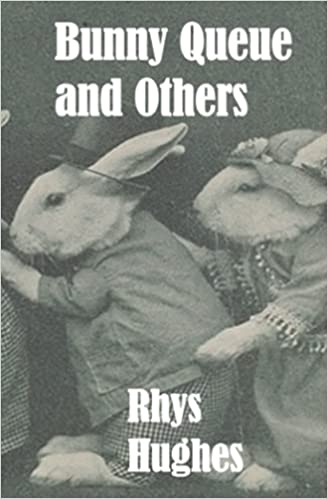
I have published many books. The question is how do I count them. I tend not to count the self-published books. It seems to me that self-publishing is too easy. On the other hand, traditional publishing is maybe too difficult. I have forty or so traditionally published books and twenty self-published books out there, so I am going to give forty as my answer. Most of my books are collections of short stories. I have only written a few novels. My poetry collections so far have been self-published with the exception of one single volume called Bunny Queue.

It is one of my goals to have all the short stories I have ever written appear in my books. At the moment there are many of my short stories that exist in magazines and anthologies that have never been collected. And there are many unpublished short stories in my files too. My plan is to write exactly a thousand short stories and consider them as part of one big story-cycle. This project is almost done. In a few more months, with luck, I will finish writing my thousandth story. Thirty years in total it has taken. When that last story is finished I will devote myself entirely to novels, plays, poetry and articles. No more short stories! So, in reply to your question, I can say that I have written a great deal of work, maybe too much, but as I said earlier, writing has been something of a compulsion for me.

What are your future plans?

I plan to finish my big story-cycle of one thousand stories. Then I will write a few novels that I have been planning for a long time. One of these novels will be called The Hippy Quixote and will be about a young, deluded fellow who in his mind is living in the 1960s. He takes a guidebook written in that decade and follows the old hippy trail to India, blissfully unaware that so many things have changed in terms of societal attitudes and geopolitics. This idea seems to me to be a fruitful one for the creation of comic scenes.

I also have to finish a novel I began a long time ago, The Clown of the New Eternities, sections of which have already been published. It’s long overdue for completion. This novel is about a highwayman who has accidentally outlived his own age and is forced to adjust to the modern world. Another variant of Quixote, I suppose. I think that many or most of my longer narratives are a blend of the Quixote and Candide models with a bit of Gulliver thrown in. We can talk about our future plans all day, of course, but whether we are lucky enough to have a chance to make them real is another question altogether. I intend to do my best, as I have always done, but nothing is certain in this world of ours.

Thanks Rhys Hughes for your time and lovely answers.

Click here to read prose & poetry by Rhys Hughes.

(This is an online interview conducted by Mitali Chakravarty.)

PLEASE NOTE: ARTICLES CAN ONLY BE REPRODUCED IN OTHER SITES WITH DUE ACKNOWLEDGEMENT TO BORDERLESS JOURNAL