Categories
Review

Voices from Beyond

Book Review by Swagata Chatterjee
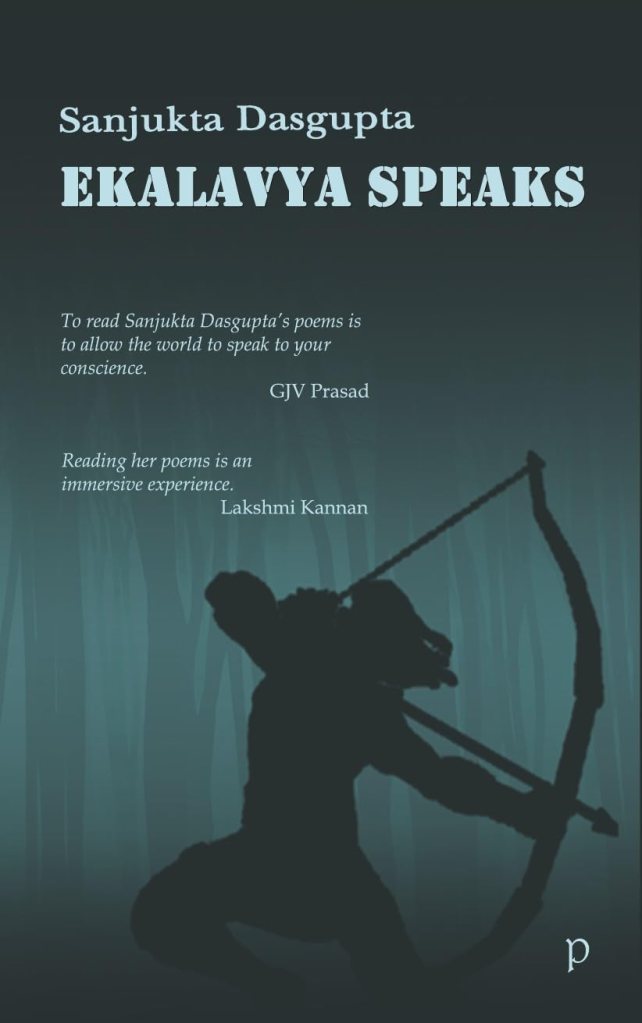
Title: Ekalavya Speaks

Author: Sanjukta Dasgupta

Publisher: Penprints

Poetry which goes beyond the boundaries of words and speaks for a greater cause calls for a captivating read. The lines become more significant when the verses address multiple socio-politico-cultural issues, aesthetically and without didacticism. Poet and academician Sanjukta Dasgupta’s latest book of poems Ekalavya Speaks is not merely a gathering of words, they rather, “[…] spread out their wings untiring/ And never rest in their flight” (Yeats) and attempt to hark at deaf ears and represent unheard voices. She is a strong voice for the otherized, marginalised sections raising issues from multiple spheres of life. Caste, gender, myth, history, pre-history, and technology all find space in her chosen selection of poems. The very last lines of the first poem, ‘Accident of Birth’ says,

“No accident could be 
More catastrophic than
The accident of birth, alas.”

This sets the tone of the whole collection, bringing out the angst of not one voice or one poet but an entire nation. The poet is a strong voice, at times ironic as she says in her titular poem ‘Ekalavya Speaks’-

“The Sun also Rises for us
I may claim your thumb some day.”

These lines are from Dronacharya, the tutor of the royal princes who asks his disciple to gift him his thumb after lopping it off  as a fee to maintain his allegiance to the throne. Ekalavya, the tribal prince could not question the ‘guru’ in the Mahabharata, whereas the poet in the surreal space gives him the voice to speak for the treachery of the great guru. The guru reappears in the poem ‘Dronacharya: The Teacher of Princes’ where questions are thrown at the intentions of a biased guru who was  “The glamourised bonded labour/ Leashed to the regal court.”

Her poem, ‘Kurukshetra-The Killing Field’, goes beyond the boundaries of territories and is akin to any war where lives are lost. At once Kurukshetra becomes the battleground of Ukraine or Gaza where humanity is killed every day. The crying mothers and wailing children are the same everywhere and they are representatives of the universal sorrow of pain and loss and how peace is a mere myth as “Peace was restored at the price/ of rivers of blood […]”. In fact, ‘In the Holy Land’, she talks of dying children and the toxic air of war-trodden Gaza; of the grief-ridden Bethlehem and Jerusalem.

In her greater narrative, Ekalavya and Karna unite to quest for justice, for a space in the mainstream, and for a better liberated world. In Dasgupta’s poetry,  Ekalavya, Shambuka or Shikhandi are not figures from the great epics, they represent the backwards sections of society who perhaps after eons of silence they have now found the time to come out of death, saying– “ I rise from my ashes/ Resurrected!”

With Shikhandi, Draupadi’s brother in the Mahabharata, who was born a female and exchanged gender with a yaksha (nature spirit) for that of a male, Dasgupta brings in the suffering caused by gender identity. She sensitively writes about Oscar Wilde’s homosexuality in her poem ‘The Poet In Reading Gaol’. One’s sexual orientation can ironically be treated as a heinous crime. Heterogeny is also a kind of capitalism as the poet strongly urges and questions progressiveness and maligning of human rights.

In her earlier books Lakshmi Unbound, Sita’s Sisters, and Indomitable Draupadi. Dasgupta has primarily addressed the feminist question. Her latest includes poems like ‘Bapu’ and ’Manipur’. In ‘Bapu’, she talks about the rape of a 12-year-old child in the name of religion in India with sensitivity.

‘The Coffee Shop’ is an interesting and ironic poem. Dead leaders meet in a surreal space where neither murderer nor violence can touch them. They are ‘immortals’ and ‘martyrs’ and, now, are even invincible. It is utopian when Gandhi, Jesus, Martin Luther, and Julius Caesar meet each other. Religion and politics, peacemakers and warriors, all blend in a higher realm of understanding. The flavour of this poem is unique and different from the rest of the poems in the collection and yet thematically it stands out as a statement against violence and death. Death cannot bring an end to the ones whose deeds and ideals are immortal. The same can be said about another visionary poem, ‘Shakespeare and Kalidasa’.

In all the poems, the poet comes across as a strong, sensitive voice whose pen cuts across dogmas, blind faiths, violence and otherization. At the same time, she speaks for the cause of humanity. There are personal poems, like ‘I can’t breathe’; a brilliant poem describing psychological claustrophobia in a world where no peace or no prayers can end the suffering of souls. ‘The Exit’ or ‘Loss’ add richer gravity .

As a poet Dasgupta’s language is lucid and she draws her allusions and examples from the myths, from the past and the projected the future. She strongly voices her opinion. As an educator and as a responsible human being she becomes the voice of the many. Each poem unfolds a story to guides our way through obstructions, which are not physical but mental barriers from which one must liberate oneself. As I read her, I am reminded of a few lines by the great Urdu poet, Faiz Ahmad Faiz, who wrote:

Speak, your lips are free.
Speak, it is your own tongue.
Speak, it is your own body.
Speak, your life is still yours.

Swagata Chatterjee is an Assistant Professor of English at a state-aided college under Vidyasagar University. She is an academician and a keen reader.

.

PLEASE NOTE: ARTICLES CAN ONLY BE REPRODUCED IN OTHER SITES WITH DUE ACKNOWLEDGEMENT TO BORDERLESS JOURNAL

Click here to access the Borderless anthology, Monalisa No Longer Smiles

Click here to access Monalisa No Longer Smiles on Kindle Amazon International

Categories
The Literary Fictionist

Bapu, Denied

By Sunil Sharma

The City of Concrete (CC) was all excited and discussing the new viral video of a man claiming to be the “Real Gandhi”.

The middle class hardly cared for surnames but anything viral got them talking. And this real vs. fake debate always made them social– quick WhatsApp exchanges of videos and messages, that is all of it, then moved on for other limited conversations, mainly digital.

In fact, the City did not care about history and heritage and trifles got them interested– who is eating what, how and where? Or wearing what and where? Or dating whom or where?

The CC grew inward-looking and obsessed with tech gadgets.

Smart phones were their portals to instant nirvana.

And viral videos, their mainstay of an urban narrow existence cramped in few hundreds of square meters in the vertical cages!

So, on a crisp morning of a holiday, the City got jolted by the new sensation of a man claiming to be authentic Gandhi left them intrigued.

But who is Gandhi, dude?

Here was this video of a somber old man with a magnetic persona– yes, you could feel the electrifying currents across the small mobile-phone- screens that affected you directly– the high-energy field, halo around the man that left you in thrall.

Incredible!

Within an hour, it was the top trending topic.

As per the recording, the man in round glasses and loin cloth, told some slum children that he was India’s Bapu.

The folks were initially dismissive and some die-hard skeptics openly cynical of this grandfatherly, scantily clad man, and told him rudely to go some other place and let them enjoy the off day.

The man was quite understanding and patient and asked them, “What day is this?”

An out-of-job guy replied gruffly, “October 2nd.”

The visitor persisted, “Why is it declared a national holiday?”

The folks, gathered under the bronze statue of a man with round glasses and walking stick, had no answer.

Then a child finally replied, “Wait! It is the birthday of the ‘Father of the Nation’.”

The stranger smiled, “Yes, son, you are right! It is my birthday.”

Thereupon, the wide-eyed child asked, “Are you that iconic Mohandas Karamchand Gandhi who delivered us from slavery to the wily British through your philosophy of non-violence and satyagrah ?”

The old man smiled and said, “Yes, I am that Mohandas, an ordinary son of motherland, who was lucky enough to serve my country in most humble manner, with the loving support of my country.”

The child beamed and shouted, “Lucky me! Meeting the Apostle in person! My dream has come true!”

The child raised voice: “Mahatma Gandhi zindabad !”

Children of the poor neighbourhood repeated it as a feisty slogan.

The old man smiled and kept on walking fast across the broken city.

The children followed — and soon others joined the long procession.

It was huge!

People clicked the man who seemed to be walking on another fresh mission.

Soon the news spread.

Citizens came out of their customary slumber and started following the kind old man who, a bit pale, still retained a strange luminosity and a hypnotic pull over his simple beholders. The moment he had stepped into their middle from nowhere, the whole space was lit in a strange way. There was a certain spring in his gait and his walking stick shone like some royal emblem. His watch had an unearthly chime—mesmerizing!

His voice was strong, eyes steady, gait firm.

This dimension collapsing into the other dimension; this reality fused into that reality– that kind of thing!

History was coming alive — in an unpredictable way! A professor wrote.

A sole surviving freedom fighter remarked, the visitor reminded them of the aura of Mahatma Gandhi, in an odd way.

This Gandhi looked other worldly, ethereal but inspired confidence—and faith!

Bapu’s smile was pure and eyes and tone, gentle.

The CC got enthralled by the heavenly presence of Gandhi and the residents went wherever this person went.

The fever spread further.

The WhatsApp exchanges galvanized the sleepy city, and it turned into a mass event.

There were the loud and regular chants of “Bapu! Bapu! Bapu is back for his country—again! We love you, Bapu!”

People got hysterical at the sight of the frail man. Many openly wept and said, “We need you Bapu, in our empty lives as mere consumers. You have made us whole!”

The freedom fighter cried, “Bapu! Nobody cares for us here!”

Bapu smiled: “They will. Follow the moral compass. The world will listen.”

The freedom fighter said, “Yes, Bapu. I will teach students your philosophy.”

.

The City of Concrete was on fire.

A real hero had emerged from the darkness.

Everybody talked of Mahatma Gandhi only.

An antidote to the global doctrine of hate.

.

The municipal corporation was busy celebrating the birthday of the ‘Father of the Nation’ via sterile speeches and garlanding.

Initially the corporators thought that he was another look-alike walking the narrow streets this morning, an annual practice for few models but when apprised of his increasing popularity, the bunch of the city fathers grew apprehensive of a new threat to their base.

By mid-morning, the national media grew aware of a new sensation. A man who called himself the original Gandhi and was visiting the CC for a reality check.

.

Of course, the new-millennial young crowd had never bothered about history or India, and they were least interested in searching for a name and legacy that no longer resonated within a geography being redone for the malls and foreign outlets of food, clothes and entertainment. Plugged into their iPhones, the cool set ate burgers and pizza and sang Western songs, wearing baseball caps turned around, dressed up in sneakers and cotton-Ts and cargo pants, tattooed up and ears, pierced.

What hooked them was the unusual sight of a bare-chested man radiating terrific energy and calmness, kind of raw star power unseen so far in a media culture and thinking of the possibility of the 5-second fame in the clutter, the teens and young adults raced to the spot where Bapu was talking to the masses. They wanted to join the trending hash tag: #Seen with our Beloved Bapu! The crowds from outside CC kept on joining that famous historical frail figure full of steely resolve and power.

Meanwhile, media arrived in big numbers and the circus started. The loud reporters asked questions about this phenomenon, without a match. One teen said he saw the statue of Gandhi in the garden coming alive; another claimed he saw the statue walking down the street in animated condition, while other versions spoke of witnessing Gandhi floating on a cloud or descending from the air! The viral videos flooded the cyber space, and the world began reacting to another trend: #Bapu, Alive!

#New Messiah of Love! Another trended.

Love Triumphs Finally! Wrote another on her blog: Young Nation.

.

The local leaders got unduly alarmed: Who is this pop figure? His minute-by-minute-increasing fandom and heavenly persona posed a problem. The cops were dispatched.

Bapu was brought before the Wise Council.

One of the senior leaders asked: “How can you be Bapu?”

Bapu asked calmly: “And why can’t be I?”

Leader: “Because you died many years ago…”

Bapu: “When did I die? I never did. Hatred can never win. I live on…”

The leader fumbled: “But, we are told you died, years ago. How can you be re-born?”

“Ideas never die. They live on. Faith revived me.”

The leader nodded.

Bapu smiled: “Do you really know me?”

“Yes, Bapu.”

“Any idea about the incident at Pietermaritzburg station? The year 1893? June 7?”

The leader did not know anything. He looked like an idiot.

Bapu said calmly: “A leader must know the history of their nation. Lead by example. By honesty. Simplicity. Ethically. Remain connected to the fellow citizens. Create a legacy of love and ahimsa! Understand?”

The leader nodded again, crestfallen before this luminous being, beyond the pale of death.

Bapu left smiling. Huge crowds waited outside.

“Gandhi is alive!” They shouted. “He has come back for his children!”

.

The Great Leader was woken up.

The media in-charge, a seasoned man handling information technology cell of the party, reported the developments that could cast a shadow on the Tall Leader.

The Great Leader replied: “Do not worry!”

“But Saab!” croaked the sycophant.

“Listen!” commanded the Tall Leader.

“Yes, sir!”

“The surest way to neutralize is to institutionalize them.”

“Sir!”

“Ritualize their memory!”

“Sir!”

“And re-write history.”

“Sir.”

“And…”

“And? Sir?”

“The best way is to erase history by making it ugly, unreadable and unproductive!”

The Tall Leader chuckled and disconnected.

.

Glossary:
Satyagrah — Using truth to non-violently resist abuse

Zindabad — Long live

Ahimsa — Non-violence

Sunil Sharma is an academic and writer with 22 books published—some solo and joint. Edits the online monthly journal Setu.

.

PLEASE NOTE: ARTICLES CAN ONLY BE REPRODUCED IN OTHER SITES WITH DUE ACKNOWLEDGEMENT TO BORDERLESS JOURNAL. 

Categories
Slices from Life

Bapu walked here

By Lina Krishnan

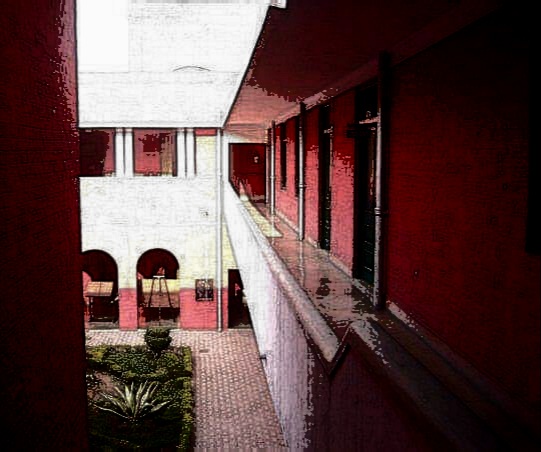
The corridors of time. The author’s school in Delhi’s Mandir Marg.

At my school, on the 30th of January, at ten minutes to eleven, a bell would ring once, like a Buddhist gong. It was a reminder to keep silence; for this was the hour and the moment when Mahatma Gandhi was gunned down. It was a time to reflect on his message and his life.

While these few minutes of silence might be common practice across India in those days, our school also had more permanent reminders of Gandhiji; there was a sculpted bust of his with a sign that said: Bapu walked here.

As young children, we had the mistaken impression that he had walked from here, and not from Birla House, to his last prayer meeting where the assassin met him; later we realised that was not so; he had merely visited earlier. Perhaps from the Harijan Basti* next door, where older students from our school went to take non-formal classes with the children of the community.

We too were sent, when a little older, to continue this form of teaching. To be frank, we did not feel much like teaching, nor did the children there like studying with newbies like us. At the time, envy was the only emotion we felt at their lack of educational fetters, a sort of Tom Sawyer meets the free-spirited Huckleberry Finn scenario. We would have to return to our classes, strict teachers and tons of homework, while those fortunate beings could fly kites and run about. After a few visits when they relaxed with us, it dissolved into fun and games and that was better than our amateur attempts to teach them.

It was years before I realised that we were the students there, learning life lessons about a world beyond the trappings of our public school life and middle class existence. In this, his birthday month, I would like to think of an old man, schooled in British law courts, yet spending a life outside, fighting both the Empire and injustice on many levels. He was probably nudging us in a puckish way, to walk in his footsteps, towards the not so privileged and to discover the symbiotic web of life in the human ecosystem.

*Harijan Basti: A low caste colony

Lina Krishnan is a poet, abstract artist and photographer in Pondicherry. She has a chapbook of nature verse, Small Places, Open Spaces, with Australian poet valli poole. 

.

PLEASE NOTE: ARTICLES CAN ONLY BE REPRODUCED IN OTHER SITES WITH DUE ACKNOWLEDGEMENT TO BORDERLESS JOURNAL

.

Categories
Poetry

Peace & Resistence

By Dr. Piku Chowdhury

Peace and Resistance

For the love of myself, I can’t shut out the drumbeats

Reverberating in the primitive groves of ancient times

Daughter of shadows, you burn in shades of my heart.

I can’t jump over untouched spaces that

Hide under urban gloss, overlying putrid fungal stretch.

If Vemula burns and daughter of soil

Is groped with soiled nails and golden fangs

The untouchable touched with carrion lust,

For the love of self, a daughter of a sacred land

Where Shanti flows in honeyed air, and

Is enshrined in the fluttering flag,

I allow the primitive drums to roar

strange rhythms loud, and echo in blood.

For the love of myself, I strain my ear

To the silent resilience of nation’s father.

And then — I wield the reticent pen

Pregnant with the pent-up pain

And catch the helpless weeping rain

To create a song woven in weft

Of Bapu’s sublime dreams of justice

Liberty, equality, reverence, mercy-

The flowing lines an obeisance

to the power of peaceful resistance.

Against dismal discrimination,

Corruption and exploitation.

The lines take flight like the winged herald

Of peace; the rhythm echoes in groves

With the power of a lonesome figure, righteous in resistance

Marching erect with might of peace; undaunted will

That breathes new life in every faltering existence.

.

Dr. Piku Chowdhury is a teacher in a government aided post graduate college of education and an author of 8 books. She has published more than 70 articles in international journals and acted as resource person in many national and international seminars and symposia. She has published poems, acted as editor,  translator and core committee member of curriculum revision in the state. 

PLEASE NOTE: ARTICLES CAN ONLY BE REPRODUCED IN OTHER SITES WITH DUE ACKNOWLEDGEMENT TO BORDERLESS JOURNAL.