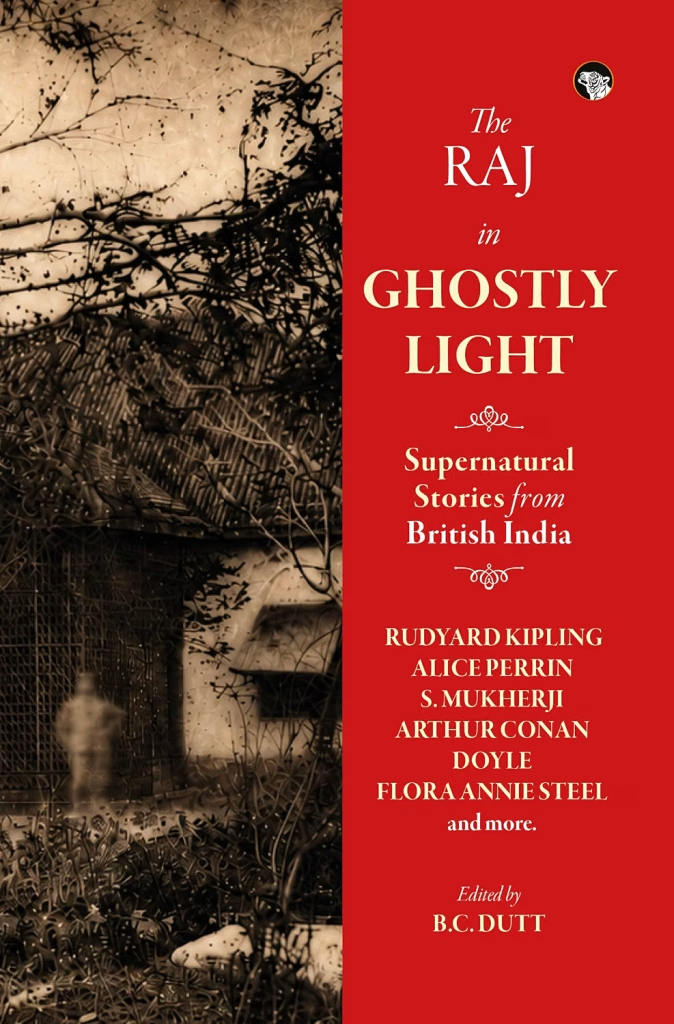
Title: The Raj in Ghostly Light
Editor: B.C. Dutt
Publisher: Speaking Tiger Books
I was awakened by some sound in the room, and I instantly raised myself upon my elbow on the couch. Some hours had passed, for the square patch upon the wall had slid downwards and sideways until it lay obliquely at the end of my bed. The rest of the room was in deep shadow. At first I could see nothing, presently, as my eyes became accustomed to the faint light, I was aware, with a thrill which all my scientific absorption could not entirely prevent, that something was moving slowly along the line of the wall. A gentle, shuffling sound, as of soft slippers, came to my ears, and I dimly discerned a human figure walking stealthily from the direction of the door. As it emerged into the patch of moonlight I saw very clearly what it was and how it was employed. It was a man, short and squat, dressed in some sort of dark-grey gown, which hung straight from his shoulders to his feet. The moon shone upon the side of his face, and I saw that it was chocolate-brown in colour, with a ball of black hair like a woman’s at the back of his head. He walked slowly, and his eyes were cast upwards towards the line of bottles which contained those gruesome remnants of humanity. He seemed to examine each jar with attention, and then to pass on to the next. When he had come to the end of the line, immediately opposite my bed, he stopped, faced me, threw up his hands with a gesture of despair, and vanished from my sight.
I have said that he threw up his hands, but I should have said his arms, for as he assumed that attitude of despair I observed a singular peculiarity about his appearance. He had only one hand! As the sleeves drooped down from the upflung arms I saw the left plainly, but the right ended in a knobby and unsightly stump. In every other way his appearance was so natural, and I had both seen and heard him so clearly, that I could easily have believed that he was an Indian servant of Sir Dominick’s who had come into my room in search of something. It was only his sudden disappearance which suggested anything more sinister to me. As it was I sprang from my couch, lit a candle, and examined the whole room carefully. There were no signs of my visitor, and I was forced to conclude that there had really been something outside the normal laws of Nature in his appearance. I lay awake for the remainder of the night, but nothing else occurred to disturb me.
I am an early riser, but my uncle was an even earlier one, for I found him pacing up and down the lawn at the side of the house.
He ran towards me in his eagerness when he saw me come out from the door.
‘Well, well!’ he cried. ‘Did you see him?’ ‘An Indian with one hand?’
‘Precisely.’
‘Yes, I saw him’–and I told him all that occurred. When I had finished, he led the way into his study.
‘We have a little time before breakfast,’ said he. ‘It will suffice to give you an explanation of this extraordinary affair—so far as I can explain that which is essentially inexplicable. In the first place, when I tell you that for four years I have never passed one single night, either in Bombay, aboard ship, or here in England without my sleep being broken by this fellow, you will understand why it is that I am a wreck of my former self. His programme is always the same. He appears by my bedside, shakes me roughly by the shoulder, passes from my room into the laboratory, walks slowly along the line of my bottles, and then vanishes. For more than a thousand times he has gone through the same routine.’
‘What does he want?’ ‘He wants his hand.’ ‘His hand?’
‘Yes, it came about in this way. I was summoned to Peshawur for a consultation some ten years ago, and while there I was asked to look at the hand of a native who was passing through with an Afghan caravan. The fellow came from some mountain tribe living away at the back of beyond somewhere on the other side of Kaffiristan. He talked a bastard Pushtoo, and it was all I could do to understand him. He was suffering from a soft sarcomatous swelling of one of the metacarpal joints, and I made him realise that it was only by losing his hand that he could hope to save his life. After much persuasion he consented to the operation, and he asked me, when it was over, what fee I demanded. The poor fellow was almost a beggar, so that the idea of a fee was absurd, but I answered in jest that my fee should be his hand, and that I proposed to add it to my pathological collection.
‘To my surprise he demurred very much to the suggestion, and he explained that according to his religion it was an all-important matter that the body should be reunited after death, and so make a perfect dwelling for the spirit. The belief is, of course, an old one, and the mummies of the Egyptians arose from an analogous superstition. I answered him that his hand was already off, and asked him how he intended to preserve it. He replied that he would pickle it in salt and carry it about with him. I suggested that it might be safer in my keeping than his, and that I had better means than salt for preserving it. On realising that I really intended to carefully keep it, his opposition vanished instantly. ’But remember, sahib,’ said he, ’I shall want it back when I am dead.’ I laughed at the remark, and so the matter ended.
(Extracted from The Raj in Ghostly Light, edited by B.C. Dutt. Published by Speaking Tiger Books.)
About the Book
When empire settles in for the night, the ghosts begin to speak.
In the bungalows, dâk houses, hill stations, jungle roads and cantonments of British India, the dark carries footsteps in empty rooms, voices from the next chamber, omens of death, cursed objects, restless animals, buried crimes and memories that refuse to stay buried.
The Raj in Ghostly Light gathers classic supernatural stories from the nineteenth and early twentieth centuries, by writers including Rudyard Kipling, Alice Perrin, B.M. Croker, Flora Annie Steel, Arthur Conan Doyle, S. Mukerji and others. These are tales of hauntings, madness, fever, guilt and dread—and of the anxieties beneath imperial confidence.
Atmospheric, unsettling and richly evocative, this collection opens a door into the shadowed rooms of the Raj, where every verandah has a whisper and the past is never quite past.
About the Editor
B.C. Dutt is the pseudonym of an archivally inclined reader with a day job far from old books, empire or the supernatural. In the early mornings and late evenings, Dutt reads forgotten periodicals, memoirs, travelogues, public-domain fiction and other odd survivals from the long nineteenth century.
.
PLEASE NOTE: ARTICLES CAN ONLY BE REPRODUCED IN OTHER SITES WITH DUE ACKNOWLEDGEMENT TO BORDERLESS JOURNAL