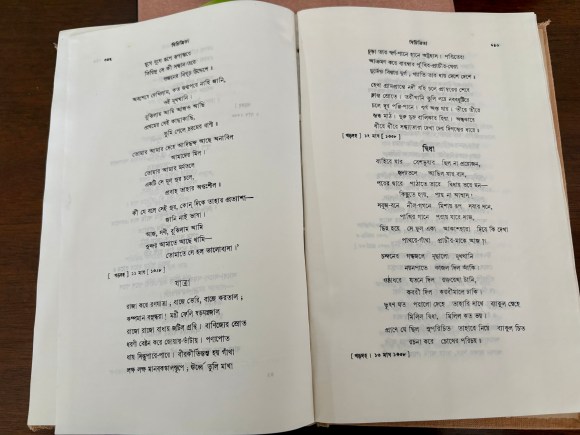
Written in 1932 by RabindranathTagore, Jatra (Journey) is a part of Rabindra Rachnabali (Writings of Ranbindranath) and Sanchayita (Compilation — in this case of poems).
The poem, Jatra (Journey) in Sanchayita
                JOURNEY

The emperor journeys to battle. The earth trembles
With the clash of drums and cymbals. The minister
Conspires, spreads web of deceit through realms.
Trading streams encircle the world with ebb and flow.
Cargo ships travel to distant shores. Monuments of
Heroism grow out of piles of human skeletons raising
Their heads heavenward to laugh with disregard.
The learned repeatedly attack impenetrable fortresses
Of knowledge, walled by books. The king’s fame spreads far and wide.

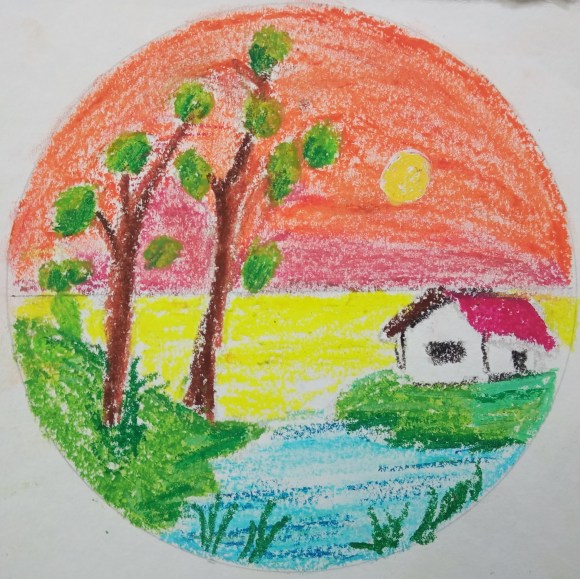
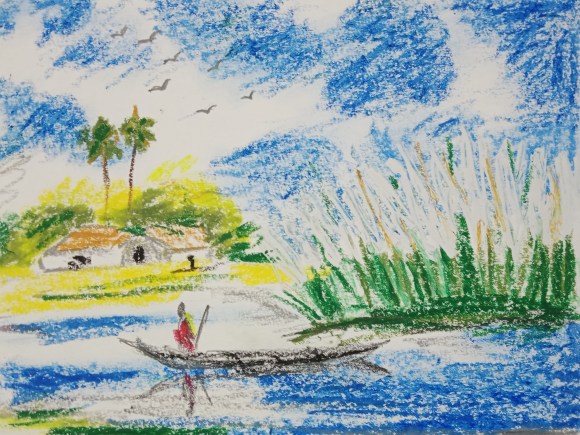
Here, in the village, the river flows sluggishly
In the distance. The ferry picks up the new bride
Sailing to a far colony. The sun sets. The shores
Are lined with silent fields. The girl’s heart shivers.
In the darkness, slowly, the evening star rises on the horizon.
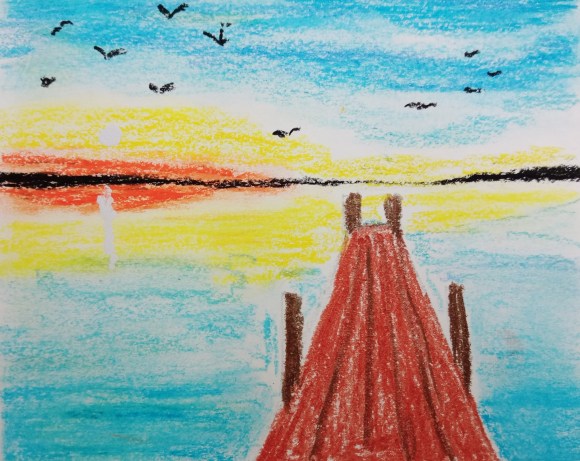
Art by Sohana Manzoor
.
This poem has been translated from Bengali by Mitali Chakravarty with editorial input by Sohana Manzoor
.
PLEASE NOTE: ARTICLES CAN ONLY BE REPRODUCED IN OTHER SITES WITH DUE ACKNOWLEDGEMENT TO BORDERLESS JOURNAL
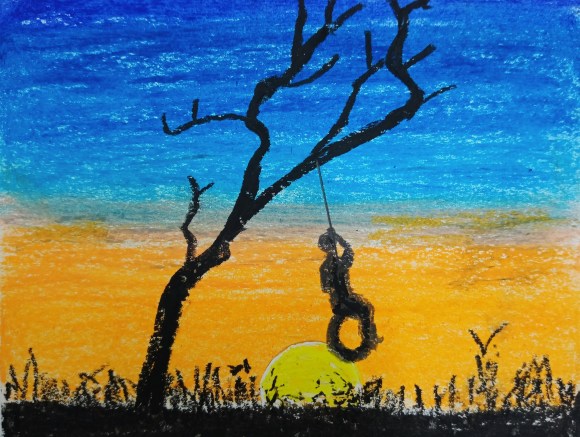
Shishur Jibon (The Child’s Life) is a part of Tagore’s 1922 collection of poems, Shishu Bholanath (Child Bholanath).
Art by Sohana Manzoor
THE CHILD’S LIFE

Do we have the
     courage to be a child?
         That’s why we die old.
We store every little thing,
         Hoard over time in trunks,
                   Stash in piles.
Today is ruined with thoughts
Of tomorrow. Tomorrow, we’ll stock
         For the burdens of the next day.
We get objects of desire,
And realise we have no need for them.
        We quest for things gone astray.
Fearing for the unknown future,
We lose sight of the path,
     And plan for the day after.
The future will always
          Be shrouded in mystery.
Then, will we have no reprieve?
As we ignite the lamp of intellect,
The flame flickers in the breeze —
         We calculate each step.
Numerous people advise
With subtle judgement
 Hair-splitting details before every quest.
Let my heart again be filled
      With the desire to be a trustful child.
         Let me flow freely like the breeze,
Swiftly unmask fears
   Hovering about the future.
      I will confront them as they are seen.
By the pond or on the rooftop,
     Mingling the known and unknown,
        The common and uncommon,
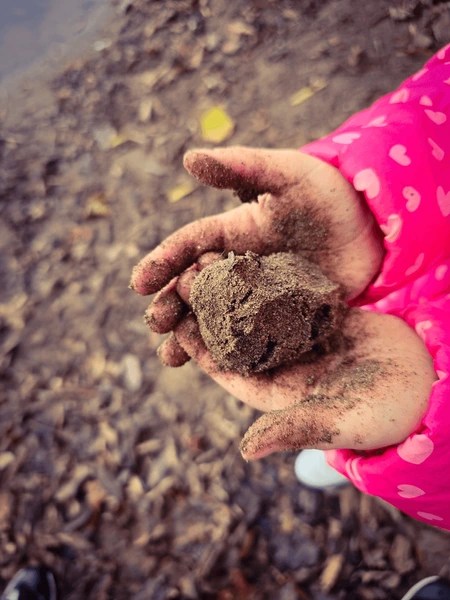
I will roll a ball of mud.
 This will be my toy.
      Happiness doesn’t need to be bought.
Taking on the onus of adulthood,
     I come to this huge market,
            Where grownups push and jostle.
Selling my world, when I
        Head home, I take
           With me only verbosity.
I have wasted away my time
    looking for bargains.
          The hours passed swiftly.
As dusk turns to twilight,
I suddenly feel, I do not like
        The deals I made deftly.
Our lives start
     With childhood.
          Let childhood prevail again.
Let us find companionship
     Like land and water,
        Let us play again in the dusty glen.
Breaking the boundaries of possibilities,
Let us sail on waves of impossibilities,
        Navigating on a ferry of dreams.
Again, let’s abandon logic
And create our world of magic,
        Forgetting the practical realms.
The first day when I arrived
           In this new world,
              Sunlight bathed my life.
 That period was filled with
     Childish imaginings —
       Where did it come from?
Who secretly beads
Dewdrops each night?
        Crickets chirp in unison.
 At dawn, I notice,
The interplay
        Of glittering lights.
There was a time
     When holidays blew in
       With breezy blue skies.
We looked for partners
     While playing games
       As childhood flew by.
Trees in play bloom flowers.
Flowers in play fruit fruits.
           Fruits sprout new buds.
Lands play with the lapping water.
Waters play with the swaying breeze.
         The breeze plays in its own tune.
With the youth,
     You remain young
              Despite your baggage.
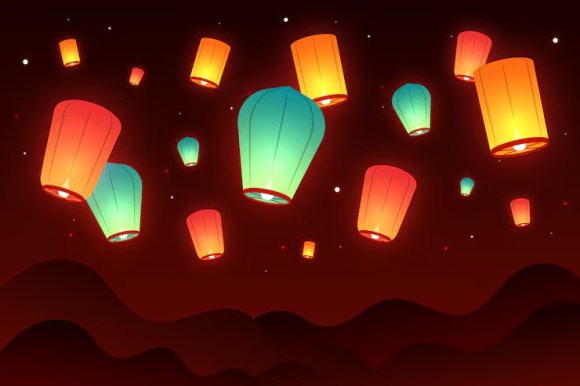
You fly paper lanterns
Of many colours,
       Paint the skies with vibrant shades.
That day I fantasied
Being back by your side.
        We played together holding hands.
We floated many dreams,
 Conversed on sad and happy themes,
          And together, we relaxed.
The flowers burdened
       By the colours of seasons,
         Flow away in the stream of time.
Again, they come to shore
        As the breeze blows,
                Drifting to the waterside.
In the wicker basket of the world,
Your flowers with my garland twirled,
      Decorating the ferry of seasons.
I have hope in my heart,
The bokul ferry’ll return to the earth,
      Listening to the shiuli’s reasons.
When I hummed a song
That day on my own,
         It drifted by unoccupied.
That day, I saw a flicker
      In your eyes of laughter,
            You recognised me by your side.
Seeing your dusty play, your light,
My heart was filled with delight,
         Despite the sad notes on the flute.
I understood that spring,
You heard me sing.
          I too love to hear your tune.
The day passed in fields and paths.
            Dusk settled in.
                If you bid me farewell,
Then in your twilight
   Raise the sail of the boat,
     I will cross the river aswell.
Again, O friend of the child,
Let’s play on our own to abide
         In a youthful Universe.
Gazing at your face,
Your world I’ll embrace,
      I’ll view it in a simple light.
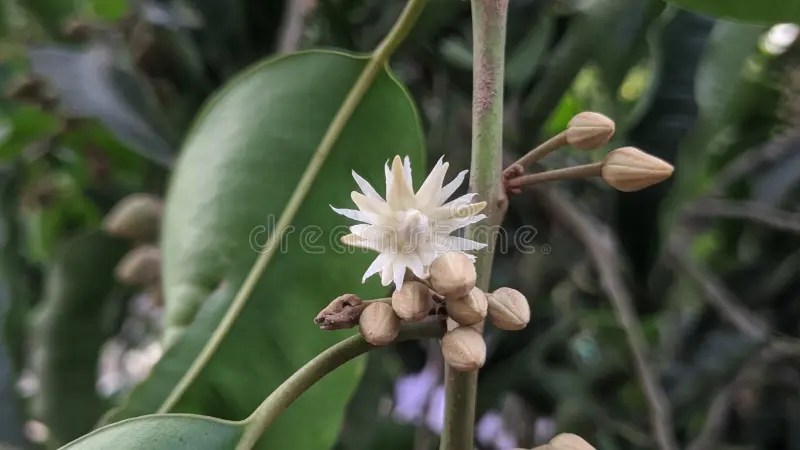
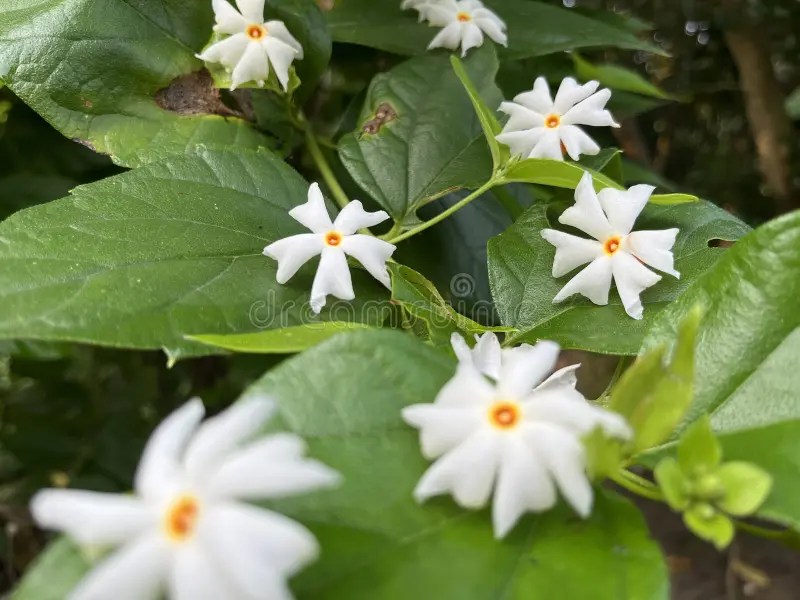
Colourful paper lanterns in the skyA child making a mud ballFrom Public Domain BokulShiuliFrom Public Domain
.
This poem has been translated from Bengali by Mitali Chakravarty with editorial input by Sohana Manzoor
.
PLEASE NOTE: ARTICLES CAN ONLY BE REPRODUCED IN OTHER SITES WITH DUE ACKNOWLEDGEMENT TO BORDERLESS JOURNAL
Kalponik (Imagined) was written by Tagore in 1897 and published in his collection called Kolpona (Imagination) in 1900.
Art by Sohana
IMAGINED

I yearn  only for dreams sown
         In the breeze’s sigh —
That is why in despair I gather
         Wishful thoughts nigh.
The ferry of hope has lost its path
In the shady corners of the Earth.
   Fictitious images lose themselves
             Wafting high.

Nothing  emerges from my scattered
           Desires' streams.
No one  joins me to
     Pursue my distant dreams.
       I play with flames alone
       I sit on my own. At the end
       Of the day, I see my dreams
                 Turn to ashes.
I yearn  only for dreams sown
          In the breeze’s sigh.
The poem was set to music by his niece Sarala Devi. Click here to hear it performed as a song by contemporary artiste, Srabani Sen.
.
This poem has been translated from Bengali by Mitali Chakravarty with editorial input by Sohana Manzoor
.
PLEASE NOTE: ARTICLES CAN ONLY BE REPRODUCED IN OTHER SITES WITH DUE ACKNOWLEDGEMENT TO BORDERLESS JOURNAL
Jatri (Passenger) was a part of Tagore’s collection, Khanika (moments), published in 1900.
Art by Sohana Manzoor
PASSENGER

 There’s place on my ferry.
You are alone. You have
      Only one bundle of paddy.
It may be a bit crammed,
But not that heavily jammed.
My ferry could be
  A bit overloaded —
      But you don’t have to leave.
            There’s a place for you!

    Come, come to my boat!
If your feet are dusty,
     Let them be mud-coated.
Your body is like a creeper.
Your eyes are restless.
Your garb’s blue-green,
       Flowing like water —
          There’ll always be place for you —
                      Come, come to my boat!


             There are many passengers.
      Their destinations are varied.
         They are all strangers.
You’ll also for a while
Sit on my ferry
Till the end of the ride.
          A denial will make no difference —
             If you want to come, join us.
                  There are many passengers.

   Where’s your jetty?
Where’s the store
    For your paddy?
If you do not state,
What will be our fate?
I’ll have to ponder
         At the end of the ride —
             Where’s your shore,
                   Where’s your home?
*The interesting thing about this poem is that it seems to be complete reversal of the poem Sonar Tori(Golden Boat), published in 1894, with the ferryman welcoming passengers aboard, whereas in the earlier poem, the ferry woman sails off with the bundle of paddy belonging to another, leaving her passenger behind.
This poem has been translated from Bengali by Mitali Chakravarty with editorial input by Sohana Manzoor
.
PLEASE NOTE: ARTICLES CAN ONLY BE REPRODUCED IN OTHER SITES WITH DUE ACKNOWLEDGEMENT TO BORDERLESS JOURNAL
Sheeth or Winter was first published in 1909 in Tagore’s collection called Shishu (Children). The poem looks forward to winter giving way to spring using simple but eloquent verses.
Art by Sohana Manzoor
The bird says, “I will leave.”
     The flower says, “I will not bloom.”
The breeze merely says,
       “I will not flit across the woods.”
Young shoots do not look up,
   Instead, sprouts shrivel to shed.
Dusty bamboos loom
     To paint an untimely dusk.
Why do the birds migrate?
        Why do flowers not bloom?
Why has the agile breeze
    stopped romping in the woods?
The heartless winter
        Has a bleak outlook.
Wrinkled and harsh,
       She imparts hard lessons.
The gleaming moonlit night,
        The fresh fragrance of flowers,
The youthful sport of breeze,
      The cacophony of leaves —
All these she looks upon as sins,
       She thinks in nature,
The knowledgeable only sit
       Still like a picture.
That is why the bird bids “goodbye”.
     The flower says, “I’ll not bloom.”
The breeze merely says,
       “I’ll not run across the woods.”
But when Hope says, “Spring’ll come,”
        The flower says, “I’ll bloom.”
The bird says, “I’ll sing.”
         The moon says, “I’ll smile.”
The newly-fledged spring
       Has just started to awake.
He smiles at whatever he sees.
       He plays with everything.
His heart is full of hope.
          Unaware of his own desires,
His being runs hither and thither
         Looking for kindred spirits.
Flowers bloom, so does the child.
         Birds sing, so does he.
He hugs the caressing breeze
         To play vernal games.
That’s why when I hear, “Spring’ll come,”
    The flower says, “I’ll bloom.”
The bird says, “I’ll sing.”
         The moon says, “I’ll smile.”
Winter, why did you come here?
       Your home is in the north —
Birds do not sing there,
       Flowers do not bloom on trees.
Your home is a snowy desert
        That’s dark and lifeless —
Sit there alone, O knowledgeable,
         Spend your days contemplating.
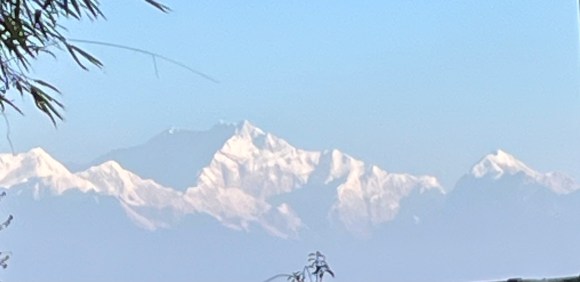
Snowy Kanchenjunga photographed from Darjeeling, West Bengal, in winters.
This poem has been translated from Bengali by Mitali Chakravarty with editorial input by Sohana Manzoor
.
PLEASE NOTE: ARTICLES CAN ONLY BE REPRODUCED IN OTHER SITES WITH DUE ACKNOWLEDGEMENT TO BORDERLESS JOURNAL
Today, it’s a cloudless day. Happy skies
Smile like friends. The breeze flits, flies
Embracing the face, chest, eyes —
Like an invisible aanchol billows high
Only to descend on a sleeping deity.
Peacefully on Padma’s waves, the ferry
Sails swishing joy. Relaxed sandbanks
Lie sunbathing at a distance.
The high sloping sides are interrupted
By tall shady trees, a hidden hut.
A narrow, curved path from a distant village
Crosses the farms and nears the water’s edge
Like a thirsty tongue. Rural brides
Wash their clothes, chatter awhile,
Joke. Their loud sweet laughter
Mingle with the sounds of water
To waft to me. A fisherman, aged,
Sits on a bent boat, weaves a net
While sunning his back. A naked child
Laughs merrily while he dives
Again and again into the water. Patient,
Padma gazes like an indulgent parent.
From the ferry, I see two shores —
The clearest lucid blue expands galore.
Amidst a flood of light, exotic lines are seen
In the water, land, forests. On a warm breeze,
The ferry sails past shores with groves, sometimes,
Scent of mango buds waft, only at times,
Faint sounds of bird calls.

                      My mind
Is filled with peace — I feel
Happiness is simple. It spreads like
Flowers in bowers, like the smile
On the face of a child — expectant lips
Holding the nectar of a kiss,
Gaze silently forever laced
With artless innocence.
The sky is immersed and stilled
with the harmony of music in sync.
How will I sing in tune with those notes?
How will I sound? How will I compose
The lyrics in simple words to gift
To my beloved so that they bring
A smile to her eyes, her lips?
How will I help unfold this to my love?
How will I convey the joy from above?
It’s tough to hold on, to clasp.
I chase it but it eludes my grasp.
I look for it. I walk fast—
Like a blind man, I stumble afar.
But it’s now lost.
                           I gaze
All around, fascinated, focussing
On this still, blue water, so calm.
And I had thought it was easy to clasp.

*Aanchol is the loose end of a sari
This poem has been translated from Bengali by Mitali Chakravarty with editorial input by Sohana Manzoor
.
PLEASE NOTE: ARTICLES CAN ONLY BE REPRODUCED IN OTHER SITES WITH DUE ACKNOWLEDGEMENT TO BORDERLESS JOURNAL
Aaj Shoroter Aloy (Today in this Autumnal Light) was first published in Tagore’s collection called Shesh Saptak (The Last Octave, 1935).
Painting by Sohana Manzoor
Today, as I gaze in this autumnal light,
   I feel I am viewing life anew.
     I see a youth.
       His eyes, weary from daily strife,
         Have lost their sight.

   I imagine —
As a pilgrim from the past,
 I have drifted here
   On the strength of chants.
Traveling upstream in my dreams,
  I have arrived at this moment,
    In the present century’s shore.
I gaze with eager eyes.
 I detach myself from the self.
   I am a stranger from another age
   Awaiting introductions as of yore.
Deep curiosity enthrals.
   I am drawn
     To whoever I find,
     Like a bee to a flower.
 Today, my mind is centred
      Amidst the chaos.
 Today, those stained
By weak popular opinions,
     Have been stripped off
Their garb of mediocrity.
   The truth of our existence
   Emerges in full splendour.
The mute who never found voice,
  The large population of neglected,
    Have broken their silence —
The first words seemed to emerge
  Like dawn after the deepest of dark.

 As a distant wayfarer,
   I travel to my own world
To glimpse eternal truths from between
     The rips torn in the present,
Like a bride wed for life
Gazes from within
  The fine curtain
      With new eyes on
Eternity’s unfading truths.
This poem has been translated from Bengali by Mitali Chakravartywith editorial input from Sohana Manzoor.
.
PLEASE NOTE: ARTICLES CAN ONLY BE REPRODUCED IN OTHER SITES WITH DUE ACKNOWLEDGEMENT TO BORDERLESS JOURNAL
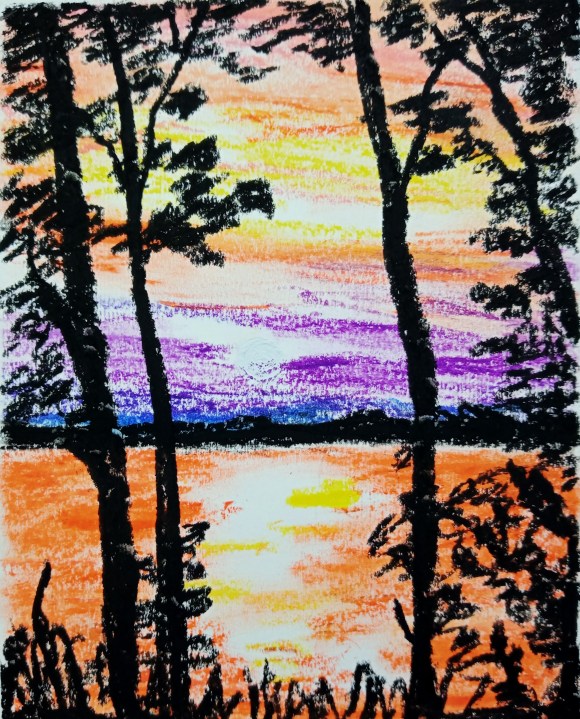
Shaishabshandha(Childhood’s Dusk) was published as a part of Tagore’s poetry collection called Sonar Tori (Golden Boat, 1894).
Art by Sohana Manzoor
CHILDHOOD'S DUSK

Slowly, across all horizons
    Spreads the weary exhaustion
    Of darkness like a mother’s anchal*.
    Standing alone, I gaze steadily
    At the west, absolutely still.
    I contemplate fixedly
    The bottomless abyss,
    The lonely riverside with a
    Dusky sky. Dawn weeps,
    As deep gloom sweeps
With tired eyes, compassionately,
    Silently over the water and land
    In this gloaming.
    Suddenly, a song bursts forth
    From the dark woods, the village paths,
    Perhaps, from a youth returning home.
    Uplifting, peaceful, fearless notes
    Resonate in tune as if sharply
    Slicing the twilight in two.
    I cannot see him. I see a village
    In the southern part. Amidst the lonely
Bamboo woods, the sugarcane fields,
    The betel nut and banana trees,
    There rests a village. I can see that.
Perhaps, it’s a cowherd’s son
    Singing on his way home.
    He does not think much
    Except of a full stomach.
    He brings back that dusk in my childhood:
    We talked, played — three friends —
    While we lay on the bed.
    That was in the distant past.
Has the world not aged?
     Have we exchanged our childhood,
     Our games, our toys, our restful
     slumber for the burden of knowledge?
     Standing on this lonely field,
     When silence fills the gloaming,
     Hearing this song, I recall —
    The riverbanks, the mango groves,
     The brass bells ringing in temples,
     The mustard fields, by the pond,
Smiling faces in many homes,
    Young hearts filled with new hopes,
      Impossible, beautiful imaginings,
      Priceless dreams, endless desires
     And beliefs. Standing in the dark,
     I see among stars, the infinite universe —
     Many young at home abed,
    Their mother’s face lit by the lamp.


*Loose end of a sari
This poem has been translated from Bengali by Mitali Chakravartywith editorial input from Sohana Manzoor.
.
PLEASE NOTE: ARTICLES CAN ONLY BE REPRODUCED IN OTHER SITES WITH DUE ACKNOWLEDGEMENT TO BORDERLESS JOURNAL
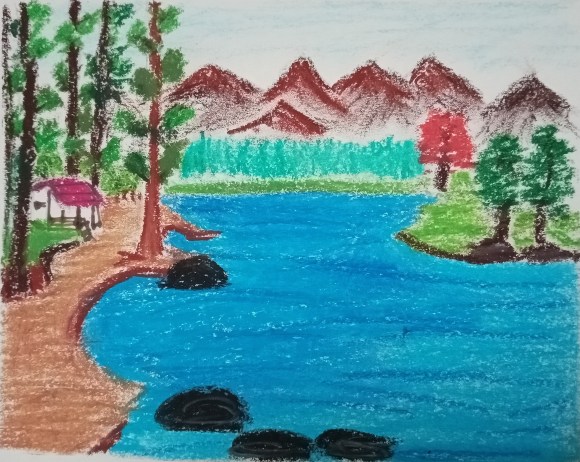
Probhatey (In the Morning) was published as a part of Rabindranath Tagore’s collection called Kheya (Ferry) published in 1906.
Art by Sohana Manzoor
      IN THE MORNING

 The heavy downpour
               Of one night
   Has filled the lake in my home
              To the brim.
        When I look, I see
     Deep blue waters overflow.
Where is its shore? Where is its bottom?
        Where does it turn?
  With one downpour, see the lake
          Is filled to the brim.


    Last night, who could imagine
            This would happen!
      The rain poured incessantly
            In the deep dark night.
     In the midnight of this monsoon,
     While I lay in a lamp less room,
            I heard the wind howl
                 As if in distress —
                  Who knew then
                This would happen!


  Amidst this outpouring of teardrops,
            I found today
           A serene lotus
        Presiding the scene.
   O tell me, when O when did it bloom,
          Pristine among multitudes
             Shining with vibrancy,
             Bringing solace to me
            In the midst of this abyss
                   Of despondency!


Today, sitting alone, I ponder
          Gazing at the site.
       I see the treasures torn
  From the chest by the tragic night.
       I can see the heartbreak,
    Hear the wailing, the awakening,
          I write from my heart
          Of the raging tempest.
    I gaze at the treasures torn
 From the chest by the stormy night.
This poem has been translated from Bengali by Mitali Chakravartywith editorial input from Sohana Manzoor.
.
PLEASE NOTE: ARTICLES CAN ONLY BE REPRODUCED IN OTHER SITES WITH DUE ACKNOWLEDGEMENT TO BORDERLESS JOURNAL
Sonar Tori(Golden Boat) is the titular poem of Tagore’s book of the same name. This celebrated collection was first published in 1894.
Art by Rabindranath Tagore. From Public domain
Amidst dense clouds and heavy downpour,
Without any hope of respite, I sit on the shore.
        Many sheaves of rice are piled in droves,
                 Housed in straw-built stores.
The river's edge is like a razor as the water flows,
                    Torrential and ferocious.
While the rice was being cut, it started to pour.

         I have a small field, and I work alone.
    The water sways on all sides and overflows.
           On the other shore’s horizon,
                     I see etched
              A village under the shadow of trees
                 Covered in misty morning clouds.
   On this shore, I am alone in this small field.

Someone is singing and rowing to this side.
    Looks like, I might know her.
           Without glancing around,
            She rows past in full sail.
            The waves helplessly
                  Part to give way—
      Looks like, I might know her.

Oh where do you row, to which foreign land?
       Come to me in your boat.
            Go wherever you want,
              Give to whoever you desire,
                      Only, do take
                       With a smile,
            My golden crop from this shore.

 Take as much as you wish into your boat.
      Is there anymore? — There’s none left.
                           By the river,
               I stashed into the boat
              All that I had done in my life
                  In bundles —
Now, please be merciful and take me along.

I have no place. The boat is too small.
It is filled with my crop of golden paddy.
                 Surrounded by heavy
                  Monsoon clouds,
                  I stayed by the
                     Lonely shore —
Whatever I had was taken away by the golden boat.
Art by Sohana
This poem has been translated from Bengali by Mitali Chakravartywith editorial input from Sohana Manzoor.
.
PLEASE NOTE: ARTICLES CAN ONLY BE REPRODUCED IN OTHER SITES WITH DUE ACKNOWLEDGEMENT TO BORDERLESS JOURNAL




 Borderless