Come now, little frightened one. That twinge is all you’ll feel as death tears you from the desiccated husk that lingers in your carapace. Then it’s done and all is light. You are floating now above your shell. You seem surprised I hover, spreading protection of bright wings as you stare down at your remnant. There is nothing you should fear as I reach to catch you, shielding you from Valkyries and other predatory fowl circling in hope that you will stray into the bardo space where you become their choice reptilian feast of sorrow. Come closer now and let me wrap my webbed, clawed feet around you as I bear you up to where you swim, with myriad freshwater turtle souls, in the river of light. Some you may recognise: your mother, who passed over soon after she laid your clutch. Several of her hatchlings swim in this bright stream in which the golden minnows jump: Leonardo, Donatello, Michelangelo. Here it’s always summertime. You will remember me as Raphael, the Terrapin of Seraphim. You may hear Ella Fitzturtle ‘rise up singing’ to Gershwin’s melody ‘as I spread my wings and take to the sky.’
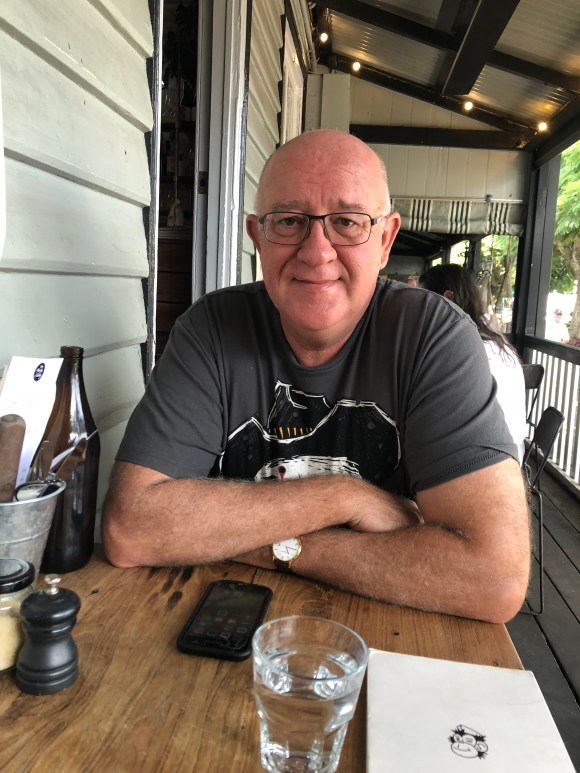
Andrew Leggett is an Australian author of fiction, poetry, interdisciplinary academic papers, reviews and songs. His latest collection of poetry Losing Touch was published by Ginninderra Press in 2022. His fiction collection In Dreams and Other Stories will be published by Ginninderra Press in 2026.
.
PLEASE NOTE: ARTICLES CAN ONLY BE REPRODUCED IN OTHER SITES WITH DUE ACKNOWLEDGEMENT TO BORDERLESS JOURNAL.
I don't need your devotion -- your attention -- or to listen, connect with my emotions -- or to tell me I'm forgiven,
I don't need your affection or to feel your tender touch, I don't need your protection -- your support -- to be my crutch,
I don't need adoration -- all your compliments and thanking, your true appreciation -- all your patience -- understanding,
I don't need all the accolades -- your gratitude -- respect, your sympathy -- your serenades -- your charming intellect,
I don't need all your lavish gifts and all your good advice, don't save me in a snowdrift - I don't need your sacrifice,
I don't need your agreement or to see my point of view, just be good to me on Sunday -- and be good to me on Monday too.
Stephen Philip Druce is a poet and surrealist from Shrewsbury in the UK. He is published in the USA, Hungary, India, Canada, Ireland, the UK and South Africa. Stephen has also written for London theatre plays and BBC Radio 4 extra.
PLEASE NOTE: ARTICLES CAN ONLY BE REPRODUCED IN OTHER SITES WITH DUE ACKNOWLEDGEMENT TO BORDERLESS JOURNAL
Stay seated, make no fuss -- Else, Night masquerade will come Claim you as his By whisking you off to the unknown land Bearing fruit off of your cries -- Kids are told when crying or throwing tantrums, Hoping they stop. Sometimes it works Other times, not!
Akintoye Akinsola loves to read and write. His works have appeared in Kalahari Review, Spillwords Review and others.
.
PLEASE NOTE: ARTICLES CAN ONLY BE REPRODUCED IN OTHER SITES WITH DUE ACKNOWLEDGEMENT TO BORDERLESS JOURNAL
Five poems by Pravasini Mahakuda have been translated to English from Odia by Snehaprava Das
Pravasini Mahakuda
YOUR POETRY

You do not get liberated by arguments.
Liberation isn’t on your mind,
Neither is it in your fortitude or your courage,
Nor in the tricky manoeuvring of your steps.
Liberation is in the challenges
Your soul ceaselessly confronts.
Salvation is in each line of the poem you write.
Do you know or do you not?
That even after you quit this beautiful earth,
Your poetry will live.
Readers of poetry will continue to be.
Your poetry will live forever because
You hold a timeless lover inside you,
And because of your love,
Which is liberation itself.
Your poetry will thrive as a green permanence,
Even on a blazing summer noon.
You and your poetry are one,
And have never existed apart.
 You yourself are poetry --
Only poetry, and nothing else.
Because like you, Poetry, too, is a woman>
And you, like poetry itself
Are the eternal Truth.

 THE REST OF THEM

Let the rest of them
Write about revolutions
And resistances,
About rights and responsibilities.
I write about life.
I write about love,
And things that happen around me.
I write about the changing seasons,
About the prices of goods,
Of the soreness hidden in the heart.
I write about the hopes and fears that
The heart incessantly wavers between,
Of an unseen wound that never stops to hurt.
I write about the eye that cannot see
The tears trickle down the other one,
Or the drenched pillow and the sari-end.
I write about a hand
That does not care to share
The ache in the other one.
I write about the song the dead river
That flowed once between us had sung.
Let others write about
What they won and lost.
I will write about the pain emanating from
An aspired for void.
Let others write about spite and disdain,
I will sing of life and love.

SHRAVANA*

For which Shravana must the woman
Write a poem now?
What kind of a poem of Shravana
Must she write to sprinkle life
Into the desert dying inside her
To cheer herself up?
Do you think it is easy to write poetry?
You do not know perhaps,
Only a drop of rain comes down
Against millions of palmfuls of tears.
In that lone drop of rain,
 Rings a primeval tune
That perhaps lay buried under
A century old rock.
You had never been in that song
In any phase of life,
Not as friend, a husband or a neighbour
Neither as a reader, nor a critic.
The agony is because
You were never a part of that song.
The Shravana is because
You were never a part of that song.
And the rain is because of that,
And the poem too!
It’s half-hour past eight.
On this evening of a Shravana Sunday
The Shravana pours generously.
Do you believe a woman somewhere
Still sits waiting for you on this evening,
Watching her own silent tears
Mingle in the Shravana rains outside?

*Month of July-August in the Indian calendar, normally monsoons in India.

GODDESS

She is not a goddess --
The one you invoked while
Immersing,
Or immersed while
Invoking.
She is a woman.
Perhaps you have not cared to see
The tears in the eyes of that goddess.
During those performances,
You have time and again played games
With her body and her tears.
Every night,
On the freshly made beds
And in freshly written verses too.
You always know that the
Finale of the game
Will be under your control
And by your choice.
Because you have ensured the result
Would be in your favour,
You have taken the game for granted.


SAREE

The pain and pangs I have lived through
Are as many
As the threads woven
In my saree.
The end of the saree fails to hold
the profusion of
All honour and dishonour,
All joys and sorrows,
Interest and indifference,
The ache of losing things
I had won,
The ecstasy of loving
And the agony of no response.
As I set out on a journey,
The sorrow-flowers bloom in a row
Along the border of the saree,
Spring into life.
As innocent symbols of that agony,
A scene floats past my mind in a flash
Where I find the whole of my being
Standing by the loom.
I marvel at the intimate emotion
Of a beautiful loving mind
Employed at the act of weaving
Such a saree of choice.
The threads in this saree
I am clad in are as many as
The sorrows and sufferings,
Joys and elations that roll
Inside me like the gentle undulations of
The middle notes of a song.
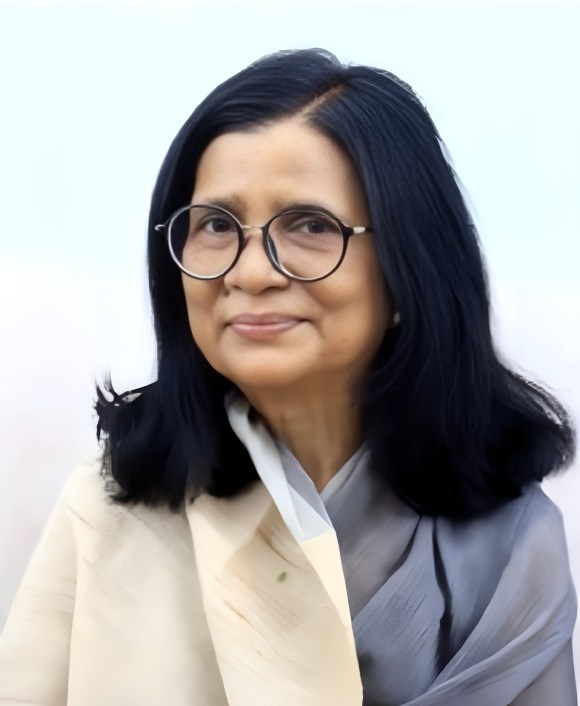
Pravasini Mahakuda is a distinguished Odia poet and translator with 18 original books and 8 books in translation from Hindi to Odia. She has received the Odisha Sahitya Akademi award, Jhankar Award and Junior and Senior Fellowships from the Ministry of Culture, Govt. of India. Her international engagements include participation in poetry festivals in Germany presenting her work in Berlin, Munich, Hamburg, Leipzig and Frankfurt. She regularly contributes poems in national magazines and attends seminars and poetry festivals across India.
Dr.Snehaprava Das, is a noted writer and a translator from Bhubaneswar, Odisha. She has five books of poems, three of stories and thirteen collections of translated texts (from Odia to English), to her credit.
PLEASE NOTE: ARTICLES CAN ONLY BE REPRODUCED IN OTHER SITES WITH DUE ACKNOWLEDGEMENT TO BORDERLESS JOURNAL
how will my daughter wash her hair?
will she fetch water from the village pump as my grandmother did?
or pull it up from the well like my mother?

will she have enough hibiscus and jasmine
to put in her braids, tuck behind her ear, or stick in a bun?
i would like to leave her a legacy of family recipes
with the goodness of fruit and leaves --
coconut and amla to oil it,
bhringraj to thicken it,
neem to clean it,
and shikakai to colour it.
i spend nights writing them down -
measurements to go in the mortar and pestle
to be boiled, pureed and distilled.

will she ever know the thick black rivers of a glistening mane?
or as the trees are decimated,
will every strand shrivel in a chemical wasteland
and her scalp run dry?

without the dirt in her fingers,
how will this young child of mine grow roots,
how will she learn to blossom and flower, then rest and recover,
without the laden boughs
and the wise hands of her mother?
Pritika Rao is an economist and freelance writer from Bangalore. Her works of fiction have been published in Adda and The Bangalore Review, while my poetry has appeared in Gulmohur Quarterly, Madras Courier and The Alipore Post, among others.
.
PLEASE NOTE: ARTICLES CAN ONLY BE REPRODUCED IN OTHER SITES WITH DUE ACKNOWLEDGEMENT TO BORDERLESS JOURNAL
What if I crossed the border after 50 springs, summers, falls, and winters? After all the learning, the forgetting, the labour, and lost loves, after all the growing pains, the births, deaths, and family joys and tragedies? What if I returned to the land of my youth, a much older man than the seven-year-old, wide-eyed boy? I will offer the best of me. Who will offer me the best of them? I will have to find a place to call home, a seat at a table where I will have my meals, a place where I could have a conversation with someone other than myself, a room where I could read and write, and most of all sleep. Who will break bread with me, help me decorate the house with books and flowers, with paintings and plants, and share stories, laughter, and wine from time to time? As I write these words, other words are being twisted, designed to make people like me to return to the place of our birth, if we are fortunate enough.
BUCKETFUL OF RAIN
If it is goodbye, I could use a bucketful of rain to drench this fire. Reduce it to smoke before this heart becomes ash.
Even the light trembles and the sun is blushing seeing this conflagration. I should have seen the signs but I hope too much.
Play that violin soft and slow. Speed up the pace as the fire spreads out of control. I can take the heat just a little bit longer.
LIMITS
I climb the branch to the flower; the spider-from-mars’ web-to-the-stars; I flow and fly with the wind further still; through time and newborn worlds; I allow my thoughts to remain on earth; keep the sun and magnifying glass away from me; even an ant has its limits.
Luis Cuauhtémoc Berriozábal was born in Mexico, lives in California, and works in Los Angeles.He has been published in Blue Collar Review, Borderless Journal, Chiron Review, Kendra SteinerEditions, Mad Swirl, and Unlikely Stories. His most recent poems have appeared in Four FeathersPress.
.
PLEASE NOTE: ARTICLES CAN ONLY BE REPRODUCED IN OTHER SITES WITH DUE ACKNOWLEDGEMENT TO BORDERLESS JOURNAL
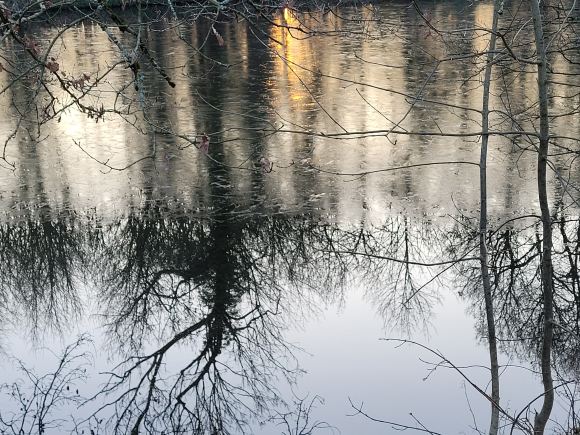
Columns stand on columns, the high arch flares light like white torchfire illuminates the marble hill, you transform the enclosure, you filigree clear sleeves of imagined air to gather camellias the winter sky emptied, bled in ashes on the snow.
Winter. Photo Courtesy by John Swain
John Swain lives in Le Perreux-sur-Marne, France. His most recent chapbook, The Daymark, was published by the Origami Poems Project. Additional information may be found at www.john-swain.com.
PLEASE NOTE: ARTICLES CAN ONLY BE REPRODUCED IN OTHER SITES WITH DUE ACKNOWLEDGEMENT TO BORDERLESS JOURNAL
Here’s your voice from across the world, the kind of time you tend to call. Still magic: “Hi Dad! How are you?”
You’re walking to the train. It’s cold. Your voice breaks up, reassembles, breaks up, reassembles again.
“Something important to tell you.” As you talk, thirty years roll back, telling my father the same thing.
“Are you quite sure?” I hear him ask. Oh yes, quite sure. Sure then and now. But you’ve missed your train; it must’ve left
early for once. That’s all you need. You protest to the official, prepare for coffee and your book.
No, here is your train, after all – running late (leaves on the line?). You’re aboard. You’ve started to move.
(Excerpted from Bonfires on the Ice, Te Herenga Waka University Press, 2025).
Harry Ricketts is a poet and scholar who has published around 30 books. He has lived in Wellington, Aotearoa New Zealand, since 1981. Until his retirement in 2022, he was a professor in the English Programme at Te Herenga Waka—Victoria University of Wellington. His books include the internationally acclaimed The Unforgiving Minute: A Life of Rudyard Kipling (1999) and Strange Meetings: The Lives of the Poets of the Great War (2010). His recent books include the poetry collections, Winter Eyes (2018) and Selected Poems (2021) and the memoir, First Things (2024). With historian David Kynaston, he is the co-author of Richie Benaud’s BlueSuede Shoes: The Story of an Ashes Classic (Bloomsbury, 2024).
.
PLEASE NOTE: ARTICLES CAN ONLY BE REPRODUCED IN OTHER SITES WITH DUE ACKNOWLEDGEMENT TO BORDERLESS JOURNAL.
It begins with that angled sidewinder of yellow curbing,
a planned pile of artisanal rocks at the base of a rounded shrub,
and spaces for all the cars, you can count them if you want,
more yellow lines that match the leaves of the trees in season.
And that chipmunk fighting with a crow over unseen bounties
while a bushy black squirrel runs under parked cars
across from the large soapy windows of the car wash place that keeps everyone looking their best.
From Public Domain
Ryan Quinn Flanagan is a Canadian-born author residing in Elliot Lake, Ontario, Canada with his wife and many bears that rifle through his garbage. His work can be found both in print and online in such places as: Evergreen Review, The New York Quarterly, Borderless Journal, GloMag, Red Fez, and Lothlorien Poetry Journal.
PLEASE NOTE: ARTICLES CAN ONLY BE REPRODUCED IN OTHER SITES WITH DUE ACKNOWLEDGEMENT TO BORDERLESS JOURNAL





 Borderless