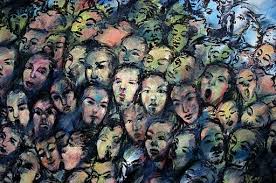
All day long, I live among strangers.
I sit side by side with a stranger on the bus, rattling along,
Choose tomatoes at the market with someone I don’t know.
My elementary school friends live far away,
And I’ve lost touch with my comrades from the army.
Childhood friends I flew kites with,
Neighbours I once shared raw sweet potatoes with —I’ve lost track of them.
Every day, I meet people, eat lunch together,
Chat like old acquaintances for a moment,
But soon, we become strangers again.
I exchange words with the dry cleaner,
Grumble about the world with the local barber,
But soon, we become strangers again.
For a while, I’m familiar with the doctor as a patient,
Live like family with the nurses,
But as soon as I’m discharged,
we become strangers again.
Those who were once close become distant,
Drinking buddies who once felt like brothers turn into strangers before I know it.
A strange world gradually becomes familiar,
And the familiar world, once again, turns strange.
Ihlwha Choi is a South Korean poet. He has published multiple poetry collections, such as Until the Time When Our Love will Flourish, The Color of Time, His Song and The Last Rehearsal.
.
PLEASE NOTE: ARTICLES CAN ONLY BE REPRODUCED IN OTHER SITES WITH DUE ACKNOWLEDGEMENT TO BORDERLESS JOURNAL.
Art by Edward Okuń (1872–1945). From Public Domain
GRATITUDE

Some days it’s easy.
Being grateful.
There are so many reasons.
Rain and sunshine.
Clear skies and fog
Breakfast dishes in the sink.
Some days I have to work at it – gratitude.
Perhaps that’s good,
When I do that, search,
I always find something new and wonderful.
A WOW factor.
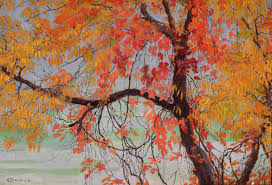
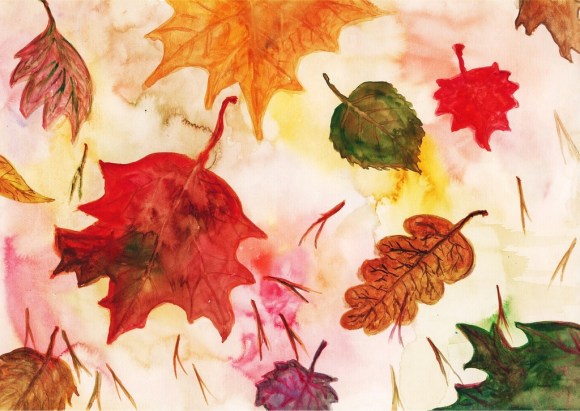
Today it was the swirl of leaves in the gutter,
Thanks to the wind and the rain.
A casual glance – it’s trash, refuse.
A job for someone and I don’t know who.
Then, my better angels look more deeply – closer,
I see the leaves as an integral part of my environment.
They’ve done a lot the leaves, growth, shade, seeds.
Now an even bigger contribution.
They will help the next generation to sprout and grow and produce seeds.
Next year there will be more leaves in the gutter,
More reasons for gratitude.
Thank you!
From Public Domain
Ron Pickett is a retired naval aviator with over 250 combat missions and 500 carrier landings. His 90-plus articles have appeared in numerous publications. He enjoys writing fiction and has published five books: Perfect Crimes – I Got Away with It, Discovering Roots, Getting Published, EMPATHS, and Sixty Odd Short Stories.
.
PLEASE NOTE: ARTICLES CAN ONLY BE REPRODUCED IN OTHER SITES WITH DUE ACKNOWLEDGEMENT TO BORDERLESS JOURNAL
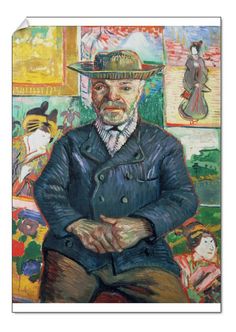
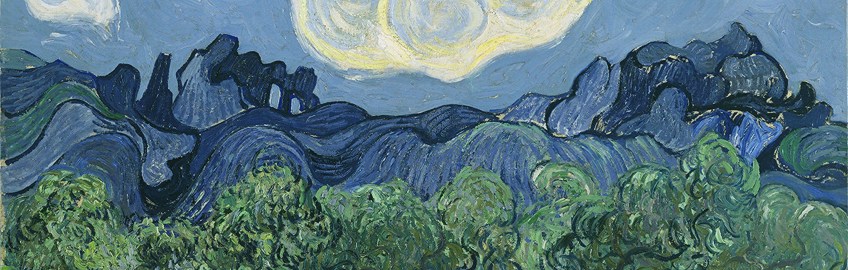
Painting by Vincent Van Gogh (1853-1890). From Public Domain
MY DAD; HE LIKED A WHISKY

My dad; he liked a whisky.
A single malt would do.
Not too much; but sufficient.
Maybe a glass or two.

'Just ample,' he'd always say,
'to see the evening through.'
It was, he would maintain,
a nice pastime to pursue.

'Conversation freely flows
once you've had a few.'
And sometimes I'd introduce
a bottle of something new.

'It's not unappealing,' he'd opine;
as appreciation grew.
He liked a double negative;
enjoyed a double Cardhu.

A touch of water, new flavours
did magically imbue.
He was watchful of my intake.
'Do not think I don't know you!'

Right, of course, as next day
a hangover would ensue.
Finally, that knowing glance.
'Don't say I didn't warn you!'

As the drams, they added up,
so the years they did accrue.
I miss your conversation.
I miss your point of view.

I recall the pipe, of course;
the measured voice I knew.
Now only an empty glass;
an empty bottle too.
Stuart McFarlane is now semi-retired. He taught English for many years to asylum seekers in London. He has had poems published in a few online journals.
.
PLEASE NOTE: ARTICLES CAN ONLY BE REPRODUCED IN OTHER SITES WITH DUE ACKNOWLEDGEMENT TO BORDERLESS JOURNAL
The spin of a shuttlecock The thwack and strum as it is slung Across the court, across the air Sieving light, writes moments in the eyes Of those at the right place, the right time The next time you are there See it spin, see its arc
Arthur Neong hails from Malaysia and taught for eleven years before doing his MA in Creative Writing. He finds poetry and short prose capture essence like nothing else.
.
PLEASE NOTE: ARTICLES CAN ONLY BE REPRODUCED IN OTHER SITES WITH DUE ACKNOWLEDGEMENT TO BORDERLESS JOURNAL
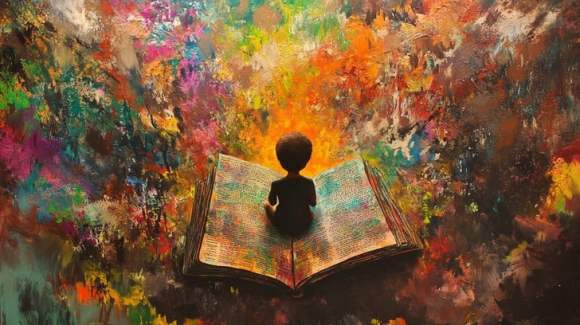
Look how elegantly I have been made, Like a polished gem. My pages contain a story, An inspiring life, a historical fact, A theory, a discovery, and so on. At least, this is how I am marketed. The world chases me whenever they need Validation, wisdom, or reference. Is it because the monks and wise men Are nowhere to be seen? Is it because there is an overload of opinions And false information everywhere? Am I relevant because people are Always confused about what's right? Despite there being many of my kind, We stay unread on the bookshelf, Waiting to be discovered.
A HOUSEMAID
I leave my home to clean others’ houses. An angry and restless man, my homeowner wants me To clean every corner of his house—the grime on the floor, The kitchen, the windows, the shelves, and so on. The unhappy homeowner forces me to work late. But there’s one place that I fail to clean: his mind.
THE DUSTBIN
My purpose is to live in a corner, eating garbage, Without friends, family, or relatives near me. Unlike the vase or the showpiece, no one Bothers to dust me or keep me clean. Sometimes, humans stuff my mouth with leftovers Until I feel choked. What can I do, other than swallow my destiny?
Niranjan Aditya is a student from Bangalore. His work has appeared in Kala Magazine, UK and the anthology, Rain and Laughter.
.
PLEASE NOTE: ARTICLES CAN ONLY BE REPRODUCED IN OTHER SITES WITH DUE ACKNOWLEDGEMENT TO BORDERLESS JOURNAL.
In the evening at sea I fish the moon’s reflection. It is my recreation and my white whale. I never catch that moon but I like the challenge. The lost souls at sea sing throughout the night. They sing an old song lost for years. The song is a curse of course, a spell from the waning moon.
GONE INTO EXILE
Pretend I am not here. Pretend I am long gone. Imagine my leaving was no magic trick, but something ordinary. I do not feel my presence is at all necessary. Forget about me and do not expect my return.
FLY AWAY MOTH
Fly away moth To the moon Of the streetlight The hot bulb That is miles Away from the Actual moon Once you get To the light bulb Don’t let go You’ll be satisfied By the false moon Its bright light Warm and round Like a breast
Luis Cuauhtémoc Berriozábal lives in California, works in Los Angeles in the mental health field, and is the author of Raw Materials (Pygmy Forest Press). His poetry has appeared in Blue Collar Review, Borderless Journal, Escape Into Life, Mad Swirl, and Unlikely Stories. His latest poetry book, Make the Water Laugh, was published by Rogue Wolf Press. Kendra Steiner Editions has published 8 of his chapbooks.
.
PLEASE NOTE: ARTICLES CAN ONLY BE REPRODUCED IN OTHER SITES WITH DUE ACKNOWLEDGEMENT TO BORDERLESS JOURNAL
The last, forlorn days of winter; still do they stubbornly cling. Idle thoughts turn to graveyards. I hear a mournful bell ring. Yet there stirs an awakening. I see a bluebird take wing. Violets bloom, and daffodils. I resist an urge to sing. My thoughts now turn to sunlight; to the new life it will bring. Farewell, the last days of winter. Behold! The first days of spring.
THE TREE MEN
I
Walking through the park, this winter morning, I saw how the Council's been at the trees. Some men, in heavy, black jackets, were throwing branches in the back of a truck. One was still sawing hard, finishing the job. The branch rolled onto the grass. The man wiped his brow with his leather glove.
II
They said the trees blocked the view; of what, exactly, it was hard to see. But trees, I suppose, you can't talk to; or urge to have smaller families. You just take an axe to them.
III
All along the avenue there are now trees marked with yellow paint. These are the next for hacking; and those, already cut, stand stark against the winter sky; their severed limbs now stacked in the back of council trucks. And, now, I wonder if, when the tree men are gone, maybe in the quiet of night, these mutilated stumps will still feel a spark crackle along a tattered nerve-way; that savage lunge, as a sharp blade splits the skin.
Stuart McFarlane is now semi-retired. He taught English for many years to asylum seekers in London. He has had poems published in a few online journals.
.
PLEASE NOTE: ARTICLES CAN ONLY BE REPRODUCED IN OTHER SITES WITH DUE ACKNOWLEDGEMENT TO BORDERLESS JOURNAL
I go outside. Bounding back into childhood. Split melon in hand with infernal separation.
The fatherless sun above rips dancing cornea from my eyes.
While the garden lice under rocks ball up like dirt magicians.
And the balance girls walk the curb, arms extended.
Trying not to fall off.
Ryan Quinn Flanagan is a Canadian-born author residing in Elliot Lake, Ontario, Canada with his wife and many bears that rifle through his garbage. His work can be found both in print and online in such places as: Evergreen Review, The New York Quarterly, Borderless Journal, GloMag, Red Fez, and Lothlorien Poetry Journal.
.
PLEASE NOTE: ARTICLES CAN ONLY BE REPRODUCED IN OTHER SITES WITH DUE ACKNOWLEDGEMENT TO BORDERLESS JOURNAL
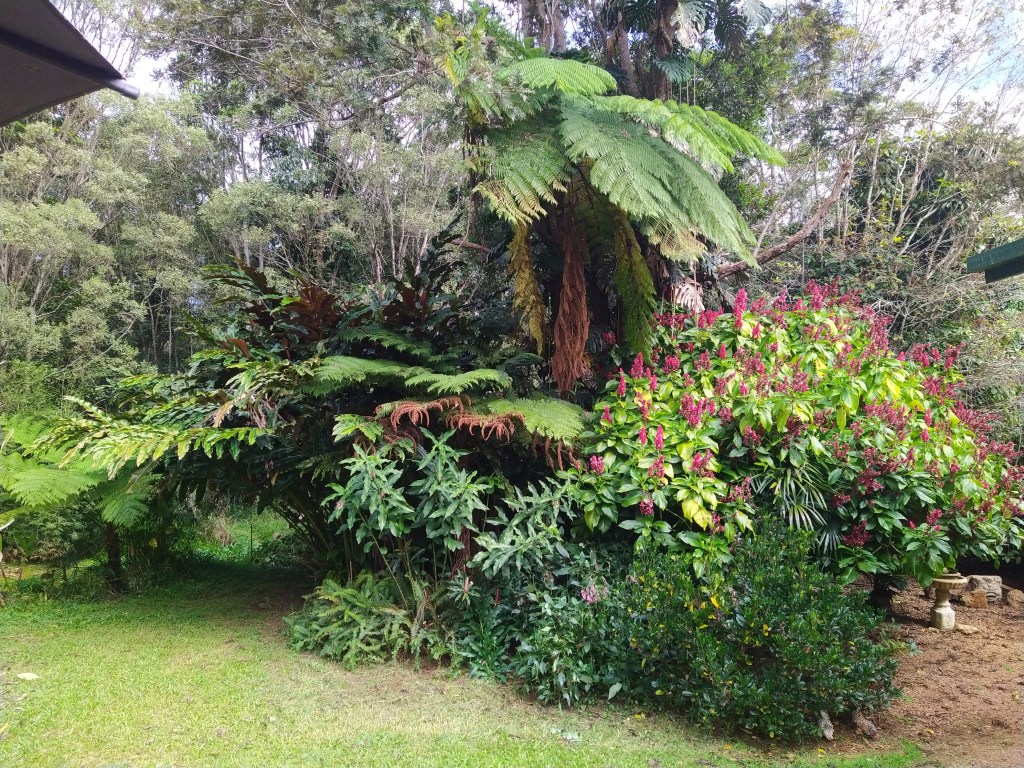
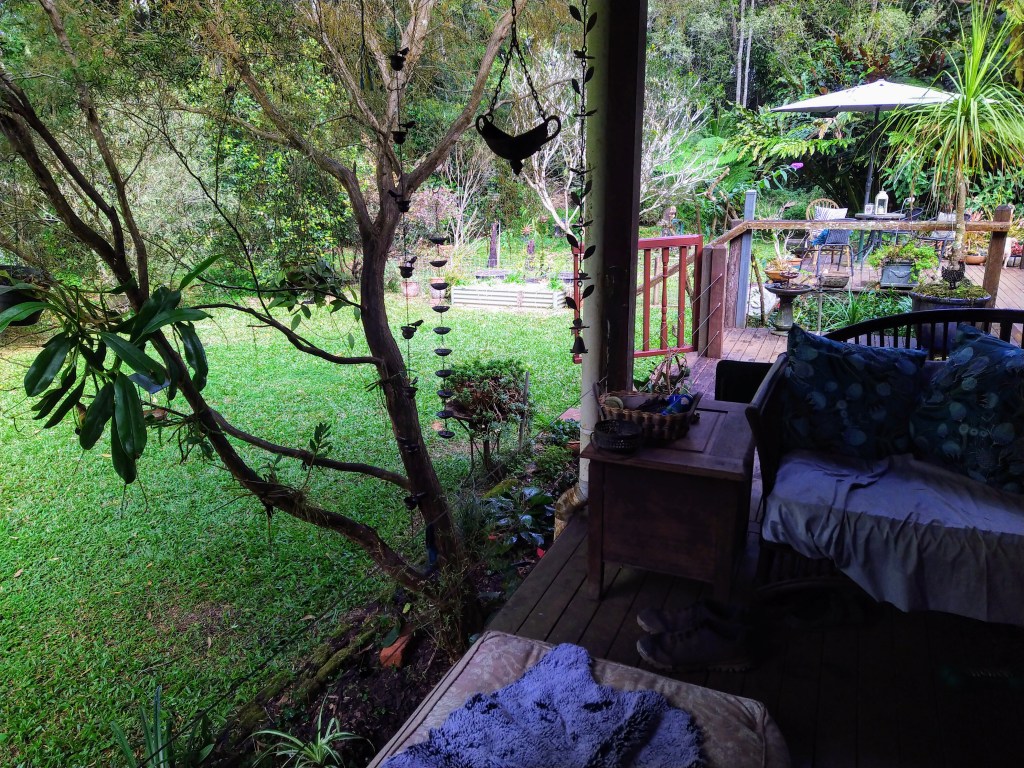
FAR NORTH QUEENSLAND
(Phil and Kaye’s place, Malanda FNQ June 2024)

Overcast sky – air moist with pending drops – from the comfortable chair on the back verandah in this micro-Eden framed by roof and posts I watch the green King Parrots fly to the feeders and boot the Emerald Doves and little Mannikin Finches out. They soon return like a scherzo in a symphony – the Bar-shouldered Doves and cheeky Lorikeets follow. Almost everything else is green except the surprise of flowers in winter – Flame of the Forest and Morning Glory – red and purple survivors of uncertain weather – days of warmth and sunshine after a slow cold front.
On this afternoon it’s humid but cool enough for a cardigan. At dusk dwarfed by the Black Wattle and Kaurie Pines behind – the leafless Frangipani’s ghostly white limbs reach for the stars. It blooms in summer – an effusion of pink and yellow blossoms thick with bright green leaves – an arboreal attention-getter beside the huge Red Torch Ginger clump and the pond bursting with water lilies.
The old tall trees creak and chatter in the afternoon flurries –– stories and secrets veiled in their leafy realm – and I drift dreamily between the worlds –– here and there –– like the lovely Blue Emperor butterfly in the canopy.

TRIANGULATION OF HOME

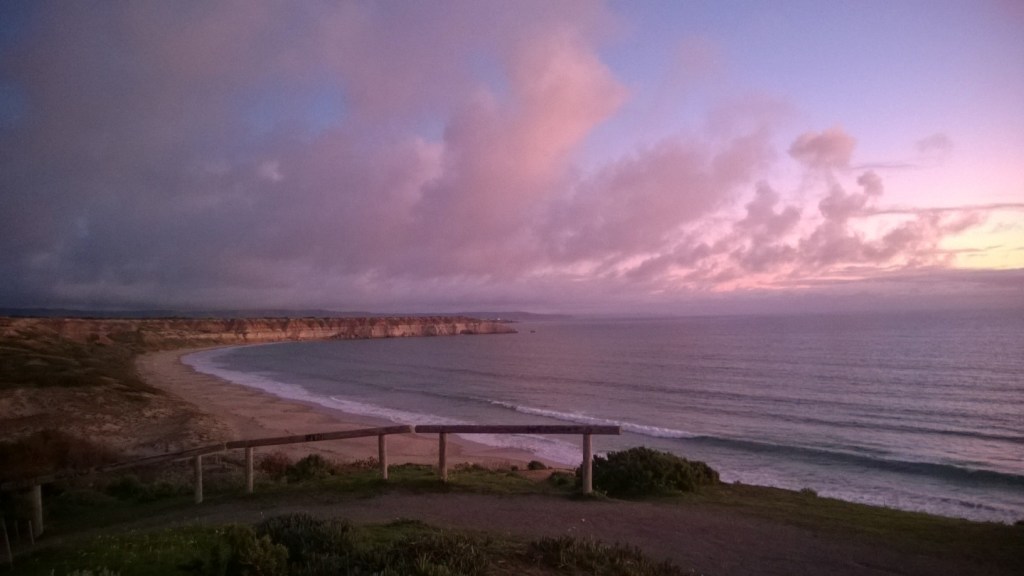
Home is barely more than 100 metres from the beach, though I rarely take the wretched stairs. I make the five-flight descent, all the way thinking about the return climb.
Walking with icy sand underfoot, in strong wind, as waves suck back, and forth again, I notice the seaweed, the shells, the crumbling cliffs, the open space, the expanse of sky.
But from the table high on the bluff, east-southeast I see the round hills of the Mount Lofty Ranges, the lush McLaren Vale vineyards, and full south, past the cliffs, I imagine the southern tip of Cape Jervis.
To the west at dusk, the sun sets over the gulf, most days in splendiferous colour. It’s a very long drop to the sea, and winter cold after heavy rain, with seagulls cawing overhead.
Disembodied in this timeless space above the wild grey ocean, my mind takes flight to the north
through the car park, over the combis, the SUVs, the 741 bus, and children playing on swings.
From the bluff, near home, it seems as though below the lone fisherman stands on the edge of the earth, and for a luminous moment, we merge in a quantum mist.
Atoms in fleeting form at the interstices.
Photo Courtesy: Lizzie Packer
Lizzie Packer is an experienced freelance writer, and an emerging poet. At Adelaide College of Arts, Lizzie established the online creative writing program and led it for over a decade.
.
PLEASE NOTE: ARTICLES CAN ONLY BE REPRODUCED IN OTHER SITES WITH DUE ACKNOWLEDGEMENT TO BORDERLESS JOURNAL
You are the fragrance of rocks, the lamentation of each flower, the unbearable heat of the moon, the icy coolness of the blazing sun, the language of my letters to myself, the smile with which all despair is borne, the millenniums of waiting without a wink of sleep, the ultimate futility of all rebellion, the exquisite idol made of aspirations, the green yesterdays of deserts, the monsoon in an apparel of leaves and flowers, the illuminated pathway from the clay to the farthest planet, the fantastic time that's half-day and half-night, the eternity of the sea's brief silence, the solace-filled conclusion of incomplete dreams, the dishevelled moment of an awakening with a start, the reluctant star in the sky brightening at dawn, the unspoken sentences at farewell, the restless wind sentenced to solitary confinement, the body of fog seated on a throne, the reflection asleep on the river's abysmal bed, the undiscovered mine of the most precious jewel, the outlines of lunacy engraved in space, and the untold story of lightning. You have, my dearest, always suffered all my inadequacies with a smile. I know I am not destined to bring you back once you've left. All I can do hereafter, till the last day of my life, is to collect the fragments of what you are and try to piece them together.
Sri Radha Canto 19
Come, take half of the remainder of my life, but fill every moment of the half that is mine with your infatuation. Was the bargain unfair? Then leave me with a single moment and take away the rest of my life, but like the sky, fill the whole space above that moment.
No, not like the sky. Come closer and become the cloud over my past, present and future so that, when I touched myself, I would touch the monsoon of your body. Your sighs would breathe the gale spewed by the despair of a distant ocean and, when I smile and touch myself, the gale would cease.
My lifetime, unconcerned with its nearing death, would everyday renew its pilgrimage to the early years of your youth. You would exist as a mass of blue carved by my command, or as the blue of all my known, partly known and unknown desires. Since I always dress in blue, you too must be blue. How can you have any other colour when it would break my heart if you had any other hue other than blue?
Was the bargain unfair? Then come, take away even that single moment. But do not bend down, look straight into my eyes. Meet the impudent traveller who has passed through hell after hell and, at the end of the very last hell, stands under a kadamba tree and awaits your coming.
Sri Radha Canto 25
It was a bad day yesterday. My husband dragged me by the hair and knocked my head against the wall several times, and insisted that I come out with the true account of where I had spent the previous night. It hurt for some time, but when he began an inspection of my body, I could not hold back my laughter.
God, I said to myself, what an imbecile I have for a husband! He is looking for proof of my infidelity in the body and at daytime too!
Sri Radha Canto 61
Reports of your passing away have reached us here.
Don’t count me among your widows or among those who carry your body in procession.
Your body, mercifully, Is far, far away.
In the parting of my hair, the vermilion mark is brighter than ever. Now stop joking, become the bridegroom, and come.
I wear the bride’s heavy silk and gold. My bangles tinkle And snub all sandals.
You no longer are anyone’s father, son, husband. You are the pure naughtiness of our last night together, the voice that teases me, and the touch that breaks the virginity of my loneliness. Just when I would stop crying, you will arrive and tickle my lifeless longing into unrestrained laughter.
When they deposit your body on the pyre, all that you ever meant to them will be consumed by flames. They would return home and, a few days later, would fill your absence with thoughts of you and a thousand other things.
My joy today is uncontrollable. If you had not died for them, you would not have become entirely mine.
Since everyone believes you are dead, my journey to the riverbank will now be without fear. All claims to you are now void, Except mine. They will forget I was ever there Or even know how I held on To your glamour-doll shoulders.
I fold up Under your common hand of desire As you disable my jelly-limbs Filling my spaces Beyond all that exists Or does not exist.
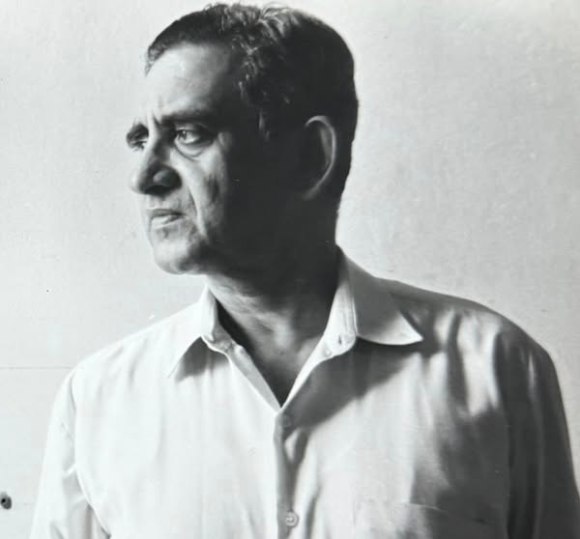
Ramakanta Rath is one of the most renowned modernist poets in the Odia literature. The quest for the mystical, the riddles of life and death, the inner solitude of individual selves, and subservience to material needs and carnal desires are among this philosopher-poet’s favourite themes. His poetry betrays a sense of pessimism along with counter-aesthetics, and he steadfastly refuses to put on the garb of a preacher of goodness and absolute beauty. His poetry is full of melancholy and laments the inevitability of death and the resultant feeling of futility. The poetic expressions found in his creations carry a distinct sign of symbolic annotations to spiritual and metaphysical contents of life. Often transcending beyond ordinary human capabilities, the poet reaches the higher territories of sharp intellectualism.
The contents have varied from a modernist interpretation of ancient Sanskrit literature protagonist Radha in the poem “Sri Radha” to the ever-present and enthralling death-consciousness espoused in “Saptama Ritu” (The Seventh Season). Some of his other major poetry collections include Kete Dinara (Of a Long ,Long Time), Aneka Kothari (Many Rooms), Sandigdha Mrigaya (Suspicious Hunting), Sachitra Andhara (Picturesque Darkness), and Sri Palataka (Mr. Escapist).
Ramakanta Rath was born in Cuttack, Orissa (India) on 13th December 1934 and passed way on 15th March 2025.
He obtained his MA in English Literature from Ravenshaw College, Orissa. He joined the Indian Administrative Service in 1957 but continued his writing career. He retired as Chief Secretary Orissa after holding several important posts in the Central Government such as Secretary to the Government of India. He received the Sahitya Akademi Award in 1977, Saraswati Samman in 1992, Bishuva Samman in 1990 and India’s 3rd highest civilian honour, the Padma Bhushan in 2006. He was the Vice President of the Sahitya Academy of India from 1993 to 1998 and the President of the Sahitya Akademi of India from 1998 to 2003, New Delhi. In February 2009 he was awarded a fellowship by the Central Sahitya Akademi.
These cantos have been excerpted from Ramakanta Rath’s own translation of his long Odiya poem, “Sri Radha”, by his son, Pinaki Rath.
.
PLEASE NOTE: ARTICLES CAN ONLY BE REPRODUCED IN OTHER SITES WITH DUE ACKNOWLEDGEMENT TO BORDERLESS JOURNAL.



 Borderless