Categories
Poetry

Three poems by Scott Thomas Outlar

Scott Thomas Outlar
Of Gasping and Grasping


I saw a cross in the sky
was that Jesus Christ or pollution

I think it’s starting to tear
all the fabric of autumn has loosened

You scried the depths of the pool
came up wild-eyed with spells of reflection

It’s like the birth of a prayer
breathing, bleeding, and begging the question

 
Headlight Fever

I wasted all my venom
too early

now I’m a stuffed koala 
bathing in the sun

baking eucalyptus 

laughing at the world
spin round and round

You told me every flash point 
needs flint
to spark

now my hair is on fire
rip off the covers

rest in the ash of your laurels

waiting for the lesson
to burn at will

 
Scattered Ages

Snapshots of mood & emotion

The mouth of death
and its inevitable yawn

Plagues throughout time
our emergent rise from the muck & mud

My ancestors didn’t starve in the cold
before passing on their swagger

and neither should I
succumb to a sin not my own

nor suffer the karma
that’s been cleansed from my soul

I caught 18 falling leaves this autumn
each one blessed with a wish still to make

Every yesterday failed to dig my grave
tomorrow remains a promise of the wind


Scott Thomas Outlar lives and writes in the suburbs outside of Atlanta, Georgia. His work has been nominated for the Pushcart Prize and Best of the Net. He guest-edited the 2019, 2020, and 2021 Western Voices editions of Setu Mag. His podcast, Songs of Selah, airs weekly on 17Numa Radio and features interviews with contemporary poets, artists, musicians, and health advocates. More about Outlar’s work can be found at 17Numa.com

.

PLEASE NOTE: ARTICLES CAN ONLY BE REPRODUCED IN OTHER SITES WITH DUE ACKNOWLEDGEMENT TO BORDERLESS JOURNAL. 

Categories
The Literary Fictionist

A Lunch Hour Crisis

By Sunil Sharma

Ms. D’souza burst into the cabin, breathless.

“S-A-R…S-A-R. He has done it.

“‘Sar” was on the phone. He placed his hairy hand on the speaker and said in an irritated tone, “Now, what is the meaning of all this?”
“So-r-r-ee, S-a-r, he has done it.”

“Cool down, cool down, Ms D’souza.    Done what? Who? What?”    

“He…he…,” she stammered, out of excitement, pointing to the hall outside, eyes popping out.

 “Take your breath…Good…now, tell me what the excitement is about?”

“He… Gopal… he says he is going to shoot himself      in the office…”

“What? SHOOT? In My Office?” Sir sounded crazy,” Where is he now?”

“There, in the mainoffice, outside, creating havoc. Out of control.”

Sir put down the receiver, adjusted the silk tie and the golden frame of the spectacles and walked with great authority to the main office, followed by an excited Ms D’souza.

The outer office was in chaos. The doors to the office were locked from inside and the heavyset Gurkha was standing there, guarding it ferociously. In the middle of the office, amid gaping colleagues, computers and files stood Gopal with a revolver pointed at his temple.

A hush fell. The boss had come.

“Good Morning, er…?”,  the boss said.

“Gopal, S-a-r,” prompted Ms D’souza.   “Yeah. Mr. Gopal, sir has come out to meet you?”

“Hi, Gopal!” the boss said.

No answer from a distraught Gopal, while colleagues waited, taking pictures.

“I am talking to you, Mr. Gopal,” the boss switched easily into his silky voice, usually reserved for tough customers and beautiful women. The room sprang into life. The assistant manager stepped forward reverentially.

“How are you, Mr. Parikh?”

“Fine Sir, thank you, Sir. How are you, Sir?”

“Well, you can see.”

“Oh, nothing to worry about sir. Sorry to have disturbed you… Sukhi bring a chair for Sir… here, take it, Sir.”

“Thanks, Parikh. Now, what is this racket about?”

“I will tell you, Sir,” said Vilas Joshi, coming forward, respect writ large on his lean leathery face, “we were taking lunch and chatting. He was sitting quietly at his desk. Suddenly, he jumps from his seat and takes out his revolver and says call the top guy, otherwise I shoot myself.”

“Why?”

“Only he can tell you, Sir.” The hush fell again.

“Mr. Gopal, I am here. Tell me your problem. You know 1 am your friend.”     

“Yes, yes, Gopal, tell Sir…”, Joshi said in a soft voice.

“Come on, Gopal bhai, ” saidRama Kamath in an equally gentle voice, “See, Sir has come, despite his very hectic schedule.”

“Yes, please, do not waste his precious time,” chirped in Subramanayam.

All eyes were focussed on the short, stout, ugly-looking Gopal.

“Gopal,” pleaded Ms Banerjee, “Sir is waiting, do not
hesitate. Tell him what agitates you so much.”

An eternity followed. Assistant manager perspired, despite the air-conditioner. The boss adjusted his tie, fumbled for his cigarette pack and took out one. Many hands darted forward with their lighters. The boss lit a cigarette from the lighter of the assistant manager and emitted a lungful of smoke. The asthmatic Ms. Banerjee dared not cough.

Gopal surveyed the scene with his red-shot eyes, cleared his throat, put the revolver in his left trouser packet and said, “OK. I want to talk to the boss and you all.”

“Go ahead.      I am listening.” The boss sounded gentle and all ears.

“You know my son is suffering from malarial fever?” 

“Is it? Since when, my dear Gopal?”

“That is the point. Nobody bothers here in this office. He has been very ill for the last seven days… I told everyone here but nobody bothers here.”

“Is that the matter? I mean,” the boss recovered quickly and added in a soothing voice, concern oozing, “nobody took notice? Strange! Awful! This must not happen in my office… really, terrible! Now, tell me, who did not notice your human agony… really, shameful!”

“All of them,” declared Gopal in a sad, broken voice, “All of them.”

A dreadful silence followed. People looked for escape routes in that air-conditioned, enclosed space.

A space dominated by the top guy who asked sternly, “Tell me, my dear friend, who did not listen to you?”

“I was feeling so miserable,” Gopal recalled in a tearful voice, “In the dumps. My only surviving child down with body-breaking fever for more than seven days… To-day, he is all alone in the flat… My wife and I have to report to work… We requested the maid to come and check him in between her busy routine…”

“What about   your neighbours?”

“Well, they are as indifferent as you folks… they think disease visits us only and not them…”

“Atrocious,” the boss boomed, puffing on his cigarette, “Death and disease, misery and accidents, are all the province of humankind.”

“Wonderful feelings — nobly expressed so subtly, sir,” gushed Parikh loudly. The boss glared at him.      Parikh immediately retreated. Kamath nudged Subramanyam. Both exchanged conspiratorial glances. And smiled at the expense of Parikh.

“For the first two days, my wife was on casual leave… then I took two-day casual leave… To-day, I came around 10 A.M. in the office. The torturedface of Sagar haunting me throughout the one-hour-and-a-half Journey from Dombivli to the CST here.” Gopal swallowed hard, his tired middle-class anonymous face cracking like a mirror, “I walked down to Colaba to ease the pain, to forget the face of a fever-ravaged sick boy… Even the beauty of Colaba failed to distract…The Arabs, the White tourists, the smilingcall-girls going in expensive cars, the Leopold Cafe, the food, the wealth — everything, just everything out there knew happiness, pleasure… I got more upset by this fun-loving world…indifferent to the suffering of a poor father!”

“I can understand,” the boss observed, “The whole world out there is wicked. Full of cannibals. They, the Czars of pleasure, have no concept of pain, suffering, fellowship. We are living on a strange planet.”

“Superb, S-a-r,” Ms D’souza heard her voice gushing like water. The boss, happily smiled at her, this time. More glances of “You, too, Ms D’souza!” were exchanged around the office.

“Well, they can be pardoned,” Gopal saidsadly, “They are strangers. What about my colleagues? I have spent ten years with them of my adult life. Ten years! Eight waking — hours of my life, six days every week.”

The air — stale and smoky — became thick with tension and a futile search for a hole in the carpeted floor of the swanky, hi-tech, expensive office on the fifth floor at Colaha, with asweeping view of the far-off sea and sprawl of the high-rises.

“No, this social behavior cannot be pardoned,” declared the boss.

“I went to Mr. Parikh”, Gopal continued the monologue, “He said he was sorry and then resumed his work.”

Parikh felt the sharp edge of the sword of the executioner, “No. No… I heard him out patiently and offered help but I was preparing the report for tomorrow’s meeting at the Taj.”

“Very unethical,” the boss admonished, “We, at Shah and Mehta, believe in management with a human face.”

“Then I went to unburden my soul to Mr. Kamath.”

Kya  bolte ho, Gopal bhai”, whined Kamath, ” We have been buddies for last seven- eight years. I even visited you at Dombivli from Virar, on a Sunday, to condole the death of your mother.”

Gopal smiled like a crazed man, “Yeah. You came there to finalise wedding details for your sister and en route, dropped in. That too, two months after my mother’s death!”

The boss glared. Kamath shrunk.  

“And what about you, Subramanayam?”

Subramanayam was already counting his number in the line of fire. “Well, I spent ten minutes with you. Then I had to prepare the salary statement. And, after all, it ismalaria — so common a disease here.”

“Even D’scuza and Banerjee spoke in monosyllables. Then I went to you, Sir.”

The bombshell. The ticking of the clock could be heard in the ensuing silence. The boss missed a beat.

“You were busy on the phone. Ten minutes I waited. Then you heard me out and said, ‘Take care, O.K.’ And dismissed me.”

The thick silence could be slashed with a knife.

“Then I decided to take my life.. As no point in living with friends who can no longer sympathise and make feel human. Not like an outcast. And I promise to keep my word — NOW.”

The boss leapt out, embraced the short, ugly man — a mere clerk and spoke in a tearful voice, “I am sorry. Do not leave us like this. We love you. “

That did it: the top guy, with silk tie, golden frames and apersonal Opel Astra, embracing the lowly, love-starved clerk. Gopal dissolved into pitiable tears and cried like a baby. Ms D’souza and Ms. Banerjee too cried. And the boss also cried. Normalcy was finally restored. After two Cokes, two sandwiches, Gopal was sent home — in the Opel. (The Opel left him at the terminus.)

Post-lunch, colleagues discussed the crisis and its apt handling by the top management.

“S-a-r was superb,” – Ms D’souza. “Real problem solver! I admire his skills.”

“This Coke – and – sandwich – and – car stuff was marvelous,” said Parikh.

“The man is nuts for sure. Seeking attention all the time. A cry baby! Cannot handle a small fever! Threatening suicide! See!”said Kamath.

“Your crisis management skills are matchless,” Subramanayam flattered Sir. “You prevented suicide by an unstable man. A disgruntled worker! Phew!”

“That is why he is the top guy at such young age, managing such a big company so well,” Ms. Banerjee said, grinning.

Boss blushed. Men nodded in agreement. The bonhomie was infectious. The boss not only sat with the juniors but shared lunch and cracked jokes—everybody smiled. Then, later on, the boss in an expansive mood, ordered a round of pastries and pizza by way of the afternoon tea party to the staff. The assistant manager summed-up the office mood, “Thanks, sir, for solving aunique crisis. It would have brought bad press and disgraced the office. Our reputations were saved by the quick thinking and timely action by you. You are great, sir!”

And the boss beamed in public adulation and boomed, “Oh, come on, guys!  It was just a small lunch-time crisis.”

Sunil Sharma is an Indian academic and writer with 22 books published—some solo and joint. Edits the online monthly journal Setu. Currently based in MMR (Mumbai Metropolitan Region).

.

PLEASE NOTE: ARTICLES CAN ONLY BE REPRODUCED IN OTHER SITES WITH DUE ACKNOWLEDGEMENT TO BORDERLESS JOURNAL. 

Categories
Poetry

Green Grin & Splash

By Vatsala Radhakeesoon

Green Grin 

At the foot of the hill,
where the sunflowers beamed,
there lived a tortoise called Green Grin.

Every Sunday, it wore its grey ‘Sprint’ shoes
and yellow ‘Alien’ hat;
It ran around the steady elegant playground
and when the summer breeze caressed the young tree leaves,
it would somersault as if touching a lower pink cloud.

The  grey grumpy mice sighed,
The red crested birds  flapped their wings;
Then, everyone unanimously exclaimed,
“Indeed it’s peculiar, that creature!
Green Grin , the only tortoise who can run!
Green Grin the finest sportstortoise who spreads  cheer
in the whole tropical land!” 

Splash

By the river reflecting golden shimmery dots
and fine green lines,
I often meet Splash, the grey mouse.
Its eyes are deep, philosophical;
Its ears unusually pink and big.

It often tells me of some Mathematical tales – 
Some narration of how the Plus and Multiplication signs
are results of simple rotation;
Some legends of how the Minus and Division signs
hold the same horizontal stem.

Amidst the hectic routine,
when some dark clouds hover over my island,
it’s indeed refreshing to chat with Splash,
the grey mouse who constantly cherishes numbers.

Vatsala Radhakeesoon is an author/poet and artist from Mauritius. She has had numerous poetry books published and she is currently working on her flash fiction/short stories book. She considers poetry as her first love and visual art as a healer in all circumstances. Vatsala Radhakeesoon currently lives at Rose-Hill, Mauritius and is a freelance literary translator and an interview editor of Asian Signature journal.

.

PLEASE NOTE: ARTICLES CAN ONLY BE REPRODUCED IN OTHER SITES WITH DUE ACKNOWLEDGEMENT TO BORDERLESS JOURNAL. 


Categories
Interview

On Raising a Humanist

Two communication scholars, Dr. Manisha Pathak-Shelat and Kiran Vinod Bhatia, from a management institute in Ahmedabad, India got together to write a book, Raising a Humanist; Conscious Parenting in an Increasingly Fragmented World. How relevant is that in the current world where people are crumbling not just under the pandemic but also under the burdens of a changing, turbulent era where nothing seems as it was earlier! The impact on children cannot be undervalued. In a time when masks and social media seem to be the only way to survive, how would we bring up our youngsters to be considerate good human beings? How do parents need to respond to their children’s needs to prepare them for a challenging future? In this exclusive, the two scholars answer questions on how to address issues we face bringing up children. Kiran Vinod Bhatia moved to University of Wisconsin- Madison midway to complete her PhD. They completed the book together and answered these questions to give us a glimpse into their book and their ideas.

How did the idea for this book come about? How difficult was it to coordinate across the ocean and get it out?

The book is one of the outcomes of our several years of collaborative work. So, it was kind of a natural progression from writing purely academic papers- which we have several by now and an academic book- and then wanting to share the insights with a larger audience. My meeting with Manisha Mathews from Sage was a catalyst because she immediately saw the merit in the idea in our first meeting at MICA (Mudra Institute of Communications, Ahmedabad, Gujarat, India) and kept pushing us till we delivered the book.

Our collaboration started way back in 2017 in India soon after Kiran joined the FPM (Fellow Programme in Management) at MICA so Kiran moving across the ocean hasn’t made a huge difference in our capacity to work together. Technology of course helps but we do miss the face-to-face conversations over tea or lunch.

You have spoken extensively of the role of family, school and media in child rearing. Can you reflect briefly on these three issues? Especially media?

These three, family, school and media surround a child constantly and there are many informal, sub-conscious lessons learnt ever day. We still look at media such as cartoon shows, mainstream movies, lyrics of the pop songs, and mythological stories as benign entertainment but they heavily influence the discourse on class, gender, caste, religion and so on. They make systemic discrimination acceptable. Of course, they also have the power to bring positive change in the hands of sensitive and thoughtful people.

You have spoken of the process of unlearning. Why do you see it as a necessary tool in parenting? How important is openness and transparency in parenting? 

Openness and transparency are the backbones of conscious parenting. Gone are the days when children will mutely accept everything you say. They have a vast number of alternate sources of information, they would want to know the reason, the rationale backing your claims. At times they are much more progressive than you are and you have much to learn from them. Encouraging your children to question things and critically introspect can be very beneficial to parent’s worldview too!

What would happen if we stopped bothering about what others say? You have emphasised that it is not good to bother about other’s opinions — what others will say to be precise. Would you have people disregard and openly rebuff each other’s views?

There is a difference between being genuinely concerned about other people’s feelings, rights, and lives and pandering to their opinion to keep appearances even if you strongly believe in the justice of your action. You must have noticed that in our book we constantly emphasise dialogue, respect, and tact in interpersonal interactions. We encourage critical thinking where you do consider all opinions. We argue that you have a right to stand by your values if they do not harm others. Ultimately, when you recognise discrimination and unjust behaviour you have to be brave to do what feels right to you.

One of the things I have sensed is a hatred between the genders in India. Women have a sense of resentment towards the patriarchal norms imposed on them and men feel that marriage is unnecessary (I have read articles) if women do not role-play. How do you bridge this gap and make parenting work? What would be the impact of such an issue on children?

This is a very complex issue and both parents normally bring their own baggage to marriage and parenting. Open communication, a genuine concern for each other’s well-being, openness to new ideas and to questioning harmful serotypes, and treating marriage and family as a collaborative undertaking and not a role-playing game to serve one’s self-interest are the practices that would keep family dynamics healthy.

Many ‘successful’ women no longer want children in India. Some think marriage as an institution has failed. Do you think it is alright to feel this way?

We are nobody to pass a judgment if someone feels this way. Personally, I have found marriage and motherhood fulfilling but there is no way I can impose this experience on others who do not see them this way.

How are children impacted if parents believe in caste or class and impose it on them? If parents employ domestic help and shout at them, what would be the impact on children?

There could be several different outcomes. Some children would internalise these values unquestioningly and turn into similar insensitive and entitled adults. Some would get exposed to other ways of thinking and behaving and would question their parents. This might result in conflicts, at least initially, until the parents see merit in their children’s questions. Some might just decide to focus on their own practice and behaviour become sensitive, humane adults.

How do we give our children a safe home, even technologically? Is a peaceful life necessary for children to thrive, focus and grow as human beings? Why is tolerance and compassion important in child rearing?

It is too utopian to expect that life will always be peaceful. To be resilient and realistic children do need to be exposed to conflict and risk but not in a way that numbs them into insensitivity or harms them irrevocably. They should be brought up to value peace, harmony, justice, and compassion but with the realisation that the reality out there is grey. If we can help them see the darkness in the world and at the same time feel hopeful enough that in their small ways, they do have the power to shape their own and other lives in a positive way it would be an important contribution.

How important is learning to forgive the perpetrator of an abuse towards yourself in parenting? Is it not right that justice be meted out to the perpetrator? Is tolerance and forgiveness of patriarchal mindset acceptable when it comes to parenting?

As they say, forgive but don’t accept. Keep striving to bring the change. Forgiveness does not mean encouraging the same abusive behaviour again and again.

What is the impact on children of news on rape, lynching, communal violence on TV and social on a young child in the age range of 1 to 10? How do we explain this to the child?

We have published another book- Bhatia, Kiran & Pathak-Shelat, Manisha (2019). Challenging discriminatory practices of religious socialisation among adolescents- Critical media literacy and pedagogies in practice. Springer Nature-Palgrave UK.

In this book we talk about many pedagogic strategies to help young people become media and information literate.

Do you think that exposure to these can affect children?

Yes. Absolutely.

How authoritative does a parent need to be? Are laying out rules not necessary to a child’s disciplined growth?

Rules are necessary but at an appropriate age they can be co-created and with a reason. All adults and children must be then expected to obey them, not just children.

How important is it to communicate with your child to raise a humanist? How do you communicate with your child, given that he has no time after school, friends and social media and your own career and social needs? Especially for adolescents.

Communication is the key to a healthy parent-child relationship. At least keep some no-distraction one-on-one time with each other and these times don’t have to be preachy — have fun together and have unstructured but deep and meaningful conversations; get them interested in your own career, get genuinely interested (not snooping around) in their friends, the games they love, their technology interests; have a practice of doing chores together…earlier all this begins in the family the easier it is. Have family movie nights or cookouts. Seek their opinion on important family matters when they are old enough.

This is an online interview conducted by Mitali Chakravarty.

.

Click here to read the review of the book.

PLEASE NOTE: ARTICLES CAN ONLY BE REPRODUCED IN OTHER SITES WITH DUE ACKNOWLEDGEMENT TO BORDERLESS JOURNAL

Categories
Interview

Samyukta & Sonya

Sonya J Nair

Sonya J Nair and Samyukta Poetry were suddenly making waves in social media with a festival of poetry called Anantha. An academic and writer, Nair spoke to Borderless Journal about their venture and their work and a bit about her own writing which flickers to life every now and then with a searing brilliance, much like the short intrusions she made during the Anantha sessions — are well-informed and apt rising to the situation. As Samyukta Poetry seems to be associated with the name of the two decades old Samyukta Journal of Gender and Culture, is it only for academics or is it for all of us? Venture into this interview to uncover the intricate workings of the Samyukta Research Foundation, its various associations, new projects that will evolve under its banner and Samyukta Poetry, which homes many poets.

Tell us how Samyukta Poetry came about. It started in April, 2020, during the pandemic lockdown. So, what made you start this venture?

Samyukta Poetry was the result of a thought that came barrelling across a long time ago. I always had the idea of starting a vlog that featured the latest in fiction. But like with everything else, I was taking my own time and in the interim, Samyukta Research Foundation, of which I am the Director of Research, asked me if I would look at poetry instead. As I do write poetry myself, the offer was too good to pass-up. And thus, was born samyuktapoetry.com. Interestingly, we started off with a laptop and a friend whose brother who handled all the initial tech matters. And now the whole enterprise has grown, there have been a lot of people who have come in on a voluntary basis, on the basis of goodwill and lent us their creative and technical know-how and made subtle-yet-strong differences in the way we look and come across today.

What is the link between you and the Samyukta Journal of Gender and Culture, which is a peer reviewed journal?

The Samyukta Journal of Gender and Culture, founded in 2001 by Prof. G. S Jayasree, is a journal that comes with quarter of a century worth of legacy behind it. In fact, Samyukta Poetry draws on a lot of goodwill thanks to the journal. There has been some cutting-edge research on Women’s Studies that the journal has presented over the years. And there have been some great collaborations with names such as Dr. Malashri Lal, Ritu Menon, Leela Gulati, Sanjukta Dasgupta, Uma Chakravarti, Sneja Gunew and Margot Badran.

You will soon be launching another off shoot of the journal. What will this one be? When will it be launched?

The Samyukta Research Foundation is the organisation that has the overall responsibility of the academic, creative and publishing wings. There are a lot of journals that are in the offing in the coming years. As of now, there is a journal of Film Studies and another one on Sexuality studies that are being readied for launch in the current year. There is a very good team in place at the Samyukta Research Foundation that helms these initiatives, and it is their vision that drives us forward. In the coming years, there are going to be serious endeavours to place before people, quality research that is rooted in integrity. Which is the benchmark of the Foundation. The publishing wing, Samyukta India Press, is a very vital agency in helping us realise these aims.

What are the kind of writers you hope to attract at Samyukta Poetry?

Samyukta Poetry does not work with a clear mandate regarding the people we want to feature. The only ground rule is that it must be honest poetry that speaks fearlessly. We look for the human…for that primordial connection that comes through and forms extraordinary narratives of everydays, of the everywhere in the nowhere…of places that are real in the imagined and vice-versa. For us, the story of the poem, where it comes from– the histories it contains is as important as the art, the craft and the technique.

Our readership is for everyone who loves poetry, who loves the intricate mesh of narratives that govern our lives. Its for everyone who would like to understand the majesty of the universe. It is not a grandiose statement that I make here. If you read our features, you will understand that we draw the poet from the many circumstances that they may not have visited, but are ever-present in. We are all about discovering the joys of that relatability of these experiences.

You just hosted a huge online festival, Anantha, to commemorate your first anniversary. Was that for Samyukta Poetry solely or for the journal. How did that go? Tell us a bit about it.

Anantha was initially conceptualised to mark the first anniversary of Samyukta Poetry. But looking at the response we got in terms of participation and the conversations that we had going on; it was decided mid-stream that we would make it an annual affair. We had tremendous goodwill and cooperation from all the people we approached when we were planning the festival. There was a lot of thought that had been put into the panels of poetry readings — my idea was to mix it up, have seemingly dissonant voices in some panels, have poets with vastly different styles and approaches in some other panels, focus groups in certain slots… it was a very trying initial time, curating the names in terms of who went where…but it worked. The poets connected, their voices rang out, there was tremendous energy, and the viewers loved the vibe.

The book launches were another thing we were particular about, we had six books released at Anantha and each of them was unique in terms of their subject and treatment. We went all out to ensure that it was an event to remember for the poets.

Our panels were moderated by some of the best-known names in Indian poetry. Menka Shivdasani, Gayatri Majumdar, Ra Sh, Jaydeep Sarangi, Ashwani Kumar, Amit Shankar Saha, Kashiana Singh, Sanket Mhatre responded brilliantly to our requests to moderate our panels and to bring in their voices to weigh and contemplate.  To have more than seventy poets zooming in and out of our portals at various times of the day for seven days was both exhilarating and at the same time nerve wracking — the electricity, connectivity and the looming miasma of the second wave of the pandemic making it a very trying time- emotionally and otherwise.

Anantha was a festival with a clear vision, to discuss the majesty of poetry with all its polyphony and to understand the beauty of the creative process. Our panels on translating Kashmir, Tagore, Multilingual poetry, Bhasha poetry were all eagerly anticipated and well received.

The In Conversation sessions with Priya Sarukkai Chabria, Arjun Rajendran, K. Satchidanandan, Anju Makhija, Anupama Raju, K. Srilata, Ranjit Hoskote and Arundhathi Subramaniam crossed frontiers in terms of the ways the poets spoke about how they see writing and the architectonics of their writings.

Now, your own journey. Since when have you been writing poetry?

Ah well, I have been writing poetry since childhood…the usual, initial rhyming ones about flowers and cats gave way to non-rhyming ones about angst and then love and then life.

Do you think publishing poetry/ prose gives the same fulfilment as the process of writing? You are planning a book. What is your forthcoming collection about?

Those are very deep questions. I think each of these processes gives a special sort of joy. Different, albeit special.

When I write, I am very happy because I always think the previous poem might have been my last. I am very aware of the mortality of my poetry. The idea that I may never write again. So each poem, is a personal testimony of being able to be moved, to be inspired, to want to feel alive and accountable.

Seeing your name in print is a very different sort of experience. It is a sort of permanent praise. An engraving of the acknowledgement that someone out there thinks you have something worth listening to and feels that others ought to hear it too. At that point, a part of you crosses over to immortality. A little part. But still.

I am in the middle of writing a biography of a transperson from Kerala. A truly inspirational figure ad it will be a book with a very different narratorial voice and very different things to say.

And yes, I am also putting together a collection of my poems. It’s an exploration of the many ways we can view the world. There are flatbed trucks, there are polaroids strung along roads, there are the places I grew up in and the people I fell in love with. It is also about people, places, trains, tunnels and the vast unknown that is the Mind.

And there is a plan evolving for an anthology of poems by Samyukta Poetry. So chaotic times ahead!

You are an academic. How do you shuffle the multiple tasks of writing, running a journal and teaching?

By not thinking about it. Honestly! I keep these worlds apart — or atleast, I think I do and trust my instincts and ensure I’m not crowded out. Also, I believe in the elasticity of Time. So, I stretch it. Thankfully, it all works out in the end. It is not for nothing that Lucky Jim is one my all-time favourite works. That’s who I identify with.

What is the future you see for yourself as a writer, an academic and for Samyukta Poetry?

My future as a writer is only as good as my next poem or prose piece. That and whatever the readers allow me. I like that edgy feel.

The academic in me and the Samyukta Journal of Sexuality Studies are going to live symbiotically. We have a fantastic network of scholars across the world who are working in tandem. So great things are expected.

Samyukta Poetry is branching into reviews and taking on a more vocal role in promoting different, organic voices and building a community of people who realise that though they are hungry, there is enough space under the sun for everyone. That graciousness is what Samyukta Poetry wants to stand for. The recognition that there is no I without a WE.

(This was an online interview conducted by Mitali Chakravarty on behalf of Borderless Journal.)

PLEASE NOTE: ARTICLES CAN ONLY BE REPRODUCED IN OTHER SITES WITH DUE ACKNOWLEDGEMENT TO BORDERLESS JOURNAL. 

Categories
Musings

Why I write?

By Basudhara Roy

Lest the title should endeavour to, and not illegitimately so, inspire grandiose expectations of an Orwellian figure articulating a significant thesis intended to shed historical light on a momentous body of work, its humble writer hastens, at the very outset, to clarify that the observations that follow amount to no pretentious authorial manifesto, constituting rather, humdrum, colloquial reflections on her overwhelming predilection for the written word.

Why I write, is a question I have often asked myself. And here, I refer to writing not merely in its grander and more serious manifestation as profession, passion or avocation but also in its immediate semantic sense of being exactly what it is, written communication. I would rather text, mail, or write in longhand to people depending, of course, on my level of familiarity with them and the kind of communication that is intended, rather than personally meet or call them. Neither voice nor physical presence succeeds in offering to me the warmth that a few written lines are able to evoke. Given that I can speak fluently, confidently, effectively, affectively, even attractively on a subject for that matter, why is it that I tend to gravitate towards writing, that universally acknowledged formal mode of expression?

To begin with, the choice, most inevitably, has to do with my fallacy that writing, somehow, is more personal than speech and, thereby, more articulate, more sincere, and more meaningful. It matters to me that written sentences are structured with more concern, written words carefully weighed and chosen, the act of writing itself more considered, less spontaneous, and requiring a degree of attention and premeditation that casual oral communication seems, sadly, to want. If speech is intended for quick communication, writing, I believe, makes way for more nuanced, more thoughtful and more pleasurable exchanges of meaning. Its texture ensures that empathy or irony or humour is not lost and that it is always rediscovered in every reading.

This brings me, secondly, to my faith in the relative endurance of the written word or at least the possibility of it, over its oral counterpart. While spoken words are obedient ghosts that, bidden, disappear into thin air, our written words are the unruly phantoms that inhere and haunt us as long as they please. This is not to say that writing, in its physical or virtual right, is immune to disasters. Note-carrying pigeons may fall exhausted in their journeys and fail to arrive; confessions may, Tess-like, be swept underneath carpets not to be found till it’s too late; poems may be lost to the winds; cards may be smudged and their greetings obliterated by spilled tea; letters may be delivered into wrong hands; newspapers may be used to line racks or dispose soiled diapers; and to top them all is the eternal threat by fire.

Technology has, thankfully, worked hard to ease one’s fears here but the threat to the written word still looms large. Recalcitrant CDs refuse to be read by unfamiliar drives; storage devices go corrupt; messages are absentmindedly deleted; mails may lie unopened for days at a time; and worse, network issues may inhibit the process of communication altogether. All this, notwithstanding, the fact remains that the spoken word, unless eminently memorable, is eminently forgettable. What is written is capable of being read as many times as one pleases and in tandem with its greater effect is its freedom to be paused at will and to be picked up, to no disadvantage, when one has regained the time or the appetite for it.

Thirdly, what excites me about the written word is that for it, the act of interpretation never ceases. Speech is lost eggresively with the breath and cannot be recalled or revisited for meaning in exactly the same context whatever one might do. Besides, intonation constitutes an important semantic factor in it so that words, often, are dressed in meanings not strictly their own. In contrast to this, the written word remains forever genuine, forever open, inviting one in the same way to linger, ponder, consider and re-consider.

But most of all, it seems to me, that my obsession with writing stems from the intimacy that is built into the verb, the intimacy of putting thought to word, pen to paper, or finger to keyboard. It matters to me that the word ‘writing’ etymologically traces its roots to verbs like ‘carving’ and ‘drawing’ and involves, thereby, a labour of love that seems absent in speech. To write is to pay attention; to carve a message thoughtfully in words that have been summoned exclusively for the act is to be personal. Again, writing is an act of survival in a bewildering world. It is an anchor to one’s sanity, an agent of existential signification, a promise of cathartic salvation. To write is to attempt to surface from the sea of anonymity and resignation. It is to protest against time’s transience, against life’s tyranny. It a world that losing all, one would rather win; a mirror in which one sees oneself as one is; a gift one bestows upon all those one chooses to write for.

.

Basudhara Roy is Assistant Professor of English at Karim City College affiliated to Kolhan University, Chaibasa. She is the author of a monograph, Migrations of Hope: A Study of the Short Fiction of Three Indian American Writers (New Delhi: Atlantic Publishers, 2019) and two collections of poems, Moon in my Teacup (Kolkata: Writer’s Workshop, 2019) and Stitching a Home (New Delhi: Red River, 2021). She writes and reviews from Jamshedpur, Jharkhand, India.

.

PLEASE NOTE: ARTICLES CAN ONLY BE REPRODUCED IN OTHER SITES WITH DUE ACKNOWLEDGEMENT TO BORDERLESS JOURNAL

Categories
Poetry

Ruminations

By Anasuya Bhar


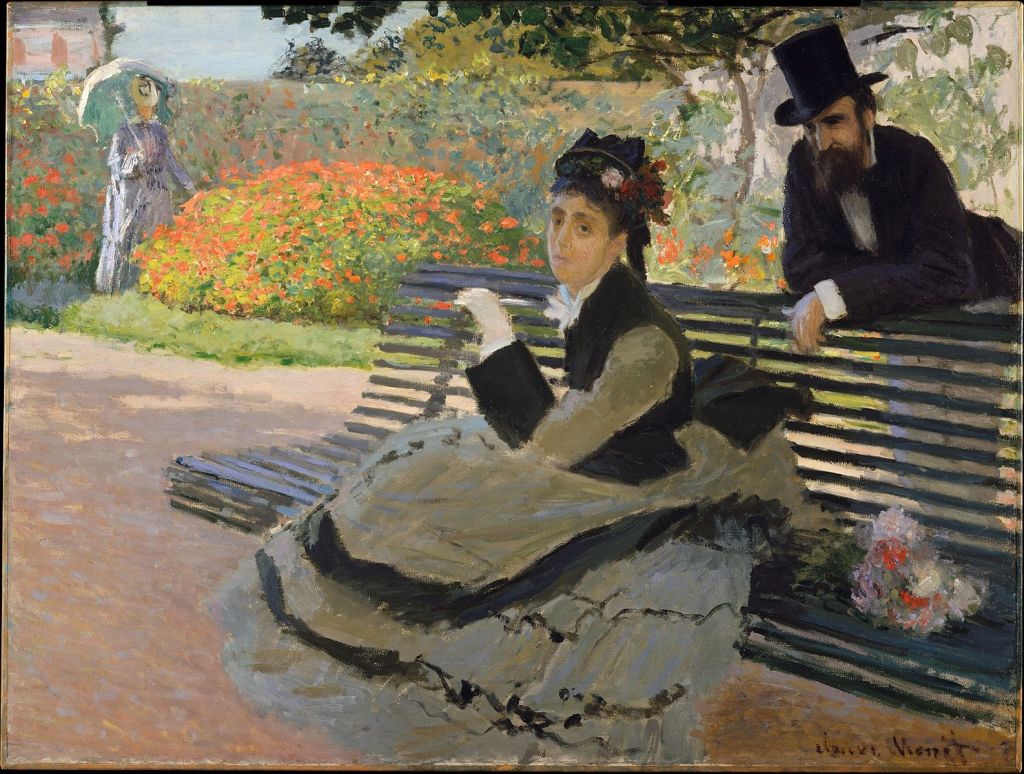
Camille Monet on a Garden Bench by Monet, 1873
Courtesy Creative Commons
Pollination 

From one thought to another 
My mind slips 
Like the insect who shifts
From one flower to another 
Trying out new flavours, new fragrances – 
My mind flits from one thought 
One task, one poem, one book
To another, in some never-ending game
Of restlessness, unease and disillusion,
Looking for some kind of satiety
Some fulfilment, some happiness. 
My mind waits to be held back 
With one thought, one look, maybe
One love of gratuitous pain - 
My mind rests from moving thought 
To thought, in the happy resignation 
Of paper to pen. 
 
Ruminations   

Silences lay pregnant 
Expectant, between them 
On that solitary bench 
Where, much could have been said, 
Much could have changed, 
But there was a ‘nothing’ between them.
Moments that flowed like lines parallel
From each heart, each soul,
But moments that hung 
Heavy with possibilities
Of somethings, happy or sad. 
In that time and mood,
Were they only two
Separated from the rest, the sundry?
In those silences, each lived 
For the other, even in non-acknowledgement,
In disdain or in pain.
There was prescient quietness where million 
Words could have stood – 
Silence lay pregnant between them 
In that bench, on that day. 

Dr. Anasuya Bhar is Associate Professor of English and the Dean of Postgraduate Studies in St. Paul’s Cathedral Mission College Kolkata. Dr. Bhar is the sole Editor of the literary Journal Symposium http://www.spcmc.ac.in/departmental-magazine/symposium/, published by her Department. She has various academic publications to her credit. She is also keen on travel writing and poetry writing. She has her own blog https://anascornernet.wordpress.com/.

.

PLEASE NOTE: ARTICLES CAN ONLY BE REPRODUCED IN OTHER SITES WITH DUE ACKNOWLEDGEMENT TO BORDERLESS JOURNAL. 
Categories
Essay

My Experiments with Identity

By Tejas Yadav

“Who are you?” Rarely do people vocalize this question, but you know they’re thinking it — from the very moment you meet them. To answer that question, you have to deal with another, internal one first. Who amI?

For a long time, I believed in a rigid identity, a fixed innate truth. Identity was a monolith, immutable and inherited. Down the river of years and landscapes, I have docked at numerous destinations, calling at each port with a distinct call. Heraclitus said you cannot step into the same river twice: the river moves on and so do you. If everything is in flux, how could I be, forever and everywhere I went, only one of the many things I could be?

In an interview, author Jhumpa Lahiri contended a singular, unchanging identity no longer interested her. Instead, she was seeking out different facets of her being and pushing the limits of how she defines herself. Lahiri grew up in an immigrant Indian family in the US but now lives in Rome, having learned and published in her adoptive language. She wonders if she is a Bengali, an American, an Italian, a woman, a writer, a wife or all of the above? Reading Lahiri’s words was liberating. Here was someone who had immersed herself into the Heracletian river, instead of skimming its superficial curves and bends.

I find this detachment from an unchanging, stereotypical identity appealing as I grow older. The more I turn around the sun, the more I want to shed cloaks of nationality, race, religion, sexuality and career. I want to be who I am, only I get to decide which emotional, political and social avatar I wish to place uppermost given the context. The richness of a pluralistic life means different hues take precedence depending on space and time. Back in the Renaissance period, polymaths were celebrated for being cultural chameleons and intellectual infidels. Utilitarianism has turned us into reductionists and prejudice into bigots. We want quick, short, predictable, comfortable answers to “Who are you?”. “Save the transgressive, subversive ambiguity of your Being,” they seem to say. “We need a label to comprehend your humanity. So, hurry up, what’s yours?”

Like Gandhi who wrote My Experiments with Truth, I too am Indian but unlike him, I am also the person who has lived most of his adult life away from India. I am gay, part of the identity politics of the LGBTQ+ minority and in the same breath I am also a cisgender able-bodied male with unspoken privileges. I am a scientist, but I am also a writer, poet. Sometimes I am a ‘person of colour’ and sometimes my emotional reactions against the racial battle fatigue, make me wish I could simply blend into the seawater of majority White.

Today, I have a paid job, but I am also someone who carries inside the memory of being unemployed. At times the immigrant in me surges to the forefront, on other occasions the anti-capitalist. I can be lucid and peaceful, but I know too the chasms between depression and vitality, the ones that are never fully bridged. Although this schizoid state recalls split personalities, a multi-layered identity is far from an incoherent, fragmented sense of self. All of these planes of existence make me who I am and, nevertheless, none of them are sufficient to define me. Only a paradox remains when I think of the whole of me. Identity then is an oxymoron, in evolution.

Undeniably, in a world that likes stock labels and neat boundaries it can feel chaotic to juggle different identities. Heterogeneity strikes many as a threat. Dissonance, variance, deviance constitute a trident charged against the constant, the power-wielding majority. The allure of sameness is strong in mobs, groups, entitled circles. They proclaim cohesiveness is the same as compassion. All outliers are dangerous. This primitive insularity reeks of exclusivity, of othering.

Invariability strikes those with unquestioned identities as the paragon of assimilation. But assimilation asks a great deal out of me and nothing out of you. How is that fair? Perhaps it is fair in the same way that ignorance and intolerance prosper while justice langours in the darkness. Assimilation has one objective: constancy. I’ve lived in four countries, speak five languages, straddle Science and Art. I stand at the crossroads of the developing East and developed West. I know the taste of racism deep in my skin (like spit full of hateful fear), I’ve walked down shiny corridors of privilege (Oxford, New York, Paris). I know the eyes that ask “Who are you?” and answer before I can, denying me the dignity of equality. In their gaze, my identity is a foregone, implicit bias. To them I say, constant is a dead word to me.

I live in the rough, mean, fleeting edges, the boundaries that no one sees because intersections are tough places. They are also thriving, lush, transcendent niches for the invisible and ignored. At intersections, we become so much greater than the sum total of our experiences. The goal of self-determination is not to figure out the right identity label and hold on to it dearly and protect it vehemently when attacked. Instead, fluidity serves natural order better. Amorphous like the primordial sizzling soup we come from, full of protean charm. Complex and dazzling like precious stones under a stolid terra firma. I wish to carry myself with my multitudinous, contradictory truths.  If someone is not prepared to engage in meaningful exchange with my nebulous vibrant ‘otherness’, they will receive a unidimensional, disengaged version of me. Or better, none at all.

Rumi allegedly said “You are the universe in ecstatic motion.” As I write these words, I’m starting to see what he meant. My experiments with difference continue, ironically because the word identity comes from the Latin one, idem, which means the same. How much of me is lost if the river stops flowing? Congruity always tries to boss over irregularity. In the end, the truth of one’s identity stems from uniqueness, not uniformity. Manifold and bewildering is the flow of an ecstatic river that refuses to be forded by narrow constraints imposed by mankind.

Tejas Yadav is an Indian scientist and writer. Currently, he lives in Paris. Themes of immigration, race and mental health inspire him. You can read more of his published work here:https://ytejas.medium.com/my-published-work-7cc06b99a443

.

PLEASE NOTE: ARTICLES CAN ONLY BE REPRODUCED IN OTHER SITES WITH DUE ACKNOWLEDGEMENT TO BORDERLESS JOURNAL.

Categories
Poetry

Universal Language

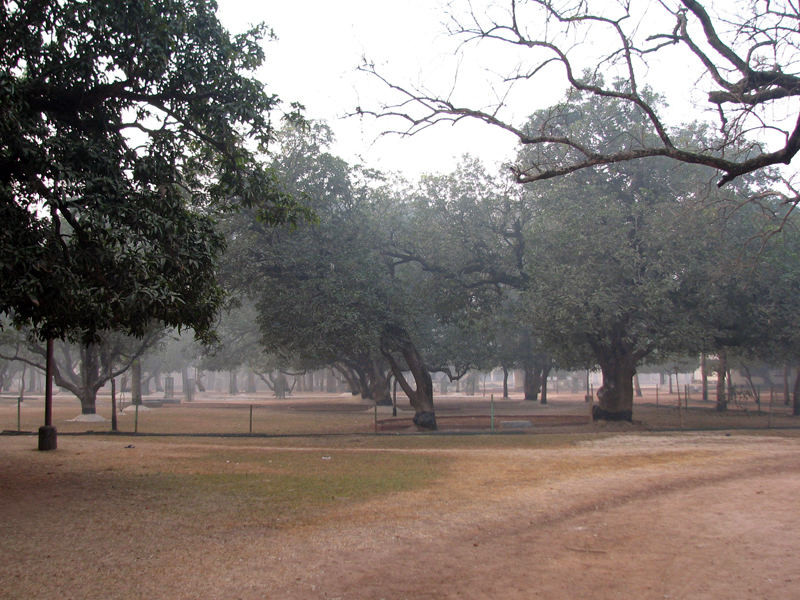
Composed by Ihlwha Choi from South Korea, while visiting a mango grove in Santiniketan, where Tagore started his unique experiment with learning.

Mango Grove in Santiniketan Courtesy: Creative Commons

In the mango groves* where children were playing,

I was reading of Jesus’ first miracle.

At that moment, two fledgling-like men came to me.

Hesitating and smiling an affable smile, mixed with playfulness and delinquency,

Gabbling about one hundred rupees and one thousand rupees in an unfamiliar language.

The only words I understood were one hundred rupees and one thousand rupees.

One hundred maybe meant he had no money for lunch.

One thousand maybe he knew nice girls somewhere.

Their fingers told me something about that. 

I thought Santiniketan, city of the great poet, was a holy city,

Though there were also some crimes, irrationality and evils.

The two appeared to me like the devil approaching the Son of Man, promising wealth, rank and splendours.

Finding the circumstances strange,

I escaped slowly from the spot and looked around after a few minutes.

They were looking at me like dogs having missed chasing the chickens.

The two, wearing rags, seemed starved for food.

Only for the reason of hunger,

Perhaps they might have thought of me as a traveller from a rich country.

So, they approached me for help.

That was maybe the last expression they could show — hospitality.

Maybe they approached me with the only universal language they knew.

.

Ihlwha Choi is a South Korean poet. He has published multiple poetry collections, such as Until the Time When Our Love will Flourish, The Color of Time, His Song and The Last Rehearsal.

.

PLEASE NOTE: ARTICLES CAN ONLY BE REPRODUCED IN OTHER SITES WITH DUE ACKNOWLEDGEMENT TO BORDERLESS JOURNAL. 

Categories
Poetry

Then Came the King’s Men

By Himadri Lahiri

Rabindranath Tagore by Sudhir Khastgir.
Courtesy: Creative Commons
Then Came the King’s Men

There he sat, a hermit under a chhatim tree
deep in meditation under the sun
that scorched the face of the earth with burning sores.
Brigands roamed about the territory at night
when it came alive with sounds of thousand crickets and glow worms.
There, there were born young saplings that grew up into dense foliage –
refuge of birds, insects and hundreds of other species.
There, there he founded a casteless ashram community
that reposed faith in God and man.

The bearded bard took the baton forward
turned the place into a nest where wise birds from distant places flocked.
They hummed different tunes in perfect unison – 
songs of diverse languages, cultures and knowledge.
With the end of the season many did not go back.
The village grew into a warm world.
The trees kept company when the young learnt 
the way chicks pick up small pieces of knowledge.
Fear was banished, freedom whispered to the innocents,
asked them of their playmates, pet dogs or birdlore
while the bard sang on.

As time moved on, the other freedom came.
With it slowly came sloth, self and salary.
The green faded into the walled universe
the size of a wooden ball.

Then came the king’s men 
manacles tied to their girdles, glistening. 
Wrapped in vanity and arrogance
with claws sharper than the wolf’s
threw a net around the greying green,
fragmented the universe into narrow walls.
Devices with strange names sprouted
with eyes on all things mortal,
turned men against men.
Wild messages ran riot
rotting the fabric of the place.
Closeted in a cold room in front of a bright screen,
the boss boasted,
“Mission accomplished, 
let us raise a toast to our great, newly bearded guru.”

Himadri Lahiri taught English at the University of Burdwan. He is now associated with Netaji Subhas Open University. His poems were earlier published in Borderless Journal, Rupkatha, Café Dissensus and in many more forums.