By Snigdha Agrawal
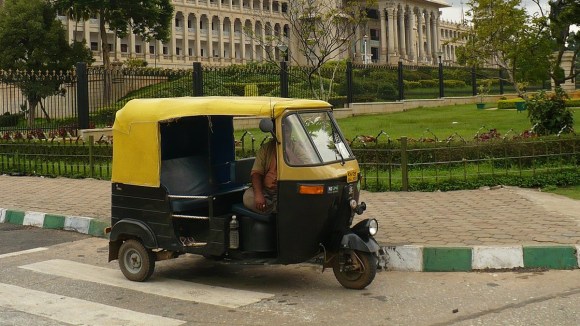
The December breeze had turned nippy in Bengaluru, carrying with it the aroma of roasted peanuts and freshly fried banana chips from roadside stalls. Fairy lights blinked across MG Road, and plastic Santas dangled from shopfronts. Ravi watched the sparkle through his rear-view mirror as he waited for his regular passenger, Ananya, to emerge from the Barton Centre, where she worked at a real estate firm.
“Sorry, Ravi bhaiya,” she said, sliding into the back seat. “The office party ran late. You know how these Christmas celebrations are: too much food, too little meaning.” She sighed, glancing at her half-open goody bag stuffed with unopened chips and chocolates.
Ravi smiled politely. He liked Ananya. Always punctual, always courteous, never haggling over the fare. But her words lingered. Too much food, too little meaning.
That night, after parking his autorickshaw near his rented room in Ejipura, Ravi noticed a group of slum children huddled under a flickering streetlight. They were watching a television through the open window of a well-to-do home. A Christmas carol drifted out, and the children sang along, slightly off-key.
“Santa will come!” one of the younger ones shouted.
“Arrey, fool,” another replied, “Santa only goes to rich houses.”
Their laughter carried a quiet truth. Ravi walked past them slowly, his chest tightening. What if Santa came here—just once?
The thought stayed with him.
The next morning, Ravi tied a cardboard sign inside his auto:
CHRISTMAS DONATION BOX – HELP BRING A SMILE TO CHILDREN LIVING IN SLUMS
An old plastic box sat beneath it. Some passengers glanced at it and looked away. Others smiled. A few dropped in coins or notes.
“What’s this for?” many asked.
“I want to buy small gifts for the children near my place,” Ravi explained. “Like Santa.”
An elderly woman patted his shoulder before slipping in a hundred-rupee note. “Good man. May God bless you.”
Within days, the box filled faster than Ravi had imagined. One evening, he counted the money: over three thousand rupees. More than a week’s earnings. His hands trembled slightly as he folded the notes.
At the market, he bought candy packets, crayons, and small notebooks. In a second-hand shop near Shivajinagar, he found a faded red Santa coat, a cotton beard, and a cap. It wasn’t perfect, but it would do.
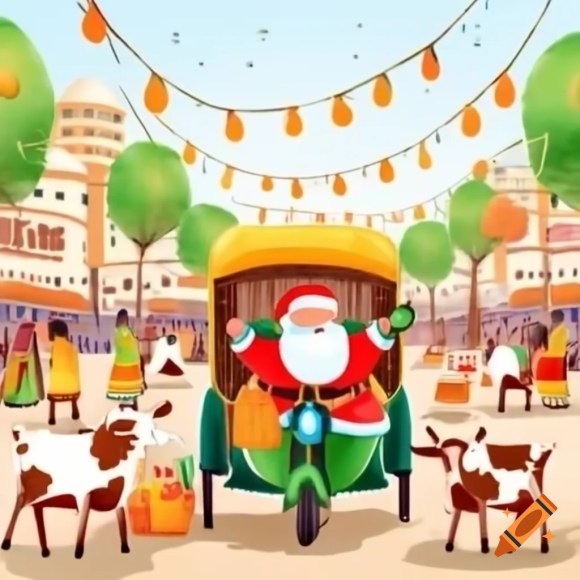
On Christmas Eve, Ravi transformed his green-and-yellow auto. Fairy lights ran along the roof. Paper stars swayed gently. A hand-painted ‘Merry Christmas’ sign was fixed to the back.
His neighbours laughed. “Ravi, have you gone mad? You’re a Hindu. Why Christmas?”
Ravi grinned. “Santa doesn’t ask who you are before giving gifts, right?”
By evening, the narrow lanes were alive with whispers and giggles. When Ravi stepped out dressed as Santa, a cheer erupted.
“Santa has come! Real Santa!”
He handed out candies, crayons, and notebooks. Laughter echoed between the tin roofs, mingling with jingling auto coins and distant church bells.
A barefoot little girl with bright eyes tugged at his sleeve. “Santa uncle, will you come next year also?”
Ravi bent down, his beard slipping sideways. “Only if you promise to study well and share your chocolates.”
She nodded gravely. “Done.”
Ravi laughed, blinking back, gripped by a sudden ache in his throat.
Later that night, he removed the Santa costume and counted the remaining money. Rs 1,800 still lay in the box. Someone had quietly slipped in two Rs 500 notes during the evening crowd. Ravi sat silently for a long moment, overwhelmed.
The next morning, he went to the Hanuman temple, where he prayed every Tuesday. He placed the leftover money before the priest as a thanksgiving.
The priest, an elderly man with cataract-clouded eyes, listened patiently as Ravi explained: the happiness he had brought to the slum children with the donation box, the costume, the Christmas star.
“I know it’s not our festival, Swamiji,” Ravi said apologetically. “But I wanted to do something good.”
The priest smiled. “Tell me, Ravi, did you ask those children their religion before giving them sweets?”
“No, Swamiji.”
“And did they ask yours?”
Ravi shook his head.
“Then where is the difference?” the priest said gently. “Whether one calls Him Krishna, Allah, or Christ, God smiles when His children care for one another. This is the true spirit of dharma[1].”
He placed his hand on Ravi’s head. “May your auto always carry light, not just passengers.”
That evening, Ravi drove through Bengaluru once more. Some fairy lights on his auto had dimmed, but a few still twinkled. The donation box remained inside. Though Christmas had passed, coins continued to clink into it.
For the first time, Ravi understood that Christmas wasn’t about religion, decorations, or abundance. It was about sharing warmth in a world that often forgets to care.
The road stretched ahead, glowing with city lights that shimmered like stars. And in the soft hum of his modest auto, Ravi felt as though he carried a small piece of swarg[2] through the streets of Bengaluru.
[1] Faith
[2] Heaven
Snigdha Agrawal (née Banerjee) is the author of five books, a lifelong lover of words, and the writer of the memoir Fragments of Time, available on Amazon worldwide. She lives in Bangalore (India).
.
PLEASE NOTE: ARTICLES CAN ONLY BE REPRODUCED IN OTHER SITES WITH DUE ACKNOWLEDGEMENT TO BORDERLESS JOURNAL
Click here to access the Borderless anthology, Monalisa No Longer Smiles
Click here to access Monalisa No Longer Smiles on Kindle Amazon International
 Borderless