Book Review by Gowher Bhat
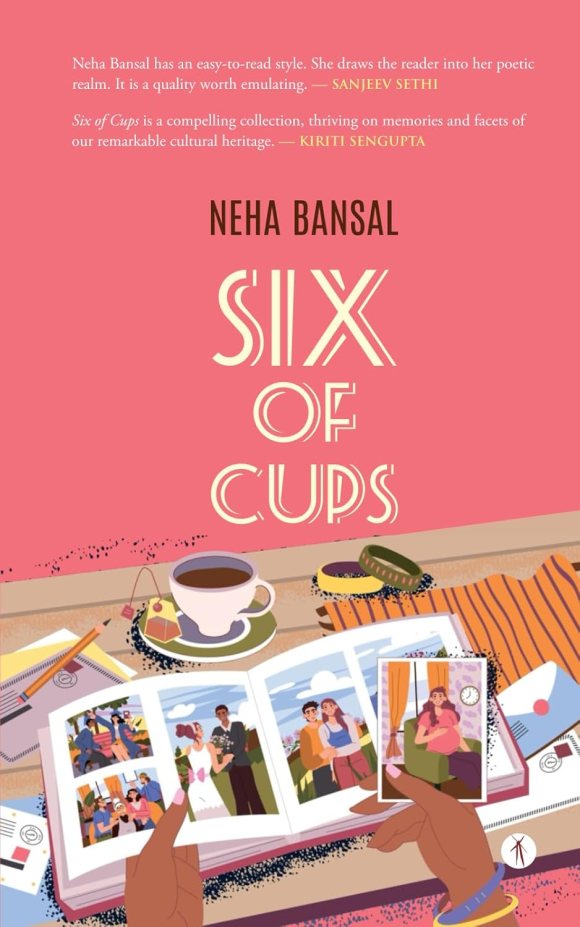
Title: Six of Cups
Author: Neha Bansal
Publisher: Hawakal Publishers
Some books speak in metaphors. Some shout their brilliance. Some want to be dissected, reviewed, analysed like puzzles. But Six of Cups isn’t that kind of book. It doesn’t ask you to do much. It just wants you to sit with it.
Neha Bansal’s poems don’t pretend. They don’t try to be clever. They don’t need you to clap. What they ask for is something quieter — your stillness, maybe. Your memory. They speak softly. Almost like they’re afraid of waking something in you. And maybe that’s exactly what they do.
This is a collection of fifty poems. Simple on the surface. But like most simple things, they carry weight. Not the kind that crushes. The kind you forgot you were holding until you’re reminded.
Reading Six of Cups is like finding an old sweater at the back of your closet. You didn’t even know you were missing it. But the moment you hold it, you’re somewhere else. In another time. Another house. Another life.
The title itself comes from the tarot — a card about childhood, nostalgia, kindness, innocence. The poems live in that space. They revisit things that aren’t just personal, but also collective such as homemade meals, festivals, sibling fights, old TV serials, chalk-smeared hands, and monsoon evenings. There’s a familiarity here that doesn’t feel manufactured. You don’t get the sense that Neha Bansal is trying to be nostalgic. She just is.
There’s a poem about Doordarshan[1]. It doesn’t try to explain the significance. It just takes you there — back to the old wooden cabinet TV, the warm static before the signal settled, the family crowding around the screen. It doesn’t say much and yet it says everything.
‘Sibling Squabbles’ is a small miracle. It captures that strange love we carry for the ones who shared our roof, our food, our secrets. The kind of love that includes shouting, pushing, sulking. But also defending each other, silently. Even now.
‘Paper Boat’ and ‘Mint Chutney’ — two more standouts don’t indulge in poetic imagery. Instead, they lean into the senses. The tartness of raw mango on your tongue. The wet smell of monsoon earth. The steam of evening tea. You read them and you’re not just reading. You’re smelling things. Tasting them. Hearing the old kitchen door creak open.
Neha Bansal is an Indian Administrative Services officer. It’s an unexpected background for a poet, maybe. Bureaucracy is about order. Poetry, one imagines, is about chaos. But in these poems, there’s order in the chaos. There’s discipline, but not rigidity. Every word is chosen carefully. Nothing feels excessive. Nothing is wasted. She writes like someone who listens closely to the world, to people, to memory. Maybe that’s what makes her poetry so honest. Her poems for people who’ve lived. People who remember the smell of their mother’s shawl. People who know the comfort of routine — boiling milk, folding bedsheets, watching Ramlila in the open field. They’re for the ones who’ve carried small hurts for years and never said a word.
There’s a kind of sacred quiet in this collection. That might be its most remarkable trait. In a time when poetry is often loud, performative, and built for clicks, these poems resist the noise. They’re not dramatic. They don’t climax. They settle in. They let silence speak.
In one of the most moving pieces, Neha Bansal writes about an old family tradition — Janmashtami, the celebration of Lord Krishna’s birth. But it’s not about religion. It’s about her grandmother drawing tiny footprints with rice flour. The quiet anticipation of the festival. The waiting. The softness of belief, not its spectacle. It’s in those tiny footprints that the poem finds its magic. You can almost see them fading slowly on the tiled floor.
These poems understand that memory is not a highlighted reel. It’s a soft murmur. A drawer that squeaks when you open it. A spoon stirring something warm. A phrase you haven’t heard in years but still know by heart. Neha Bansal knows that nostalgia isn’t about grandeur. It’s about the details we almost miss.
Her form is mostly free verse. But that doesn’t mean it’s careless. She knows how to pause — where to breathe. The white space around her lines isn’t empty. It holds meaning. A kind of emotional residue. You finish a poem, and it doesn’t end. It lingers. Like the scent of someone who just left the room.
There’s no poetic ambition here and that’s its strength. These poems don’t ask to be poetry. They just are. And that’s why they work. You trust them. You feel at home in them.
I thought of my own home while reading these pages. Kashmir. The long winters. My grandmother in her worn pheran, roasting cornflakes and walnuts on an old iron tawa, her hands, cracked and slow. The hush of mornings. No urgency. Just living.
That’s what Six of Cups reminded me of — the art of simply being. And how much that art is vanishing now.
Some poems mention festivals like Lohri, Janmashtami, Diwali. They present them as they are — domestic, lived-in, full of ordinary magic. For those unfamiliar, there’s a glossary at the end. But the real understanding happens not through translation, but emotion. Neha Bansal doesn’t lean on metaphor much. And when she does, it’s light. A passing breeze, not a storm. She doesn’t build complex imagery. But she does ask you to notice. In a world of scrolling, skimming, glancing — she’s saying, “Stop. Look. Listen.”
Even the titles of her poems have that simplicity: ‘Old Shawls’, ‘Grandmother’s Halwa’, and ‘First Rain’. They sound like diary entries. And in a way, they are. Only they’re not just her diary — they become ours too.
The brilliance of Six of Cups is that it democratises poetry. It makes it accessible again. You don’t need a theory. You need memory. You need feeling. That’s it. If you’ve ever missed someone or some place or even some version of yourself — you’ll get this.
And maybe that’s the beauty of it. It doesn’t want to be studied. It wants to be remembered. Like an old friend. Like a childhood street. Like a scent you can’t name but know in your bones.
The last poem in the collection doesn’t try to wrap everything up. There’s no neat ending. It just… fades out. The way light fades at dusk. Slowly. Gently. Without warning.
You close the book and feel something that isn’t quite sadness. It’s quieter than that. Maybe it’s the feeling of being seen. Or the feeling of remembering something small that meant something big. You sit with it for a while. You let it settle.
Six of Cups is not a loud voice. It’s a warm room. A soft light. A hand reaching back, not to pull you into the past, but to remind you it’s still with you. That you are made of it.
And maybe that’s what poetry should be sometimes — not a performance but a presence.
[1] Official Indian TV channel
Gowher Bhat is a published author, columnist, freelance journalist, and educator from Kashmir. He writes about memory, place, and the quiet weight of things we carry. His work often explores themes of longing and belonging, silence and expression. He believes the smallest moments hold the deepest truths.
PLEASE NOTE: ARTICLES CAN ONLY BE REPRODUCED IN OTHER SITES WITH DUE ACKNOWLEDGEMENT TO BORDERLESS JOURNAL
Click here to access the Borderless anthology, Monalisa No Longer Smiles
Click here to access Monalisa No Longer Smiles on Amazon International
 Borderless
2 replies on “Six of Cups”
wow reading ‘Six of Cups’ really was a nostalgic experience, bringing our mental frame back to the joy filled day, taking us away from the present competitive scenario, and allowing our small mistic smell to creep on our face unknowing to us. That’s Magic…
LikeLiked by 1 person
must read ….. Beautiful poems!
LikeLiked by 1 person