Narrative by Meredith Stephens & photographs by Alan Noble
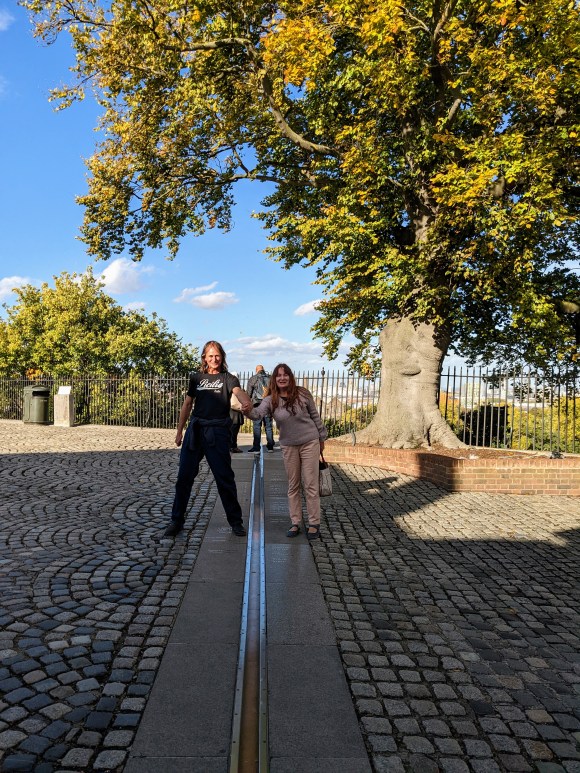
Whenever we visit another city, Alex and I always head straight for a science or maritime museum. When we spent a day in London several years ago, Alex insisted that we visit the National Maritime Museum in Greenwich, and then the Royal Observatory. The highlight of the latter was John Harrison’s marine timekeepers, which made the calculation of longitude at sea possible, therefore making navigation safer. A fun part of visiting the Observatory was standing on either side of the Prime Meridian Line, which defines zero longitude and divides the eastern and western hemispheres of the earth. If you are facing north, the person on the left is in the western hemisphere, and the person to the right is in the eastern hemisphere. We had to queue behind other couples to stand either side of the line. The couple in front of us were taking an inordinate amount of time to have their photo taken here, from which global time is calculated.
“Time’s up!” quipped someone behind us.
“What’s time?” came a philosophical comment from someone else.
The quick banter between strangers is one of the many reasons why I love visiting London.
During our short stay we devoted hardly any time to visiting any other tourist sites. The changing of the guard at Buckingham Palace held little allure. After visiting the Royal Observatory, we strolled past the historic British clipper ship “Cutty Sark” and then caught a ferry back from Greenwich to Central London. We briefly hopped off to see the Houses of Parliament, but after having visited the Royal Observatory Alex’s curiosity was sated.
Fast forward to March 2025 and we found ourselves in a remote town in Western Australia called Carnarvon. The first attraction Alex wanted to visit was the Carnarvon Space and Technology Museum. Carnarvon has a little-known relationship to Cape Canaveral in Florida. Many people have heard of Cape Canaveral and its rocket launching site, but who has heard of the not dissimilar-sounding town of Carnarvon?
Unlike the grand public museums in Western Australia, this one is self-funded and run by volunteers. NASA established a tracking station at Carnarvon in 1964, which played a critical role for both the Gemini and Apollo programs. Carnarvon was strategically located as the most distantly located site on the earth diametrically opposite from Cape Canaveral, providing the ability to track spacecraft over the Indian Ocean that were out of range from Cape Canaveral. The most famous launch was Apollo 11 in July 1969, which achieved humanity’s dream of landing humans on the Moon and safely returning them to Earth.
This museum was different from public museums in that when we visited it was managed by a grey nomad couple from the east coast. (“grey nomad” is an Aussie term for retirees who embark on an extended period of travel around the country, usually in a caravan.) A resident cat curled himself into a ball proudly on the reception desk. It was the only museum we visited in Western Australia that required a fee to enter. The first experience we sought was to hop in the replica of the Apollo capsule to get a feel for the astronauts during the July 1969 launch. I was worried about a panic attack coming on in a confined space but the manager assured me that he would open the door to let me out at any time if I felt uncomfortable. We lay down with the lower half of our bodies propped up on a platform in what we hoped was an astronaut launching posture, while footage from the 1969 launch played out on the screen in front of us. Countdown on the screen was followed by lift-off. Not only did I not have a panic attack, it felt exhilarating to be transported to Cape Canaveral in 1969. Having watched this on black and white television when we were in primary school, it was all the more meaningful to watch it as adults. After touring the rest of the museum, we returned to the Apollo capsule to experience it a second time, like the space nerds we were.
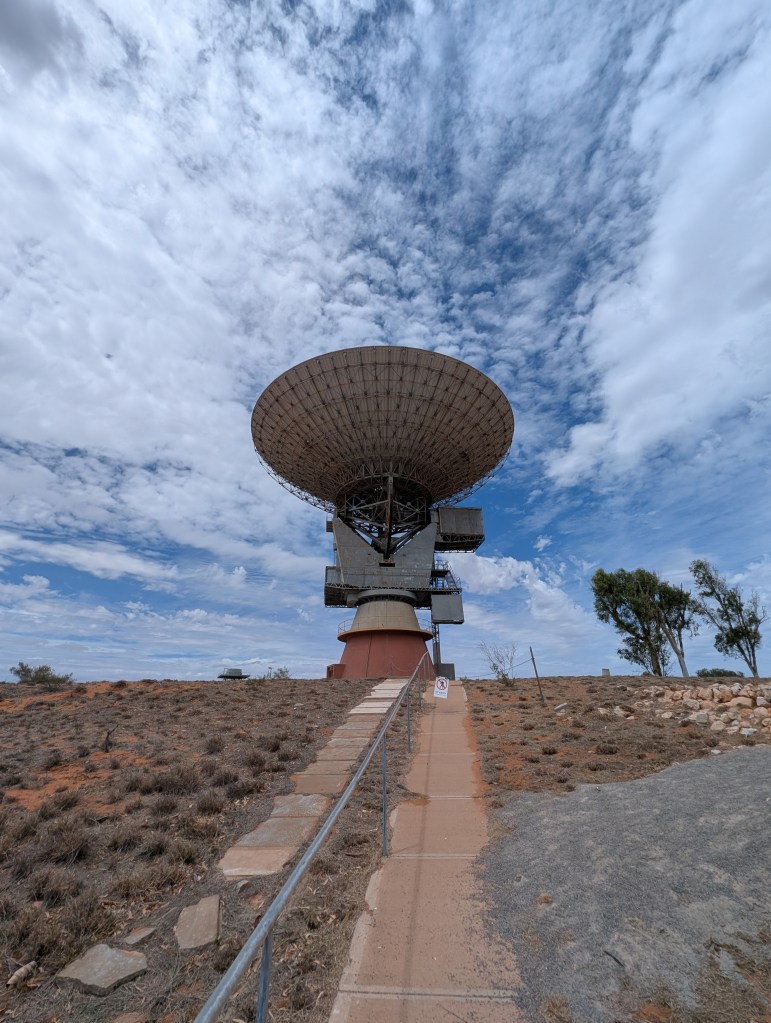
We braced ourselves to face the oppressive heat as we headed outside to view the original satellite dish. Rather than languishing as ancient technology the dish has been leased to an overseas company who were upgrading it to track satellites orbiting Earth.
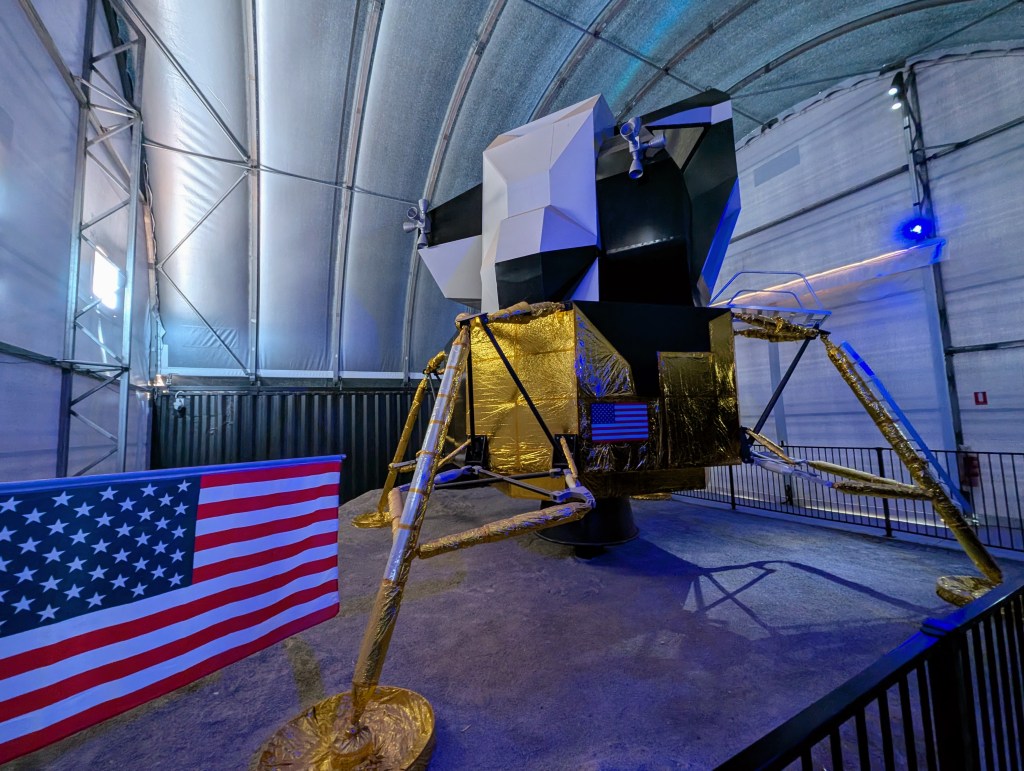
After viewing numerous 1960s space memorabilia, such as a replica of a Gemini capsule, which had preceded the Apollo series of capsules, and a life-sized replica of the lunar lander module, we bought some tourist T-shirts, chatted with the manager couple, and bade farewell to the resident cat. This was the most thrilling of the magnificent museums we visited in Western Australia. Thanks to Alex, we had a bias to visit maritime museums, including The WA Maritime Museum in Fremantle, The Museum of Geraldton, and The WA Shipwrecks Museum. They provided rich accounts of the many arrivals from distant lands to the west Australian shores since Dutchman Dirk Hartog’s nearby landing at Shark Bay in 1616. All visits were immensely educational and informative, but somehow the less glamorous Carnarvon Space and Technology Museum stood out. Unlike the public museums, it was somewhat ramshackle, but this was more than made up for in terms of authenticity and charm. Who would have thought that this outpost in regional Western Australia that even many Australians have not heard of, could have played such a pivotal role in the tracking of Apollo 11? This museum enjoys none of the fame of the Royal Observatory in Greenwich, but the role it played in history is just as moving.
.
Meredith Stephens is an applied linguist from South Australia. Her recent work has appeared in Syncopation Literary Journal, Continue the Voice, Micking Owl Roost blog, The Font – A Literary Journal for Language Teachers, and Mind, Brain & Education Think Tank. In 2024, her story Safari was chosen as the Editor’s Choice for the June edition of All Your Stories.
PLEASE NOTE: ARTICLES CAN ONLY BE REPRODUCED IN OTHER SITES WITH DUE ACKNOWLEDGEMENT TO BORDERLESS JOURNAL
Click here to access the Borderless anthology, Monalisa No Longer Smiles
Click here to access Monalisa No Longer Smiles on Kindle Amazon International
 Borderless