By Paul Mirabile
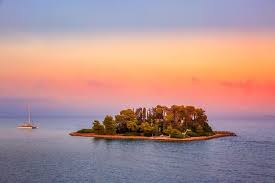
It was Easter holiday. Nico had ten days off from school. His grandfather, Vasiliki, had promised his grandson to take him out on a fishing expedition for a few days on the island of Pontikos to the south-east of Hydra. It was a tiny island hardly inhabited by man where wildlife roamed freely. Vasiliki had been there several times with his father. They always stayed in a cave which lay hidden in a small creek, unknown to all, save of course, themselves …
So one April morning, the sky more or less clear and the sea calm, Vasiliki weighed anchor and they set out in his motorised sailing dinghy. Making sure the motor was not in gear he pulled the pull-starter to ignite it. An instant later he choked it.
“Why did you choke the motor, grandpa?” Nico enquired, eating sardines with a slab of goat cheese and bread.
“Have to warm her up a bit, my boy. The fuel needs a few seconds to fill her.” Vasiliki again tugged at the pull-starter and away they glided, humming slowly away from the make-shift pier, Nico now hauling in the tie-ropes. Vasiliki took firm hold of the throttle, steering the boat out of the coastal waters.
“Shouldn’t we hoist the jibe, grandpa?”
“Not today. There isn’t much wind and Pontikos is far off. Thanks to my new motor, we’ll get there quicker … Tonight we’ll be eating shrimp,” he shouted over the pleasant humming of his new motor. “ And tomorrow morning we’ll fish for sea bream. Prawns and shrimp rise to the surface of the water at night and sea bream during the day.”
“Why is that, grandpa?” Nico sat sleepily on coils of rope at the bow wiping off the pieces of bread that had fallen on his anorak. He enjoyed the smell of the sea, that briny, seaweed smell. The air had a sweet taste to it that he could not identify, perhaps oleander or fuchsia.
His grandfather scratched his silvery beard: “I really don’t know why. Fish are like us humans. They have different reactions to different circumstances.” Nico, although not quite satisfied with this response had not the heart to pursue the subject.
“The sky was red last night,” continued Vasiliki, gently manoeuvring the throttle, steering the sail-less dinghy further out away from the dangerous rocky shores of Hydra. “You know what they say: ‘Red at night, sailor take delight; red in the morning, sailor take warning.’ No storm will be on us this morning.”
“Why do they say that, grandpa?” asked the inquisitive Nico.
Vasiliki observed the clouds moving in behind Hydra: “I really don’t know, Nico. It’s just one of rhymes that fishermen and sailors have repeated for centuries.” Vasiliki sniffed the air: “The weather will be clear only for us up till tonight, Nico. Who knows, we just may see a rainbow.”
“Only for us, grandpa?”
Vasiliki smiled: “Well, we’re the only ones out on the sea this morning, right?”
Nico nodded. Indeed their vessel was the only one seen on the whole wide horizon. The boy looked up — white puffy clouds plodded across the blue like camels over desert sands.
The motor raced them out into an Aegean smooth as silk. Gentle wavelets slapped the sides of the dinghy. The plodding caravan continued it’s heavenly voyage, the sun peeping over and to the sides of their creamy white humps. Nico gasped, he was witnessing an amazing spectacle of Creation! The early morning breeze stung his cheeks a crimson red. It was his first time out on a fishing expedition with his grandfather. How excited he was. He shot a glance behind him: a few dark clouds rose above the bleak cliffs of Hydra.
“The northern winds, grandpa,” he informed the steering Vasiliki, his voice a bit shaky. “They’ll be on us.”
“No bother, my boy, we’re out-racing them thanks to our new motor. That’s why I didn’t hoist the jibe, you see. Don’t forget : ‘red at night is sailor’s delight !’ Anyway, we’ll be at Pontikos in a few hours, long before those nasty black clouds chase or swallow those lovely white puffy ones.”
“Like the sea monsters that swallow boats and their crew, grandpa?”
Vasiliki offered no reply.
Three hours later, Vasiliki slackened speed by gradually easing up on the motor until he pressed the choke button on the throttle. He then took up the oars and began rowing strenuously, the muscles of his arms and shoulders contracting to the rhythmic movements of the current.
“Why have you cut the motor, grandpa?”
“Cause we’re entering the creek where our cave is. We have to be very careful to avoid snags. The strong current will also help us through the creek and push us right to the mouth of the cave. I know these waters well, my boy. You see, I’m not even rowing, it’s the current that’s doing all the work. Just look at this creek, Nico. It’s magic to the eye.”
Vasiliki gazed dreamily at their surroundings. He had indeed pulled up the oars and now let the current eddy them through sprays of seaweed toward the sandy beachhead. With the rising mist, the towering cliffs of Pontikos loomed eerily before them, encircling the indented crescent creek, although paths could be discerned on the pebbly strand, widening and snaking amidst the huge fissures and cavities of the cliffs. Tiny maritime parasols clung precariously off the jagged crags. The ruddy colours of the late afternoon bathed the whole scene in a marvellous fairy-tale aura. Nico sat mesmerised before the slightly rolling reflexions of the craggy palisades in the turquoise waters of the creek, over which his grandfather was now rowing prudently to avoid any collisions with the flat rocks that surged up here and there on the foamy wavelets. He envisioned himself on a page of A Thousand and One Nights, or on one in Robert Louis Stevenson’s Treasure Island which he had just finished reading …
“There she is, Nico … the mouth of our cave. That’ll be our home for a few days.”
Suddenly Nico cried out: “Grandpa! Look, a seal on the rock, I heard her cry … There she is!”
Nico stood up at the bow to get a better look. “It’s a fat seal with tiny white eyes.” The seal squealed in delight and dived into the cool, clear waters. “What a beautiful seal, grandpa!” added an overjoyed Nico.
“She sure is, Nico. Now let’s do the same. We have to jump into the water to haul the boat on to the beachhead. Take off your sandals and roll up your trousers.”
“I’d love to dive like that fat seal,” Nico called out as he hauled away. “I’d be able to catch so many prawns and sea breams and …”
“Get a hold of the rope and tie it to a few of the trailing vines that criss-cross the beach,” broke in Vasiliki, rubbing his calloused hands. Then he dropped anchor. “Get our bags out of the dinghy, but leave the fishing gear inside.”
Nico gathered up their bed-rolls, firewood and spittle, carrying them into the cave. Meanwhile his grandfather busily cleared and smoothed the floor of the cave to make it comfortable to lie on and build a fire. “I hope she comes up again,” Nico said, listening to his echo.
“Who?”
“The seal, grandpa.”
“She’ll come up. My father and I always saw her come up and dive back down.”
“Can seals live that long?” Vasiliki glanced at his curious grandson.
“Well, I’m not sure she’s the same one. It may be her baby.” After that rather enigmatic reply, Vasiliki vanished into the deepest shades of the cave in search of prawns caught in the many shallow pools of water. Nico sat on the strand watching their boat dance suavely upon the wavelets that lapped the shore like ripples of laughter. The sun was setting over Hydra. The seagulls were laughing and the cormorants crying, both now on the wing, rising from the darkening waters, lifting their wet wings, flapping them madly. Suddenly the seal jumped up again on to the flat rock with a joyous squeal. The foamy waves brushed against the flat rock, soundlessly. She dived back into them. A call from the cave! Vasiliki had netted dozens of small prawns and was now scooping them out of the pools.
“Nico, get the big pot from the boat. We’ll be having boiled prawns with goat cheese, olives and bread tonight.” Vasiliki appeared stirred by the idea.
No sooner said than done! Whilst Nico searched for the big pot, Vasiliki dug a small hole, filled it with dry wood bits and made a fire. They used bottled water to boil and drink since no drinking water was found on Pontikos.
Nico and his grandfather ate a hearty meal that first night. Tired from their voyage, they spread out their bed-rolls and lay down in the silence of the dim, fire-lit cave. Nico used his anorak for a pillow. He observed the last plumes of smoke rising to the rocky ceiling where there, they fanned out, the wisps tracing weird configurations: shapes of birds perched upon gigantic cliffs, deep-sea fish and reptilic creatures all moving slowly … very slowly. Nico rubbed his exhausted eyes, the phantasmagoria gradually vanished into the black rock. The fire lowered, then died out …
Streams of orange rays broke into their dreamless sleep. Vasiliki awoke first: “Nico, go out and find some brush and underwood for our fire. Be careful on the paths between the boulders, there may be scorpions or snakes.”
Nico rolled out of his bed-roll, splashed his face with a bit of briny-scented seawater, then throwing a sack over his shoulder which he retrieved from the dinghy, set out in search of firewood. The agile boy had not been at it for long when he stopped dead in his tracks. On the strand lay a seagull shaking her orange legs, pecked at the reddening morning sky with her horny beak. He approached the bird carefully. She opened her eyes as if pleading for help. Vasiliki soon joined his grandson.
“What’s wrong with the bird?”
“She’s dying, grandpa.” Nico lamented. “Look, she can’t fly when she spreads her wings.” Vasiliki shook his head sadly and turned to leave.
“We got to get to the boat, my boy, the fishing will be good today.”
Nico cradled the seagull’s head in his hands then poured some seawater onto her beak. She shook her head violently, closed her eyes and lay still. The boy dug a hole in the warming sands, placed the dead bird gently in it then covered her with sand and pebbles. He erected a little mound on the burial spot. The gloom-filled boy retraced his steps to join his grandfather at the boat, his bag full of wood bits and dry brush.
“What’s wrong, Nico?” asked Vasiliki as they pushed the dinghy into the still waters.
“The seagull’s dead, grandpa. I buried her.”
Vasiliki eyes shone with warmth. “Seagulls die, my boy,” he mulled, waist deep in the creek. “Like us, we die too.”
Vasiliki took up the oars and rowed out towards the open sea. Pulling them in, he let the dinghy float gently on her own whilst he prepared the fishing lines.
“We’re not too far out, grandpa?” observed Nico, fixing his line with a plummet and baiting his hook with worms and not with pieces of fish as the fishermen of Hydra would always do much to the dislike of his grandfather.
“No … Have to keep that coastline in sight,” reminded Vasiliki. “These waters can change in a blink of an eye.”
Nico fixed his line and sent it spinning through the rod out into the choppy waters. He sat on the coil of ropes sniffing the pleasant morning breeze. The air smelt of flowers. He scanned the watery horizon where he felt overwhelmed by a strange sensation of encountering a primordial world when primitive men hunted, fished, built fires in caves … sang dirges to the dead. Would he chant a dirge for the dead seagull that night in the warmth of their cave fire?
Hours passed. Both stared dreamily into the sea as they held their rods steady, a sea so creamy, so milk-like. Now and then a slight turbulence, perhaps a whirlpool, tossed the dinghy from side to side.
“Do you see any mackerel?” Vasiliki asked, peering over the surface of the sea.
“I’m not sure if they’re mackerel or scad fish, grandpa,” answered the boy, tugging lightly at his rod.
“Well, the mackerel chase the scad, so you know that the mackerel are behind them.”
Nico nodded.
“Tell me about the seagull, Nico.”
Nico peered at this grandfather’s aging face, leathery from the wind and sun, at his deep, gimlet set eyes. “Which one, grandpa? The one I just buried or Dimitri’s?”
“Dimitri’s?”
“Yes, remember Dimitri, he was one of my classmates … He had a seagull for a pet.”
“A seagull for a pet? That’s strange. Tell me about her.”
“She was a different kind of seagull. A domesticated seagull. She would fly up on to a rock whenever Dimitri and his father were out fishing. From that rock, she would observe them with her beady eyes. Then she would dive straight down to the boat but she never perched on Dimitri’s father’s side of it, only on Dimitri’s side. His father was a grouchy old man and the seagull never cared for him. Dimitri would throw her fishbones, picarels and other bait. His father would get angry, saying that bait was for fishing and not for that blasted bird ! Dimitri never listened to his father. He would just wave a hand and keep feeding his companion. They were an inseparable pair, you know. When Dimitri died of the flu the seagull flew off and was never seen again … »
“Where did she fly off to?” enquired Vasiliki, intrigued by this tale.
“Perhaps she flew to China, grandpa … Like the Nefeli[1] …”
“To China?” Vasiliki eyed his grandson thoughtfully.
“Yes, grandpa. Or to somewhere unknown, or at least not known to us.” Vasiliki bowed his head. They shook their rods : nothing yet …
The sun was high in the sky now. It warmed their bones and skin. Nico threw off his anorak. How beautifully the sunbeams bounced off the blue waters. They shimmered like the scales of a fish just caught on the line. From time to time, the gulls and the cormorants that glid over their heads swooped down and skimmed the surface of the white foam in search of scud or other schools of fish that were presently leaping at the surface. The birds certainly had more luck than our two fishermen. Plunging downwards, fluttering their huge wings, their graceful dives and surges hypnotised Nico. Meanwhile in the fathoms of the deep, millions of sea-creatures pursued millions others. The microscopic fish were swallowed up by the bigger fish, and in turn were swallowed up by even bigger fish! The whole lot of them were then completely disappeared in one enormous suction into the hollow vortex of the great whale. A great battle indeed was underway both in the inflamed sky and in the broiling sea. Nico felt enfolded in this chaotic struggle for life. Would he, too, be swallowed up along with his grandfather?
Nico shot a questioning glance at Vasiliki who suddenly broke the silence with cries of joy: “Ah ! Nico, here … a fish … two or three fishes!” Vasiliki, all agog, triumphantly displayed three flapping fish in his straw-weaved basket, their gills quivering silver in the intense sunlight. Nico, too, quite unexpectedly got lucky. Not only had he reeled in a mackerel, but also a big, white fleshy sea bream. He had at first lost his plummet, no doubt badly tied. But when Vasiliki showed him how to fix it properly the fish came to him as if the bait were a magnet.
“We’ll be having a hot-pot tonight, my boy,” rejoiced Vasiliki. “We’ll cook some vegetables with our catch. What do you think?”
Nico smiled. He thought it an excellent idea …That night when they had cleaned the fish, Vasiliki boiled them with an assortment of vegetables brought over from Hydra, especially egg-plant, red-pepper and tomato.
“How was the meal, Nico?” asked his grandfather when they had finished eating.
Nico, who had been listening to the moaning wind, turned to him: “Delicious, grandpa. But you know, I thought of the dead seagull all day when fishing. She should have been diving and catching fish with the others.” He paused a moment. “Grandpa, what did you think of my story?”
“What story?”
“About Dimitri’s pet seagull.”
“A good story, my boy. A beautiful story. A very beautiful one.” Vasiliki puckered his lips. “Why do you keep thinking about the seagull you buried ? Do you want to give her a name, like your boat that sailed to China?” Nico stared at his grandfather rather perplexed.
“No grandpa, I have no name for her. She’s gone far away … like the Nefeli … to another land …”
“We’ll build another boat together,” Vasiliki promised. “A bigger boat. The biggest of them all. But the seagull,” he hesitated. “The seagull has flown off to a land where we can never see her again. I’m sure it’s a beautiful land, like where the Nefeli is now on her way.”
“Wouldn’t you like to see that land, grandpa?”
“Well … not right now, my boy. Right now I’d like to close my eyes and sleep. Tomorrow we’ll be on the sea the whole day again. They’re biting out there.”
And that is exactly what the old man did …
The last embers of their fire cast undulating shadows on the walls of the cave. Vasiliki was sound alseep, snoring lightly. Nico strolled to the beachhead. The moon had risen, girt by a rosy halo. Darkened seagulls glided in and out of the misty moonbeams. They danced an eerie dance. Nico perceived Hydra’s beacon far, far off at the south-west tip of the island. A steamer passed over the sleepy waters heading for Hydra, her lights burning bright against the umber orb of the horizon. Nico thought of the Nefeli on her long voyage to China. Slicing unmanned, captainless over unchartered seas, like Dimitri’s pet seagull on the wing, perhaps she too flying towards unknown lands now that her master had long since departed. The seagull he had buried could also be flying off to some mysterious place, a paradise for seagulls where she could fly and fly and fly without a thought of ever diving for fish or of escaping the hunter’s gun. A peaceful place…
Nico’s grandfather told him that tomorrow night they would be eating mussels with lemon juice; a real regale his grandfather had beamed. With bread and olives, too. Olives always go so well with mussels, he said. Nico smiled. Why they always go so well together his grandfather never offered a reason. But Nico believed him. Nico believed everything that his grandpa told him, even about the monsters of the sea that swallow boats and their crews. Perhaps the Nefeli had been swallowed up by one of those monsters.
Nico stared at the shadowy moon. A slight wind began to groan. The dinghy tossed gently, the scraping of the pebbly strand under her bow prompted a rather strange rhythm like a saw sawing wood.
Nico strolled back into the dark cave. The fire had gone completely out. Nothing could be seen, only heard: his grandfather’s snoring, the seagulls screaming, the wavelets lapping, the dinghy scraping … He loved his grandfather. Yes, they would build a great, majestic boat, sturdier than the Nefeli — an unsinkable boat, one that would voyage all around the world like Magellan’s galleon. He would name the boat Mytho … Yes, that would be a fitting name for such a beautiful boat.
Nico stared at his unseen snoring grandfather. He would have liked to ask him why olives and mussels go so well together. And his grandfather would have probably answered: “Well my boy, it’s just a feeling I can’t really explain. But believe me, they do go well together.”
And Nico would have believed him. Would have accepted that answer as a perfectly acceptable answer …
Nico slipped into his bed-roll and immediately into a deep, deep sleep. He dreamed of seagulls on the wing, boats navigating on the high seas, underwater monsters with long, leathery tentacles chased by the great whale and caves full of gold and diamonds and other precious stones whose names Nico had not as yet learned but would surely ask his grandfather their names when he awoke.
[1] Read the story by clicking on this link.
.
Paul Mirabile is a retired professor of philology now living in France. He has published mostly academic works centred on philology, history, pedagogy and religion. He has also published stories of his travels throughout Asia, where he spent thirty years.
.
PLEASE NOTE: ARTICLES CAN ONLY BE REPRODUCED IN OTHER SITES WITH DUE ACKNOWLEDGEMENT TO BORDERLESS JOURNAL
Click here to access the Borderless anthology, Monalisa No Longer Smiles
Click here to access Monalisa No Longer Smiles on Kindle Amazon International
 Borderless