By Suzanne Kamata
When I first came to Japan from America to teach English on the Japan Exchange and Teaching (JET) Program, I had no idea how popular baseball was in this country. I quickly found out, however. I was assigned to a high school in Tokushima, on the island of Shikoku to be an assistant English teacher. It was summer, and I was immediately informed that the school’s baseball team had won the regional baseball tournament. They had gone on to the National High School Baseball Summer Tournament at Koshien stadium near Osaka.
This event is on par with the Super Bowl in the United States. The games are televised, and the entire country is riveted for the duration of the tournament. Many star players go on to play professional baseball in Japan, and later maybe even in the Major League in America. Ichiro Suzuki, Yu Darvish, and Shohei Otani are just a few players who first claimed the spotlight at Koshien.
Once classes started in September, I discovered that the baseball players were immediately recognisable by their shaved heads. I often saw them practicing on the baseball diamond very early in the morning, sometimes dragging tires yoked to their shoulders as they ran. I noticed that they were respected by the teachers. Even if they fell asleep in class, the teachers didn’t try to wake them up. When they were awake, the baseball players were very polite. They had been trained to greet their elders in a loud voice, and to bow and doff their caps.
Another thing that I quickly found out was that in Japan, baseball season is basically year-round, at least up through high school. Japanese students can choose only one sport. While in the United States, coaches often cut weaker players from their teams, in Japan anyone who wants to join a team is welcome. The team becomes a community for players of different abilities. The bonds that Japanese kids form with their teammates tend to be very strong, since they spend so much time together.

My second year in Japan, I met the man who became my husband. He was a teacher, and a baseball coach. Through him, I became even more aware of what a big deal baseball was in Japan. I also acquired a lot of insider information. I started to write a novel about an American woman married to a Japanese high school baseball coach, which I called The Baseball Widow. I asked my husband many questions while I was writing the book.
We later had twins – a daughter, who is disabled, and a son, who began to play baseball in elementary school. He devoted himself to the sport throughout high school, sometimes waking up at five o’clock in the morning on weekends for out-of-town games. He never once complained. At one point, he asked me to write a baseball story. I did. I wrote the text for a children’s picture book, Playing for Papa, which was published in Spain and is now sadly out of print. I also wrote a middle grade novel, Pop Flies, Robo-pets and Other Disasters, featuring a boy in junior high school. I read the entire novel to my son, and made some changes following his advice.
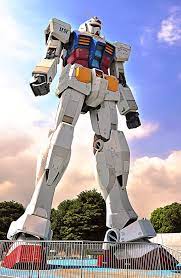
In addition to baseball, Japan is famous for its robots. Gundam is a well-known robot character, who first appeared in Japanese anime in 1979. Although many science fiction stories feature robots, they are increasingly becoming a part of daily life in Japan. This is partly because Japan’s population is decreasing. There are fewer and fewer young people to do necessary work, so machines are called upon to take up the slack.
Recently, the Japanese have developed robots which can help elderly people and others in many different ways. For example, there are robots which can help farmers pick fruit, as well as humanoid robots that can chat with people and ward off loneliness. Robot pets, like Paro (which became Mon-chan in The Baseball Widow), are also used to keep elderly people and children in hospitals company. There are special cafes staffed entirely by robots, including at least one at which the robots are controlled by people with disabilities. A nearby art museum has a robot guide which takes visitors on tours of exhibits. Robots in Japan have performed weddings and funerals. During the COVID-19 epidemic, one small university even used robots as avatars in a graduation ceremony.
I am fascinated by robots. They are not always what people expect. Sometimes they are soft and fuzzy. As soon as I learned of the robo-seal, I wanted to put it into a story. However, I sometimes feel uneasy about the replacement of humans by robots. Fortunately, at the moment, family bonds remain strong in Japan, with multiple generations living together and helping each other. Like the family in my book, we were three generations, living in the same house. We don’t have a robo-seal yet, but we do have a robotic vacuum cleaner.
.
Suzanne Kamata was born and raised in Grand Haven, Michigan. She now lives in Japan with her husband and two children. Her short stories, essays, articles and book reviews have appeared in over 100 publications. Her work has been nominated for the Pushcart Prize five times, and received a Special Mention in 2006. She is also a two-time winner of the All Nippon Airways/Wingspan Fiction Contest, winner of the Paris Book Festival, and winner of a SCBWI Magazine Merit Award.
PLEASE NOTE: ARTICLES CAN ONLY BE REPRODUCED IN OTHER SITES WITH DUE ACKNOWLEDGEMENT TO BORDERLESS JOURNAL
Click here to access the Borderless anthology, Monalisa No Longer Smiles
Click here to access Monalisa No Longer Smiles on Kindle Amazon International
 Borderless