Narrative and photographs by Meredith Stephens
My partner, Alex, has always been enthralled with the natural beauty of the west of the United States, having spent sixteen years studying and working there in his youth. He wanted to share his love of this part of the world with me, so took me on a seven-day road trip from his base in the Sierra Nevada Mountains to Fort Collins in Colorado and back.
“You must see Arches National Park in Utah!” urged Alex’ long-time friend Ryan. “Bryce National Park is worth visiting too.”
Two days later we arrived at Bryce National Park. At first, the scenery was pleasant but unremarkable. I wondered why there were so many tourists and so many cars in the carpark. We donned our raincoats and walked towards the trail to follow the other tourists. It started hailing and I pulled my hood around my face. Thunder and lightning resounded. A tall thin park ranger approached us from the other direction and looked directly at me.
“We advise you to turn around immediately and seek shelter. We have lost ten people in twenty-five years in these weather conditions.”
We looked at the brochure to confirm this and read that there had been four fatalities and six injuries. I would have been happy to follow the park ranger’s advice, but we had driven for eleven hours to get there and were too curious to turn back. We started walking towards the Navajo Loop trailhead at Sunset Point. Tourists were posing for photographs at the rim. I wondered what the attraction was and peered over the rim myself. Suddenly, I understood why the site was so crowded.
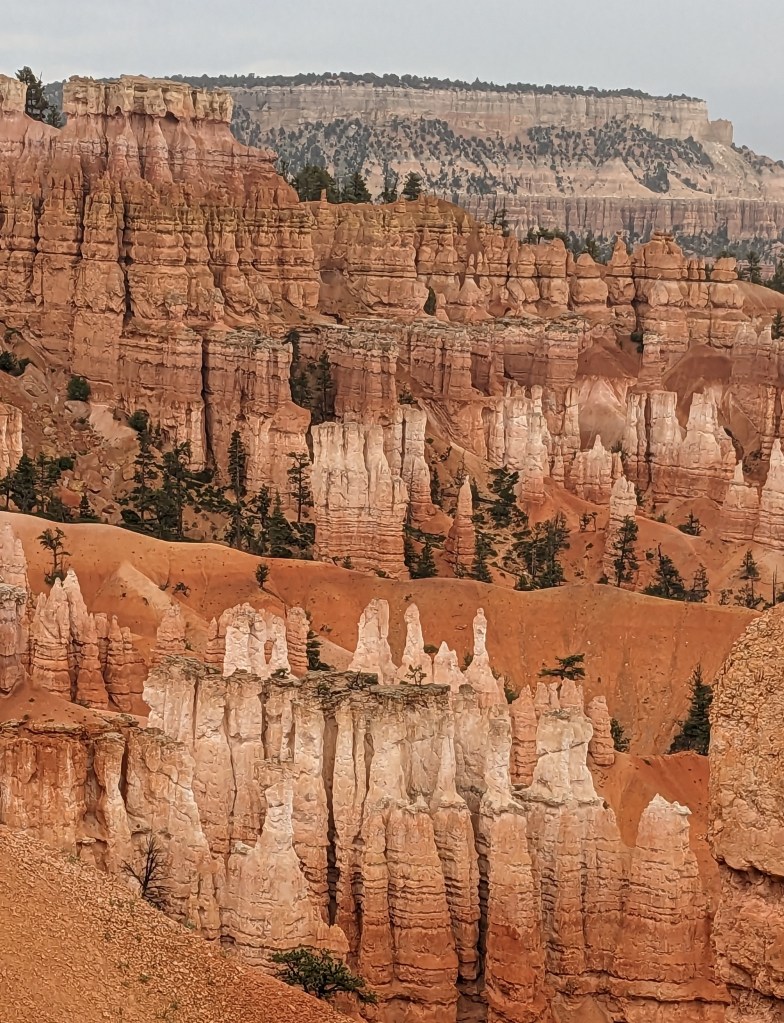
I gingerly placed one foot after another to carefully descend the steep muddy trail. Each time I planted my foot down I held it steadily to ensure I would not slide. A couple approached us from the opposite direction as they ascended the trail.
“We strongly recommend you turn around immediately!” they warned. “It’s treacherous in these muddy conditions.”

We thanked them, but I continued to gingerly traipse through the mud along the downward trail for a few metres.
“You go ahead,” I urged Alex. “I can’t go any further.”
It continued to hail, and we could hear thunder. I turned around and slowly plodded back up the muddy trail back to the edge of the rim, closely followed by Alex. We contented ourselves with the less slippery 2 km walk along the rim to Sunrise Point and back. Back at the car, we scraped the mud off our shoes, fairly unsuccessfully, and continued our drive to Arches National Park.
The Arches National Park is so popular that visitors have to book through a timed entry system. At 6 pm, when the booking system opened, Alex opened the booking site and secured one of the few remaining availabilities for a 7am entry the next day. He hoped we could also enter just before sunset that day, after 6pm when entry was not timed.
Four-and-a half-hours later we arrived at Arches National Park. The drive had been uneventful along straight desert roads and it had been difficult to force myself to stay awake, as I sat in the passenger seat.
“If we are too tired, we can go straight to our accommodation,” suggested Alex.
I hoped we would do so. I needed to escape from the enclosed space of the passenger seat. Suddenly huge rock formations loomed just beyond the park gates, and we decided to enter. I was lulled from my stupor into a sense of shock from the grandeur of the giant ochre rocks emerging from the plains. I could sense the onset of palpitations.
“I think I’m going to faint, Alex,” I warned him.
“I think you’re experiencing ‘geophilia’,” he responded.
Suddenly, I realised why people found the study of geology so fascinating. Strata upon strata of ochre rocks rose before us. Their layers indicated the movement of the earth’s surface over eons of time,
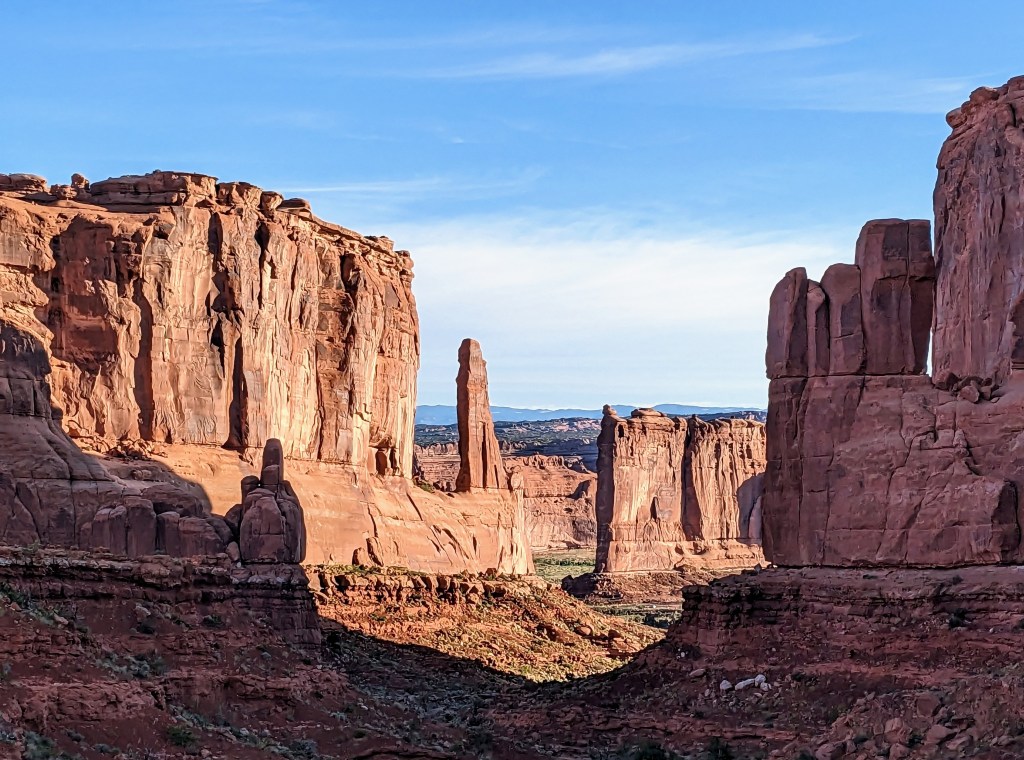
The sunset light flattered the rock formations. Cars lined the road heading to the distant formation of Delicate Arch thirteen miles into the park, and tourists parked their vehicles at the many carparks along the wayside to walk amongst the various giant rock formations.
The next morning, we rose to meet our 7am booking to enter the park. The light portrayed the rock formations in a slightly different way from the light of the evening before. We headed to the trail leading to the Delicate Arch. Even at that early hour, the carpark was almost full, and we secured a space before following the throng of tourists walking the trail heading to the arch. We scrambled across rocks and boulders in the piercing sunshine. I glanced at the climbers ahead of me and thought it would be impossible to reach where they were climbing, but with Alex’s encouragement found myself joining them. After a series of false summits, we found ourselves within sight of the arch. I looked at the abyss below and suddenly decided I would content myself with watching others pose for photographs in the arch rather than entering myself. A photographer was set facing a couple posing in the arches perilously close to the drop-off. Couples and children walked across the rocks in front of me towards the arches.
“I feel sick, Alex! I can’t go any further.”
I wondered why the others were walking so freely along the rocks in front of me, in full view of the yawning abyss.
“I promise I’ll hold your hand.”
“I don’t want to drag you down!”
“You won’t!”
I continued to worry I would drag Alex down with me in the abyss, but as usual, succumbed to his confidence. I gripped his hand and refused to gaze below me, carefully placing one foot in front of the other. Fellow tourists were taking turns to pose under the arch. A couple noticed us heading towards the arches.
“Shall we take your photo for you?” they offered.
Alex accepted and handed them his phone.
We continued to inch towards the arch. Finally we reached it and posed beneath it. I tried to assume a confident stance that I did not feel, all the while steeling myself away from glancing down at the abyss. I was naturally inclined to hold myself steady in a tense position, but instead decided to stretch my free arm outwards and pretend to exert confidence.

After standing there for long enough for the couple to take turns photographing us, we returned to the smooth large boulders ready for our trail down the mountain. As we walked down, I started reflecting on the contrast between how brave others seemed to feel as they freely walked over the boulders facing the abyss, and how timid I had felt.
“I think I have a fear of heights!” I announced to Alex. “I don’t know how I made it to retirement age without noticing this.”
There was one more trail we wanted to pursue, namely, the Devil’s Garden. As before, there were few empty places in the carpark. We finally edged into a free space, and then headed to the trail on our way to the Landscape Arch. This time I decided to read the information posted on the sign at the entrance. It read “Drop-offs on both sides challenge those with fear of heights”. I realised that there must be at least some people who shared my fear.
Arches National Park remains the most impressive national park I have ever visited. The force of nature had never felt so overwhelming. I felt small in this vast ancient landscape but privileged to be able to witness it.
Meredith Stephens is an applied linguist from South Australia. Her work has appeared in Transnational Literature, The Muse, The Font – A Literary Journal for Language Teachers, The Journal of Literature in Language Teaching, The Writers’ and Readers’ Magazine, Reading in a Foreign Language, and in chapters in anthologies published by Demeter Press, Canada.
PLEASE NOTE: ARTICLES CAN ONLY BE REPRODUCED IN OTHER SITES WITH DUE ACKNOWLEDGEMENT TO BORDERLESS JOURNAL
Click here to access the Borderless anthology, Monalisa No Longer Smiles
Click here to access Monalisa No Longer Smiles on Kindle Amazon International
 Borderless