Categories
Review

Is it a Story, a Novel, or a Memoir?

Book Review by Somdatta Mandal
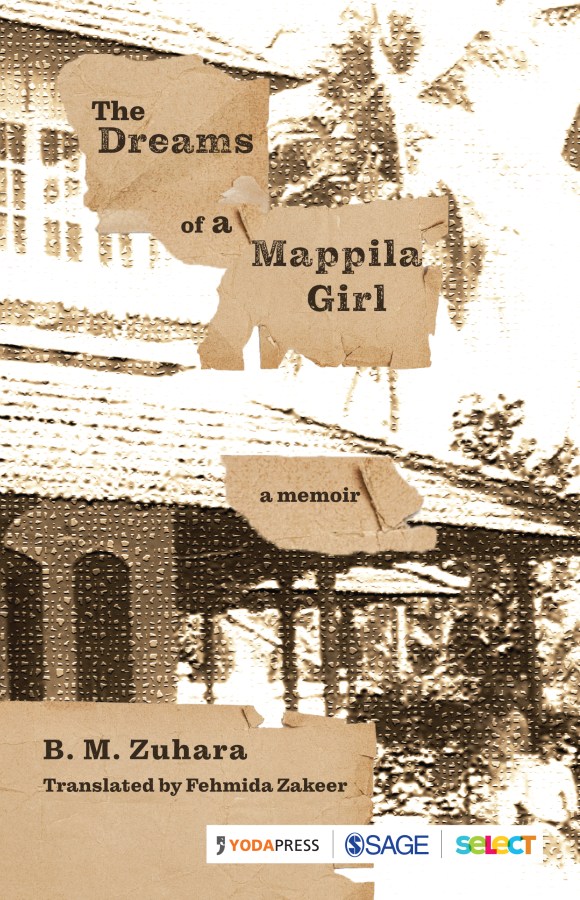
Title: The Dreams of a Mappilla Girl: A Memoir

Author: B.M. Zuhara

Translator: Fehmida Zakeer

Publisher: Yoda Press & Sage

 The terms ‘autobiography’ and ‘memoir’ are sometimes used interchangeably but the former is more fact-based and tends to be historical, whereas a ‘memoir,’ derived from the Latin word ‘memorandum’, is chiefly a personal, minute recollection of events, not necessarily intending to cover a person’s entire life, but often written from an epiphanic perspective, a significant event, or a particular aspect of the memoirist’s life. Thus, memoirs are essentially subjective and can never claim to be bio-bibliographical narrations. B.M. Zuhara, the writer and columnist from Kerala and a Sahitya Akademi awardee who writes in Malayalam, had penned The Dreams of a Mappila Girl: A Memoir (2015), which was recently translated by Fehmida Zakeer to English. It traces the childhood years of the writer, growing up in the village of Tikkodi in rural Kerala as a young Mappila girl from the Muslim community in post-Independence India.

For Zuhara, the things she remembers from her childhood act as vignettes which we readers string together to form a wholesome picture of the feudal system and social issues that were significant in her mind as she was growing up in the Malabar Muslim community in the 1950s. The tenth and youngest child of her parents living in a huge ancestral house called Kizhekke Maliakkal, Soora’s narrative gives us details of the things she remembered about the place till the point where at the age of thirteen she moves with her family to live in a rented house at Kohzikode to be admitted in a high school and begin a new chapter in her life. But even after she gets admitted into a prestigious school at Kozhikode, uncertainty looms large over Soora’s life as her mother stays adamant about not allowing her daughter to wear a skirt as a uniform as mandated by the school. In the ‘Preface’, Zuhara mentions that her childhood ancestral home does not exist anymore, but its memory is so strong that it appears as a character in many of her writings.

From the very beginning of the memoir, we form a clear picture in our minds about the location of the house, its detailed set-up filled with characters of the extended family including servants and cooks who lent a helping hand to run it smoothly. Like many other narratives, food plays a significant role in developing the ambience of Soora’s household. We get details of the elaborate tea ritual every evening, the eating of pathiris soaked in coconut milk, the aroma of fried plantains and coconut residue that filled the air, the details of the betel leaf chewed by her mother and grandmother with their decorative boxes and copper spittoons, the attempts to hatch chickens from eggs that were undertaken in the storeroom, the rearing of hens and ducks and goats by her brothers, the midday meals offered in their village school which their mother did not allow them to partake considering that it was solely meant for underprivileged children, and so on fill up a considerable portion of the narrative. Apart from visiting the village fair, Zuhara recounts the social mores of the society she lived in and offers glimpses into the secluded lives of Muslim girls and women who, despite obstacles, made the best of their circumstances and contributed positively to their communities.

One significant point about the memoir is the presence of Soora’s mother throughout the narrative and the strong influence that she had over her. While growing up, Soora often accused her of not looking after her well because she was an unwanted child. A religious woman who prayed five times a day, she not only tried to apply the teachings of the Quran to her life, but also shared her newly acquired knowledge with the people around her. Any deviation from the traditional lifestyle was, according to her, punishable as an offence by Allah. A pampered cry baby who would often burst into tears for the slightest reason, Soora from the very beginning was a sensitive child, who was often admonished for her interest in playing with boys and learn Kalari Payattu like her brothers, play with them in the rice fields, stand on the bridge and listen to the songs sung by the farmhands as they worked. She was also scolded for eavesdropping into conversations made by adults and like all traditional Muslim women, her mother wanted to get her married at a very young age. The real and perceived slights that Soora was subjected to, were primarily targeted at her physical appearance, specifically her dark complexion and her tendency to cling to her mother. But paradoxically for a seemingly timid child, Soora’s propensity to constantly question what is established as normative behaviour for a girl earns her the nickname of ‘Tarkakozhi’ – one who argues. What these contradictory impulses perhaps reveal was a girl who was overwhelmed by the big and small battles she must constantly fight, a life burdened by gendered expectations, yet a girl whose deepest desire was to be like Unniarcha, a mythological woman celebrated for her fearlessness whose ballads Soora grew up listening to.

But soon Soora realised that some of her dreams would never materialise because of her gender. Certain details, such as that of Soora’s grandmother passing away at the age of thirty when Soora’s mother was fifteen; or that two of Soora’s sisters were married even before she was born, reveal the dark reality of women’s lives in those times. In the ‘Preface’ Zuhara categorically states:

“I grew up at a time when Muslim girls did not have the freedom to dream. When I started writing, I had to face a lot of criticism and threats, and I found many limitations imposed on me. Until then, only men had recorded the inner lives of Muslim women. Even though I could not comfort my sisters physically, I have tried through my writings to give them a voice by speaking about their dreams, chronicling the obstacles and difficulties faced by them, and providing a perspective from the point of view of women. In the process, I have tried to define a space for myself in the literary landscape.”

In her ‘Preface’, the author also wonders if her work is a “story, or a novel, or a memoir.” Her words became the wings upon which forgotten, and deeply bruised memories travelled out into the world. She recreated the stories of her dear and near ones around whom she had spent her childhood. She coloured her childhood experiences with her imagination and penned them all down. Even though all the names are of actual people, if she is asked if the stories are real or imagined, she can only say that they are both. So, she leaves it to her readers who have encouraged and supported her writing journey to decide.

Here one needs to add a few words about the translation. The translator Fehmida Zakeer also hails from Kerala and being a Muslim herself, her effort to make this book read as smoothly as the original Malayalam text is laudable. There is no italicisation of non-English words throughout the text and the list of kinship terms at the beginning, along with the elaborate glossary at the end, makes the book as reader friendly as possible while trying to retain the flavour of the original. The only occasional problem this reviewer faced while reading the text was that too many authentic words and salutary terms for relationships of even a single individual often turned confusing for a lay reader like her who had to pause and recollect who the actual person referred to was. For the protagonist, mention of Sora, Soora, Sooramol, and Zuhura is understandable, but addressing members of the extended family and others residing in the neigbhourhood in different salutations sometimes becomes difficult for people not acquainted with the South Indian Malayali culture. However, despite such a minor lapse, the book is engrossing and offers a wonderful slice of life of the rural and semi-urban Muslim community in Kerala, of its customs and lifestyle which otherwise would remain unknown to us in a muti-cultural and multilingual country like India.

.

Click here to read an excerpt from The Dreams of Mappila Girl: A Memoir

.

Somdatta Mandal, critic, translator, and reviewer, is a former Professor of English at Visva-Bharati, Santiniketan.

.

PLEASE NOTE: ARTICLES CAN ONLY BE REPRODUCED IN OTHER SITES WITH DUE ACKNOWLEDGEMENT TO BORDERLESS JOURNAL

Categories
Excerpt

The Dreams of a Mappila Girl

Title: The Dreams of a Mappila Girl: A Memoir

Author: B. M. Zuhara Translator: Fehmida Zakeer

Publisher: Jointly published by SAGE Publications and Yoda Press under the Yoda-SAGE Select imprint

The kitchen was a woman’s world in those days. Work started there soon after the morning prayers. Each morning, Ummambiumma and Ummatha had the job of grinding parboiled rice that had been soaked in hot water. The clacking of the grinding stone resounded through the nalapad and the central hall during the early hours of the day. A half wall divided the big kitchen into two sections. On the ground in the main section, facing east, were five firewood stoves. Squatting on the floor, Kunhamina got these stoves burning every morning. Three grinding stones, one large and two small, were placed on a ledge built against the half wall. Ummambiumma called the big grinding stone Bombayiammi, after the city from where Valippa brought it. 

‘The master brought this ammi from Bombay especially for grinding the rice for pathiri. If the consistency of the dough is not correct, the pathiri will not be good. The pathiri we make here is famous,’ said Ummambiumma, her tone full of the pride she took in her work.

The ammis operated from morning until afternoon. Once the rice for the pathiris had been ground, the coconut for the curries was ground next, then the items required for making lunch. Ummambiumma and Ummatha kept up a continuous chatter as they worked on the ammis. Kunhamina, seated on the ground and attending to the pots on the stove, joined in their conversation every now and again.

‘If you keep talking like this, your mouths will become dry,’ Kadeesumma who supervised the work in the kitchen would warn. Mostly she went unheeded. ‘Talking helps us to do our work quickly, Kadeestha,’ Ummatha would say.

Since we cultivated rice, we always had either puttu or pathiri made with unpolished red rice for breakfast. At night, it was always pathiri. The curries were rotated on a daily basis—onion, dried fish, drumstick leaves, egg curry. The onion curry was prepared by frying peeled and diced shallots, adding turmeric and chilli powder, and finally mixing in coconut milk. When drumstick leaves were substituted for the shallots, it became drumstick leaves curry; when dried fish was added to the basic onion curry, it became dried fish curry; adding boiled eggs to the onion curry converted it into egg curry. A change in the menu happened only on special occasions or when we had visitors. When the children grumbled about the unvarying fare, omelettes or bulls-eye eggs appeared on the table. Sometimes, they gave us coconut mixed with sugar, a favourite with me.

For breakfast, the side dish for the puttu was supposed to be fish in red gravy. But we didn’t get fish early enough on most days, and so the children were served bananas and sugar with their puttu. The puttu, which was made by steaming rice flour layered with liberal quantities of shredded coconut in hollow logs of bamboo, was delicious enough to eat without any accompaniments. 

In the mornings, the kitchen was a cacophony of sounds. After the morning prayers, Valippa and Uppa were each served an egg along with their morning tea—half boiled for Valippa and hard boiled for Uppa. After he was diagnosed with diabetes, Valippa stopped eating rice pathiris, switching to wheat dosas and oats boiled in milk for his breakfast. The preparation of wheat dosas involved soaking the wheat grains in water the previous night and grinding them into a fine batter in the morning. Valippa liked tomato roast with his wheat dosas. Uppa wanted egg roast for his breakfast, whether it was pathiri or puttu. Egg roast was made by frying onions in coconut oil, adding turmeric, chilli and cumin powders, and finally breaking an egg over the mixture. When we had guests, egg chops replaced the egg roast. Instead of breaking an egg into the onion mixture, hard-boiled eggs were added into it and topped with a layer of finely sliced onions and thin round slices of golden-fried potatoes. Egg chops were Umma’s speciality. She also prepared Valippa’s oats.

Umma supervised the making of breakfast. Ummama avoided the morning rush in the kitchen and came in to oversee the preparations for lunch. When the servants heard the tapping of Umma’s medhiyadi, they would turn down the volume of their chatter.

‘Kunhiammayi is coming. Have you boiled the milk for the oats, Kunhamina?’ Kadeesumma, sitting on the wooden box peeling onions, would ask.

‘I’ve boiled the milk and kept the pan ready.’

Kunhamina would wait with the washed and dried pan. Umma came into the kitchen holding a tin of oats. On the tin was a picture of a man with a white hat that never failed to intrigue me. The tin of oats was bought specially for us at Jambu Stores in Kozhikode. Umma scooped two spoons of oats into the pan placed on the table in the kitchen. She added milk and handed it to Kunhamina who boiled the mixture, cooled it, poured it into a glass tumbler and then covered it with a lid. Meanwhile, Umma sat on a low stool by the stove on the ground. She made the egg roast for Uppa, intermittently giving instructions to Kunhamina who had started preparing the wheat dosas for Valippa.

‘Drizzle some ghee and turn the dosa, Kunhamina. Don’t let it burn.’

Like a shadow, I would stand behind Umma.

‘Move aside, Soora. Don’t follow me like a tail.’ Irritated, she pushed me aside and I started crying.

‘Dear girl, don’t cry, I’ll give you a dosa secretly,’ Kunhamina whispered. I stopped crying.

Assan came into the kitchen. ‘Is the master’s breakfast ready?’

Umma placed the wheat dosas, tomato roast and oats on a tray for Valippa. On another tray, she placed Uppa’s food and asked, ‘Have you laid the supra on the thinna?’

Assan confirmed that he had laid the mat and went to Valippa’s room with his breakfast.

Uppa and the older boys had their meals on the thinna beneath the front staircase. Mats were laid out on the platform before serving the food. Valippa joined them on the thinna for lunch.

About the Book: As a young Muslim girl growing up in the 1950s in a small South Indian village, B. M. Zuhara had simple dreams—to go to the newly opened ‘talkies’ in town and watch a movie, play with her brothers in the rice fields, learn the ancient martial art of Kalari Payatu with them, stand on the bridge and listen to the songs sung by the farmhands as they worked. But she soon realised that even being the pampered, youngest child of her family would not help her in realising some of her dreams because of her gender. Set at the time when Independent India was embracing its new identity as a free nation, this book provides a wide lens for the reader to view life in a semi-rural Kerala village. Zuhara recounts the social mores of the society she lived in and offers glimpses into the secluded lives of Muslim girls and women who, despite obstacles, made the best of their circumstances and contributed positively to their communities.

About the Author: B. M. Zuhara is a Malayalam writer hailing from Thikkodi near Kozhikode. She has written novels and short stories and has been a columnist in regional newspapers. She is the first Muslim woman writer from Kerala. Her new novel titled Pennungal (Women) is forthcoming from Chintha Publications. She won the Kerala Sahitya Akademi Award for her contribution to Malayalam literature in 2008 and has also been a recipient of awards such as Lalithambika Antharjanam Memorial Special Award, Unnimoy Memorial Award and the K. Balakrishanan Smaraka Award. Her novel Iruttu was translated to Arabic recently as part of the Qatar Ministry Cultural Exchange and was launched at the Doha International Book Fair in January 2020. She has also translated Tayeb Salih’s Wedding of Zein and Naguib Mahfouz’s Palace Walkinto Malayalam. The English translation of her novella Nilavu (moonlight) was published by Oxford University Press in the anthology titled Five Novellas. The same novella was translated into Arabic and published as Zooul Khamar while Mozhi (Talaq), another novel of hers, was translated into Arabic and published by IQRani Publishers, UAE.

About the Translator: Fehmida Zakeer is a writer hailing from Kerala. Her work has appeared in Indian Quarterly, Rose and Thorn Journal, Out of Print Magazine, Asian Cha, The Bangalore Review, Quarterly Literary Review Singapore, Muse India and elsewhere. Stories written by her have come out in print anthologies such as Pangea: An Anthology of Stories from Around the World (Thames River Press, UK), Ripples: Short Stories by Indian Women Writers (APK Publishers, India), Happy Birthday to Me (Dahlia Publishing, UK) and others. A story of hers placed first in the Himal South-Asian short story competition 2013 and another was chosen by the National Library Board of Singapore for the 2013 edition of their annual READ Singapore anthology. She was twice on the honourable mentions list of the Binnacle Ultra Short competition (University of Maine at Machias). A story of hers was shortlisted in the DNA-Out of Print short story competition, 2014 and another one was published in the Out of Print magazine issue focusing on Sexual and Gender Violence. An anthology of stories, titled Keeper of Secrets, is forthcoming from Dhauli Books.

(Excerpted from The Dreams of a Mappila Girl: A Memoir by B. M. Zuhara; translated by Fehmida Zakeer. Jointly published by SAGE Publications and Yoda Press under the Yoda-SAGE Select imprint.2022, 228 pages, Paperback, Rs. 550, ISBN: (978-93-5479-280-9), YODA SAGE Select.

.

PLEASE NOTE: ARTICLES CAN ONLY BE REPRODUCED IN OTHER SITES WITH DUE ACKNOWLEDGEMENT TO BORDERLESS JOURNAL