Categories
Poetry

Poetry by Daniel Gene Barlekamp

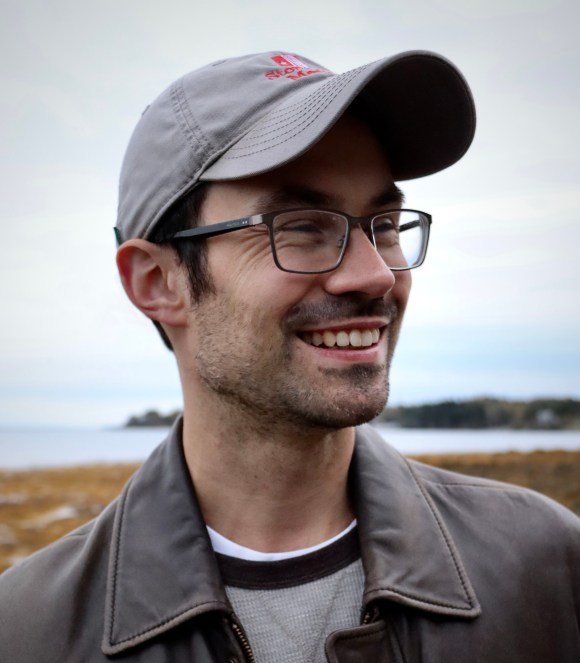
Daniel Gene Barlekamp
TWO QUESTIONS AND AN ANSWER


i

“Which cloud is God on?”
the boy asks.

“I don’t know,”
his mother says,
fiddling with the radio.

Outside the window,
a cemetery rolls by.

ii

“What happens when you die?”
the boy asks.

“The worms eat you,”
his mother says.

His father joins in,
singing:
“The worms crawl in,
the worms crawl out…”

Inside the boy’s chest
blooms a fear
that wasn’t there
before.


DOWNTOWN, FUNERAL HOME, 6PM

There’s a wake tonight.
About now the few mourners
will be dusting off the black dresses and navy suits
they save for these occasions,
wondering how quickly they’ll be able to leave
without being rude.
Meanwhile, I’m digging through a shoe box
looking for a photo to prop
on the easel
by the coffin.

Nothing jumps out.

He had no Golden 50th,
no Viking Cruise,
no banquet with veal parm and chardonnay.
So I’ll stand around with my hands in my pockets
and watch the headlights of the passing cars
pierce the lace curtains,
unsure whether to smile or look sad
while the guests mingle in drab clusters
trying not to glance toward the front of the room
as they edge their way to the door
and out into the night
where they’ll sigh with relief, order pizzas,
and drive home to binge Netflix.


CAVERNOUS GLOOM

water echoes—
quiet corridors
of cavernous gloom


EARLY BIRD

I used to stay up late
looking for grit, for neon, for blood
until you brought me to the hour
when the water is at its bluest,
taught me the difference
between the flicker and the woodpecker,
showed me
how the leaves are greenest on a cloudy day,
and now I look for the light
as it leaches into a lifeless sky,
taking your hand
and welcoming the lessons of the day.


AFTER THE PARTY

For me, the real party starts after everyone has gone,
after we’ve washed down the pizza and sheet cake with cheap decaf
and hauled out the black bag of paper plates, hats, and napkins into the February night
and finally settled in the quiet dark of your room
to listen to Johnny Cash
and admire the blinking lights of Boston in the distance
and promise each other to visit a lighthouse
once the spring sun melts the icy crust of Maine,
a promise that keeps me warm as you charge into your third year with blind joy
and wisdom far greater than mine.

Daniel Gene Barlekamp writes poetry, fiction, and audio drama for adults and young readers. He lives with his wife and son in Massachusetts, where he practices immigration law. Website: https://dgbarlekamp.com/.

.

PLEASE NOTE: ARTICLES CAN ONLY BE REPRODUCED IN OTHER SITES WITH DUE ACKNOWLEDGEMENT TO BORDERLESS JOURNAL

Click here to access the Borderless anthology, Monalisa No Longer Smiles

Click here to access Monalisa No Longer Smiles on Kindle Amazon International
Categories
Poetry

A Sailor’s Sea-faring Song

By Paul Mirabile

From Public Domain

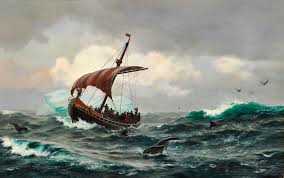
Red-bearded hearty sailors take up their oars,

Singing in high melodious harmony —

Coarse, vigorous staves offered in overt sympathy

To the Sea while their drakkar[1] quits the mossy shores.

.

Are those sea-faring Vikings afraid of stormy waters,

Of the lurking dangers beneath the briny black ?

With heaves and hoes never do their muscles slack;

Those long-haired raiders without homes, without borders.

.

There are no seas that welcome comfort,

Nor warrior hearts that shun adventure.

Bold are the Viking oarsmen of solitary investiture

For from the bottomless Deep their hearts are wrought.

.

.

[1]        Viking boat.

Paul Mirabile is a retired professor of philology now living in France. He has published mostly academic works centred on philology, history, pedagogy and religion. He has also published stories of his travels throughout Asia, where he spent thirty years.

.

PLEASE NOTE: ARTICLES CAN ONLY BE REPRODUCED IN OTHER SITES WITH DUE ACKNOWLEDGEMENT TO BORDERLESS JOURNAL

Click here to access the Borderless anthology, Monalisa No Longer Smiles

Click here to access Monalisa No Longer Smiles on Kindle Amazon International
Categories
Poets, Poetry & Rhys Hughes

Dylan on Worm’s Head

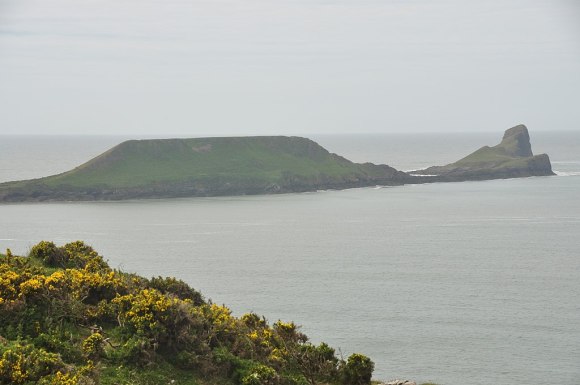
Worm’s Head. Photo Courtesy: Rhys Hughes

When I learned that the poet Dylan Thomas had spent an uncomfortable night stranded on a headland called Worm’s Head I wondered what thoughts, if any, had gone through his mind at the time. The headland in question is the furthest westerly point of the Gower Peninsula.

I know Gower well. I have often hiked the coastal path that winds around this spectacular wedge of land that juts into the sea. I have climbed on Worm’s Head, though I have never been marooned on it. The headland consists of three small islands connected by causeways.

The main causeway linking the formation with the mainland is covered when the tide comes in. In fact, it is only accessible on foot for two and a half hours either side of low tide. This means it is very easy to become stranded on the headland, to be alone on the Worm.

It is perilous to attempt to swim back to shore. Many people have come to grief in the endeavour. Official advice is to remain on the Worm until the tide turns. That is what Dylan did. He described the headland afterwards as “the very promontory of depression” but before his unsettling experience as a temporary castaway, he was fascinated by its contours, the air of mystery surrounding it, a feeling almost of some ancient magic.

The headland has a distinctive shape, rearing out of the sea like the dragon it is named after, for ‘Worm’ originally was ‘Wurm’, a Viking word for dragon, and has nothing to do with wriggly soil-dwelling terrestrial invertebrates. It is a fossilised monster, a petrified myth, an undulating geological feature that seems poised to dive down into the depths.

Dylan scrambled over the rocks with a book and a bag of food, and when he reached the ultimate point of the Worm, the head itself, he made the classic mistake of falling asleep in the sun. When he was awakened by chills, he saw that it was sunset, the tide had come on, he was cut off. And so, he huddled on the coarse grass, frightened of “the things I am ashamed to be frightened of,” and waiting for the tide to go back out.

What things scared him on that little adventure? The ghosts of his fraught imagination? I know from experience how our senses can deceive us when we are in similar situations. I have bivouacked on enough beaches and islands to understand that the slap of the sea on reefs, the rolling of submerged pebbles, the cries of nightbirds, the breath of the breeze, can sound like the footsteps of goblins, demons, imps, the whisperings of phantoms, the groanings of ghouls. And so I wrote a poem for Dylan and the Worm, a poem in the form of three islands, each linked by narrow causeways…

Dylan

on the tiny hill

at the end of the causeway,

stranded by high tide and waiting

for it to recede again so he might escape

back to normality. But there’s no

normality in the whole land,

only the devilish

night

&

those

gusts of icy wind

that bite the exposed flesh

of wrists and throat that poke out

of cardigan warmth. Next time he’ll check

the tide times and plan a crossing

with more care, he’ll boast

appropriately and

laugh

a

brisk

laugh that’s more

like a dragon’s bite in the

way it sounds, a legendary snarl,

but now his knees are drawn up and fears

gnaw gently on his spirit’s bones,

a man alone, far from home,

musing on a stone

skull.

Worm. Photo Courtesy: Rhys Hughes

Rhys Hughes has lived in many countries. He graduated as an engineer but currently works as a tutor of mathematics. Since his first book was published in 1995 he has had fifty other books published and his work has been translated into ten languages.

.

PLEASE NOTE: ARTICLES CAN ONLY BE REPRODUCED IN OTHER SITES WITH DUE ACKNOWLEDGEMENT TO BORDERLESS JOURNAL

Click here to access the Borderless anthology, Monalisa No Longer Smiles

Click here to access Monalisa No Longer Smiles on Amazon International