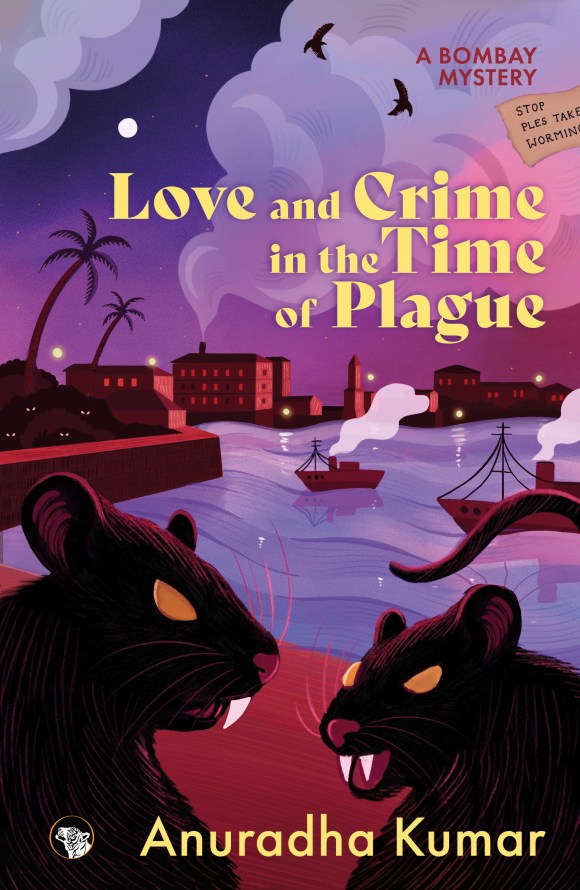
Title: Love and Crime in the Time of Plague: A Bombay Mystery
Author: Anuradha Kumar
Publisher: Speaking Tiger Books
Maya is Discomfited
What shall we talk about?’ Maya asked in her irrepressible way, a lilt in her voice. That afternoon she was out cycling with Henry when the rain came down, turning heavy in moments. It was August and the middle of the monsoon season.
‘Tell me more about what you found. More about those…mysterious sketches. You have two minutes,’ Henry rolled his eyes playfully as he pulled out his watch.
Dark, thick clouds loomed over the sea and gathered by the palm trees and rocks lining the shore. Leaving their bicycles against the tall, old Ashoka tree, they had run, like many times before, toward the old Prong’s lighthouse to their right. Its white walls were damp-streaked and moss-stained, and the grey rocks huddled by it were dotted by foamy flecks. The sea swirled in noisily with an insistent rhythm.
They stood on the low stoop, looking out at the gravestones across the road. The door behind, blue paint flaking in places, creaked in the wind. The room in the old lighthouse always smelt musty. It was sparsely furnished with wooden chairs, a table, and a cupboard. Faded red curtains fluttered on the windows. A part of the roof near the fireplace leaked, and rainwater often dripped down into a large wooden tub. Soon, Henry always joked, it would fill up with fish. The keeper, an old Eurasian, waved to them from an upstairs window, his beard flailing through its rusting iron bars.
They were right at the tip of the city on the island of Colaba, and the new bicycles—shipped to Henry only that summer—were safe to ride on, with their evenly spaced wheels, pneumatic tyres, and a chain system. Henry was pleased with these new ‘Rover’ cycles, made by a company in Chicago, Henry’s home town. The wind left a mist on their faces, the gulls were noisy on the rafters, and they waited for the rain to ease.
The Causeway, its white stones grey in the wan light, stretched to the mainland. Built some fifty years ago, it now connected what had been the separate islands of Colaba, and the Old Woman’s Island to the bigger island of Bombay. If they craned their necks and looked to the left, through the palm trees, the stone walls of the old fort were clearly visible.
Henry took his cap off, twirled it with his fingers then placed it back on his head. Maya scraped the soles of her muddy boots against the stoop, and leaned against the door. They heard a sharp clear call, two eagles were majestically scouring the skies, their wings spotted white, and lighting up when the sun momentarily breathed through the clouds.
‘You’ve been thinking about the sketches, haven’t you?’
Maya nodded, her eyes the colours of the stormy sea. The eagles, she was thinking, maybe they were the White-bellied Sea Eagles familiar to these parts.
‘Tell me about it,’ Henry encouraged, stealing a look upstairs, and noting the open window. The keeper was probably all ears. They were always the subject of gossip, and Henry ruefully accepted this, always with a turmoil in his heart. He enjoyed Maya’s company and tried not to think too much of the future; most times he failed. Sometimes he thought Maya felt the same way.
~
Maya had found the sketches only a fortnight ago. In a room, dark, mysterious and unused, at the very back of the grey-stone ‘doctors’ house’ where Maya lived. She had wanted to use the room as a study. The doctors’ house stood on a narrow lane leading off the Colaba Causeway, on the sliver of land where Bombay stretched into the sea in a crab-like way. One walked through the house’s main hallway, and the study appeared after a series of small steps. Next to the study was the covered courtyard and on the left, its lone window faced the garden, with its wooden latticed fence, the bougainvillea and oleander creepers, and tall palm trees. Farther beyond, closer to the sea, lay the asylum and a part of the lighthouse, always visible from the upper floor windows of the doctors’ house. Sounds of the horse-drawn tramcars, the bells of the Afghan Church, the train coming in every morning and in the late afternoon, and the constant rolling of the sea, shaped a pleasing backdrop to everyday life in the house.
Once owned by Hormuzji Dorabji, a merchant whose business interests spread across Bombay, Surat, East Africa and Natal, the doctor Edith Pechey had first rented it when she came to Bombay to manage the city’s first women’s hospital. Soon there were two of them, when Charlotte Ellaby responded to Edith’s invitation, and that was how the bungalow got its name. Then about two years ago, though Maya felt it was much longer, the doctors’ house had a new resident when Maya joined them, a few weeks after reaching Bombay as part of a travelling theatre troupe from Lahore. The troupe soon moved on to another city, but Maya had stayed back. For a while only, she had thought at first, but months had flown by and the ‘doctors’ house’ was her home now. Edith had moved out when she married Herbert Phipson, an American businessman with offices in Bombay, and Maya still stayed on with Charlotte. Finding her feet in a city, warm and lively. Finding her heart too, but with that Maya wanted to take more time.
~
For Maya, the string-bound folder with the sketches was an unexpected find. It lay in the old wooden almirah, lost among dusty old account ledgers, old books, in old Pali and Persian, and crinkled maps brown with age.
‘They look so old, and so skilfully done.’ Henry still remembered the awed expression on Maya’s face the afternoon she told Charlotte and him about it. They had shared Maya’s delight, looking at the sketches—lifelike depictions of birds, drawn mainly in black ink, with distinct colours on some.
(Excerpted from Love and Crime in the Time of Plague: A Bombay Mystery by Anuradha Kumar. Published by Speaking Tiger Books, 2025)
ABOUT THE BOOK
It is 1896. A ship docks in Bombay Harbour, and as the workers rush to unload the cargo, a scream rings out. A large black rat, frothing at the mouth, has bitten one of the men.
Within weeks, a miasma of fear engulfs the city as ship-borne rats overrun its nooks and crannies, and more and more of its inhabitants fall sick—and die. Dr Acacio Viegas is the first to ring the alarm—it is the plague. The only way to control it is to sanitize the city’s slums, clean its drains, report any fever, and stay at home. The British Administration embarks on these measures on a war footing—until warning notes begin to turn up at Doctors’ House, where Maya Barton lives with Dr Charlotte Ellaby, and at the Women’s and Children’s Hospital—notes that threaten those who are ‘interfering’ with people’s religion and customs with dire consequences—all signed by the ‘Native Society’.
Maya and her friend Henry Baker, the American trade counsel, are soon hot on the trail of the Society, which leads them to the formidable Rangnekar Bhau, the Society’s founder, and its Secretary, the treacherous Satarkar, who hates everything new and ‘modern’, whether the British and the brown sahibs, and their so-called anti-plague drive, or women like Maya, who think too much of themselves.
As Maya and Henry unravel the mystery, they draw closer to each other and to what could be a future together. And Maya learns more about Reverend Barton, who could have been her father, and the Kashmiri woman who might have been her mother.
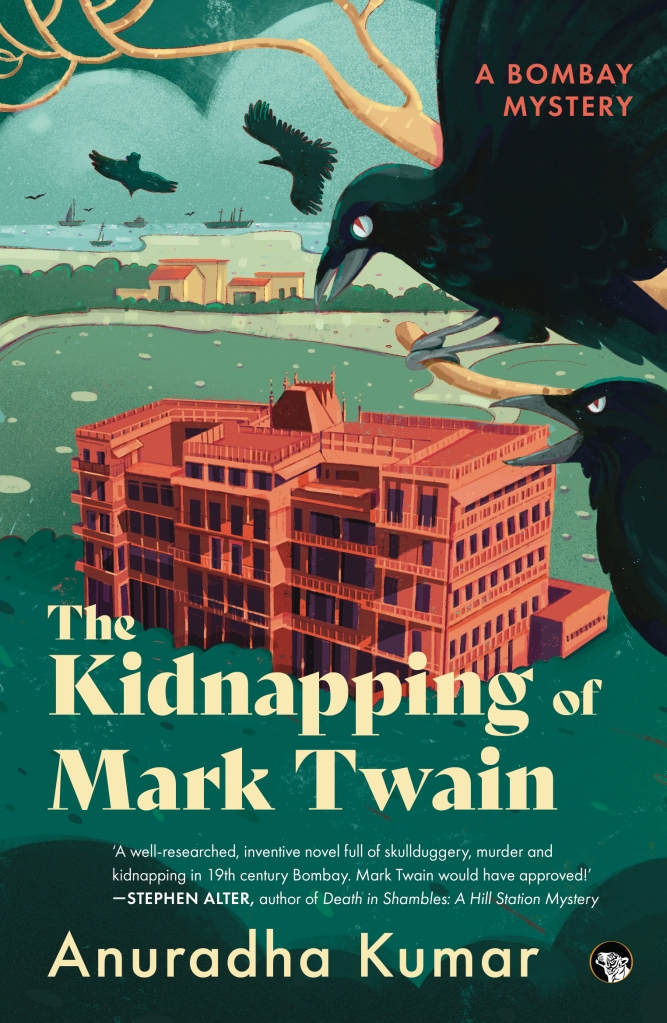
Anuradha Kumar once again uses her talent for recreating a period setting and engaging characters to brilliant effect in this sequel to the acclaimed The Kidnapping of Mark Twain, her first Bombay Mystery.
ABOUT THE AUTHOR
Anuradha Kumar has worked for the Economic & Political Weekly. She has an MFA in Writing from the Vermont College of Fine Arts (VCFA). Her stories have won awards from the Commonwealth Foundation, UK, and The Little Magazine, India. She writes regularly for Scroll.in. Her stories and essays have appeared in publications like Fiftytwo.in, The India Forum, The Missouri Review, among others. Two of her essays received notable mention in ‘Best American Essays’ editions of 2023 and 2024. Her essay collection, The Sound of Lost Memories, was recently a finalist for the Gournay Prize (University of Iowa) and will be published (2027) by Cornerstone Press (University of Wisconsin, Stevens-Point).
PLEASE NOTE: ARTICLES CAN ONLY BE REPRODUCED IN OTHER SITES WITH DUE ACKNOWLEDGEMENT TO BORDERLESS JOURNAL
 Borderless