Categories
Excerpt

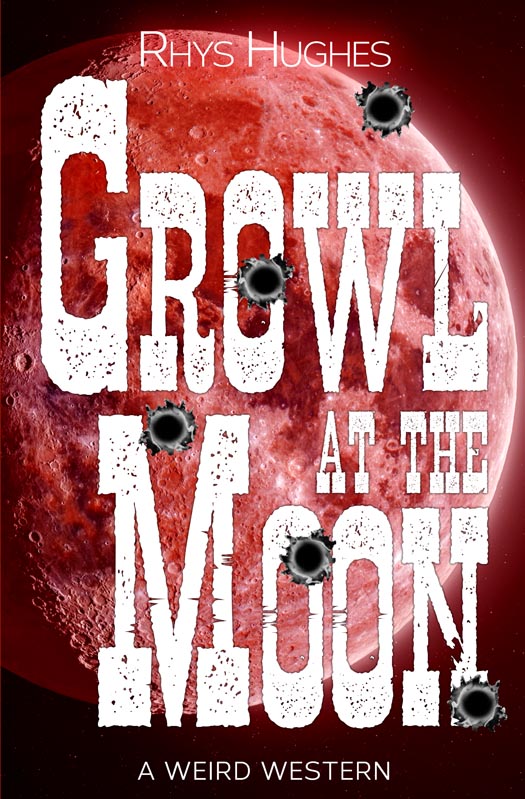
Growl at the Moon by Rhys Hughes

Title: Growl at the Moon, a Weird Western

Author: Rhys Hughes

Publisher: Telos Publishing Ltd

1.

She rode to the crest of the hillock and looked down. The other rider was a pale shadow on the trail below and in the moonlight his shadow was even paler than he was. That was because of the mica in the rocks which gleamed, glittered and shone and turned the landscape into something ethereal and strange. With a low snarl, she spurred her horse forwards.

She zigzagged down the slope and still the other rider didn’t hear her. Was he engrossed in his private thoughts? That must be the answer. Her Winchester was cradled in her arms and her low snarl turned into a stealthy laugh. Her prey seemed oddly incautious, but this was to her advantage. At the base of the slope, she spurred her mount to a fast canter.

The other rider finally became aware that something was behind him. As he turned in his saddle, she raised the rifle and aimed at his face. She slowed in order to be sure of hitting him square.

“Hey, what’s this?” he cried in astonishment.

His head, which was that of a giant rabbit, bobbed up and down, his nose twitched and his long ears undulated.

“Howdy, pard,” she said, and then she added, “I guess you think I’m just a bandit, some unwashed desperado who wants your money. But that’s not true at all. My name is Jalamity Kane and I’m hunting all the men who are part animal. I know what it means that you’re a man-rabbit, it means that you studied with a shaman, one of the Mojave wizards.”

“Well, yes I did,” answered the other rider.

“I make the same speech every time I find one of you people. When I was younger and full of hope and desire, I also sought out a shaman to study with. I found one. Seven years in a subterranean cavern, putting myself through horrid exercises, expanding my mind! But it didn’t work, I didn’t acquire the power. I failed and my soul became bitter. It’s not nice to be bitter and that’s especially true when I look upon your sweet little visage. Gonna blow a hole right through it. Say your final prayers, bunny boy!”

The other rider raised a paw to remonstrate with her but it was too late. Her finger squeezed the trigger and the canyon echoed with the shot. He slumped in the saddle and his horse bolted. He didn’t fall off but remained in place, his feet held by the stirrups. Jalamity watched him vanish into the crystalline darkness. She said to herself, “I’ll destroy all of you. I have no interest in money. I have no interest in anything, only in slaying every cat-man, owl-man, worm-man and cougar-man in the land. You’ll see!”

It was her mission in life. A cruel and futile mission, but a mission all the same, and a gal’s gotta have a mission.

2.

Jalamity was in position to ambush her next victim. She squatted in the shallow pit she had dug. The dry plain extended all around here, as flat as a tune played on a badly-maintained piano in a rotten old saloon somewhere in the worst kind of decayed ghost town where the railroad was supposed to come but didn’t. She had constructed her own cover because there was no natural cover available in the geography of the bland landscape.

The rider was a puff of dust at the limits of her vision. It was early evening and he was evidently trying to cover as many miles as possible before night fell and she chuckled at the malevolent thought that he was hurrying to his doom, a circumstance he would soon be aware of. The Winchester was firm in his grasp and she chewed a stick of licorice root.

This wasn’t European licorice or Glycyrrhiza glabra which also grew in a few places in a few states, having been brought over by settlers, but the harsher Glycyrrhiza lepidota that the Zuni people had liked to chomp as a medicine. Not that Jalamity needed a cure for anything. She just liked to chew on something at the end of a day and she hated tobacco.

She waited patiently as the cloud of beige dust that was the rider expanded in size and took on more of a familiar shape. His horse was tiring a little and his pace was slowing. As he approached, she saw that he wore a hood. All of these fools liked to cover their telltale faces!

She stood up straight, rising out of the pit like a snake about to strike, and strike she would, by which we mean attack and not cease working because of dissatisfaction with pay. She cared nothing for wealth. No ordinary bandit, this Jalamity, half woman and half man, the product of seven years’ meditation that hadn’t worked out the way she’d wanted.

“Hey, what’s this?” he cried in astonishment.

His head, which was that of a giant squirrel, bobbed up and down, his nose twitched and his jaws chattered.

“Howdy, pard,” she said, and then she added, “I guess you think I’m just a bandit, some unwashed desperado who wants your money. But that’s not true at all. My name is Jalamity Kane and I’m hunting all the men who are part animal. I know what it means that you’re a man-squirrel, it means that you studied with a shaman, one of the Mojave wizards.”

It was the same speech, or nearly the same speech as before. It was a short speech but one she had made dozens of times. Very few people ever got to hear it more than once, apart from herself.

An occasional victim escaped her, but it was such a rare event that in terms of statistics it counted for nothing at all.

Jalamity was now reaching the end of the speech. “Gonna blow a hole right through ya. Say goodbye, squirrel boy!”

The other rider raised a paw to remonstrate with her but it was too late. Her finger squeezed the trigger and the plains absorbed the sound of the shot. First he slumped in the saddle and then he fell off. His horse didn’t bolt but remained where it was, looking confused. One day, Jalamity knew, she would meet a man who was half horse. What would the horse he rode on do then? Would he regard Jamality as an enemy of all horses and try to kick her? She had no idea. It was a riddle that only the future could solve.

Most horses didn’t care about their riders but that one might be different. It was better to wait to find out the answer for sure. Speculation was a waste of her time. She climbed out of the pit, moved to the side, leaned over and reached out with her hands and jerked her wrists.

An unseen blanket came up in her fingers. Her horse was beneath it, lying on its side, and now it got clumsily to its hooves. She had covered it with a sheet and covered the sheet with sand and gravel and grit so that it resembled only the smallest of humps in the almost featureless plain. There had been nowhere else to hide it. She could have dug a pit, as she had for herself, but that would have been very hard work. Alternatively, she could have covered herself with a sheet too, but that would have restricted her visibility. Everything had worked out for the best. The squirrel-man was dead.

And now she had his horse as well. She could maybe use his horse as some part of a trap for her next victim. Killing these beasts was her mission in life. A cruel and futile mission, as we already have been told, but yes, a mission all the same, and a gal’s gotta have a mission.

About the Book

Bill Bones was a normal human being until he studied under a Mojave Shaman and was transformed into a man-dog called The Growl. Now, driven by a keen sense of justice, The Growl is on the hunt for the villains who killed his boss, newspaperman Ridley Smart … and he’ll stop at nothing!

Crossing the deserts and forests of the American continent, The Growl searches for the men he must kill. Along the way he meets more beast-men, more magicians, the avenger Jalamity Kane who is seeking to rid the world of the beast menace, and other dangerous characters, from the artificial to the wild, from the robotic to the demonic.

In the deft hands of Rhys Hughes, this inventive tale becomes a masterpiece of twists and turns … exploring and questioning our definitions of humanity, discovering the very meaning of what life and reality might be.

About the Author

Rhys Hughes is a writer of Fantastika and Speculative Fiction.

His earliest surviving short story dates from 1989, and since that time he has embarked on an ambitious project of writing a story cycle consisting of exactly 1000 linked tales. Recently, he decided to give this cycle the overall name of PANDORA’S BLUFF. The reference is to the box of troubles in the old myth. Each tale is a trouble, but hope can be found within them all.

His favourite fiction writers are Italo Calvino, Stanislaw Lem, Boris Vian, Flann O’Brien, Alasdair Gray and Donald Barthelme, all of whom have a well-developed sense of irony and a powerful imagination. He particularly enjoys literature that combines humour with seriousness, and that fuses the emotional with the intellectual, the profound with the light-hearted, the spontaneous with the precise.

His first book was published in 1995 and sold slowly but it seemed to strike a chord with some people. His subsequent books sold more strongly as my reputation gradually increased. He is regarded as a “cult author” by some and though pleased with that description, he obviously wants to reach out to a wider audience!

PLEASE NOTE: ARTICLES CAN ONLY BE REPRODUCED IN OTHER SITES WITH DUE ACKNOWLEDGEMENT TO BORDERLESS JOURNAL

Click here to access the Borderless anthology, Monalisa No Longer Smiles

Click here to access Monalisa No Longer Smiles on Amazon International
Categories
Review

Nineteenth-century Bengal and Tales of Early Magic Realism

Book Review by Basudhara Roy

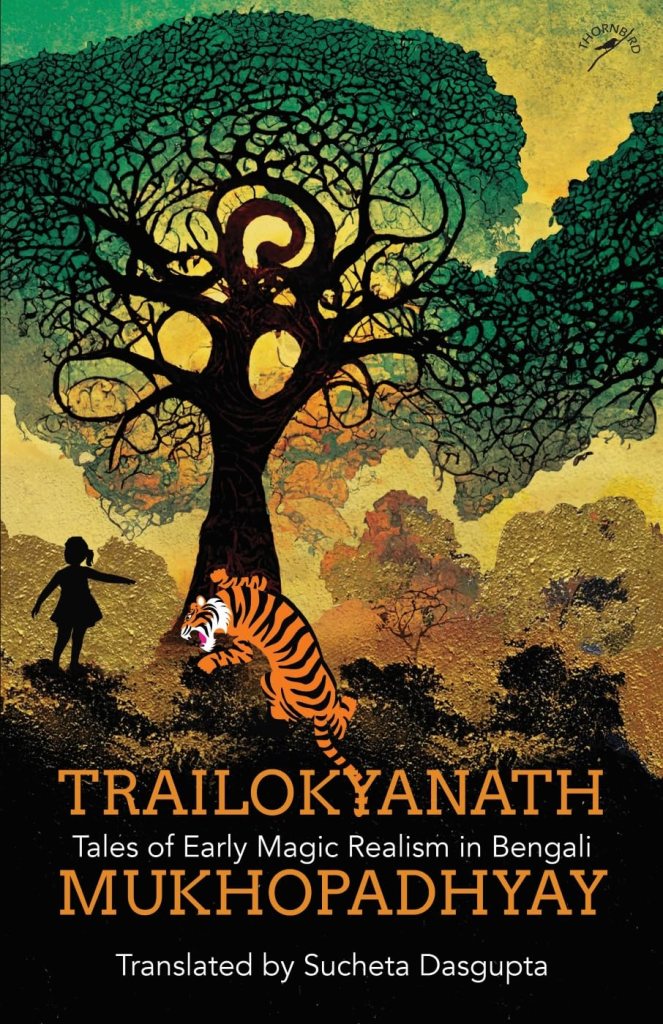
Title: Tales of Early Magic Realism in Bengali

Author: Trailokyanath Mukhopadhyay

Translator: Sucheta Dasgupta

Publisher: Niyogi Books

A good translation is a sorcery of desire, determination, and language. It opens a portal into not just another culture, reminding us of the texts, subtexts, contexts and conned texts richly underlying words but involves an admission into a whole new world that the reader would have missed altogether had it not been for the sincere striving of a visionary translator.

For, indeed, all translation is built around a vision that extends beyond that of giving life to a work in another language. There has to be a rationale as to why this reincarnation should, at all, be necessary or worthwhile, a logic as to how this can be effectively worked out in the asymmetrical arena of languages, and a dream as to what can be accomplished through this.

In Sucheta Dasgupta’s case, the translation of Trailokyanath Mukhopadhyay’s Tales of Early Magic Realism in Bengali stems from a desire to introduce readers of English to the wide, vibrant, unusual and remarkably fabulist world of the author as a pioneering attempt in the field of global speculative fiction.

Speculative fiction as a genre, is an umbrella term that stands for all modes of writing that depart from realism. It includes myth, fable, fantasy, surrealism, supernaturalism, magical realism, science fiction, and more. Being a speculative fiction writer herself, Dasgupta finds in Trailokyanath’s world an interesting attempt at “creating these genres and bending them in Bengali, in nineteenth-century United Bengal” which, to her, was a revelation of sorts.

Her intention to bring Trailokyanath Mukhopadhyay to the attention of a wider international audience has helped to add to our understanding of the rich and diverse society of nineteenth-century Bengal and its conflicting intellectual inheritance. This translation, in vital ways, also does service to Bengali literature in which Trailokyanath’s reputation has remained eclipsed and which, following Tagore’s estimation, has mostly looked upon him as a children’s writer.

A mere glance, however, at the six interesting translations in Tales of Early Magic Realism in Bengali will clarify that they are far from yarns meant for children. Driven by a clear vision to make sense of their times by negotiating between two distinct epistemologies – the native and the colonial, these are essentially narratives of ideas that speak to the confused public conscience of the age.

The tales, in question, are ‘Lullu’, ‘Treks of Kankabaty’, ‘Rostam and Bhanumati’, ‘The Alchemist’, ‘The Legend of Raikou’ and ‘When Vidyadhari Lost Her Appetite’. These are, properly speaking, ‘tales’ that stem from and echo a fecund oral tradition of storytelling and answer to no formal conceptions of the short story genre. They are indiscriminate with regards to length, plausibility, fineness, and intention and except for the last story which exemplifies a certain tightness of plot and effect, these tales are characterised by a clumsy looseness which marks oral forms.

Rich in description and sensory detail, each of these stories has its own distinct style and flavour. While ‘Lullu’ and ‘Treks of Kankabaty’ are pure fantasy, ‘Rostam and Bhanumati’ and ‘The Legend of Raikou’ weld elements from myth and folklore. ‘The Alchemist’ attempts to combine moral treatise and scientific history together while ‘When Vidyadhari Lost Her Appetite’ sticks to realism, emerging as the most well-told tale in the collection terms of both craft and cultural representation.

How far it is justified to call these six narratives ‘tales of early magic realism’ remains a question well-raised in the ‘Foreword’ to the book by Anil Menon where he points out that the bringing together of realism and fantasy sans the socio-political context of the twentieth century seems inadequate. “What we can say is that there is a magic realist reading of such-and-such work. The classification refers to the relationship between the reader and text, and not to some essence in the text itself.”

Trailokyanath’s world, whether realist or fabulist, is the world of a robust, liberal, discerning intellectual who is well aware of the various currents and counter-currents of native and colonial reflection of his times, all of which he adroitly conjures in his fiction to offer readers sumptuous food for thought. While these tales might want in artistry and unity of effect, they revel in ideas and the multiplicity of points of view which offer readers today a very faithful portrait of nineteenth-century Bengal and the intellectual debates that actively ranged on issues such as religion, widowhood, sati, women’s education, fashion, the codes of marriage and remarriage, caste, family, and economy.

Dasgupta makes sincere efforts to offer as honest a translation as possible, (“I fully intend my work to be the ‘same text in a different language’ and not a transcreation”, she points out in her ‘Translator’s Note’.) retaining native words where there are not acceptable substitutes and offering a well-researched and nuanced glossary at the end of each tale to point out Bengali meanings and usages. The prose style of the book, following the original, tends to be ornate at places but the humour and satire that gives sinewy form to these tales is unmissable.

In ‘Lullu’, for instance, Aameer insists that the only qualification for an editor of a newspaper is the ability to curse and his purpose in choosing to appoint a ghost as editor was that “…all the curse words known to man have been spent or gone stale from overuse. From now on, I will serve ghostly abuse to the masses of this country. I will make a lot of money, I am sure of it.” In our own times, the experience of sensational headlines and of fake news, and the sight of bickering spokespersons and screaming anchors in newsrooms makes us smile at Trailokyanath’s foresight.

In ‘Treks of Kankabaty’ which attempts to be a Bengali adaptation of Lewis Caroll’s Alice’s Adventures in Wonderland (1865), a mosquito informs the protagonist that the true purpose for which humans have been created is so that mosquitoes “can take a drink of their blood”. “All mosquitoes,” states Raktabaty “know that humans have brains, but no intelligence. The foolish amongst us are called humans in the pejorative sense.”

A comic geographic, cosmic and karmic purpose for the traditional religious prohibition on travel for Indians emerges in this tale:

“India is surrounded by the black waters on three sides while on the other, there are gargantuan mountain ranges. Just as animals are kept inside a paddock, so, too, we had kept Indians enclosed by the means of these natural fences. By staying in India, Indians so far had remained at our service and humbly donated their blood for the purpose of our nourishment. Not so any longer. Today, some of them are waging attempts to cross the high seas and conquer the mountains. That if they behave thus and deprive us of their blood, they commit a great sin is common knowledge.”

Again, on hearing that “the British have banned the custom of sahamaran[1]”, the monster Nakeshwari says:

“Well, the British did ban the custom, but do you know what the young and educated Bengali men believe today? They believe in restarting old customs in the name of Indian pride. They have gone stir-crazy in the name of throwing their grief-stricken mothers and sisters into the burning fire. And we, monsters, heartily support them in their mission.”

In ‘When Vidyadhari Lost Her Appetite’, humour aligns with stark realism in this argument between two maids:

“One day, Rosy addressed Vidyadhari, ‘Have you lost your judgement? Just this morning, you went to the confectioner’s shop and bought Sandesh for the master. Before serving it to him, you let the brahmin lick at it twice and then you, yourself, gave it ten good licks. When did you say to me, “Rosy, why don’t you, too, give it a couple of licks?” If one attains something, one’s duty is to share it with others.”

Common to all these tales is the empowering of the marginalised, a challenge to status quo, and a sustained intention to speak the truth for empowerment. In that sense, these narratives are all anti-authoritarian and disrupt various forms of hegemony to establish a vision of life that is swift, changing, capable of responding to oppression with wit, and where the spoken word has sacral value. That is why in ‘Lullu’, Aamir’s thoughtless remark ‘Le Lullu’ to frighten his wife actually summons a ghost called Lullu who spirits her away. Similarly, in ‘Treks of Kankabaty’, the moment Kankabaty’s father says, “…if a tiger appears in this very moment and asks for Kankabaty’s hand, I shall give it to him”, a roar is heard and a tiger appears seeking her hand in marriage.

Language, in its diverse potential, becomes an important thematic link in these tales and in this immensely polyphonic text that unleashes a host of voices, human and non-human, to capture a reality that operates on multiple axes and can be best appreciated through the third eye of the imagination.

.

[1] Dying together — A wife(or Sati) was burnt in the funeral pyre of her husband. This custom was banned in India by the British in 1829 and continues banned.

Basudhara Roy teaches English at Karim City College affiliated to Kolhan University, Chaibasa. Author of three collections of poems, her latest work has been featured in EPW, The Pine Cone Review, Live Wire, Lucy Writers Platform, Setu and The Aleph Review among others. 

.

PLEASE NOTE: ARTICLES CAN ONLY BE REPRODUCED IN OTHER SITES WITH DUE ACKNOWLEDGEMENT TO BORDERLESS JOURNAL

Click here to access the Borderless anthology, Monalisa No Longer Smiles

Click here to access Monalisa No Longer Smiles on Kindle Amazon International