Book Review by Meenakshi Malhotra
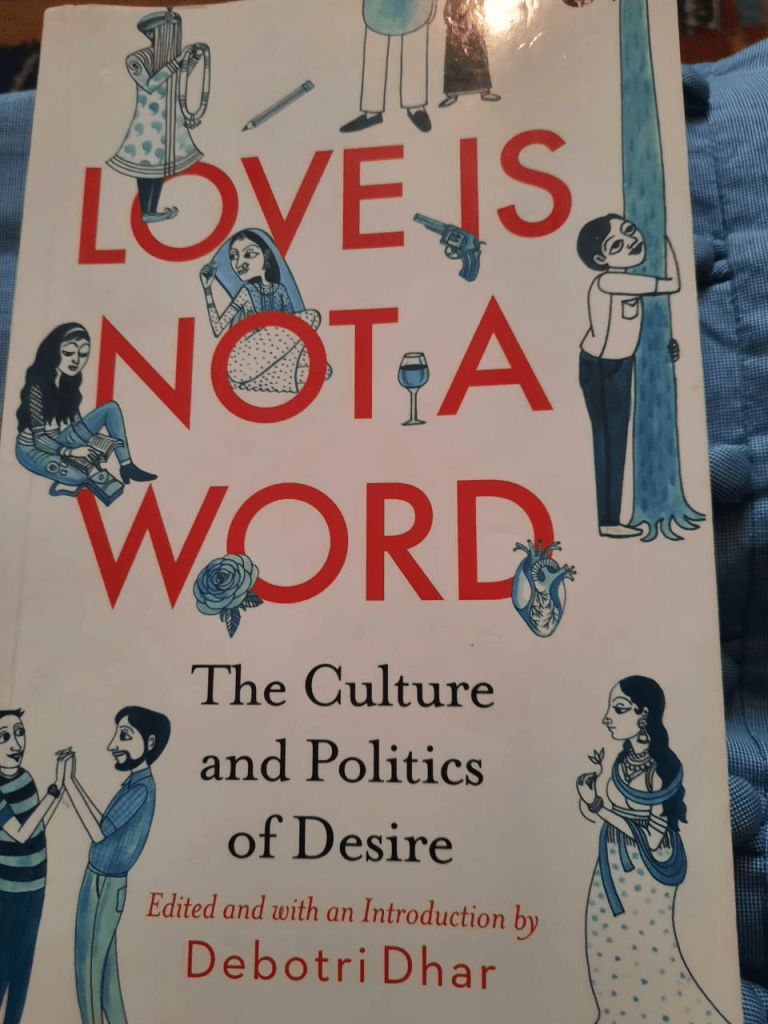
Title: Love is not a word: The Culture and Politics of Desire
Editor: Debotri Dhar
Publisher: Speaking Tiger, 2020
Love is not a word: The Culture and Politics of Desire edited by Debotri Dhar is a timely and illuminating book. It asks the right questions, sets up the debate on issues which need to be debated in order to bring the many hues of love and desire out of stranglehood of monolithic constructions. Dhar has brought together some interesting essays by noted academics, art historians and curators, cultural and literary historians and writers musing on the theme of love, its histories and its manifestations in religious mythography.
In the first essay in the anthology, ‘Swayamvara, Arranged Marriage, Desi Romance’, Professor Malashri Lal brings her considerable acumen and expertise to offer “some fascinating perspectives on Indian love, mapping both continuity and change, possibility and paradox.” She draws upon a spectrum of sources to unsettle some of the binaries and clichés about love and marriage in India. She points out the very heterogeneous nature of Indian realities and the simultaneous existence of designer weddings along with the prevalence of child marriage, the latter motivated by stark poverty and custom. In this heterogeneous context, where contradictions exist and jostle with one another, it is difficult to formulate one overarching reality which collapses every aspect of Indian reality into one single, overwhelming truth. Drawing upon a diverse set of sources from the Indian epics like Ramayan and Mahabharata to the writings of diasporic women writers in the US, to Bollywood films, Lal problematises the question of women’s choice in love and marriage, even when it is arranged. In her essay, she highlights the exercise of agency enabled by the ancient practice of swayamvara, where the bride reviews a number of suitors and selects one as her husband to the popular Hindi film, Queen (2014), where the ‘bride’, jilted by her suitor at the eleventh hour when practically at the altar, sets off alone on a ‘honeymoon’ to Paris and Amsterdam. All these vignettes, according to Lal, point to a long history of critiques of compelled marriages for women. Decoding the history of marriage and the space both accorded to and negotiated by women within it, the author traces both continuities as well as complicating questions of love versus arranged marriage, choice, desire and agency.
Some of the themes and issues initiated by the first essay are questions that come up elsewhere, albeit in varying registers. Professor Makarand Paranjape’s essay focuses on immortal love and on the lover-God Krishna and his consort Radha, who is “a milkmaid elevated to the status of the erotic and holy beloved of the Supreme Godhead”. Paranjape reads the figure of Radha in the context of Indian history, art, culture and metaphysics, traces the genealogy and argues that the increasing importance of Radha acted as a corrective to the male-dominated theology which lacked a strong Goddess prior to the emergence of Radha. According to the author, she is largely absent in the classical sources and in the scriptures, her origins shrouded in obscurity, but assumes importance later as Krishna’s chosen paramour in Jayadev’s Gitagovinda, which is how medieval poets like Chandidas, Vidyapati and Surdas write of her.
A common theme which is indicated in the previous essay is developed by Paranjape and then later, by Alka Pande in the subsequent essay on ‘Love, Longing and Desire: A Nayika’s tale’. The flattening out of desire in keeping with the imperial puritanical norms of social control dwell on how desirous voices create discomfort. The messiness of love and desire is sought to be controlled and circumscribed into the heteronormative frame of marriage. Both imperial control and nationalistic schemes of reform collude to silence and erase traces of lascivious female desire and the erotic is therefore subdued and subsumed into the discourse of female purity, with which it sits uncomfortably. Thus, Prof Paranjape discusses how, “with the beginnings of colonial modernity in India, Radha the Goddess underwent another drastic modification, now coming to often represent illegitimate sexual desire. In the new Puritanism fostered during the so-called Indian renaissance(18th to 19th century), Radha and her dalliance with Krishna proved an embarrassment to the agenda of social reform that the proponents of Hindu respectability espoused.”
By the 20th century, Radha was represented as “a victim of patriarchy” — as a symbol of the degraded and exploited woman, a fallen or abandoned woman. This is a far cry from the tantric version of Radha , which exalts her, sometimes over Krishna. In other traditions, she is often domesticated and shown to be a “chaste and jealous wife”, very possessive of Krishna, given to fits of rage. The theme of romantic love is played out in varying registers and the sacred and profane so intermingled and intertwined that it is difficult to separate the two.
Alka Pande’s essay on ‘Love, Longing and Desire: A Nayika’s Tale’ is deliciously erotic in its texture as it narrates the tale of Amrapali, the “nagarvadhu”(bride of the city) of Patliputra, who lives life and fulfils her desire on her own terms. It shows the courtesan as an empowered figure, who exercises considerable agency in her choice of partner after the demise of her royal consort. As a reader and an editor of Vatsyayana’s Kamasutra, she claims to have transformed the book “from a compendium of living a deeply enriched and sexually fulfilled life to much more: strategies of romance, love, longing, desire, seduction and an unabashed valorization of carnal love.” (Pande,44) The essay also sets the record straight about the popular reception in the public imagination which sees the book as a manual of sex; rather it conforms to the Indian philosophy of “Purusharthas” which includes the goals of “dharma”, “artha”, “kama” and “moksha”, roughly translatable as virtuous living, material prosperity, aesthetics and pleasure and salvation, respectively. Kamasutra, in this narrative, emerges as a document which explores the art of living life to the fullest. Love and its many facets are explored along a spectrum of aestheticism, in a way that elevates it to a level beyond hedonism.
Christina Dhanaraj’s essay on ‘Swipe me Left, I’m Dalit’ explores the world of possibilities of romantic love for Dalit women, and finds the odds heavily weighted against them on account of caste prejudice. She therefore finds the optimistic and celebratory accounts on social media and /or dating apps like tinder which declare ‘caste’ as a thing of the past to be false and facile. Dalit women, according to the author, “carry the double burden of gender and caste, and are one of the most socially undervalued in India, are therefore under constant pressure to project an acceptable version that mimics the ‘savarna’ (upper caste) ideal.”
From the problems besetting inter-faith Hindu-Muslims relationships because of a persistent polarisation intensified by right-wing ideologies to the variegated spectrum of love’s vows and woes in Urdu poetry, are some of the themes explored in some of the subsequent essays.
Rakhshanda Jalil, the eminent literary historian , points out interesting aspects of the “Barahmasa”( Twelve Months)which are songs of love, separation and yearning, both mystic and secular, in a woman’s voice. However, while the form concerned itself with the “women’s world, adopted a woman’s voice and spoke of a woman’s needs , none were actually written by women poets.’’(Jalil,125)Further, a study of the “barahmasas show how the word was lost to text, and orality to textuality, but also how pluralism was replaced by Unitarianism, multi-culturalism by puritanism, the feminine-gendered narration by the masculine, and inclusion by exclusion.”(Jalil,112)
Debotri Dhar’s thought-provoking musings on the profoundly gendered nature of love and waiting is a delightful read, punctuated with valuable insights into women’s writing and experiences. So are the other essays by Sumana Roy, Parvati Sharma and Didier Coste.
In its exploration of the variegated hues and discourses of love and its analysis of its many histories, the essays in the book demonstrate that love — as text, as play, pain and pleasure, in somewhat unequal measure — is truly a many-splendoured thing and makes the world go around. These essays also illustrate the peculiarly gendered nature of love, where we are tempted to echo Byron’s lines from Don Juan
Man’s love is of man’s life a thing apart,
‘Tis woman’s whole existence
.
Dr Meenakshi Malhotra is Associate Professor in English at Hansraj College, University of Delhi. She has edited two books on Women and Lifewriting, Representing the Self and Claiming the I, in addition to numerous published articles on gender and/in literature and feminist theory. Some of her recent publications include articles on lifewriting as an archive for GWSS, Women and Gender Studies in India: Crossings (Routledge,2019),on ‘’The Engendering of Hurt’’ in The State of Hurt, (Sage,2016) ,on Kali in Unveiling Desire,(Rutgers University Press,2018) and ‘Ecofeminism and its Discontents’ (Primus,2018). She has been a part of the curriculum framing team for masters programme in Women and gender Studies at Indira Gandhi National Open University(IGNOU) and in Ambedkar University, Delhi and has also been an editorial consultant for ICSE textbooks (Grades1-8) with Pearson publishers. She has recently taught a course as a visiting fellow in Grinnell College, Iowa. She has bylines in Kitaab and Book review.
.
PLEASE NOTE: ARTICLES CAN ONLY BE REPRODUCED IN OTHER SITES WITH DUE ACKNOWLEDGEMENT TO BORDERLESS JOURNAL.


 Borderless