Categories
Stories

A Queen is Crowned

By Farhanaz Rabbani

The grand images of a historic event flashed before her eyes, as 11-year-old Jui, flanked by her sisters, sat still in the dark hall of Gulistan Cinema Hall. There was a great buzz about the new Technicolor documentary on the coronation.

The week before she had heard her elder sisters, Ruby and Shelly trying to convince their mother to let them watch it at Gulistan. For an affluent wealthy Muslim family, allowing girls to watch movies outside was unheard of. But the matriarch of the family, Zubeida, was groomed in a different manner. Born of a renowned family in Munshiganj, she was educated at the Sakhawat Memorial Girl’s High School in the 1920s. Inspired by the values of the Bengali feminist writer and the founder of her school– Begum Rokeya Sakhawat Hossein, Zubeida was an avid reader and extremely aware of the social issues of her times. When she was married at the age of 14, her husband, a renowned physician, encouraged her to read at home.

Zubeida’s sons and daughters grew up reading the latest literary journals and novels written by legendary Bengali writers. Being the third daughter and the fourth among all the siblings, Jui was surrounded by casual conversations of the latest plays in town or the scintillating songs from the All India Radio. Her immediate elder sister Shelly was a huge fan of Dilip Kumar’s songs and was often seen pressing her right ear to the battery driven radio, swaying to the mellifluous melodies of S.D. Burman. But life was not all play in Zubeida’s home.

In the evenings, as soon as everyone completed their Maghrib prayers, the children had to study. Seven children had several different techniques of playing truant during this special time. The eldest son being an avid football player, would often stay away from home playing in tournaments for the Mohammedan team. The next child Ruby looked at life in a more serious manner. She sat on her table with the hurricane lamp illuminating her social studies book. But sometimes, Jui would often see books by Kamini Roy, or Ashutosh Mukherjee or Tagore hidden within the centrefold of the schoolbooks!

Once, their father had just returned from his medical chamber to catch Shelly pressing her right ear to the small battery driven radio intently listening to the latest Dilip Kumar song.

“Ruby’s Maa!” he exclaimed, “These girls will all get married to rickshawallas! All they do, every day, is to waste time. How will they ever pass their exams?”

 While the veteran patriarch was fuming in rage, Ruby’s Maa, Zubeida, appeared to be totally undisturbed by his lamentations. She never worried about the future. With her deep faith in God, she took life one day at a time,

Ruby and Shelly were intently looking at the screen transporting themselves to Westminster Hall amid all the grandeur of the Coronation. The sultry voice of Laurence Olivier wafted through the Cinema Hall of Gulistan as images of a sparkling crown being placed on the elegantly styled head of Queen Elizabeth II mesmerized the audience.

Zubeida, in her usual quiet persuasive way, had convinced her husband to give them permission to watch the famed documentary on the coronation of the new Queen — Elizabeth II. Abu Chacha– their darowan 1 went to great lengths to get 5 rickshaws for the journey from Naya Paltan to Gulistan.

The ladies adorned themselves in their best attires. The older daughters gave special care to apply their homemade surma2 on their eyes. The younger ones were just too excited to have a day out with the ladies of the household. Zubeida wore a beautiful cream coloured saree with a black border, the dark kohl accentuating her dreamy eyes, and she had mouthful of paan that made her lips ruby red. With a splash of attar, the ladies wearing saris got on the rickshaws– all veiled meticulously — so that passersby would not see their faces.

Abu Chacha was relegated with the noble duty of guarding the ladies–perched on a sixth rickshaw keeping track of the ladies at the front. As soon as Zubeida and her daughters reached Gulistan Cinema Hall, Abu Chacha stood on guard at the front of the Hall. He was not interested in the coronation of a foreigner. His life was not affected by the wonders of the colonial rulers. His only loyalty was for Doctor Sahib — who saved his mother from her deathbed. He would dedicate his life to the service of Doctor Sahib’s family.

Jui was silent– perhaps a little overwhelmed by the discipline and formality of the whole affair. She wondered if she would ever break away from the confines of her home and see the world outside. She was always the quiet one. Since she was not as robust as her sisters, she was considered to be docile and shy.  But the 11-year-old girl had a deep-rooted desire for breaking boundaries. The ornate gilded halls of Buckingham Palace flashed throughout the screen. Huge paintings framed in gold and the elegant procession of the Royal Guards clad in red and gold transported the audience to the glamour of the crowning of the new Queen of the United Kingdom. Jui, with her innate curiosity, watched the red canopy covering the Queen as she was anointed with holy oil. She had no idea about the significance of these actions. All she noticed was the splendour of a distant world – where women did not have to travel in covered rickshaws. 

Queen Elizabeth’s calm but firm look seemed to send a message to this little girl thousands of miles away. As she sat on the cushioned seats of Gulistan Cinema, surrounded by her protective sisters, Jui suddenly felt her resolve strengthening. She wanted to know more and see more of the world. She dreamed of visiting the land of the Queen one day. She dreamed of breaking out of the confines of her home one day.

 She would be the queen of her own destiny.

.

  1. Security guard ↩︎
  2. Kohl ↩︎

Farhanaz Rabbani loves to chronicle interesting stories and events that happen around her.  She is an avid listener. Contact: fnazrs@gmail.com.

PLEASE NOTE: ARTICLES CAN ONLY BE REPRODUCED IN OTHER SITES WITH DUE ACKNOWLEDGEMENT TO BORDERLESS JOURNAL

Click here to access the Borderless anthology, Monalisa No Longer Smiles

Click here to access Monalisa No Longer Smiles on Amazon International
Categories
Essay

Remembering Rokeya: Patriarchy, Politics, and Praxis

In this tribute, Azfar Hussain takes us on a journey into the world of Madam Rokeya who wrote more than a century ago in English, Urdu and Bengali. Her books talked of women, climate and issues related to patriarchy.

I repeat the same truth, and, if required, I will repeat it a hundred times.

— Rokeya Sakhawat Hossain*

 What’s the worst that could happen to me if I tell this truth?

—Audre Lorde

December 9 marks both the birth and death anniversaries of Rokeya Sakhawat Hossain (1880-1932). The Rokeya Day in Bangladesh also falls on December 9. Indeed, Rokeya has by now been institutionalised, iconised, and, for that matter, even reified. This means a certain misappropriation and depoliticisation of her work as well. But there are now several biographies of Rokeya and scores of books and articles on her. Although I do not intend to recount Rokeya’s biographical details here, I should stress the point right at the outset: Rokeya’s life as a Muslim woman — lived courageously and even dangerously — illustrates nothing short of sustained struggles against religious bigotry, lack of education, shifting vectors and valences of colonialism, patriarchy affecting the practice of everyday life, and other forms and forces of oppression in colonial Bengal in the late nineteenth and early twentieth centuries.

Theorist-activist, essayist, fiction-writer, poet, translator, journalist, educationist, organizer — and an organic intellectual in her own right — Rokeya produced a remarkable corpus of written works, making distinctive contributions to Bangla literature while articulating with full force the cause of women with a particular, if not exclusive, focus on their education and emancipation. Roushan Jahan already characterized Rokeya as “the perceptive feminist foremother,” given the ways in which she anticipates a constellation of feminist questions and concerns broached later, although Rokeya and what a whole host of third-world feminists have called “Western, white feminism” do not go hand in hand. 

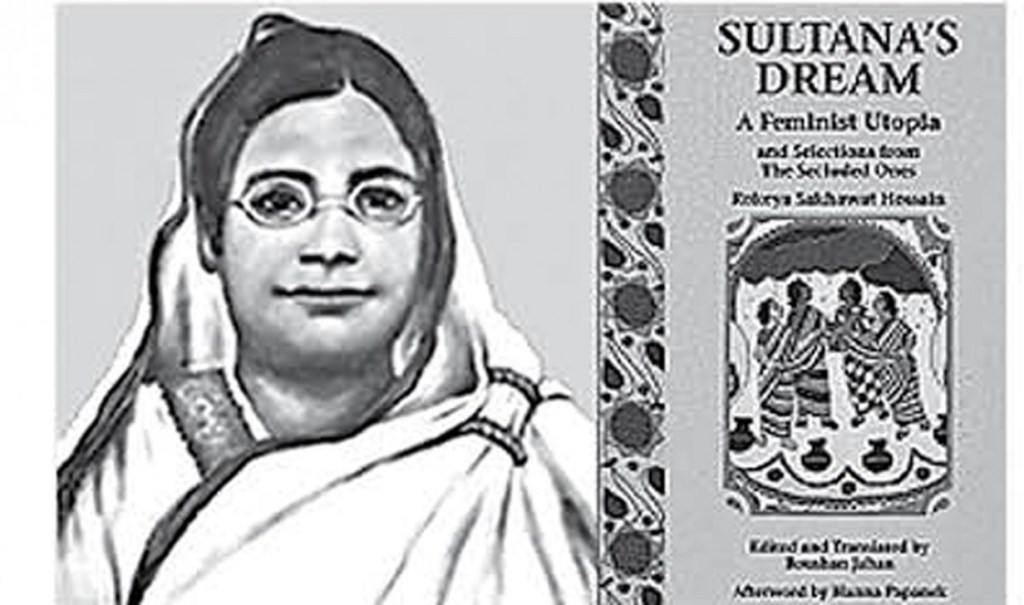
Rokeya’s important works include Motichur, vol. 1 (1904); Motichur, vol.2 (1921); her only novel Padmaraag (1924); and Aborodhbashini (date uncertain), among numerous others. Rokeya knew five languages — Bengali, English, Urdu, Arabic, and Persian — while she directly wrote in three of them — Bengali, Urdu, and English. Her work Sultana’s Dream — a novella first written in English and later translated into Bengali by the author herself — is usually described as “a feminist utopia” that, as Roushan Jahan rightly points out, “antedates by a decade the much better-known feminist utopian novel Herland by [the American novelist and poet] Charlotte Perkins Gilman” (1860-1935).

Yet another work in English by Rokeya is instructively titled “God Gives, Man Robs” (1927). It’s a powerful essay that carries her famous words: “There is a saying, ‘Man proposes, God disposes,’ but my bitter experience shows that God gives, Man Robs. That is, Allah has made no distinction in the general life of male and female — both are equally bound to seek food, drink, sleep, etc., necessary for animal life. Islam also teaches that male and female are equally bound to say their daily prayers five times, and so on.” Some contend that this work advances Rokeya’s nuanced version of what is called “Islamic feminism” at a conjuncture that witnesses androcentric and colonialist abuses of religion itself. Rokeya of course already puts it clearly and simply: “Men dominate women in the name of religion”*.

Although it is impossible for me to characterise or summarise the entire range of Rokeya’s written works, I can readily call attention to one particularly predominant concern that prompts, energises, and constitutes the very production of her words and her world: the woman question relating to the question of the total emancipation of humanity — of both women and men. And the woman question itself is constitutively and irreducibly a revolutionary question insofar as in the final instance, it prompts us to interrogate, combat, challenge, and even destroy the historically produced system of male domination called patriarchy on the one hand, and, on the other, those systems of domination and exploitation that variously support and even enhance patriarchy itself. And Rokeya’s specifically revolutionary stance decisively resides not only in raising the woman question but also in making that question integral and inevitable to the entire horizon of her work — literary, pedagogical, organisational, social, familial.

****

Let me return to Sultana’s Dream (1905), because a number of its aspects still continue to remain ignored, although these days this work often gets discussed by those who claim to do postcolonial studies. I think this work is more than just a subversive and satirical intervention in the genre of what might be called “political dream-fiction” or “political science fiction.” And I read it as a work offering—through a radical reversal of the patriarchal or male-dominated order of things—a social imaginary that looks forward to, or even creates in imagination, a space and a place in which not only patriarchy spells out its own death but in which also science, political economy, ecology, and the forces of nature and the forms of justice remain adequately responsive to one another in the best interest of not only all humans but also all living beings themselves. And, thus, this work remains opposed to the destructive and oppressive logic of colonialism, militarism, and masculinism—and even anthropocentrism—profoundly interconnected as they are. In Sultana’s Dream, Rokeya also brilliantly anticipates a version of feminist science, offering a critique of colonialism’s relationship with science as a power/knowledge network. Indeed, “Sultana’s Dream” is, thematically and stylistically, the first work of its kind in the entire history of literary productions in Bengal.

Rokeya is also an early but powerful theorist of women’s liberation, a tireless organiser, an exemplary pedagogist of hope, and even a revolutionary in her own right. And her revolutionary moves reside in ways in which she gave voice, at the beginning of the twentieth century, to an entire generation of women struggling in confinement, or struggling against the purdah system itself, against the abuse of religion, against the shackles of not just double but multiple colonisations of women by patriarchy and colonialism and ‘feudalism,’ for instance.

Rokeya’s work Aborodhbashini is often reckoned the locus classicus of the discourse surrounding the purdah system, but does Rokeya combat the system of women’s seclusion and segregation à la Western feminists? No. For Rokeya, purdah is not just a floating signifier but heavily meaning-loaded, conjunctural, contextual; it’s more than an external veil covering a face or any part of the body, but it refers to an entire system of both mental and physical imprisonment to which the questions of colonial patriarchy and patriarchal colonialism remain relevant. Rokeya says: “The Parsi women have gotten rid of the veil but have they got rid of their mental slavery* [manosik dasattya]?”. It’s here where Rokeya not only anticipates Kazi Nazrul’s own formulation of “mental slavery” (moner golami) — but she also accentuates — way before Frantz Fanon, Paulo Freire and Ngugi wa Thiong’o — the need for anti-colonial, emancipatory education for both women and men.         

Last, Rokeya is also a politically engaged satirical poet whose apparently playful wit and sarcasm could be devastatingly subversive at times. Some of her famous poems include ‘Banshiful’, ‘Nalini o Kumud’, ‘Saugat’, ‘Appeal’, ‘Nirupam Bir’, and ‘Chand’. And her poetic but satirical interventions at various levels keep making the basic point about praxis itself: your silence is not going to protect you. Notice, then, a stanza in a poem she wrote as a response to those sell-outs, those middle-class bhadralok collaborators of the Raj who not only resorted to silence, but who were also nervous about losing their “honorific title”s, in the face of the Indian nationalist movement gathering momentum in 1922:

The dumb and silent have no foes

That’s how the saying goes

All of us with titled tails

Keep so quiet telling no tales

Then comes a bolt from the blue

Passes belief, but it’s true

All of you who did not speak

Will lose your tails fast and quick

Come my friends and declare now

In loud and loyal vow

Listen, ye world, we are not

God’s truth, a seditious lot

(quoted in Bharati Ray’s Early Feminists of Colonial India)

I’ve so far quickly contoured only a few areas of Rokeya’s interventions but honouring the legacy of her work calls for rereading, remobilising, and even reinventing Rokeya in the interest of our struggles for destroying patriarchy and all systems of oppression.

* These phrases have been translated by the writer, Azfar Hussain.       

Azfar Hussain teaches in the Integrative, Religious, and Intercultural Studies Department within the Brooks College of Interdisciplinary Studies, Grand Valley State University in Michigan, and is Vice-President of the Global Center for Advanced Studies, New York, USA.

First published in the literary page of Daily Star Bangladesh

.

PLEASE NOTE: ARTICLES CAN ONLY BE REPRODUCED IN OTHER SITES WITH DUE ACKNOWLEDGEMENT TO BORDERLESS JOURNAL