Categories
Tagore Translations

The Century’s Sun by Rabindranath Tagore

Published as part of Naibedya (1901) Tagore’s Shotabdir Surjo Aji (This Century’s Sun Today) remains relevant to this day.
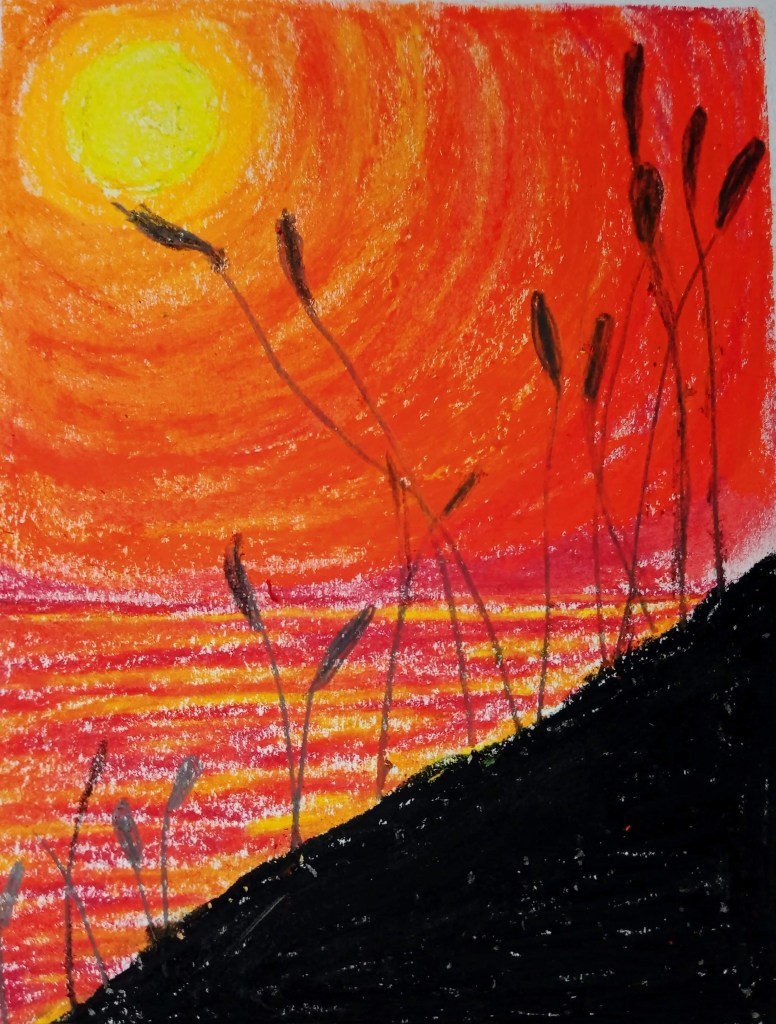
Art by Sohana Manzoor
THE CENTURY’S SUN 

The century’s sun sets today amidst clouds that are blood-red.
Revelling in violence, the crazed ragini* of death
Plays a fierce tune. Civilisation’s merciless serpent raises
Its evil hood, its concealed fangs with deadly venom laced.
Conflicts are born of self-interest.
Wars are fought to satiate greed.
Hurricanes rage in distress and churn
Barbarism that rouses from filth
Shamelessly, disguised as decorum.
Terrible outrages are committed.
Faith is pushed adrift by force,
Ostensibly, for the love of the race.
Poets scream stirring fear in hearts.
Dogs in the graveyard snatch and bark.

*Female raga

This poem has been translated from Bengali by Mitali Chakravarty with editorial input from Sohana Manzoor

.

PLEASE NOTE: ARTICLES CAN ONLY BE REPRODUCED IN OTHER SITES WITH DUE ACKNOWLEDGEMENT TO BORDERLESS JOURNAL

Click here to access the Borderless anthology, Monalisa No Longer Smiles

Click here to access Monalisa No Longer Smiles on Kindle Amazon International

Categories
Tagore Translations

I Cling to This Life…Rabindranath on Death

Written and published in 1901, Mrityu (Death) was a part of Rabindranath Tagore’s collection called Naibedya (Offering).

Death Scene painted by Tagore (1861-1941). From Public Domain
DEATH 

Death is a stranger to me.
Today, I shiver in apprehension.
I cling to this life with all my might,
With tears in my eyes, I wait to bid
This world goodbye.
O ignorant, why did you grow
So attached to this life when
The cycle of life and death was
Known to you? The dawn of death
Is like reacquainting with a stranger.
I love this life so much that I am
Convinced I will love death equally.
A child torn from one breast wails but is comforted
Within moments of being held at the other breast.

This poem has been translated by Mitali Chakravarty with editorial input by Sohana Manzoor 

.

PLEASE NOTE: ARTICLES CAN ONLY BE REPRODUCED IN OTHER SITES WITH DUE ACKNOWLEDGEMENT TO BORDERLESS JOURNAL

Click here to access the Borderless anthology, Monalisa No Longer Smiles

Click here to access Monalisa No Longer Smiles on Kindle Amazon International

Categories
Tagore Translations

Deliverance by Tagore

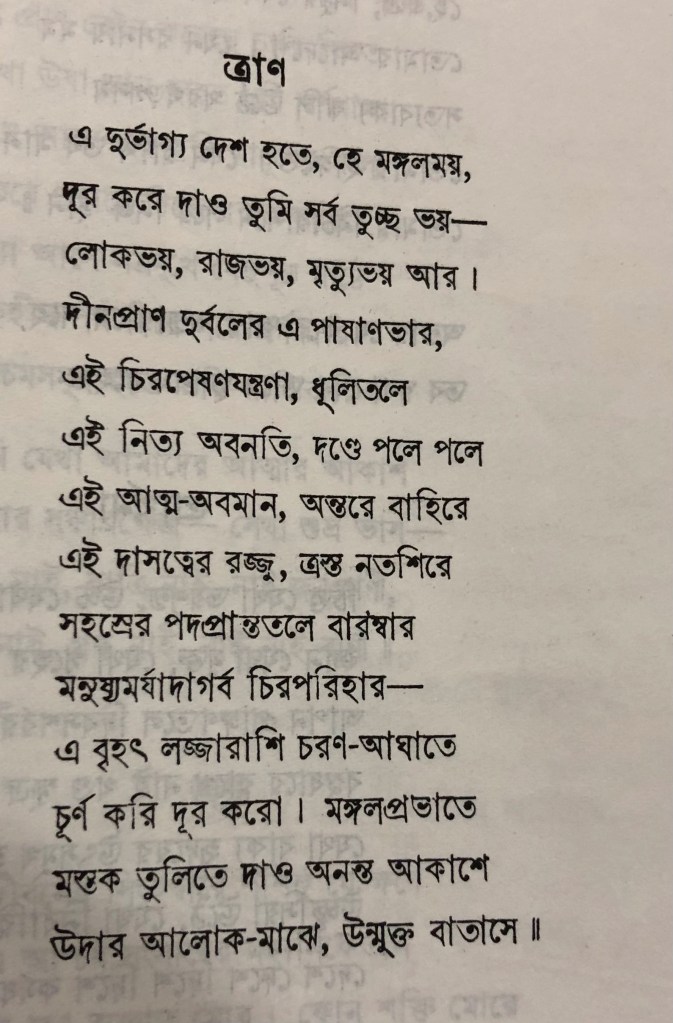
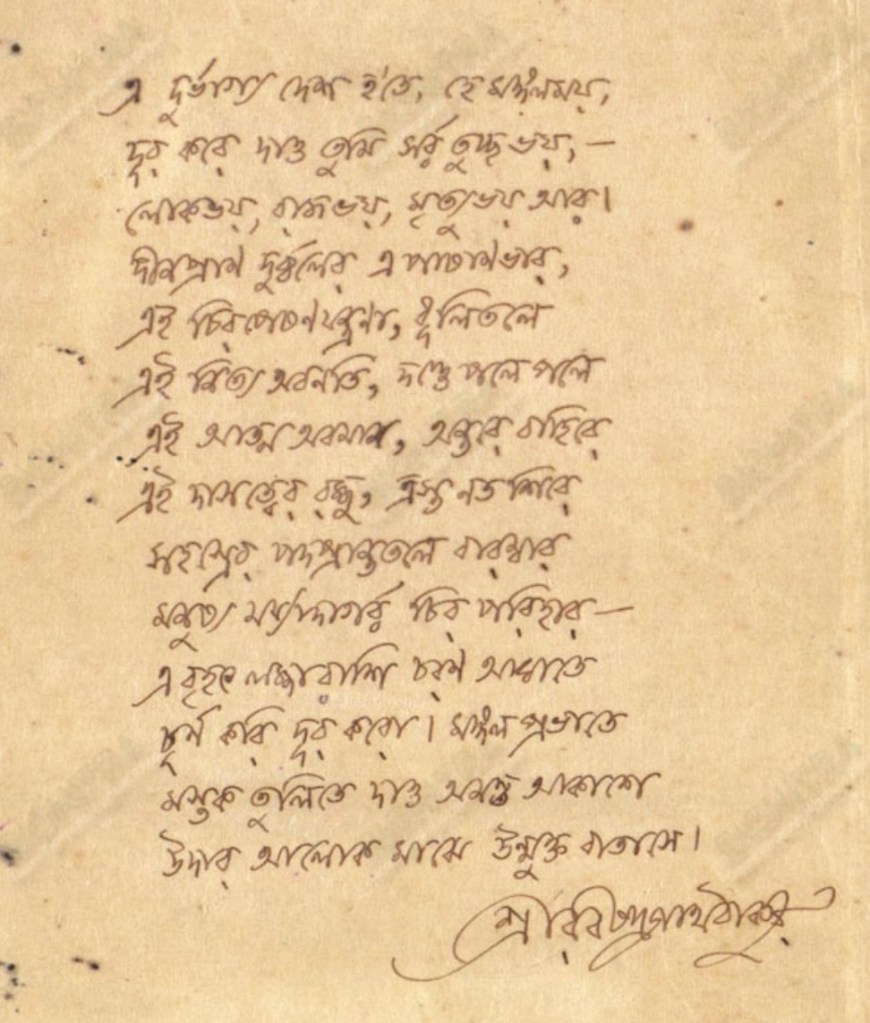
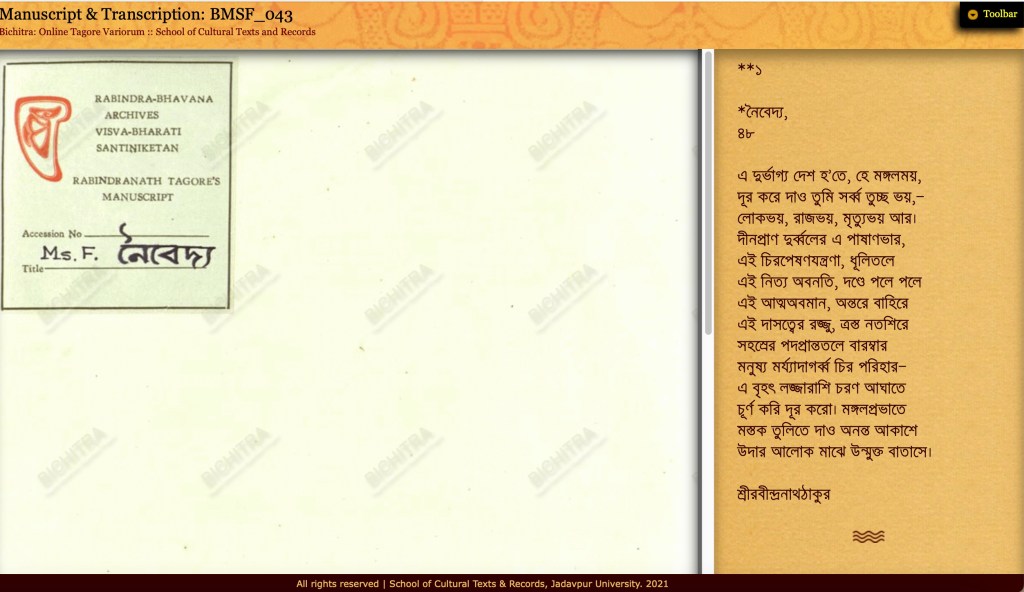
Tran (Deliverance)’ was first published in 1901 in a collection known as Naibedya (Offering to God). Here we present a translation from the Bengali poem as found in Sanchayita (Collection), a compilation of poems published by Visva-Bharati to mark the Tagore septuagenarian celebrations in 1931.

Art by Sohana Manzoor
Deliverance

From this hapless country, oh Benevolent One, 
Efface all petty fears —
Fears of society, governance and death. 
The rock-like burden borne by the impoverished and the weak,
This pain of being ground under dust, 
This endless abuse, reinforced each second,
This self-debasement, within and without,
This yoke of enslavement, terror, subjugation,
Is trod on again and again by many marching feet.
Beaten out of self-worth, pride —
Break this enormous pile of shame
With your foot. On this auspicious dawn,
Let us hold our heads high in the infinite sky 
Amidst the light of bounteousness and the heady breeze of freedom.

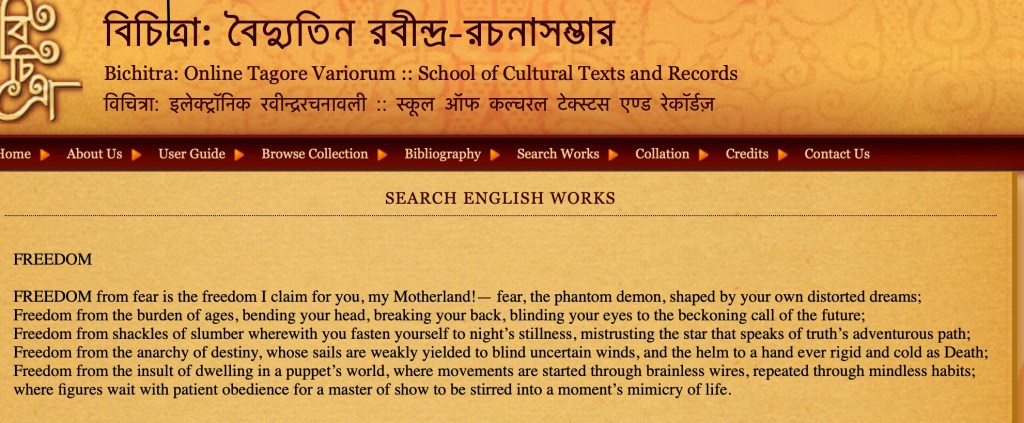
Subsequently, it was translated by Rabindranath Tagore himself as ‘Freedom from Fear’ and published in the Vishwa Bharati Journal in 1933; then, in Modern Review in 1934 according to Bichitra, an online Tagore valorium. It was first anthologised in Collected Poems and Plays of Rabindranath Tagore (Macmillan, London). The translation varies from the original Bengali poem with the last two lines missing completely.

(Translated by Mitali Chakravarty, edited by Sohana Manzoor on behalf of Borderless Journal. Thanks to Anasuya Bhar, Associate Professor of English and Dean of Postgraduate Studies, at St. Paul’s Cathedral Mission College Kolkata University, for helping with the research. Also thanks to Fakrul Alam and Aruna Chakravarti for their feedback.)

.

PLEASE NOTE: ARTICLES CAN ONLY BE REPRODUCED IN OTHER SITES WITH DUE ACKNOWLEDGEMENT TO BORDERLESS JOURNAL