Categories
Review

Mapping the Mind

Book Review by Navleen Multani

Title: Mapping the Mind, Minding the Map

Editors: Basudhara Roy and Jaydeep Sarangi

Publisher: Sahitya Akademi

Mapping the Mind, Minding the Map edited by Basudhara Roy and Jaydeep Sarangi anthologises twenty contemporary poets. This book unveils a large canvas of poems penned by poets hailing from diverse locations and cultures, evoking thoughts on existential dilemmas of the contemporary world. The 391 pages of the anthology comprise poems by multiple poets: Adil Jussawalla, Arundhati Subramaniam, Ashwani Kumar, Bashabi Fraser, Bibhu Padhi, Jayant Mahapatra, K. Satchidanandan, K.Srilata, Keki N.Daruwalla, Lakshmi Kannan, Mamang Dai, Nabina Das, Robin S. Ngangom, Sanjukta Dasgupta, Tabish Khair, Usha Akella, Yogesh Patel and more

Every poem entails evocative images, visual and syntactic cues that put forth poetics of everyday life. Traversing maps and minds, this engaging collection of two hundred poems unravels different places and persons. The anthology is a poetic narrative and holistic exploration of locating oneself through language. As the book brings together experiences and knowledge of space, it pushes readers to rethink how landscape shape identity.

Memories encompassing reflections on landscapes, ancient history, myth, family, home, towns, cities, countries, music, seasons, elements of nature, disasters, wants, love and wounds of Homo Sapiens, women, mother as well as immigrants abounds the creation of every poet. Memories of special days, seasons, cities and cultures culminate in the compositions of Mamang Dai. Nabina Das’ creations talk about death and else. Sanjukta Dasgupta juxtaposes past and present to celebrate free spirit of Kali, Alakshmi and Millenial Sita.

This compilation, published by Sahitya Akademi, is an itinerary for dreamers and travellers alike. Ten poems by each poet weave a tapestry of emotions, experiences, moments and memories that define persons, places, practices and cultures. Every word, image and syntactical turn in these poems moves readers to discover poet’s emotional state. Events and myriad experiences, memorable and unpleasant, form an intricate reflection on life. The poems are also revelations about the contemporary world. The mosaic of memories present a ceaseless stream of significant moments that mould the minds and the maps. The compositions heighten consciousness, enrich the understanding of readers and deepen their humanity. The poems make the readers encounter hardships, moments of despair, compassion, empathy and resilience to extract invaluable insights. Reflections on difficult and dark times infuse renewed strength to deal with adversity.

Every poet uses different linguistic register to delve into solitude, decay, death and a new force that nurtures mind as well as takes to greater understanding about existence. “When Landscape Becomes Woman” by Arundhati Subramaniam reveals “That a chink in a wall is all you need to tumble into a parallel universe”. Whether it is Bashabi Fraser’s “Mothers All” claiming, “They are the bravest soldiers-marching on”, or Adil Jussawalla’s “Refuge” telling “Mother tells her rosary from six to seven, her one hour refuge,” each poet, irrespective of gender, envisions an independent and autonomous identity. “What’s wrong with us Kali women?”, “Maryada[1] and modern Draupadi”, “Woman in a Landscape” by Adil Jussawalla, “History”, “Draupadi”, “Partition Ghazal”, “The Tribal Goddess” and “Patna to Nalanda-1979” by Keki N.Daruwalla transport readers from past to present and illuminate multi-facets of life. “Somewhere like a shadow in the night like a black mineral in the earth, /Somewhere in a mirror where you can see your dreams a poem awaits deftly angled light,” writes Keki Daruwalla. Ashwani Kumar’s poems dwell on Alzheimer’s, lies emerging from deception, town vanished in the reservoir of waters and the strange ways of the world.

The deftly crafted poems blend imagery, thoughts and experiences. Many of the poems are centred on home, landscape and seasons. Titles of a few poems like “Mitti[2]’, “Bhakti[3]”, “Haldi[4]”, “Mahaprajapati[5]”, “O Boisakh[6]” and “Lopamudra[7]” have not been provided with a translation. Supplementing these titles are poems like “Earthrise”, “Missives of Music”, “The Same Moon from Edinburgh to Calcutta: A Refracted Lens”, “Sunrise at Puri-on-Sea”, “The River” and “Earth Day”.

The poems ranging from prose to typographic and linguistic variations, Mapping the Mind, Minding the Map speaks to larger issues of urban Indian identity, acceptance, adaptation and cultural estrangement. These map the poetics of womanhood, the body, institution, family and love. By doing so, the anthology erases traditional boundaries to develop a new poetic form. The poems are ensembles of words that unite to present verbal, vocal and visual sphere of communication.

This three-dimensional language becomes carrier of aesthetic message of the poet. The reduction of language to a word or fragments in many of the poems is similar to the reduction of landscape to map elements selectively and generally. This gives a distinct charm to the anthology. The poems explode with bird-names, names of cities and countries making these compositions a dialectical map. Very aptly the poems, as Howard McCord contends, can be comprehended as “a map on which articulation of consciousness can be charted, and the serial flow we associate with prose can be gathered into clusters and islands of words which reveal the individual’s voice and vision, even his philosophical stance, more accurately than a line broken by a general rule imposed.” Poems in Mapping the Mind, Minding the Map are maps that offer ways to know simplified, generalised and selective views on the world and human existence.

[1] Dignity

[2] Mud

[3] Devotion

[4] Turmeric

[5] The woman who raised Buddha

[6] The second month in the Bengali calendar which coincides with April-May

[7] A philosopher who lived in the Rigvedic age

Dr Navleen Multani is Associate Professor, Head, School of Languages, and Director, Public Relations at Jagat Guru Nanak Dev Punjab State Open University, Patiala (India). She is Area Editor with Oxford Online Bibliographies: Literary and Critical Theory.

.

PLEASE NOTE: ARTICLES CAN ONLY BE REPRODUCED IN OTHER SITES WITH DUE ACKNOWLEDGEMENT TO BORDERLESS JOURNAL

Click here to access the Borderless anthology, Monalisa No Longer Smiles

Click here to access Monalisa No Longer Smiles on Kindle Amazon International
Categories
Interview Review

The Fearful Trill of Freedom & Equality

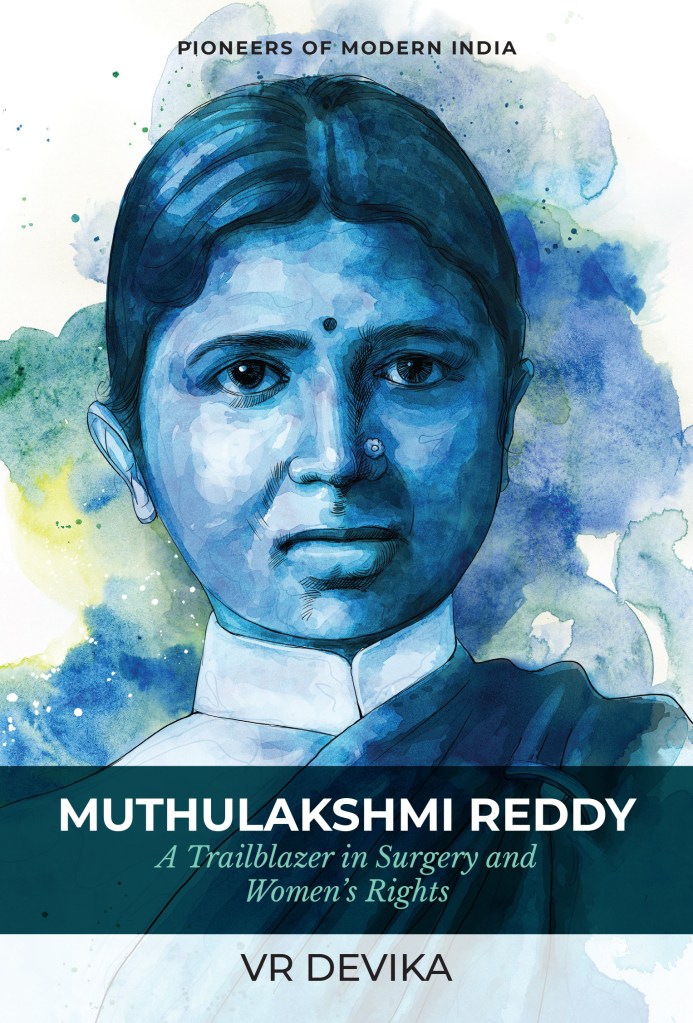
A conversation with VR Devika, author of Muthulakshmi Reddy: A Trailblazer in Surgery and Women’s Rights, Niyogi Books.

“Education, Freedom and Responsibility bring out the best from the individual and race. This will apply to all men and women irrespective of caste, creed or colour.”

—Dr Muthulakshmi Reddy, Muthulakshmi Reddy: A Trailblazer in Surgery and Women’s Rights

 Muthulakshmi Reddy: A Trailblazer in Surgery and Women’s Rights by VR Devika is a biography of a woman who shouted out to demand reforms among devdasis ( women who had been ‘married’ to lifelong service of a deity or a temple) and prostitutes in the nineteenth-twentieth century. The biographer, V R Devika, is a storyteller, educationist and Gandhi scholar.

Muthulakshmi Reddy (1886-1968) was born to a devdasi mother and transcended the system that had deteriorated from when a devadasi was considered ‘auspicious’ as she would never be widowed or married, and she could maintain her status quo, the book informs, adding a historic perspective to this ‘norm’. By Reddy’s times, these women had been reduced to become mistresses to rich men. In ancient times, before malpractices set in, a princess is said to have opted to become a devdasi. The decline started in the sixteenth century when devdasis were transferred from temple to temple.

The narrative is simple and straightforward but what stands out is the value of the content, the strength of the woman who could speak up boldly and demand reforms — even have some of them instituted. She spoke out for reforms with searing words. The author quotes from many of her speeches.

“Muthulakshmi used strong language to explain her position on the Devadasi question. ‘Of all the laws, rules and regulations which down the centuries have helped to place women in a position of inferiority, none has been so very powerful in creating in the minds of men and people a sentiment of scorn and contempt for women as the degrading idea of the double standard of morals.’

“She thundered, ‘From this double standard that has sprung that worst attack on women’s dignity, that safety valve theory that a certain number of women should exist, should sacrifice their self-respect, their honour, their comforts, their health and happiness to satisfy the lust of the other sex. At the present day, the continuance of such a doctrine and of the laws which are founded on it, is a shameful anachronism unworthy of our civilisation. Both in the past and in the present, women have disproved their inferiority, and how then can we at the present day tolerate or connive at a system which transforms a woman of whichever caste or class she may be, into a mere chattel, a piece of tainted merchandise? The inequity of the system is too deep for me to give expression, and further under that inhuman and unjust system the innocent children of a certain caste or community are trained to become proficient in all the arts of solicitation that they become captives to vice.’”

That men and women perpetrate social norms to justify the existence of the so-called ‘world’s oldest profession’ is well brought out in the book. That women forced into the sex trade are not doing this out of choice is conveyed with conviction. Names of Reddy’s associates include Sarojini Naidu (1879-1949) and the well-known singer whose mother was a devdasi too, MS Subbulakshmi (1930-1997).

Reddy was one of the first female medical graduates[1] in India, the first woman[2] to enter an Indian Legislature and the first woman in the world to preside over a Legislative Assembly. A recipient of the Padmabhushan and more accolades, she, as a doctor founded the Addyar Cancer Institute in 1952 after her sister was caught with cancer, and, as a humanitarian, started the Avvai Home in 1931 for those rescued from brothels and streets. Her spirit is well captured by the author when she writes:

“In 1942, during the World War II, soldiers of the British Royal Airforce camping in tents on the banks of Adyar river had made some derogatory remarks about the girls and harassed them. Muthulakshmi stood vigil all night with a stick in her hand and dared any soldier to come near the Home. She even went up the ranks to the commander’s house near Fort St. George to complain to him about the conduct of the soldiers and curb their behaviour.”

VR Devika has extensively shown that Reddy was a force to be reckoned with but she has not given way completely to adulation. She has objectively shown how Reddy over ruled her son’s choices for the well-being of her own institutions. It brought to mind Gandhi’s attitude towards his own family. An established cultural activist, VR Devika has been associated with the inception of Chennai’s Dakshinachitra Heritage Museum and Tamil Nadu INTACH[3], has been visiting the Avvai Home and in this exclusive she tells us the story of how the book came about and why she visited this home and its impact on her.

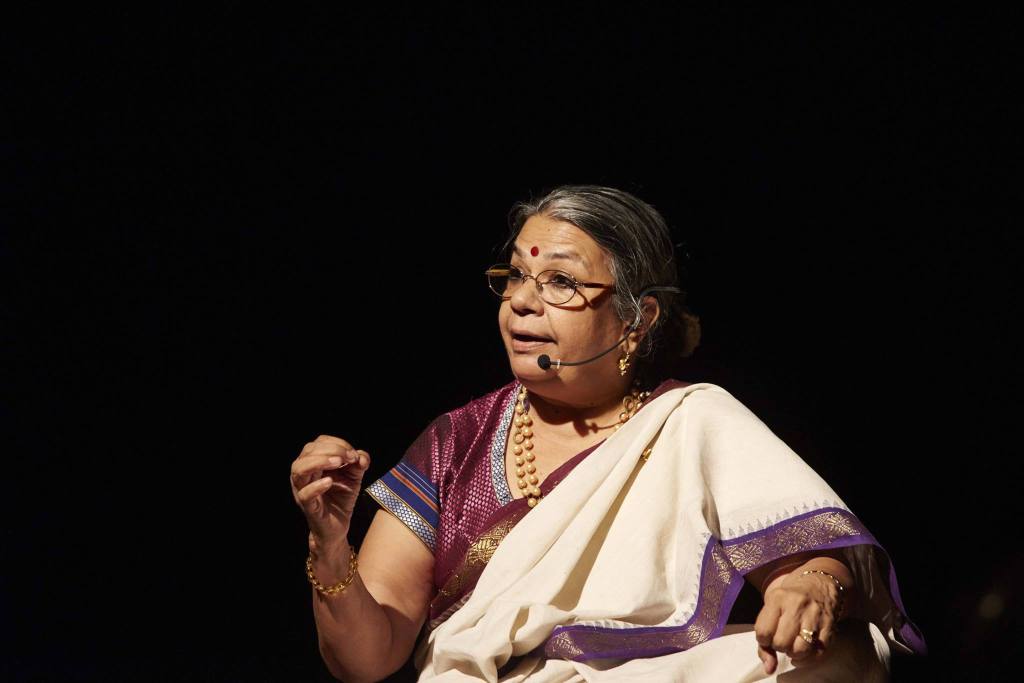
VR Devika. Photo provided by Niyogi Books

Tell us why you felt that Muthulakshmi Reddy’s story needed to be told. What was the readership you had in mind when you wrote the biography?

The dance scholarship [donors] consisting of mainly outsiders who had a hypothesis, got a good grant, employed interpreters and cherry picked to denigrate her in a fashion that took dance academic world by storm after the 1980s. I had also bought into them when I began to learn Bharathanatyam. But when I joined INTACH Tamilnadu and Madras Craft Foundation in 1985 after having been a schoolteacher since 1974, I began a project of English language as a skilling programme and theatre as empowerment for Avvai Home. That is when I began to get the other side of the story that was really fascinating. I kept thinking I must reach this story out. Dr.V.Shanta, chairman of Cancer institute, said I must write her [Muthulakshmi Reddy’s] biography and I decided to work on it after she passed away. I had young people who were studying English but had no access to English other than their textbooks as the target audience but I am a story teller and I just began to tell the story in simple way as I always do.

You tell us in the authorial note that you went on ‘work’ to the Avvai home. Tell us about the home. Why were you there?

Geetha Dharmarajan and I lived near Avvai Home. I had no idea about the history of the home etc. But I knew very poor girls studied there. Geetha had spoken to them and I went along but Geetha relocated to New Delhi and started Katha[4] and I stayed on helping Avvai Home in many different ways. I have written a full story of Avvai Home in the book. It was volunteer work. Rajalakshmi of Avvai Home requested me to help them on a production on Dr.Muthulakshmi Reddy. I interviewed Sarojini Varadappan, Dr.Shanta, and several others to write the script for the production. I am now on their school advisory committee.

For me, the most interesting aspect was how Muthulakshmi Reddy made the transition from being born a devadasi to empowering herself enough to outlaw the custom. Did her parents ever marry?

No there was no way they could marry as a girl born in the system was barred from ritualistic marriage according to Hindu custom. She was his companion.

Your narrative is direct and eulogistic of great names and associations of/ developed by Muthulakshmi Reddy and the lady herself. The personal is largely left out, except to emphasise her achievements. Why?

I cannot [describe that] as I never met her. I had to sketch a portrait from her writings, her achievements and her son’s writing.

Would you regard the devdasi system as a social ill that has been erased or is it an ongoing battle?

There is no social evil that has been erased completely. Nostalgists for devdasi system denigrate her [Reddy]. But there is the social evil of discrimination against Dalits still, but should Ambedkar be blamed for giving a legal handle for those who wanted to come out and achieve something of their own despite the caste hierarchy? Those who benefited from the abolition of dedication are in thousands while those who bemoan the loss of culture in the way they want it are in hundreds.

The devdasi system is a generic system in a number of states in India. Did Reddy’s reforms benefit all the states? Was the Avvai Home open to all devdasis or only from her state?

Avvai Home never claimed to be only for devdasis but for girls who needed protection and access to education. No reform benefits everyone. Her law was for the Madras Presidency of the time which consisted of parts of Andhra, Orissa and Karnataka too as part of it.

Muthulakshmi Reddy started a number of things, including the second oldest cancer hospital in India. But all these were reactions borne of personal experiences. Do you think if she had been born into a regular family, and her sister would not have had cancer, would she have striven for these institutions too?

I can’t answer a hypothetical question. How do we know what she would have done?

What was the driving force behind the reforms instituted by Muthulakshmi Reddy?

Her own indomitable will and the stubborn streak that sought to get it done and get others who would help her come in whole heartedly.

Would you justify the “emotional blackmail” on her son to fulfil her own dream by giving up his own? Do you think that it is right of a parent to impose their will in this way?

I am not justifying it. It happened that way. Just telling the story. She did not force her elder son who went into Electrical Engineering. Her second son never resented the “emotional blackmail” He went along whole heartedly.

What for you was the most endearing quality of Dr Reddy?

I have many who worked with her telling me she was very kind, but she was also a tyrant and would not bend. Her own indomitable will and the stubborn streak that sought to get it done and get others who would help her come in whole heartedly. She was a mother (Amma) was the unanimous opinion.

Thank you for giving us your time.


[1] Anandi Gopal Joshi(1865-1867) and Kadambini Bose Ganguly (1861 –1923) graduated and practiced as doctors in other parts of India.

[2]  Muthulakshmi Reddy joined the Madras Legislative assembly in 1930.

[3] Indian National Trust for Art and Cultural Heritage 

[4] Katha is a non-profit and non-governmental organisation that has established itself in the field of community development, child welfare, education and literature.

(This review and interview is by Mitali Chakravarty.)

.

PLEASE NOTE: ARTICLES CAN ONLY BE REPRODUCED IN OTHER SITES WITH DUE ACKNOWLEDGEMENT TO BORDERLESS JOURNAL