Narrative by Meredith Stephens
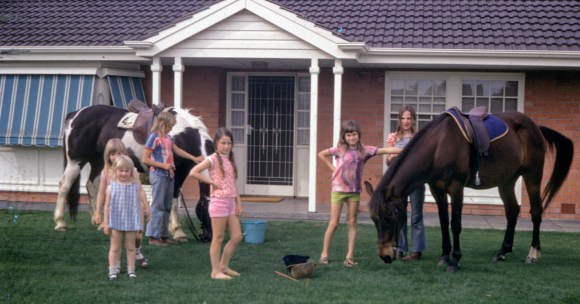
Sisters and friends and the author with horses, Whisky and Macka, outside Grandma’s house, in 1972. Photo Courtesy: Judith Stephens.
December 1972, Adelaide
I opened the fridge, pulled out some carrots and put them into the back pocket of my jeans. Then I headed into the backyard shed to retrieve my saddle and bridle. I slung the saddle over the handlebars of my bicycle and placed the bridle in the basket. Then I cycled to the first gateway to the riverbank. I left the bicycle by the fence and walked up the riverbank to find my bay steed, Macka. I couldn’t see him. Then I returned to my bike and cycled to the next entrance to the riverbank and looked for him. Still no Macka. When I entered the third entrance, I spotted him grazing by the river. I pulled out a carrot from my back pocket and held it out to him on my flattened palm. He pricked his ears, looked at me and headed towards me. He picked the carrot up with his soft lips and started crunching it. I slung the reins over his head, placed the bit in his mouth, and bridled him. Then I led him to a spot by the river where I could take advantage of the slope to stand higher than him and jumped on his back. I could never fatten him up, and his backbone pressed into my rear as I sat on him slightly askew. I regularly fed him chaff, and he grazed all day, but like some people, he remained forever thin. I rode him back to where the bicycle was, saddled him up, and trotted and cantered along the riverbank towards the sea.
This was my daily routine after school. Homework was rarely set, so I hardly ever studied in the evenings. Why would you study when you had already been at school all day? Sometimes my black labrador Jason accompanied me. In those days there were no rules about keeping your dog on a leash, so Jason would follow me, even if this meant swimming behind Macka and me to cross the river.
January 1973, Adelaide
“Meredith!” came the voice from my window at 5 am. It was my best friend, Debbie. Debbie owned a 16-hand piebald heavy horse, taller than her, called Whisky. Debbie knew that without pressure from her I would not rise this early. On this occasion, rather than being on the riverbank, Macka was stationed in the corral that Mum and Dad had built in the backyard.
I rose, dressed, and made my way to the corral to bridle Macka. Then I led him to the front yard where Debbie was waiting for me on Whisky. Today we were riding bareback, because our destination was the beach, and we were going to sit astride our horses as they swam. We headed to the riverbank and rode a kilometre to the mouth of the river. Then we rode across the sand and entered the water. When the horses started swimming, we started floating above them, my legs rising above Macka’s sides. I grabbed his mane so as not to part company with him. Then we turned the horses back towards shallow water. Once Whisky had found his feet, Debbie turned around and stood on his rump. From there she dived into the sea, quickly swam back and mounted him again. I wasn’t confident enough to attempt the same feat on Macka. Next, we headed back to shore and dismounted. We lifted the reins over the horses’ heads and held them while they rolled in the sand, thrashing their legs in the air. Then we jumped back on them, and galloped along the sand, before retracing our steps upriver.
August 2025, Monarto, South Australia
We were visiting the largest open-range safari park outside of Africa, Monarto Safari Park, an hour’s drive from Adelaide. Of all the African animals, I was most looking forward to seeing the giraffes and was excited to find myself a place on the giraffe tour. I took a seat on the bus and listened to the guide’s spiel as we made our way to the giraffe feeding station. The guide provided a bucket of carrot sticks for the tourists to feed to the giraffes.
I dipped my hand into the bucket, retrieved a carrot stick and offered it to the giraffe. He inclined his neck towards me, extended his enormous blue tongue to the carrot, gently took it between his lips, and started crunching it. I stood back in order to give the other tourists a chance to do the same, and a few came forward. In the next interval, I retrieved another carrot stick and offered it to the first giraffe. I stood back again for the other tourists, but few were interested. I ended up giving most of the carrot sticks to the giraffes because no-one else seemed to be as engrossed with this as I was. As soon as the bucket was empty the giraffes lost interest and gently loped away. I realised that the reason I was enjoying this so much was that I was reliving the experience of over fifty years earlier of feeding carrots to Macka.
In the years since the 1970s, although I never lost my love of horses, motherhood and working overseas took precedence over riding. My early years of daily caring for Macka felt like a distant dream. And yet in a distant time and space, I sometimes yearned for a simple life where I could care for large herbivores. I cannot return to 1973, and am unlikely to own a horse again, but at least I could re-experience the thrill of feeding carrots to gentle giant herbivores at Monarto Safari Park.
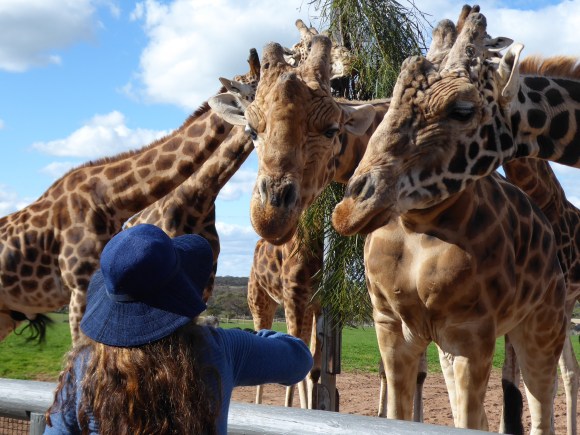
Feeding giraffes at Monarto Safari Park in 2025. Photo Courtesy: Cathie Noble.
Meredith Stephens is an applied linguist from South Australia. Her recent work has appeared in Syncopation Literary Journal, Continue the Voice, Micking Owl Roost blog, The Font – A Literary Journal for Language Teachers, and Mind, Brain & Education Think Tank. In 2024, her story Safari was chosen as the Editor’s Choice for the June edition of All Your Stories.
PLEASE NOTE: ARTICLES CAN ONLY BE REPRODUCED IN OTHER SITES WITH DUE ACKNOWLEDGEMENT TO BORDERLESS JOURNAL
Click here to access the Borderless anthology, Monalisa No Longer Smiles
Click here to access Monalisa No Longer Smiles on Kindle Amazon International
 Borderless