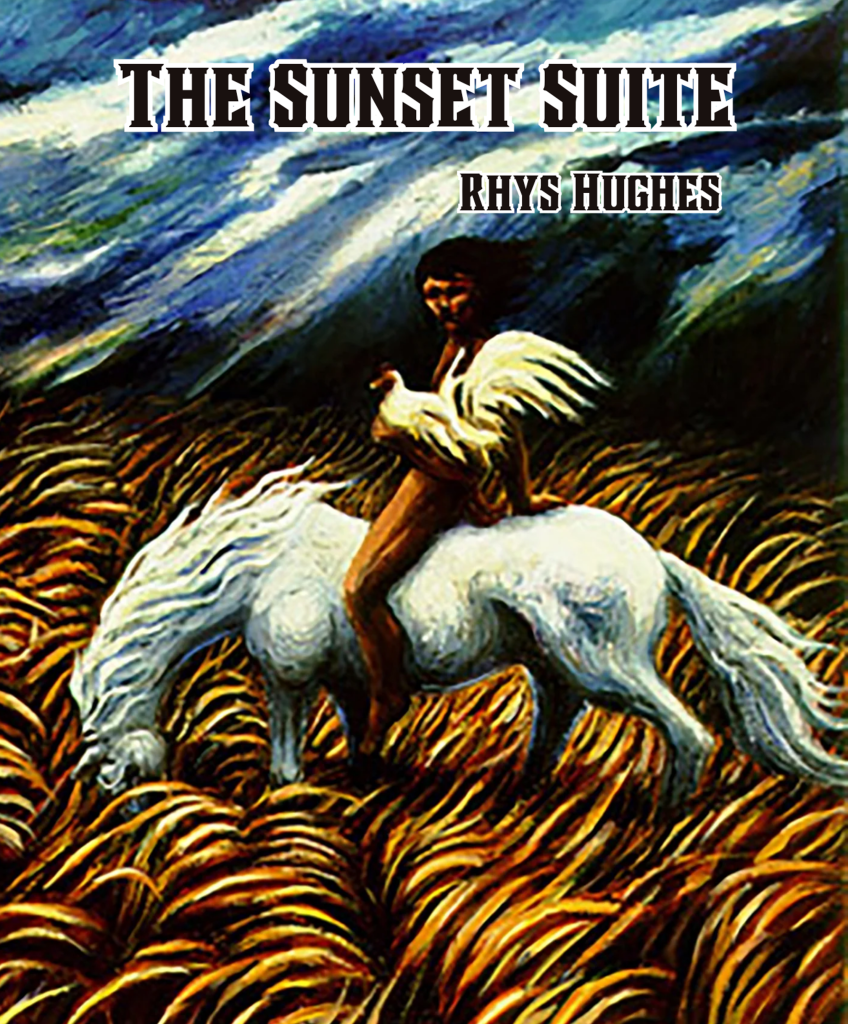
Title: The Sunset Suite (A Weird Western)
Author: Rhys Hughes
Publisher: Gibbon Moon
The two men had made camp beneath a bristlecone pine and they sat with a fire between them. The flames had died down but the embers were glowing and the pot of coffee was resting on the ashes and bubbling. They had tiny cups in their gnarled hands and sipped them as they blinked at each other and the stars over the world burned without twinkling. The first man, who was called Brand, spoke to the second, who was named Thorn, and his words were about the beverage in their cups, and his tone was awestruck.
“You know something, pard? This coffee tastes not just like coffee but also like something else. I think it tastes like a story, a different story with each cup, but a very short story every time because the cups are so small. And that’s not a normal thing for coffee to be like. I won’t say the situation is worrying, no siree, but I might venture the opinion that it’s highly unusual. The cup I drank just now tasted like an anecdote about a mule.”
And Thorn said, “You are right, Brand. What should we do about it? There is a lot of coffee remaining in the pot.”
“I guess we’ll keep drinking it, pard. But maybe we ought to tell it as well as drink it. Get those stories out there. It might be injurious to our health if we swallow them and absorb them all.”
“Agree with you, I do. The cup I just drank tasted like a fable concerning a cactus and a coyote. Should have related it to you, but I didn’t. Maybe I’ll get an attack of indigestion now. Hope not.”
“Listen then, Thorn. Let’s help ourselves to another cup each and I will tell you the story that I’m tasting. You can go second. We’ll take it in turns and keep going until the coffee pot is exhausted.”
“That dented thing looks tired already. But I know what you mean. Alright, I am waiting for you to tell me a tale.”
And the one named Brand opened his mouth.
Into the Sunset
Cowboys are often depicted riding off into the sunset. Jake Bones loved riding off into the sunset more than anything. He refused to ride in any other direction or at any other time. Sunsets don’t really last long, and so Jake rarely rode more than a mile every day. He hung around places until the sun started to turn orange and when it reddened he would mount his horse and canter towards the western horizon until the fiery ball vanished over the edge of the world. Then he would pull on the reins, dismount and look for a place to sleep. In this manner he very slowly crossed the continent. It took years for him to complete his journey and when he started, from a small town on the coast of North Carolina, he hadn’t a plan at all. He just knew he had to follow the sunset. The plan came to him five years later, when he was halfway across the mighty landmass. Jake Bones knew that one day he would finally reach the Pacific Ocean. How would he be able to ride off into the sunset then? His horse would drown if he attempted to make it swim through the rippling light. But there is a solution to every problem and he was riding through a forest of dead trees when inspiration struck. He snapped a branch off, then another, as he went, while the rays of the setting sun slanted at a lower and lower angle and finally were horizontal before they were blocked by the curvature of the Earth. Jake strapped the branches to the sides of his horse with the rope he always carried. In the days, weeks and months that followed, he acquired more branches and other pieces of wood, and the appearance of his horse changed dramatically. Finally, the tang of a salty breeze filled the nostrils of Jake Bones and he knew he had almost reached the ocean. With his knife he cut off the brim of his Stetson and turned the hat into the cap of a sailor. Then he climbed over a rise and found himself gazing down at a seashore lapped by little waves, and the sun was setting into the sea and making a ladder of reddish light towards him. That ladder beckoned and he spurred his horse the short remaining distance into the cool water. His horse was watertight and floated well and he had no anxiety as he slowly paddled towards the west. Why should a lack of land interrupt his progress? Jake Bones had converted his horse into a boat and he had done this on the hoof. He still follows the sunset and has been sighted by the crews of several ships since.
A Model Prisoner
He was guilty of shooting off the ear of a man in a saloon, a man who later died, and that’s why he went to jail. Everyone knew that Shorty Potter was quite an unpleasant individual and that he had tried to place that bullet in the brain of the mad auctioneer, Killy the Bid, but he had been drinking heavily and his aim was amiss and the ear flew off and landed in the middle of an important poker game on a table in the far corner of the saloon.
The bar keeper sent an errand boy to fetch the town sheriff and Shorty was apprehended and locked up and a trial date was set, but Killy the Bid made the incident more complicated than it might have been. The loss of his right ear left him with a ringing in his head, and at first he supposed the ringing was the noise of a train coming through the town, so he tended to stop in his tracks whenever he heard it and wait for the train to pass.
But there never was a train and he soon understood that the ringing was in his mind or maybe some form of tinnitus. He was crossing the railway tracks on a bright morning three weeks after the incident, and when he heard a ringing he just ignored it, and the train struck him and not much of Killy the Bid remained, apart from his left ear, curiously enough.
His demise was deemed wholly, albeit indirectly, a result of Shorty Potter’s discharge of his Colt in that saloon, and the public prosecutor wanted him to be charged with murder, but in the end he was charged with affray and disorder and sentenced to ten years behind bars. Ten years was considered a harsh sentence at a time when men died relatively young and Shorty was appalled at the idea. But he decided to make no trouble henceforth.
He was meek and mild and his reputation as an unpleasant fellow began to erode, at least among the other prisoners and the prison guards. Shorty became, in short, a model prisoner. He volunteered for menial tasks, swept the cells and corridors even when it wasn’t his turn, tended to inmates who fell sick, kept his own cell neat and tidy, was always polite to the guards, no matter how savagely they spoke to him, and in fact they started to soften their tone when telling him something. They eventually trusted him.
The result of all this activity was that he was awarded privileges, nothing a free man might regard as a luxury, but small liberties that any incarcerated felon would certainly appreciate. He was allowed to read books, though the choice he was offered was very limited, but not all of them were religious tracts, and a big volume of Longfellow’s poetry became his favourite. He was also permitted two hours of exercise in the yard instead of one.
Shorty Potter never pushed his luck too far. He scarcely pushed it at all, but one day he approached the most senior guard in the prison and softly asked if he might be allowed some clay. He wanted to construct models for his amusement, a hobby that nobody could surely regard with disapproval, and the guard agreed it was a great idea, an outlet for Shorty’s exuberant creativity that was obviously pent up not only by metallic bars but the rigid routines of prison life. Permission was granted. A bucket of clay was provided.
He moulded it to create little figures of men and women, and as his skills improved he made small houses, churches, even a replica of the prison itself, a model that delighted the senior guard so much he asked for it as a gift. Shorty was happy to give it to him. He produced another, deliberately not as detailed, for himself, and followed this up with ships and saloons, wagons and herds of bison, incredibly lifelike eagles and coyotes. He was especially admired for the hungry bear and a pack of wolves he made.
During this phase of his imprisonment, Shorty Potter often thought about his own surname and wondered if fate was playing a joke, but fate sometimes is kinder than that, and in this case it wanted to help him. Shorty began work on a special piece, the most ambitious of his models. He required more clay than one bucketful and it was given to him after he answered the question, “Why do you need so much?” by saying he was preparing a surprise for the prison guards, an artistic statement that would electrify them.
He worked on this project only at night. The prison guards trusted him now and waited to see what surprise he was preparing for them, and they laid bets on what his masterpiece might turn out to be. A paddlesteamer, said one. A replica of the White House, said another. One guard, pondering the word ‘electrify’ had the unhappy idea that Shorty was making a model of an electric chair, a method of execution introduced the previous year.
One morning, he failed to respond to the wake-up call. A guard rapped on his door with a short iron pole, but there was no answer. The guard peered into the cell and saw Shorty Potter still in bed, and there was something wrong with him. He looked an unhealthy colour. Had he died in his sleep? The guard turned his key in the lock and rushed inside. He shook Shorty and felt the clamminess of his flesh. No, it wasn’t flesh. It was clay!
Shorty had made a model of a man and substituted the model for himself. A decoy! He must have made his escape. But how? There were no holes in the wall and no tunnels under the cell. How had he managed this miracle? With an angry yell, the guard summoned his comrades. They felt betrayed, and it must also be admitted that they felt some respect for Shorty. He really had turned out to be a model prisoner. Then they growled:
“Send out a search party. He can’t have gone far. Shoot on sight! And get that clay model out of here. There will be hell to pay for this. No one has ever escaped from this prison before! Hurry…”
And they hurried. Two of them carried the clay model out of the cell and along the corridors to the main gate and threw it into the dust outside. Then they returned into the prison and slammed the door. One minute later, the clay model stirred, sat up and blinked, then stood. It began hobbling away from the prison until it reached the bushes. It pushed on through the undergrowth, avoiding the paths, until it reached a rapidly flowing river.
It knelt and washed itself in the foamy water and every part of its exposed skin needed a good scrubbing, all apart from the left ear. People would later say that this was a secret message to Killy the Bid about his missing right ear, but in fact the reason was merely that there hadn’t been enough clay to cover it. Shorty Potter cleaned himself and when he looked like a flesh man again, he forded the river with difficulty and reached the far side.
Then he started running for the hills. He reached them too, a sanctuary safe from his pursuers. But on the sixth day of his newly-won freedom, as he walked over a fissured plateau, he slipped down a narrow crevice…
About the Book
Coffee around a camp fire. But every cup tastes like a story. And so the two cowboys, Thorn and Brand, exchange tall tales as they drink. And they will keep telling stories until the pot is empty. They will relate implausible and incredible accounts of outlaws, pioneers, visionaries, musicians, lawmen, warriors, ghosts, mountain men, dreamers and hellfire preachers. They will gradually and inevitably turn into stories themselves as they sit beneath the bristlecone pine tree…
“Rhys Hughes seems almost the sum of our planet’s literature. He toys with convention. He makes the metaphysical political, the personal incredible and the comic hints at subtle pain. Few living fictioneers approach this chef’s sardonic confections, certainly not in English.” — MICHAEL MOORCOCK
“If I said he was a Welsh writer who writes as though he has gone to school with the best writing from all over the world, I wonder if my compliment would just sound provincial. Hughes’ style, with all that means, is among the most beautiful I’ve encountered in several years.” — SAMUEL R. DELANY
About the Author
Rhys Hughes is a writer of Fantastika and Speculative Fiction.
His earliest surviving short story dates from 1989, and since that time he has embarked on an ambitious project of writing a story cycle consisting of exactly 1000 linked tales. Recently, he decided to give this cycle the overall name of PANDORA’S BLUFF. The reference is to the box of troubles in the old myth. Each tale is a trouble, but hope can be found within them all.
His favourite fiction writers are Italo Calvino, Stanislaw Lem, Boris Vian, Flann O’Brien, Alasdair Gray and Donald Barthelme, all of whom have a well-developed sense of irony and a powerful imagination. He particularly enjoys literature that combines humour with seriousness, and that fuses the emotional with the intellectual, the profound with the light-hearted, the spontaneous with the precise.
His first book was published in 1995 and sold slowly but it seemed to strike a chord with some people. His subsequent books sold more strongly as my reputation gradually increased. He is regarded as a “cult author” by some and though pleased with that description, he obviously wants to reach out to a wider audience!
.
PLEASE NOTE: ARTICLES CAN ONLY BE REPRODUCED IN OTHER SITES WITH DUE ACKNOWLEDGEMENT TO BORDERLESS JOURNAL
Click here to access the Borderless anthology, Monalisa No Longer Smiles
Click here to access Monalisa No Longer Smiles on Kindle Amazon International
 Borderless