Categories
Essay

Walking about London Town

By Sohana Manzoor

The first thing I realised while walking around London is that not a single one of all the people I had known who had been to England, told me how charming the city is. The buses with open tops, the red telephone booths, Big Ben, the London Bridge and all those pretty buildings simply fascinated us. So, before heading out for Haworth, we walked around in London and took Duck’s tour and saw some really enchanting stuff.
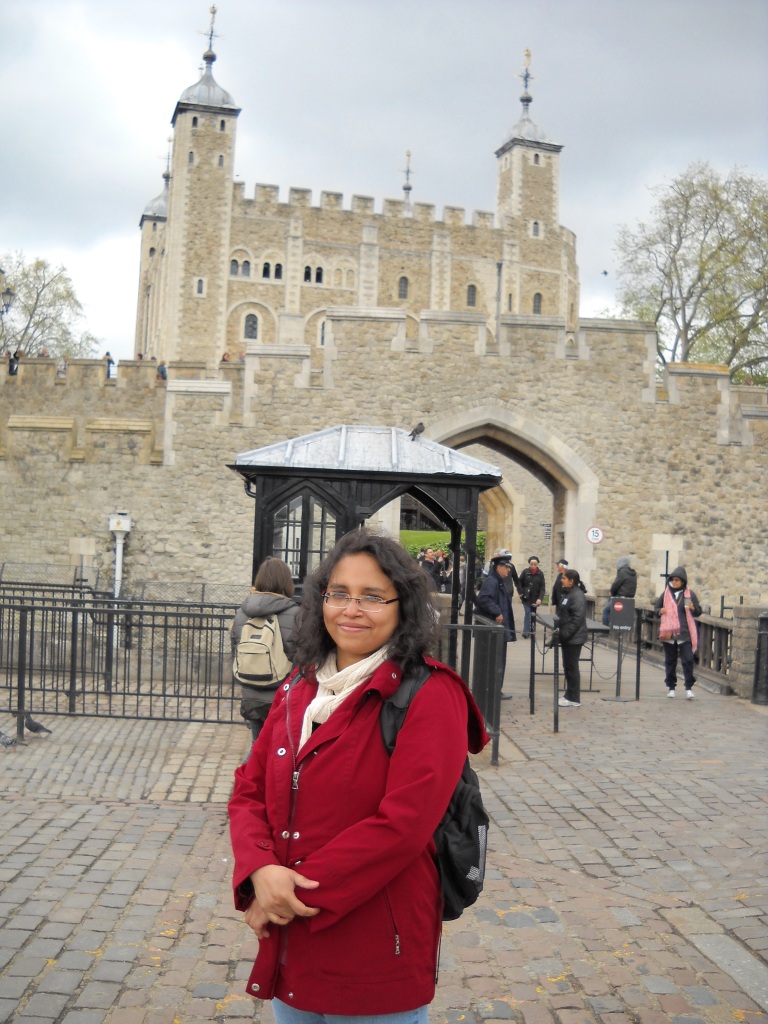
Sohana at the Tower of London

We spent a large part of a day at the famed Tower of London, which is literally a thousand years old, first built by William the Conqueror in the 11th century. Our visit began with a tour by a Beefeater (also known as a Yeoman Warder), who gave us a general overview of the Tower’s history. He had a wicked sense of humor and kept making puns like “Let’s be heading this way.” We saw Tower Hill, the site of public executions on the scaffold, and also Tower Green, where Anne Boleyn and Lady Jane Grey were executed – the spot is now commemorated by a glass sculpture with a pillow on top. The tour ended at the Chapel Royal of St Peter ad Vincula where those executed on Tower Green (including Boleyn and Jane Grey) are buried. Afterwards, we took a picture with the Beefeater outside the chapel.

Next, we went to the building that houses the Crown Jewels. Our eyes were dazzled by the rich display of crowns, scepters, and orbs bejeweled with diamonds, rubies, sapphires, and every kind of precious stone possible in the vault. We also saw the famed Kohinoor diamond, set in the Queen Mother’s crown, as well as the crown worn by the late Queen Elizabeth II. After the crown jewels, there was also a section of gold plates, serving dishes, goblets, wine jugs, etc. that were used for ceremonial occasions by various monarchs. We will probably never again see such a display of wealth, and perhaps there is no other place with so much wealth on display in one place. However, all the gold and perhaps some of the obnoxious histories attached with the splendour on display started to make me feel nauseous, so I was glad to get out into the open air.

We looked around in the White Tower, which stands in the center with a display of military equipment and history. Then we went to the Beauchamp Tower, which is known for the graffiti on the walls left by various prisoners, including some very high-profile ones. At one point, when I saw the graffiti attributed to Robert Dudley, Earl of Leicester, I stood rooted to the spot. It was incredible to think we were standing in the same room where such illustrious prisoners once lived, carving their convictions into the walls.

We walked around the grounds, taking pictures, and then came across some costumed characters, including James Scott, Duke of Monmouth, who posed with me graciously for a picture. The costumed characters put on a dramatic reenactment of James trying to claim the throne. James Scott is the fellow who required several blows of the axe, followed by a butcher knife, during his beheading on Tower Hill by the half-drunk Jack Ketch. The Beefeater told us the story in all its gory detail, though the reenactment, thankfully, included the trial but not the execution.

We took pictures, including one of Nausheen posing with a raven. These birdsare kept and bred on the grounds of the Tower. Apparently, they have kept at least half a dozen ravens since the time of Charles II, who thought the Tower would fall and the empire disintegrate if he did not always keep ravens there. There is even one beefeater whose job it is to feed and take care of the ravens! Finally, we also saw the room where Sir Walter Raleigh was imprisoned for many years, and the place where he used to walk back and forth (now called Raleigh’s Walk), and I got goose bumps.

Our day ended with a brief stop at Tate Modern, which is just across the river from the Tower. I’m not really into modern art, and as I paused in front of a famous painting by Picasso, I had to admit that I understood nothing about its greatness. To me it looked like a misshapen human figure lying on its side. Nausheen kept on dancing around the pieces and went on explaining what she had learnt in conjunction with modern poetry.
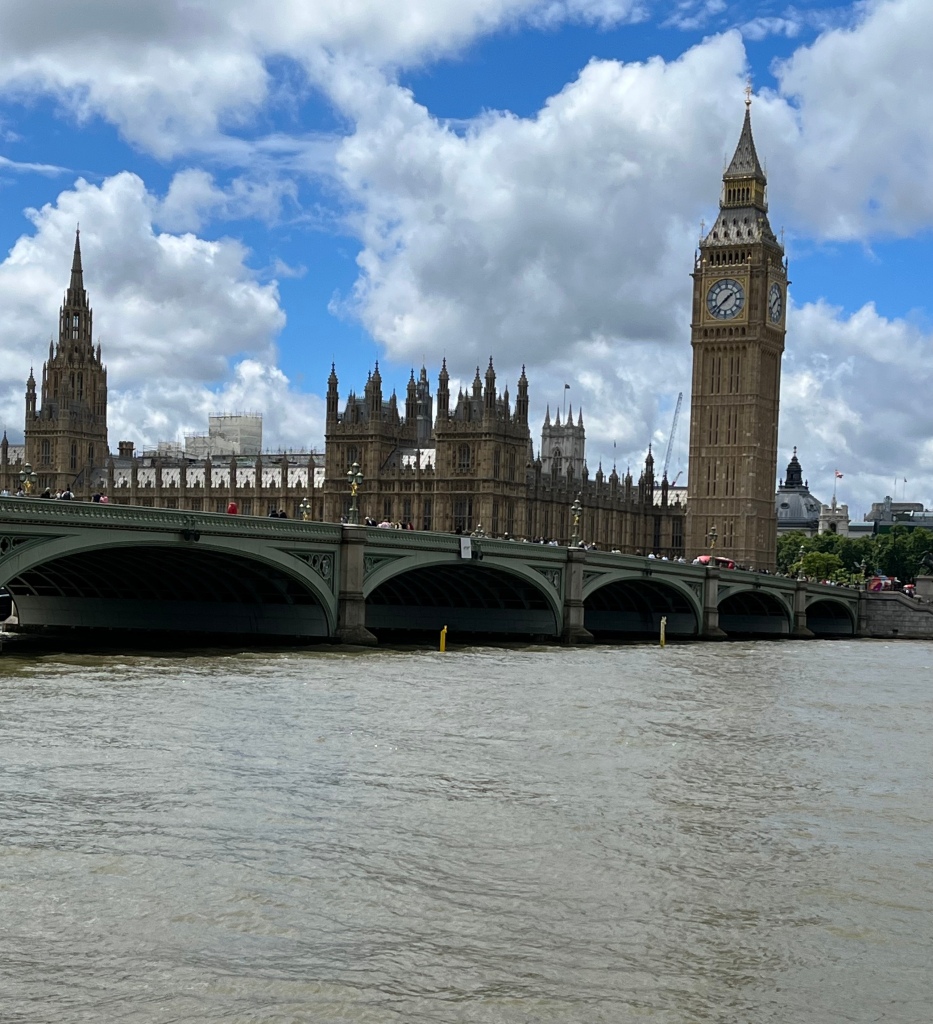
The Parliament & Big Ben

Next morning, we passed Big Ben and the Houses of Parliament on our way to Westminster Abbey where kings and queens are still coronated, and where many notable historical, political, and literary figures are buried. It was very crowded, but also a very solemn kind of place – kind of dark and gloomy, with tombs and effigies all around, and Latin epitaphs everywhere. Many of England’s kings and queens are buried here, and we saw the tombs of Henry VII, Elizabeth I, Bloody Mary, and Mary Queen of Scots. The tomb of Queen Elizabeth felt unreal – almost as if it was part of a dream I had nurtured for long.

Eventually, we made our way to the Poets’ Corner, which Nausheen was especially eager to see. She got excited seeing the tomb of Chaucer, who was the first to be buried in the Poets’ Corner. We both patted the tomb in homage to the great man. We also saw tombs of various other poets and writers, such as Austen and Dickens, and memorials to writers who are buried elsewhere, but commemorated here nonetheless, such as Shakespeare and the Brontës. Finally, we stopped at the museum shop to buy some souvenirs.

The afternoon saw us at the Tate Britain. We took a tour with one of the museum guides, who took us through the Turner wing. It was really great that they have an entire wing devoted to Turner, since his work is familiar to me from my dissertation supervisor, Dr. Collins’s course. There were also paintings by Constable and Gainsborough, but of course, Turner’s are the most dramatic and majestic. There was also a smaller wing dedicated to Blake’s prints, paintings, and engravings. However, the ones that are most familiar to us, from Songs of Innocence and Experience, are mostly elsewhere, such as in the British Museum, so there were only a handful of those.

The next day was cold and gloomy and we decided to stay in. We made plans of visiting Hampstead, the home of the young Romantic poet John Keats the day after. I knew days would be bad as I was developing a fever. But I could surely rest for one day.

Sohana Manzoor is an Associate Professor at the Department of English and Humanities at ULAB, a short story writer, a translator, an essayist and an artist. This essay was previously published in The Daily Star in January 2019.

PLEASE NOTE: ARTICLES CAN ONLY BE REPRODUCED IN OTHER SITES WITH DUE ACKNOWLEDGEMENT TO BORDERLESS JOURNAL

Click here to access the Borderless anthology, Monalisa No Longer Smiles

Click here to access Monalisa No Longer Smiles on Kindle Amazon International
Categories
The Literary Fictionist

Walls

By Sunil Sharma

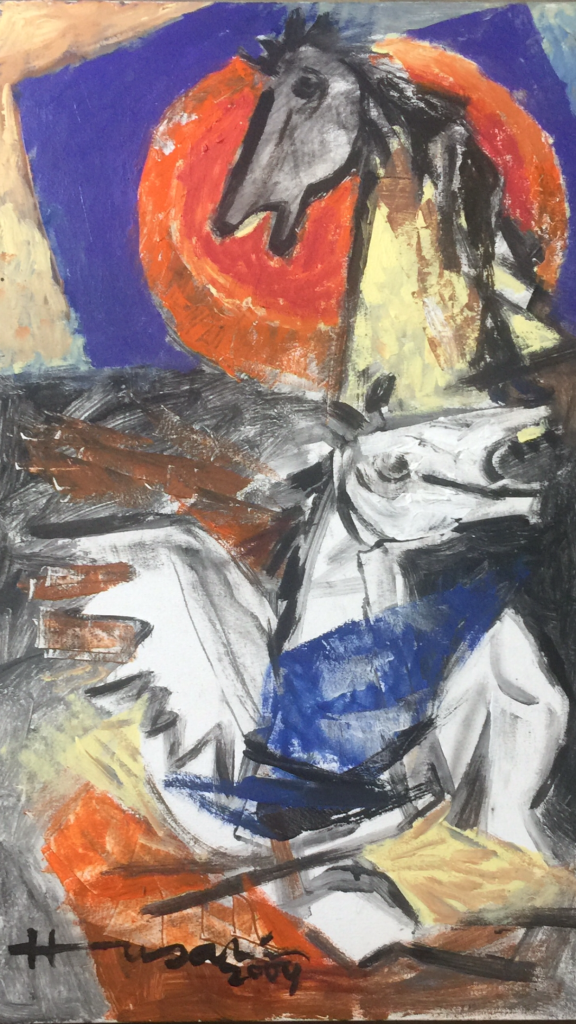
Pegasus in Blue by MF Hussian, 2009. Courtesy: Creative Commons

“There is a man, at the gate, who says he is the brother of Madam Goodman,” the nervous Gurkha announced in a low, soft whisper oozing respect.

“A brother?”

“Yes sir.”

Mr. Goodman turned to his bejewelled short portly wife.

“Do you have a brother…I mean, a real blood brother?”

“Not as far as my human memory can recall,” declared Mrs. Goodman in a cheerful voice, surveying the Saturday-night-party going on in the big hall of exquisite chandeliers and imported Italian tiles.

“But there is a man, at the gate, who claims to be your kin,” persisted Mr. Goodman in a tipsy voice. Young couples, in various stages of drunkenness and fever, were dancing to a loud orchestra. December night of cold foggy winter and a howling wind was knocking the windowpanes of the huge hall. “A who?” demanded Mrs. Goodman, refusing to tear her slightly reddish eyes, from the un-rhythmic crude dance of the fused couples.

“A man,” Mr. Goodman said patiently, his alcoholic eyes surveying a lissome beauty’s body contours, like a hungry caveman attacking the raw flesh of an animal, “Your brother…resurrected from void…wants to see you.”

Mrs. Goodman felt irritated by this unauthorized intrusion of an alien. Her porcelain-white face, with painted cheeks, arched eye-brows distorted in fury, “We demand to see that imposter. Now… in our study.”

The small Gurkha cringed in fear.

The private study was small and comfy. In the tradition of a European or a British manor house. Hard, leather-bound books from the floor to the ceiling- all of them untouched. A leather -bound sofa; a centre glass-topped table; two low stools and a crackling hearth.  A large M.F. Husain– those galloping horses against a featureless background– to lend an ‘ethnic’ touch to essentially the foreign opulence. The man was ushered in, Mrs. Goodman did not like the appearance of this new object: small, medium-height, grizzly; wearing rumpled denim jeans, a brown turtle-neck sweater sitting tight on a protruding belly, a crumpled jacket and tear-shaped bifocals that enlarged his big brown eyes brimming with brotherly love and tenderness; and an imitation crocodile skin brief-case. Mrs. Goodman looked at him and looked hard.

The man, intimidated, said, “How are you, sis…my beloved sister?”

Mrs. Goodman did not register. Incomprehension. The man waited for a response.

“You OK., Leela?”

Mrs. Goodman looked on uncomprehending.

“I am your younger brother…Your little Kabir.”

Mrs. Goodman, a perfect picture of faded aristocracy, said, “I have no brother.”

Thunder rolls and lightning strikes. The little man said, “Have no brother? What do you mean?”

“You heard me.”

“Come on, Leela.”

“Mrs. Goodman,” said the lady sharply, “The wife of a top diamond merchant of South Africa, on a winter vacation in the mystical magical India.”

“Cut the crap…You are Leela…the same old little sis good at play-acting.’

A young man popped in, “Any problems, Ma?”

“How are you, Rajiv? I am your maternal uncle.”

The man smiled and said nothing.

“This little man says he is my brother.”

The young man smiled broadly, “Oh, not again! The rich and famous have carloads of unclaimed relatives.’

Roll of thunder and lightning. “I can prove it,” the little man insisted.

“How? By calling God to the witness stand?” the young man asked.

“Or through genetic study?” enquired the booming voice of Mr. Goodman from the doorway, “Welcome to our private and exclusive little world, Mr.….?”

“Kabir, your little brother-in-law.”

Both the men surveyed each other: the former with open curiosity and the latter with fond remembrance. Mr. Goodman sank in the sofa, whipped out a Havana cigar, lit it, emitted a rich aromatic smoke, “How do you prove your kinship, Mr. Intruder?”

The little man, a bit confused, sat down on the opposite chair of the sofa set.

“I can prove it — if proof were required, although in blood relations no proof is required…blood recognises blood.”

“Ok. Proceed,” says Mr. Goodman, “Make it quick…we have thirty guests on our hands for this champagne- and-dinner party.” The little man fishes out a frayed small pocket-sized family album, opens it on the third page and announces, “Here you are…This picture…see, Leela and I….”

The picture is grabbed greedily by the Goodman family: a sixteen-year-old “Leela” and a ten-year-old Kabir against a railway bungalow with lots of shady trees in the background.

“And this one: When she staged a play…. Ah! King Lear, yeah…at the auditorium of the Railway Officers’ Club…I am third there… And this wedding picture…she and you at the reception…”

The pictures were scrutinised carefully. “And this New-year greeting-card from Leela with her signature from Johannesburg…” Mrs. Goodman seems bored, “My cat, my cat…where is my favourite cat?”

The young man “Rajiv” presses a bell. A male servant puts his face in the doorway.

“Fetch Kohinoor.”

 Within seconds, a beribboned white cat is brought by a liveried maid servant. Mrs. Goodman is all affection, “Come on, sweetie, my precious, my L-O-V-E…”

“Anything else?” demands the merchant of diamonds and orders a large one for him.

“Like?” the little man asked.

“Anything… family trivia…”

“My L-O-V-E,” coos Mrs. Goodman.

“Family trivia? You mean family history?”

“Yeah…sort of…”

“My precious,” sang Mrs. Goodman.

“Well, our father was a station master at Lalitpur…he met your father there who was a personal valet of an English captain Mr. Goodman. Mr. Goodman was a bachelor and very wealthy…he was very fond of your family, especially your mother’s artistic talent…You were young and handsome…. People called you an Englishman.”

“Ha, ha, ha,” The merchant laughed like an Englishman, “He was more than a father to me…. Good.”

“The English captain acted as a matchmaker. He arranged this match between Leela and you. He stayed on in the free India and invested a lot and wisely here and multiplied his wealth. Then, in late 60s he moved on to South Africa along with your family…There he invested a small fortune in the diamond industry and became stinking rich. After his death, you inherited the business.”

“My cuties,” Mrs. Goodman crooned, “what a wonderful creature!”

“Wonderful,” declared Mr. Goodman.

Mrs. Goodman returned her attention to the new object of the study.

“Are you listening?” asked Mr. Goodman.

“Yeah…listening pretty good…So, this interview is now over?” enquired Mrs. Goodman.

“What is the judgment?” Rajiv quipped.

“Well, the photographs can be manipulated, autographs forged, and family trivia can be collected by any good detective. In short, this man is an imposter,” said Mrs. Goodman. Her voice is devoid of any emotion. Like a judge pronouncing death sentence in a cold, impersonal tone.

“And Leela, why should I do that?” asked the devastated little man, Kabir.

“For money, maybe,” ventured Goodman Sr.

“I see,” said Kabir, hurt obvious in the weather-marked, lined face and voice, “I see now…Your whole world revolves around money only…Money, status, parties…You have no idea of emotions and love and beauty.”

“Wrong,” butts in Rajiv. “My Ma and pop love animals, paintings and people. Ask our staff.”

Silence — heavy, awkward. The little man Kabir looks at their well-fed, contented faces. He faces them and asks Leela, “You recognize me?”

“No.”

“You, Mr. Goodman?”

“No.”

“You, Mr. Goodman, Junior?”

“No.”

And he was denied thrice.

“OK! sorry to disturb you. I did not come here to claim money but to claim the affection of my elder sister and her family. I wrote letters for many years and made an occasional call but got no response…Today, I made bold to come over here and reclaim a part of my emotional existence… Now, I find I was wrong in my pursuit.” He paused sadly and looked at them again. No response. He concluded, “If claiming a sister or a brother as your own is a crime, I am a criminal. Goodbye.”

As a courtesy, Goodman Jr, escorted the man to the gates of the spacious, sprawling farmhouse in Delhi. The party was in full swing.

Alcohol, tobacco smoke was in the air. “A parade of obscene wealth,” thought the intruder.

“OK! It was a nice encounter,” said Goodman Jr. ironically, lips pursed.

“Or a non-encounter?” asked the man. They shook hands. When he looked up, he saw his own face mirrored in the face of Goodman Jr.

Mesmerised, he again looked: his own face beamed back at him.

Kabir shuddered at the unreality of the whole situation and resumed a long walk towards the first bus stop.

Sunil Sharma is an academic and writer with 23 books published—some solo and joint. Edits the online monthly journal Setu. 

Sunil Sharma,PhD (English), is a Toronto-based academic, critic, literary editor and author with 23 published books. His poems were published in the prestigious UN project: Happiness: The Delight-Tree: An Anthology of Contemporary International Poetry, in the year 2015. Sunil edits the English section of the monthly bilingual journal Setu published from Pittsburgh, USA:
— https://www.setumag.com/p/setu-home.html  
 For more details, please visit the link:— http://www.drsunilsharma.blogspot.in/

.

PLEASE NOTE: ARTICLES CAN ONLY BE REPRODUCED IN OTHER SITES WITH DUE ACKNOWLEDGEMENT TO BORDERLESS JOURNAL.