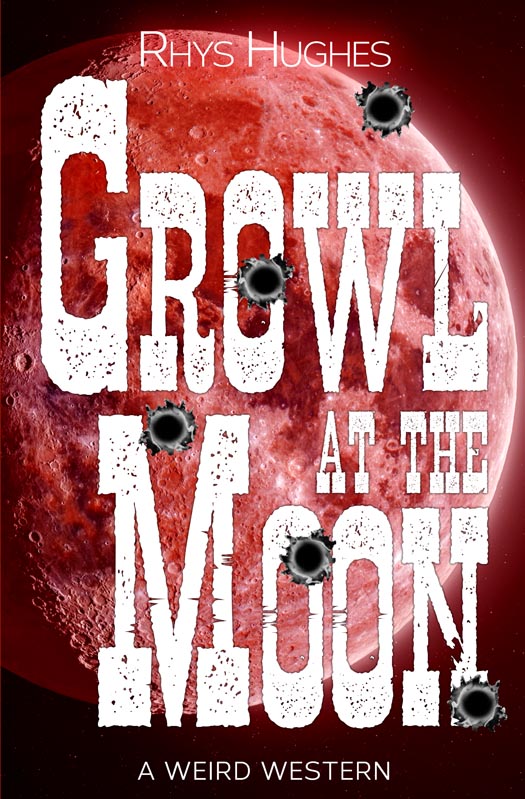
Title: Growl at the Moon, a Weird Western
Author: Rhys Hughes
Publisher: Telos Publishing Ltd
1.
She rode to the crest of the hillock and looked down. The other rider was a pale shadow on the trail below and in the moonlight his shadow was even paler than he was. That was because of the mica in the rocks which gleamed, glittered and shone and turned the landscape into something ethereal and strange. With a low snarl, she spurred her horse forwards.
She zigzagged down the slope and still the other rider didn’t hear her. Was he engrossed in his private thoughts? That must be the answer. Her Winchester was cradled in her arms and her low snarl turned into a stealthy laugh. Her prey seemed oddly incautious, but this was to her advantage. At the base of the slope, she spurred her mount to a fast canter.
The other rider finally became aware that something was behind him. As he turned in his saddle, she raised the rifle and aimed at his face. She slowed in order to be sure of hitting him square.
“Hey, what’s this?” he cried in astonishment.
His head, which was that of a giant rabbit, bobbed up and down, his nose twitched and his long ears undulated.
“Howdy, pard,” she said, and then she added, “I guess you think I’m just a bandit, some unwashed desperado who wants your money. But that’s not true at all. My name is Jalamity Kane and I’m hunting all the men who are part animal. I know what it means that you’re a man-rabbit, it means that you studied with a shaman, one of the Mojave wizards.”
“Well, yes I did,” answered the other rider.
“I make the same speech every time I find one of you people. When I was younger and full of hope and desire, I also sought out a shaman to study with. I found one. Seven years in a subterranean cavern, putting myself through horrid exercises, expanding my mind! But it didn’t work, I didn’t acquire the power. I failed and my soul became bitter. It’s not nice to be bitter and that’s especially true when I look upon your sweet little visage. Gonna blow a hole right through it. Say your final prayers, bunny boy!”
The other rider raised a paw to remonstrate with her but it was too late. Her finger squeezed the trigger and the canyon echoed with the shot. He slumped in the saddle and his horse bolted. He didn’t fall off but remained in place, his feet held by the stirrups. Jalamity watched him vanish into the crystalline darkness. She said to herself, “I’ll destroy all of you. I have no interest in money. I have no interest in anything, only in slaying every cat-man, owl-man, worm-man and cougar-man in the land. You’ll see!”
It was her mission in life. A cruel and futile mission, but a mission all the same, and a gal’s gotta have a mission.
2.
Jalamity was in position to ambush her next victim. She squatted in the shallow pit she had dug. The dry plain extended all around here, as flat as a tune played on a badly-maintained piano in a rotten old saloon somewhere in the worst kind of decayed ghost town where the railroad was supposed to come but didn’t. She had constructed her own cover because there was no natural cover available in the geography of the bland landscape.
The rider was a puff of dust at the limits of her vision. It was early evening and he was evidently trying to cover as many miles as possible before night fell and she chuckled at the malevolent thought that he was hurrying to his doom, a circumstance he would soon be aware of. The Winchester was firm in his grasp and she chewed a stick of licorice root.
This wasn’t European licorice or Glycyrrhiza glabra which also grew in a few places in a few states, having been brought over by settlers, but the harsher Glycyrrhiza lepidota that the Zuni people had liked to chomp as a medicine. Not that Jalamity needed a cure for anything. She just liked to chew on something at the end of a day and she hated tobacco.
She waited patiently as the cloud of beige dust that was the rider expanded in size and took on more of a familiar shape. His horse was tiring a little and his pace was slowing. As he approached, she saw that he wore a hood. All of these fools liked to cover their telltale faces!
She stood up straight, rising out of the pit like a snake about to strike, and strike she would, by which we mean attack and not cease working because of dissatisfaction with pay. She cared nothing for wealth. No ordinary bandit, this Jalamity, half woman and half man, the product of seven years’ meditation that hadn’t worked out the way she’d wanted.
“Hey, what’s this?” he cried in astonishment.
His head, which was that of a giant squirrel, bobbed up and down, his nose twitched and his jaws chattered.
“Howdy, pard,” she said, and then she added, “I guess you think I’m just a bandit, some unwashed desperado who wants your money. But that’s not true at all. My name is Jalamity Kane and I’m hunting all the men who are part animal. I know what it means that you’re a man-squirrel, it means that you studied with a shaman, one of the Mojave wizards.”
It was the same speech, or nearly the same speech as before. It was a short speech but one she had made dozens of times. Very few people ever got to hear it more than once, apart from herself.
An occasional victim escaped her, but it was such a rare event that in terms of statistics it counted for nothing at all.
Jalamity was now reaching the end of the speech. “Gonna blow a hole right through ya. Say goodbye, squirrel boy!”
The other rider raised a paw to remonstrate with her but it was too late. Her finger squeezed the trigger and the plains absorbed the sound of the shot. First he slumped in the saddle and then he fell off. His horse didn’t bolt but remained where it was, looking confused. One day, Jalamity knew, she would meet a man who was half horse. What would the horse he rode on do then? Would he regard Jamality as an enemy of all horses and try to kick her? She had no idea. It was a riddle that only the future could solve.
Most horses didn’t care about their riders but that one might be different. It was better to wait to find out the answer for sure. Speculation was a waste of her time. She climbed out of the pit, moved to the side, leaned over and reached out with her hands and jerked her wrists.
An unseen blanket came up in her fingers. Her horse was beneath it, lying on its side, and now it got clumsily to its hooves. She had covered it with a sheet and covered the sheet with sand and gravel and grit so that it resembled only the smallest of humps in the almost featureless plain. There had been nowhere else to hide it. She could have dug a pit, as she had for herself, but that would have been very hard work. Alternatively, she could have covered herself with a sheet too, but that would have restricted her visibility. Everything had worked out for the best. The squirrel-man was dead.
And now she had his horse as well. She could maybe use his horse as some part of a trap for her next victim. Killing these beasts was her mission in life. A cruel and futile mission, as we already have been told, but yes, a mission all the same, and a gal’s gotta have a mission.
About the Book
Bill Bones was a normal human being until he studied under a Mojave Shaman and was transformed into a man-dog called The Growl. Now, driven by a keen sense of justice, The Growl is on the hunt for the villains who killed his boss, newspaperman Ridley Smart … and he’ll stop at nothing!
Crossing the deserts and forests of the American continent, The Growl searches for the men he must kill. Along the way he meets more beast-men, more magicians, the avenger Jalamity Kane who is seeking to rid the world of the beast menace, and other dangerous characters, from the artificial to the wild, from the robotic to the demonic.
In the deft hands of Rhys Hughes, this inventive tale becomes a masterpiece of twists and turns … exploring and questioning our definitions of humanity, discovering the very meaning of what life and reality might be.
About the Author
Rhys Hughes is a writer of Fantastika and Speculative Fiction.
His earliest surviving short story dates from 1989, and since that time he has embarked on an ambitious project of writing a story cycle consisting of exactly 1000 linked tales. Recently, he decided to give this cycle the overall name of PANDORA’S BLUFF. The reference is to the box of troubles in the old myth. Each tale is a trouble, but hope can be found within them all.
His favourite fiction writers are Italo Calvino, Stanislaw Lem, Boris Vian, Flann O’Brien, Alasdair Gray and Donald Barthelme, all of whom have a well-developed sense of irony and a powerful imagination. He particularly enjoys literature that combines humour with seriousness, and that fuses the emotional with the intellectual, the profound with the light-hearted, the spontaneous with the precise.
His first book was published in 1995 and sold slowly but it seemed to strike a chord with some people. His subsequent books sold more strongly as my reputation gradually increased. He is regarded as a “cult author” by some and though pleased with that description, he obviously wants to reach out to a wider audience!
PLEASE NOTE: ARTICLES CAN ONLY BE REPRODUCED IN OTHER SITES WITH DUE ACKNOWLEDGEMENT TO BORDERLESS JOURNAL
Click here to access the Borderless anthology, Monalisa No Longer Smiles
Click here to access Monalisa No Longer Smiles on Amazon International

 Borderless