Book Review by Anindita Basak
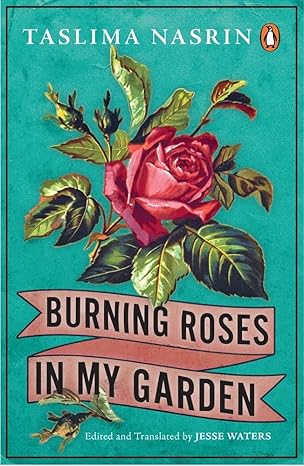
Title: Burning Roses in My Garden
Author: Taslima Nasrin
Translated from Bengali by Jesse Waters
Publisher: Penguin Random House India
Imagine a woman bound by shackles – not of iron, but of her own people, her country, her religion, and above all, by men. This is not just a metaphor; it is the reality that moulded Taslima Nasrin’s life and journey as a writer. Her first English poetry collection, Burning Roses in My Garden (translated and edited by Jesse Waters), gathers 103 poems that bear the scars of exile and the defiance of survival.
Nasrin, hounded by fatwas and banned for her unflinching criticism of patriarchy and religious dogma in Bangladesh, writes from the margins yet refuses to be silenced. The anthology commences with early meditations on passion and desire, seen in poems like ‘A Bouquet of Scarlet Envy’ and ‘On Love’, toward darker elegies like ‘The Cycle of Loneliness’, ‘Walking through This Life and into Death’, and ‘Am I Not to Have a Country of My Own?’ that grapple with loneliness, mortality, and the burden of political banishment. These poems become the very tools with which she breaks the restraints, not to escape them, but to forge them into weapons of truth.
The collection opens with poems like ‘On Love’, which delve into romantic love and intimacy as the poet tenderly explores physical connection through sensory detail. In the piece ‘The Last Kiss’, the poet reminisces about a lover’s touch that transcends geographical boundaries. “That kiss that brought an entire world within her grasp, /…a rush of youth, /His kiss was becoming more than him,” compares her memories to permanent imprints. These early poems in the collection reveal a different register – more vulnerable, more willing to dwell in private emotions rather than public testimony. It creates a counterpoint to the later poems of exile and loss, suggesting what was left behind when she was forced to choose between fragile love and unwavering candour.
Through images of loss and displacement, which work both as wound and testimony, the poet confronts her banishment with stark honesty: “To me, my country is now a crematorium. /A lonely dog stands and whines all night, a few/Pyre-makers lie here and there, drunk to the bone.” In her traversal of exile, she transforms personal anguish into universal questions of belonging and continues to write from a place of loss. Her voice carries the weight of those who cannot speak, turning poetry into both elegy and resistance.
Feminist consciousness also flows through Nasrin’s verses with unflinching directness. In ‘Another Life’, she exposes the grinding reality of women’s domestic servitude through devastating metaphor: “Women spend half of their lives picking stones from rice. /Stones pile up in their hearts.” The image suggests not only physical drudgery but emotional calcification – the heart itself becoming a repository of unspoken grievances. Her feminist vision extends beyond individual suffering to collective oppression, revealing how patriarchal structures trap women in cycles of invisible labour.
The poet’s political views turn philosophical, confronting mortality while examining the cost of speaking truth to power through the lens of displacement and exile. This progression from the collection’s early love poems to these darker meditations reflect not only her growing maturing but also usher in a socio-political awakening – the recognition that private desire cannot exist separately from public consequence.
Nasrin doesn’t shy away from contemporary political realities; instead, she shows how religious fundamentalism and state censorship became suffocating forces that compress individual expression. She highlights the way authoritarian systems silence dissent through both legal mechanisms and social ostracism. In ‘Am I Not to Have a Country of My Own?’, she directly questions the price of dissent and the meaning of citizenship when one’s own nation rejects its truth-tellers. In contrast, particular tender pieces like ‘Miserable Ma’ highlight the endurance of personal relationships despite geographical separation within the collection’s otherwise relentless critique.
This collection’s strength lies in its refusal to separate the personal from the global. An American poet and professor, Waters preserves Nasrin’s directness in her translation while maintaining the emotional intensity that makes her work so compelling. These poems serve as both autobiography and historical document, charting one woman’s journey from intimate expression to public testimony. Her masterful use of juxtaposition, placing tender domestic moments against brutal political realities, creates a poetic tension that amplifies both spheres of experience.
Ultimately, Burning Roses in My Garden becomes a new mythology of endurance, not the tidy myth that comforts, but a foul-weather myth that survives storms. In the current climate, Nasrin’s poetry resonates with startling immediacy – mass rallies, hardline backlashes, midnight vigils, and student protests – the streets themselves find their voice through her verses. As if to remind us what her poetry truly stands for, the last poem of the collection bears the words: “I don’t write poetry, I write life on paper. /I don’t write poems; the wind that hits my body/When I stand on the top of a hill? I pen it down.” In closing lines like “when all game ends… I’ll sit down to write about love,” Nasrin promises that love’s survival against cruelty becomes an article of faith. The world of the poet and that of the reader blur here, and in that blurring, a strange comfort arrives, a lesson that even in a country’s crematorium, the rose of hope can burn and perfume the air.
Anindita Basak, a student at the University of Calcutta, is an avid enthusiast of literature and philosophy. Her published works include poetry, prose, and reviews in reputed magazines.
PLEASE NOTE: ARTICLES CAN ONLY BE REPRODUCED IN OTHER SITES WITH DUE ACKNOWLEDGEMENT TO BORDERLESS JOURNAL
Click here to access the Borderless anthology, Monalisa No Longer Smiles
Click here to access Monalisa No Longer Smiles on Kindle Amazon International
 Borderless