Categories
Review

Flaming Forest, Wounded Valley

Book Review By Rakhi Dalal
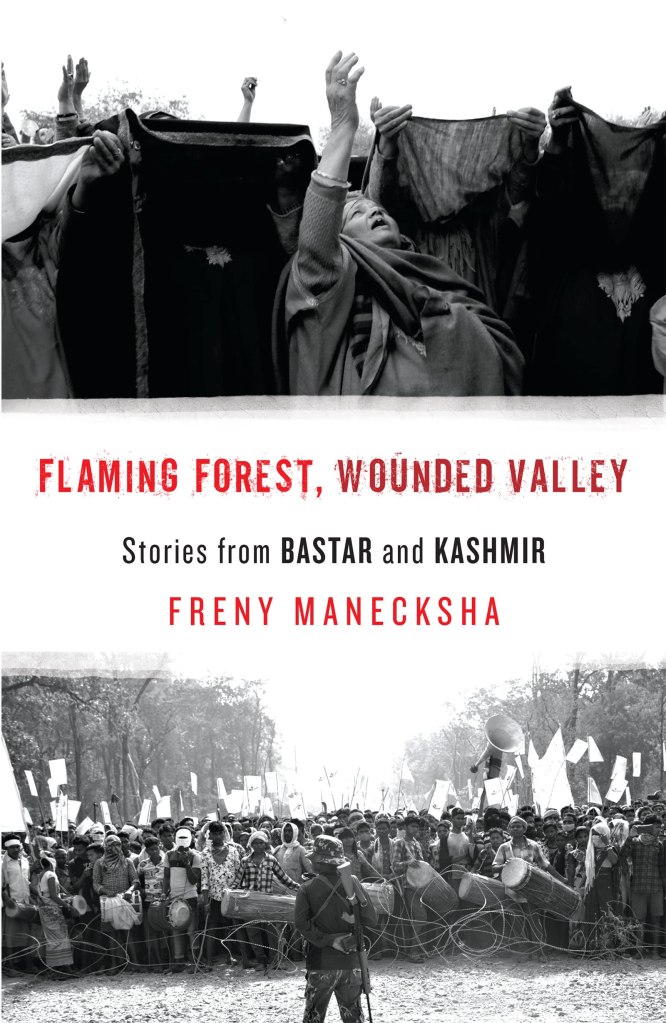
Title: Flaming Forest, Wounded Valley: Stories from Bastar and Kashmir

Author: Freny Manecksha

Publisher: Speaking Tiger Books

People who have never lived in or around conflict riddled zones, have a scant notion of how the politics of a nation impact survival in such places. In the name of curtailing extremism, the punitive measures adopted, achieve little more than turning daily living into a nightmare. How would one feel if the forces employed by a state, supposedly to safeguard the common people, barge into their homes unannounced at any time whether day or night and leave them terrified? Or, if a group of civilian people are fired at by the forces while sitting in their fields discussing as routine a thing as celebration of a festival?

In a country like India where the mainstream media turns a blind eye and sometimes help propagate a biased and false narrative, it takes courage of a few who, despite looming threats, try to bring in stories from such places, stories that tell of the oppression of common people both at the hands of extremists and the state.

Flaming Forest, Wounded Valley by Freny Manecksha is one such attempt towards bringing out truth from two militarized zones of the country – Bastar and Kashmir. Manecksha is an independent journalist from Mumbai. She has worked with Blitz, The Times of India, Mid-Day and Indian Express. She has travelled and written extensively from Kashmir and Chhattisgarh. She is the author of Behold, I Shine: Narratives of Kashmir’s Women and Children.

In documenting the accounts from these restive places, Manecksha draws parallels between the everyday struggle of people to live in their villages or homes, the distrust for the forces or police system because of the brutalities suffered, the hesitation to file reports because justice is seldom achieved, the state narratives which usually demonstrate scant regard for the people and their right to live with dignity, the impunity with which their lives and their bodies, especially those of women, are disregarded and desecrated.

In case of Kashmir, “the Armed Forces Special Powers Act (AFSPA) gives blanket immunity to the security forces against crimes like unlawful detentions, torture and custodial killings.” As a result, they can force enter a home at any time for a raid and search the entire house while deploying a member as a ‘human shield’. This makes the concept of home as a safe and inviolate space alien for the people because anything can happen at any time.

Neither home nor outside is safe. Whereas in Bastar, public institutions like schools become places for interrogation and torture, in troubled towns of Kashmir, the hospitals becomes places for identifying and arresting protestors. Shot with guns or pellet guns, the bodies become spaces trampled by coercion and ruined or silenced by violence.   Their stories of suffering and pain find echo in a poet’s words:

“At an avant-garde cafe in uptown Pune
the reserved tables celebrate 
a teenager’s birthday in cosmopolitan English
My nearly dead phone flares up with a call from home
My mother laments in frayed Kashmiri: 
I am happy you aren’t at home, two other boys
Were shot dead today.”

The reports from these fractured lands are harrowing and forces one to delve into the motives and repercussions of State’s militarisation policy which, instead of maintaining peace, has brought unrest to people’s lives. Whether it is through Ikhwanis[1] in Kashmir or Salwa Judam[2]in Chhattisgarh, the state, irrespective of the Government at Centre, has tried to constrain people through violence. In the name of national interest, their lives have been dispossessed of the merit to normality. At stake as ‘collateral damage’, a term used by state or forces as matter of fact, has just not been their lives but also the dignity in death. The struggle, whether of the Adivasis of Bastar or of people from Kashmir, has been to reclaim their everyday life, their land and their homes.

These stories, however, are also those of resilience. The book celebrates the idea that even in the face of tortures and abuse, collective grief transforms into collective sharing which make people stand together and claim their rights to live. Manecksha writes with empathy and tenderness. Her reportage reflects the efforts that are put in collecting these narratives. It is a book as critical as it is relevant to our times. 


[1] Religious Militia

[2] Militia employed to crack down on counterinsurgents

Rakhi Dalal is an educator by profession. When not working, she can usually be found reading books or writing about reading them. She writes at https://rakhidalal.blogspot.com/ .

.

PLEASE NOTE: ARTICLES CAN ONLY BE REPRODUCED IN OTHER SITES WITH DUE ACKNOWLEDGEMENT TO BORDERLESS JOURNAL. 

Click here to access the first Borderless anthology, Monalisa No Longer Smiles

Categories
Review

A Story from Manipur

Book review by Rakhi Dalal

Title: Waiting for the Dust to Settle

Author: Veio Pou

Publisher: Speaking Tiger, 2020

In his debut novel, Veio Pou weaves fiction to chronicle the forgotten history of Naga people, a past whose dust, even after three long decades, is yet to settle. Waiting for the Dust to Settle is set against the backdrop of Indo-Naga conflict in Northeastern India.

The story of this novel follows the life of a ten-year-old Rokovei from Senapati district in Manipur from late 1980s onward. He lives a peaceful life with his parents. Fascinated by the convoy of army trucks passing daily in front of his home, he secretly wishes to become an army officer. Once, while visiting his native village of Phyamaichi, he witnesses atrocities committed by the soldiers on the villagers. His disenchantment with the army comes to the fore when he becomes aware of his people’s sufferings as a consequence of confrontation between Naga undergrounds and the Indian Army. At the center of this novel is the Operation Bluebird, carried out in the state in 1987.

In September 1958, the Government of India enacted Armed Forces Special Powers Act (AFSPA) in the North-Eastern states to quell Naga resistance. In July 1987, the National Socialist Council of Nagaland (NSCN) attacked an Assam Rifles post at Oinam village, in Manipur’s Senapati district. The Naga undergrounds of NSCN looted large arms and ammunition from the post. The Assam Rifles launched a counter-insurgency operation code-named “Operation Bluebird” to recover the looted arms and ammunition. This intense search operation, which was carried for three months in nearly thirty villages, was a torturous period for the residents of those villages. The Rifles committed large-scale human rights violation, including forcing two pregnant women to give birth to their babies in full view of the soldiers.

By spinning the narrative around the operation, the author attempts to give voice to the otherwise erased account of a people’s history from the consciousness of a country. The final erasure came when in 2019 the Manipur High Court disposed case against the Assam Rifles, filed by Naga Peoples Movement for Human Rights (NPMHR), after twenty eight years citing dislocation of entire record of the case. Nandita Haksar, who was the lawyer who filed the case on behalf of NPMHR, wrote in an essay that the entire record consisted of twelve volumes of evidence and ran into thousands of pages.

Through account of Rokovei and his family’s life after Operation Bluebird, Veio Pou brings to notice the physical as well as mental sufferings endured by the victims of army brutality.  Disillusionment of natives with respect to Naga undergrounds and their cause, the splitting of NSCN and rivalry between Naga factions, increased awareness among natives for better education, the issue of racism that people from North East face in Mainland India, are the themes dealt prominently within this novel.

Rokovei, while studying in Imphal, witnesses the hostility between Kuki and Naga factions after their conflict in the 1990s. When he moves to University of Delhi few years later, he comes in contact with Lalboi – a Kuki, but does make friends with him because he is the only other boy from the state in his class. After coming to Delhi, he realises the difference of living in a place where no ASFPA is enacted, an experience which should have come as a breather but is marred by racism which he confronts and leaves him astounded. The prejudice that he faces makes him wonder about his identity. Rokovei wishes to find answers. His conversations with his cousin Joyson, with whom he lives in Delhi, gives him a clearer perspective on the history, issues and realities of his people and state. 

Finally, keeping in mind better prospects for the future, he settles down in Delhi. It is the year 2008, five years after the leaders of NSCN visited Delhi to meet PM Vajpayee and yet a solution to the political question his people face is nowhere near. Rokovei ponders over the relevance of Naga resistance which had once started with the dream of a sovereign state but was subsequently made weaker by the split in the party. He reflects upon the corollaries of a struggle which had left the natives disappointed because at stake was a peaceful existence that has long been denied them. For him the dust hasn’t settled yet and his hopes are tinged with despair. 

The history of a place is essentially the history of its people. To recapitulate it, especially when it is complex and painful to remember, must be an arduous task for the people who have witnessed harrowing times and have lived every subsequent day of their lives watching the repercussions unfold. To pen a fictional account of such history therefore requires conviction and also courage to endure the trauma all over again.

This book is not only an attempt at chronicling the events which led to the political question that kept haunting the lives of the Naga people but is also an effort to bring their predicament to the attention of people who have little idea about their sufferings and about the gravity of denial of justice to them.

.

Rakhi Dalal is an educator by profession. When not working, she can usually be found reading books or writing about reading them. She writes at https://rakhidalal.blogspot.com/ .

.

PLEASE NOTE: ARTICLES CAN ONLY BE REPRODUCED IN OTHER SITES WITH DUE ACKNOWLEDGEMENT TO BORDERLESS JOURNAL.