Categories
Tagore Translations

Bolai

A story about Man and Nature written in Bengali by Rabindranath Tagore in 1928, translated by Chaitali Sengupta.

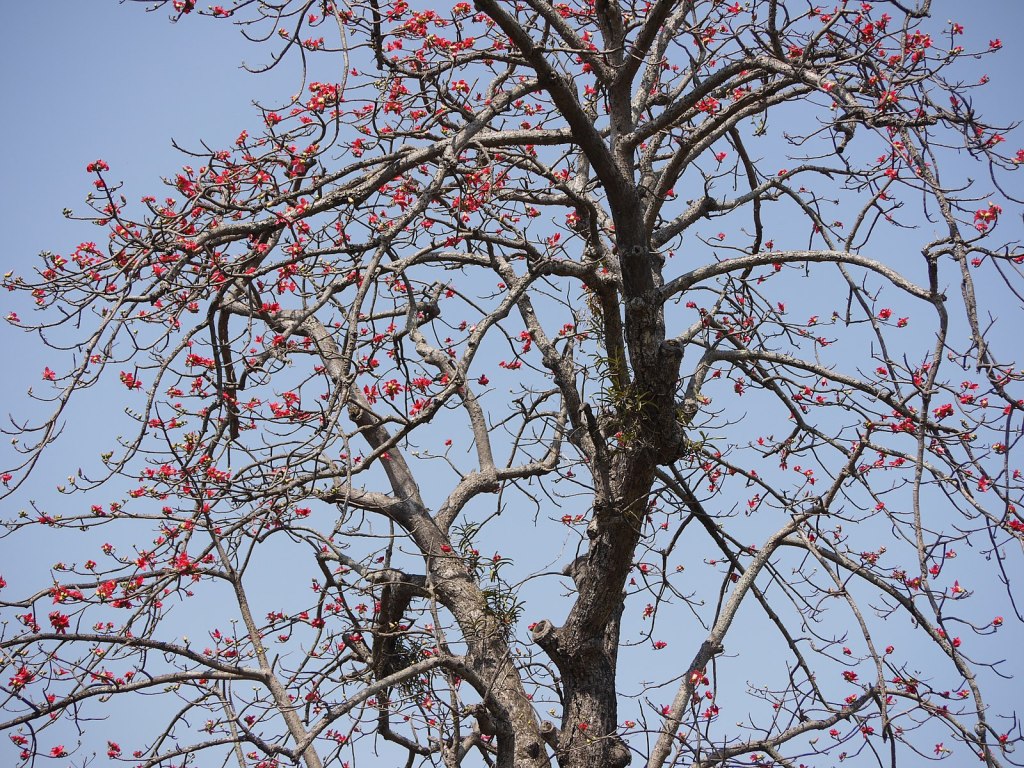
Simul tree, also known as Rokto Simul in Bengali. Photo Credit: Wiki

It is often said that human life is a culmination of various other life forms in this world. In our daily lives, most often, we come across diverse characteristics of other animals in a human being. Honestly said, in the character of a human, we see a blend of attributes usually found in animals. The domesticity of a cow and the ferocity of a tiger reside in the same human; it is, as if, the snake and the mongoose are both put together. It is somewhat like the melody that is created when the entire range of notes come together. Only then, a raga is formed. However, in a raga, one note can be more prominent than the other.

In the character of my nephew Bolai, I believe the affinity for flora and fauna, perhaps, reigned supreme. He was an observant child rather than an active one. Even at an early age, he’d quietly observe Nature around him. The dark, billowing clouds in layers, on the eastern sky would collect and pour. They would moisten his heart and bring forth the untamed breeze of the forests. It was, as if, his entire being could hear the pitter-patter of the rain.

He seemed to want to fill his being with rays of the departing sun, perhaps, in an attempt to collect something precious from it. In the end of Magh (the month of January), when the trees would be laden with the tiny fruits, an intrinsic, deep happiness, a joy defying description awakened in him. His inner nature would blossom forth, expand and take on a deeper shade of colour, much like those flowering Sal trees, with the advent of Falgun (the month of February). In those moments, he had a deep urge to sit in solitude, in conversation with himself, piecing together the various tales he’d heard. Like the story of that very old pair of birds, who had made their nest in the deep crevice of the ancient banyan tree.  He never talked much, this wide-eyed, staring boy. In the silence of his being, his thoughts ran deep.

Once, I took him along on a trip to the mountains. His joy was immense, when he saw the lush carpet of the green grass, sprawling across the valley from our house at the top.  In his mind, the grass carpet on the slope was not an inanimate, lifeless thing; he felt it to be a living one, that rolled playfully down. Often, he would roll down the slope, become a part of the grass, enjoy it tickling his back. He giggled aloud.

After a rain-washed night, when the first rays of sun gently broke free, and its golden light kissed the tops of the clustering deodar trees, he would tip-toe out of our home, alone. He would walk to those tall trees, and stand in awe, watching the motionless mighty trunks. In them, he’d envision a living spirit, a human presence, as it were. The spirits who wouldn’t talk but would know all our secrets like our ancestral grandfathers, from times immemorial.

His deep-thinking eyes weren’t always heavenwards. Many a times, I’d seen him roaming in my garden, his eyes on the ground, as if in quest something new or unusual. His curiosity knew no bounds, when he discovered new seedlings piercing out of the soil. Each day, bending down, he would talk to them, as if asking, “What’s next? Now what?” Those were, like his eternally incomplete stories — like those new, tender leaves, with whom he shared a strange affinity, verging on companionship.

And they, too, would be eager to ask him questions. Perhaps, they asked him his name. Or, about his mother, where was she? In his mind, Bolai perhaps would reply, “But I don’t have a mother.”

When someone plucked a flower from the tree, it hurt him. He realised soon enough that his concern or hurt was not at all important to others. He tried to hide his pain. When the young boys of his age threw stones at the trees, trying to bring down amlokis (gooseberries) from fully laden branches, he ran away from the scene. To tease him further, his companions would walk through the garden, thrashing the row of shrubs on both sides with their sticks; they would tear the branch of the bakul tree (Minnesap species) — he felt like crying but couldn’t. Then, others might have thought of him as mad. The worst days in his life were when the grasscutter came to mow the grass in the garden.

For he would have noticed the small tendrils of creepers, rousing their heads within the patch of grass, and those purple-yellow tiny nameless flowers, embedded with them. Here and there, the kantakari (wild eggplant) shrubs, with small bluish flowers sporting a speck of gold in their hearts. Those creepers of kalmegh (bitter medicinal plant) near the fence borders, and the anantamul (a medicinal plant) displaying their leaves; the sprouting neem that blossomed forth out of the seeds dropped by birds, how beautiful they looked! And all these were brutally mowed down by the cruel grass mowing machine. Nobody listened to their pleas or protests, for these were not the most sought-after plants in the garden.

Somedays, Bolai would come to his aunt, sit on her lap and wrapping his small arms around her neck. He would only say, “Why don’t you ask those grasscutters not to kill my plants?”

His aunt replied, “Bolai, don’t be a fool. These are overgrown weeds, almost a jungle, these must be cleaned.”

Bolai had by then understood that there were some pains, some sorrows, that were exclusively his own. Those never resonated with others.

Bolai probably was truly born in that age and time, when the universe first swam out of the womb of the ocean, taking its first breath, eons of years ago. At a time, when on the newly formed layers of mud, the nascent forests rose and cried out for the first time. Then, there were no birds, no noise, no life — only layers of rocks, slime and water. Those tall trees, heralding other life forms on the path of time, calling out to the glowing sun, with their raised hands, saying, “I’ll live, I’ll exist, I’ll survive, like the eternal traveler, through the cycles of death, through days and nights, rain and shine, I’ll progress on the path of my growth, my evolution.”

Those murmurings of trees can be heard still, through the forests and the hills; on the tendrils of their leaves the life force of Earth murmurs, “I’ll live, I’ll exist.” These mute trees, like foster mothers of the Earth, have milked the heavens for endless time, to gather life’s nectar, it’s radiance, for this planet. And endlessly, they raise their eager heads to the air, expressing their soul’s call, saying, “I’ll live.” In some strange, miraculous way, Bolai could hear that calling in the blood that coursed through him. The very thought had made us laugh.

One fine morning, as I was reading the newspaper, Bolai came up and took me to the garden. Pointing out to a small shrub, he asked me, “Uncle, what’s that plant?”

It was a small shoot of a simul (silk cotton) tree, growing through the crack of our gravel road. Bolai had made a mistake by bringing me there.

The sapling was a tiny one, just like the first babbling of a child; it was then that Bolai noticed it. Thereafter, Bolai had himself tended to the plant, watering it, checking it earnestly to monitor its growth, each morning and evening. Though the silk cotton plant grows fast, it could not keep pace with Bolai’s eager wait. When it grew to a certain height, Bolai observing the beauty of its rich leaves, was certain it was a tree of a special kind. His observation was quite similar to that of a mother who after observing the first hint of intellect in a child, marks him as a wonder. Bolai, too, had thought that he’d astonish me with his tree.  

I said, “I’ve to tell the gardener to uproot the tree.”

Bolai was aghast. Those words were terrible for him.  He said, “No Uncle, I beg of you, please don’t get it uprooted.”

“I truly don’t understand you,” I told him. “It stands right on the middle of the path. It’ll spread cotton all over, once it grows bigger. It’ll be a nuisance.”

Bolai realised it was no use arguing with me. The motherless boy then went to his aunt. Sitting on her lap, with his arms around her neck, he sobbingly said, “Aunt, please tell uncle not to uproot the tree.”

His plan worked. His aunt called me and said, “Oh listen, please let his plant be.”

I let it be. Had he not shown me the sapling, I would have surely not noticed it. But now, I notice it every day. Within a year, the tree grew taller shamelessly. As for Bolai, he reserved his best adoration for this tree.

The tree continued to grow in a ridiculous manner, without paying any respect at all to anyone around. It grew to its full height, standing on that inappropriate spot. Whoever saw it, wondered why it was placed there. A couple of times more I proposed to uproot it. I tempted Bolai with my offer of nice, high quality rose saplings. I also proposed, “If you still opt for the silk-cotton tree, then let me get you a fresh sapling. We can plant it next to the fence. It’ll look pretty there.”

But any talk of uprooting it, alarmed Bolai. And his aunt said, “Oh, it doesn’t look that bad there.”

When Bolai was an infant, my sister in-law had passed away. The grief, perhaps, made my elder brother careless; he went abroad to study engineering. Motherless, this child grew up in my childless home, in the lap of his aunt, my wife. Ten years later, my brother returned and took Bolai to Shimla to school him so that he could accompany his father abroad. He was given western education in Shimla.

Bolai cried inconsolably as he left our home, turning it into an empty house.

Two years passed. During this time, Bolai’s aunt, saddened by his absence, dried her tears in solitude, and spent her time in Bolai’s room, arranging and rearranging a single torn shoe that he wore, a damaged rubber ball he played with and that picture book of animals. She wondered if Bolai had outgrown all these by now.

In between, the wretched silk cotton tree continued to grow shamelessly; so tall it had grown, that it was now absolutely mandatory to cut it down. I chopped it down one day.  

Very soon after this, Bolai’s letter reached us from Shimla. “Aunt, do send me a photograph of my silk-cotton tree.”

Before going overseas, Bolai was supposed to come and meet us once. But since that had now been cancelled, Bolai wished to take his friend’s photograph along.

His aunt called me, saying, “Listen, please bring a photographer.”

I asked, “Why?”

She showed me the letter in Bolai’s childish handwriting.

I said, “That tree has already been chopped off.”

Bolai’s aunt didn’t touch food for the next couple of days and stopped communicating with me for even longer. When Bolai’s father had taken him away from her, it was the severing of her umbilical cord; but when Bolai’s uncle uprooted his favorite tree forever, it shattered her world and deeply wounded her heart.

For, that tree was, to her, a reflection of Bolai, his substitute image.

Amloki tree

Author’s Bio:

Rabindranath Tagore (1861 to 1941) was a brilliant poet, writer, musician, artist, educator – a polymath. He was the first Nobel Laureate from Asia. His writing spanned across genres, across global issues and across the world. His works remains relevant to this day.

Translator’s Bio:

Chaitali Sengupta is a published writer, translator, journalist from the Netherlands. Her works have been regularly published in both Dutch and Indian literary platforms, her poems also been anthologized in many acclaimed collections.

.

PLEASE NOTE: ARTICLES CAN ONLY BE REPRODUCED IN OTHER SITES WITH DUE ACKNOWLEDGEMENT TO BORDERLESS JOURNAL. 

Categories
Tagore Translations

The Library

A part of Bichitro Probondho (Strange Essays) by Rabindranath Tagore, this essay was written in 1885. It has been translated from Bengali by Chaitali Sengupta from Netherlands

Rabindranath Tagore

The stillness inside the library can be compared to the thousand-year-old roar of the mighty ocean that has now been tamed to sleep. A deep, peaceful slumber of a baby. A place where language is on hold, its rhythmic tide is locked and the brightest light in our souls is imprisoned behind the black and white words. I wonder, what would happen, if one day, the words revolt, breaking free of the bondage? Just as the Himalayas contain in its frozen ice a thousand floods, in the same way this library too preserves the best of human emotion in its breast.

Humans have been able to fence in electricity with iron wires, but who knew that man would lock words behind silence? Who knew that he could trap music, boundless hopes, the happiness of an awakened soul and the prophecy of the oracles in the pages full of words? That he would imprison the past in the present? And create a bridge upon the infinite ocean of time just with the help of a mere book?

We stand at the crossroads of a hundred roads in the library. Some paths lead to the boundless sea, some to the topmost peak, and yet another meanders to the inner crevices of the human heart. There’s no barrier, no matter where you wish to go. Man has created his salvation within the small perimeter of a book.

In this library, one can very well listen to the rise and fall of human emotions, like the echoing of the sea resonating through the conch shells. The living and the dead co-exist in close proximity here and opposition is a close relative of compliance. Trust and doubt, research and discovery are mates here. The popular and less popular live together amidst great peace and harmony. None ignore the other with contempt.

Crossing several rivers, oceans, mountains the voice of humans have reached here, galloping through several ages of time. Come, come here, for here we’re singing the birth song of light.

The Great One, who after discovering heavens, had given out a clarion call to all humans — ‘You all are the sons of heaven, this earth is your heavenly abode’ — it is his voice and millions of other similar voices, that reverberate within these walls through the years.

Have we then, from the foot of Bengal, got nothing to say, no message to give out to the human civilization? In the unified music of the world would Bengal’s contribution be only silence?

Doesn’t the sea at our footsteps speak out to us anymore? Doesn’t the Ganga bring forth the song of Kailas for us? And the vast blue canopy- isn’t it anymore there above us? And the galaxy of stars there, are they not for us?

Each day brings messages to us from far away countries from past and present. In response, are we only going to produce a few flimsy English newspapers? The countries around the globe are writing their names with the ink of immortality. Would we, Bengalis, be happy to put our names only on the application papers? Humanity is putting up a stiff fight against the preordained destiny; with the bugle calls, soldiers are being called upon. At a time like this, are we only going to be immersed in petty affairs?

Bengal’s heart is full after a long silence. Let her once speak out, in her own tongue. Her voice would indeed add melody to the music of the world.

Author’s bio

Rabindranath Tagore (1861 to 1941) was a brilliant poet, writer, musician, artist, educator – a polymath. He was the first Nobel Laureate from Asia. His writing spanned across genres, across global issues and across the world. His works remains relevant to this day.

Translator’s bio

Chaitali Sengupta is a published writer, translator, journalist from the Netherlands. She is involved in various literary & journalistic writing, translation projects for Dutch newspapers (Eindhoven News, HOWDO) and online platforms, both in the Netherlands and in India. Her works have been extensively published in many literary platforms like Muse India, Indian periodical, Borderless Journal, Setu Bilingual, The Asian Age. Her recently translated work “Quiet Whispers of our Heart” (Orange Publishers, 2020) received good reviews and was launched in the International Book Fair, Kolkata, India.

.

PLEASE NOTE: ARTICLES CAN ONLY BE REPRODUCED IN OTHER SITES WITH DUE ACKNOWLEDGEMENT TO BORDERLESS JOURNAL