Categories
Review

Truck de India: An Epiphanic ride

Book Review by Rakhi Dalal
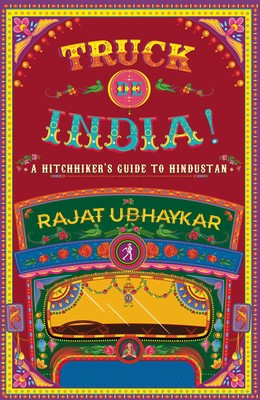
Title: Truck De India

Author: Rajat Ubhaykar

Publisher: Simon and Schuster, India, 2019

“Gaddi jaandi ae chhalanga mardi

(The truck goes jumping)

  Mainu yaad aaye mere yaar di”

(I remember my beloved)

The one image that I have always associated with the thought of truck/ goods carrier on Indian roads is a boisterous Punjabi driver driving the truck in abandon while singing this song full throttle. Part of the reason lies in my spending my early childhood years in Punjab and part in being enamoured by the bitter sweet song which is as much about love as it is about lamenting the distance between lovers.

But apart from this sweet image, one other image that has been deeply ingrained in my mind about these trucks is that of a formidable giant body on wheels which must never ever be overtaken on a highway.

This was one of the first lessons I was given while learning to drive – “Don’t ever overtake a moving truck or a bus, especially on Haryana Roadways.” So while I have adhered to this rule most of my life, sometimes I have indulged in the guilty pleasure of overtaking the giant on a highway, more specifically whenever I found it trudging painfully slow. It generated a sense of exhilaration when I beat the king of the highway on its own territory.  

But other than this, the sight of a truck never evoked much contemplation. That was not until I came across Truck De India.

Really, I thought? A book on trucks? WOW.

And then I read the subtitle – A hitchhiker’s guide to Hindustan

In the prologue of the book, the author narrates the incident which kind of seeded the idea of discovering the country through road:

Staring outside the window on that trip, the wind tousling my unruly hair, I remember being struck by a sort of epiphany, that India is bigger than the boundaries of my imagination, or anyone’s, for that matter. You didn’t have to go the scale of the cosmos to imagine something vast – India was enough.”

That the author, Rajat Ubhaykar, chose trucks to hitchhike to undertake the journey was at first kind of bewildering to think. But then as I read on, I realised what better way to discover a country if not through the eyes of one of the most vulnerable yet surprisingly one of the most underrated and suspected class in the workforce of the unorganised sector which forms the backbone of logistics across the country.

Another reason might be the mysterious air that hovers around the sight of a truck on a highway. It seems to be destined for discovering vistas unknown to commoners like us and so the experience of its riders may seem much richer than that gained through journeys undertaken by conventional means.  

Ubhaykar started the journey from Mumbai, moving all the way upto Kashmir and then Far East to Nagaland before finally reaching Kanyakumari in the South. A journey across the country hitchhiking thus with truck drivers and their helpers, gave him a first-hand experience of the many tribulations and dangers they face while transferring goods for people like us — the goods we eventually consume unthinkingly.

What I found immensely likeable about his hitchhiking with truck drivers is that he entered their world only when taken kindly in. Throughout, he maintained a respectful distance while asking questions about their lives, their experiences. He found that apart from paying “taxes” on road to braving harsh weathers, the threat of insurgents or evading highway robbers, the drivers also spent long periods away from family only to save a couple of thousands more. But none of the problems that they faced made them hostile as they conversed about these with a total stranger. In fact, as opposed to the commonly held notion, he found most of them very friendly and warm.  

Aap humare mehmaan hain” (you are our guest). How else can one define the gesture of the driver paying for a stranger’s meal where a single penny mattered to him? Or sharing the already cramped space for two to sleep with someone they had barely met? What held them together apart from the commonality of being part of the same journey from one destination to the next? Or was it the inherent human desire for the need to be understood, respected and treated kindly by fellow beings? In the journey of life each of us choose a path, most suitable circumstantially, and so, a comparison materialistically is not only naïve but also degrading.

While on his journey to initially discover the unseen India, Ubhaykar found what really mattered were the transits which characterise life. He has penned his experience to showcase what happens in the lives of the truckers who spend most of their lives behind wheels — away from their loved ones — to ferry goods and materials which not only run our country’s economy but also bring comfort to the lives of millions of strangers. 

It is fascinating to enter Ubhayakar’s world of truckers in India who live with the uncertainties of highways and circumstances to earn their livelihoods. Now, with this book by your side, are you ready to embark on the ride?

Rakhi Dalal is an educator by profession. When not working, she can usually be found reading books or writing about reading them. She writes at https://rakhidalal.blogspot.com/ . She lives with her husband and a teenage son, who being sports lovers themselves are yet, after all these years, left surprised each time a book finds its way to their home.


Categories
Review

The Forever Abode

Book Review by Candice Louisa Daquin

Title: The Forever Abode
Author: Dustin Pickering
Publisher: Transcendent Zero Press

I’d not read a lot of Dustin Pickering before reading a draft copy of The Forever Abode. Pickering had mentioned this was a collection of poetry about a long-term relationship and thus, I found the idea intriguing. Poetry and love going so well together.

The first thing you notice reading Pickering is, he’s not a modern poet. His writing style and the emotional emphasis behind it, is very much inspired by, and in the genre of poetry from the 17th and 18th century poets.

For many this may be a little too classical, but I found it refreshing and ironically, original, because of its homage to the poetic form of old. What better genre in which to accomplish this than poetry about love or love in poetry?

Pickering is a huge romantic, that’s clear from the first few lines. Another thing in his favour. When men are romantic, I think they excel at it. It becomes their life blood and bleeds into their words effortlessly. Who better to be romantic about than a woman? She is the object of desire, whether we with our modern principles accept this or not.

The style is distinct. Pickering doesn’t title all his poetry. He has three sections. In 1. Baby, the first poem speaks of:

“because I honor you because love isn’t cheap— / my heart sequestered by phantom desires / and touch what soul?”

I love the use of his question(ing) in the lines, this reminds me of William Blake so much and is very poignant, working so well with the idea of asking (the desired one) whilst at the same time beseeching them.

“when darkness preens our bodies / flight like a whistle birds of stone we cannot eat / I lay quietly in your light.”

If you say this poem out loud, you can hear the skill with which it was wrought. There is a baseline melody and then an upper cadence, rhythmic throughout and the ‘voice’ is extremely predominant, almost begging you to usher it into existence. This accomplishes a sense of: the poet himself, the object of his desire, his emotions. In many ways this is a classical recipe when writing love poems and you either love them or hate them. I fall into the former category.

Beautiful wordplay also dominates almost effortlessly. One such example: the use of “phantom desires” saying so much in two words. And the ending – “I lay quietly in your light” such a brief ending, so perfectly crafted with the flow of words, and overall feeling of gentle love and adoration. The tenderness he is able to evoke using his mastery of language is evident from the first line.

Although it’s harder to navigate the book due to not having titles, I quite like the idea of titleless poems and a reliance instead on the meaning, the emotion, the swell so to speak. In the second poem of 1. Baby, the lines: “by design I am fatal/ horse of sleep / carrying you toward me / where dreams eviscerate the mind” stood out as being stocked with metaphor and glorious imagery. Sometimes when you write obliquely in some ways and at the same time, say so much through your use of image, you set a stage far more vividly than by deliberate illustration. Suffice to say, such lines appear classic in their magnificent deliberation, how Pickering is able to shift our reading by the choice of which line they appear on, is surely the poet at his finest.

Poem 3 in the same series states: “you inhabit this tender world/ with a majesty no one recognizes/ but me.” By using “tender” before world Pickering deliberately and artfully softens the tone. Again using “majesty” he reveres his subject without needing to say more, and so, in three lines, so much is given, and little is lost. Another poetic device few possess, for we are often tempted to spell out what can be self-evident if we know our craft well enough.

As I read on, I find lines like: “the efficacy of dawn / like hammers clutched to the skin—” . These are equal to lines you would recall from taking a poetry course, that’s how tight and well-woven they are, and remain long after reading. Few authors have the ability to bring two lines alive with such dexterity and it is to Pickering’s credit that he is able to do this throughout this collection again and again.

Then suddenly there is a titled poem – “We Are Descending Together (After Marcel Duchamp’s Nude Descending a Staircase, No. 2)” and from this, I learn, how Pickering is able to be the poet I find. He takes a snapshot of something beautiful and speaks on it. As he does here, as he does throughout, and it works with such a crescendo of evocative naturalness, you feel he’s the creator and the subject:

“I admit to my failure at lovemaking. / I don’t make love; I destroy it.”

These lines are shattering. Their purity is staggering and I am reverent in my appreciation of Pickering’s high feeling like I have never been before.
I become aware that maybe I have mis-stepped, that this format is actually more deliberate than I even realised. I think of Duchamp’s staircase and then see the way these poems are arranged, with title or section title it matters not, these are meant to be read as one would fall down or climb up a staircase. You can hear it in the arrangement, as if Pickering were a composer writing music. That is exactly how this collection reads and I have never read a book of poetry that did this, not even Rossetti’s Goblin Market.
Within this, lines stand out like stars: “in empty fear there is an impulse to love—”. A mature and eerie understanding of human beings, emotions, desire, compulsion: “bolt the doors, rinse your wings: / every fear is justified. / nightingale slit throat, stolen honey.” It is a veritable glut of homage to every poet from Keats, the Brontë’s, through to Sappho, but done so naturally that it is in no way pretentious or seeking acclaim on the back of another. No, this is informed writing at its best.

Whether you are fan of poetry en masse or classical poetry, you will sink into lines like: “how do worms canker the flower? / envy’s sweet bud purses its lips in song.” I expect at times you may find this removed from the modern world and that will be a delight, because poetry isn’t of this world and a real poet will not conjure our world but a mirror of it, and reflect it back. Pickering has accomplished this through his breadth of knowledge about the world of literature and his own heart, that lives among those airy lines.

In the second section, ‘II Adult.’, Pickering shows his virtuoso as a philosopher of poetry with lines like; “What is known is not what we are certain of” and “heaven is anonymous and there are raging flags / above us”. And “nothing is senseless. Only the lack of sense.” (‘Intuition and Destiny’). Lines like those make me envy the quiet mind Pickering possesses, how he intuitively gleans beneath surfaces and remains in his imagination in ways that bring redolent colour and depth to his language.

The irony of when Pickering states: “you will be born forever into my tired stanzas.” Is that nothing could be further from the truth. These stanzas are anything but tired, they are fresh with intensity and passion and for those who love poetry, they are a welcome boon from the lackluster world beyond. If you find yourself envying his muse, then you know his work as a true romantic poet is accomplished.

Section Three is called ‘Walking Stick’ and symbolically I felt this line spoke of its meaning: “if I was perfect your stars would engage me.” This is the last part of the journey, where love slips through his hands, as beautifully as tragedy can be:

“if a monster I am, let me galvanize the pretty flux of death. / rapid sleep, dream in agency, I will not forgive.”

As an ardent fan of tragic love as well, I found Pickering’s handling of this delicate grief remarkable. It is far, far too easy as a writer to slip into maudlin self-pity and to retain that flourish of poetry whilst writing such despair is extremely challenging. Pickering succeeds in making tragedy beautiful and this is when you know, yes, he’s got that bittersweet magic in his soul:

“if prayer and fortune are no better than chance, / sublime randomness rules the punch— / we dig in, we live, the banquet of folly.”

It sounds pretentious of me to say this, but I have to because it’s what I thought reading The Forever Abode. Dustin Pickering’s writing reminds me of Shakespeare in his dexterous handling of tragedy especially and John Keats or Gabriel Garcia Marquez, in his wild submergence into love. With lines like:

“I will not forget my love, for she is silver / to gestalt eyes.”

What else can come to mind but those greats, who know how to pick silver from the darkness and make it see? Equally, as a writer of poetry I have learned so much about the importance of line breaks, something so seemingly obvious and yet, Pickering could give seminars on it in his sleep.

Two final points necessary to make mention of. Firstly, that Pickering may use old-world language in such a way we have seen and grown bored of before, but he does it with intelligence. He doesn’t just borrow the words; he inhabits and understands them. Many times, I read words like ‘o-er’ and know the author doesn’t really understand more than the obvious meaning behind them, and not how to employ the rhythm and romance of those old words into song. Pickering is dexterous in his awareness of these words, both then and now, and as such they are not just symbols, he is bringing the past into the future.

Lastly, Pickering has wrought a beautiful creation with The Forever Abode. He has reminded me why I was drawn to poetry way back when I first read it. He has tapped me on the shoulder and let me know it’s okay to be a hopeless romantic. He has let it be okay to love language and wordplay without needing a modern twist. For this I owe him a debt of gratitude. Reading The Forever Abode has been an awakening into my own love affair with poetry and how no matter what, it endures within us, without us and throughout us, in its ability to make us feel … everything.

“Gold chalices are floating in an array of fleecy torpor: / wind puts the candle to its test. Failure is only a game./ It doesn’t matter how or when— / love will sink into you like a raw fruit / seeded by memory. / The thought of you reconciles me to death.”

Candice Louisa Daquin is a Sephardi immigrant from France who lives in the American Southwest. Formerly in publishing, Daquin is now a Psychotherapist and Editor, having worked in Europe, Canada and the USA. Daquins own work is also published widely, she has written five books of poetry, the last published by Finishing Line Press called Pinch the Lock. Her website is www thefeatheredsleep.com

Categories
Review

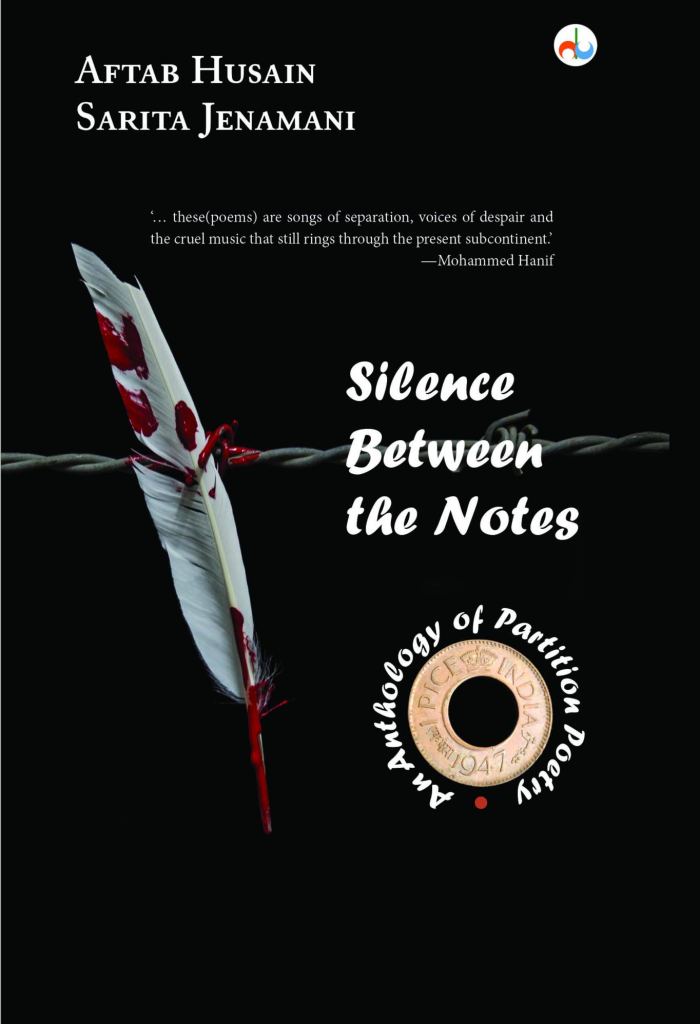
Silence between the Notes

Title: Silence between the Notes – Anthology of Partition Poetry

Selected, edited and introduced by Aftab Husain and Sarita Jenamani

Book Review by Namrata

Despite being more than seven decades old, Partition continues to be raw and unflinching. Endless books and movies have tried to capture its pain and enigma and yet there seems to be so much more that needs to be told about that one incident that changed so many lives, forever.

Silence between the Notes is an anthology of Partition poetry which includes contributions from Urdu, Punjabi, Sindhi, English, Hindi, Bengali and Kashmiri languages. It is a unique collection as this is the first book which is extensive, representative and inclusive of it all. Selected, edited and introduced by Aftab Husain and Sarita Jenamani, this anthology promises to bring forward the voices which had perhaps got lost somewhere in all the noise that followed Partition.

Sarita Jenamani is a poet based in Vienna who writes in English, Hindi and Odia, her mother tongue. A general secretary of the Austrian chapter of PEN international, she is also the co-editor and publisher of the bilingual literary magazine Words and Worlds.

An eminent name on modern Ghazal poetry from South Asia, Aftab Husain writes in Urdu, English and German. His poems have been translated into many languages. Apart from being a member of the Austrian chapter of PEN international, he is also the co-editor of the bilingual literary magazine, Words and Worlds.

When India was declared independent, the joyous news was also followed by the sad news of Partition of India into two countries, India and Pakistan. What followed was mass migration of lakhs of people as Muslims in India migrated to Pakistan while Hindus and Sikhs in Pakistan migrated to India, all in a hope for better tomorrow. Nobody knew how this supposed call for betterment led to so much blood shed on both the sides that till date, the cries and blood stains can be heard and seen.  Was it religion or was it politics, no one can say! All one can say is that the wound is too deep for even time to heal it.

My soul quivered at the sight of human blood, spilled here and there

Like beasts, men madly roamed at city’s every thoroughfare.

(‘The Partition’, Maikash Ambalvi)

Picking up gems from different languages ranging from Urdu and Kashmiri to Bengali and Sindhi, this collection of ninety-one poems is a heart-wrenching read. One cannot read this collection without feeling that pinch in their heart and sensing a lump in their throat on this poignant portrayal of the incidents that happened before, on and after Partition. The beauty, irrespective of the language they were written in and despite being translated, leaves one unnerved.

With works of stalwarts like Sahir Ludhianvi, Faiz Ahmed Faiz, Amrita Pritam, Agha Shahid Ali, Taslima Nasreen, Keki Daruwalla and many others featured therein, these poems are strung together with the thread of hope binding them. Taking us through the conflict they witnessed, heard or experienced, the poems in this collection make you witness the trauma inflicted upon through Partition. One can almost hear the sobs and feel that fear undergone through these pages.

Even in some of the darkest stanzas it is difficult to miss the tiny glimmer of hope in the hearts of the poets. Like that ladies who tied pillows on their waists and stomachs to protect themselves, or the one where they talk about how trains arrived at stations but the names of the places had been changed, leaving them unidentifiable. These poems talk endlessly about kind neighbours who took them in and protected them or that random stranger who had offered them food. There might be pain in their words and through ink, they might be giving form to their blood and tears shed at that time. However, their voices are trying hard to hold onto hope.  As Sarita Jenamani’s poem, ’70 years later’ begins,

‘August is the cruelest month

It drags us

To a butchery

Plastered with mirrors-

Mirrors of the ancestral rage’

And ends with,

‘August in a month of monsoon

And monsoon brings

A maze of hope’

If someone were to ask, whom did the Partition benefit, there would be pin-drop silence in response. This is the same eerie silence that reflects out in the title of the book ‘Silence between the notes’. Each poem, each stanza, every word is followed by a pause which is reverberating with questions but sadly, has no answers. This silence is also reminiscent within the moments when the reader pauses reading the book briefly after finishing one poem, just to regain composure and start reading it again.

Today, almost seventy years later, we are still at a point where the harsh memories of this incident have chained us and sadly, there are times, when we see the signs of it reoccurring around us clearly pushing us further down the abyss. The only thing that helps us stay afloat is that we have hope, for a better tomorrow, for a kinder world and for humanity to prevail above it all.

Namrata is a lost wanderer who loves travelling the length and breadth of the world. She lives amidst sepia toned walls, fuchsia curtains, fairy lights and shelves full of books. When not buried between the pages of a book, she loves blowing soap bubbles. A published author she enjoys capturing the magic of life in her words and is always in pursuit of a new country and a new story. She can be reached at privytrifles@gmail.com.

Disclaimer: The opinions expressed are solely that of the author.