Categories
pandies' corner

For Sanjay Kumar: To Sir – with Love

Here is a Hindustani poem by Tanvir from the Nithari village, where pandies’ conducted workshops to help traumatised and deprived youngsters. It has been translated to English by Lourdes M Supriya.

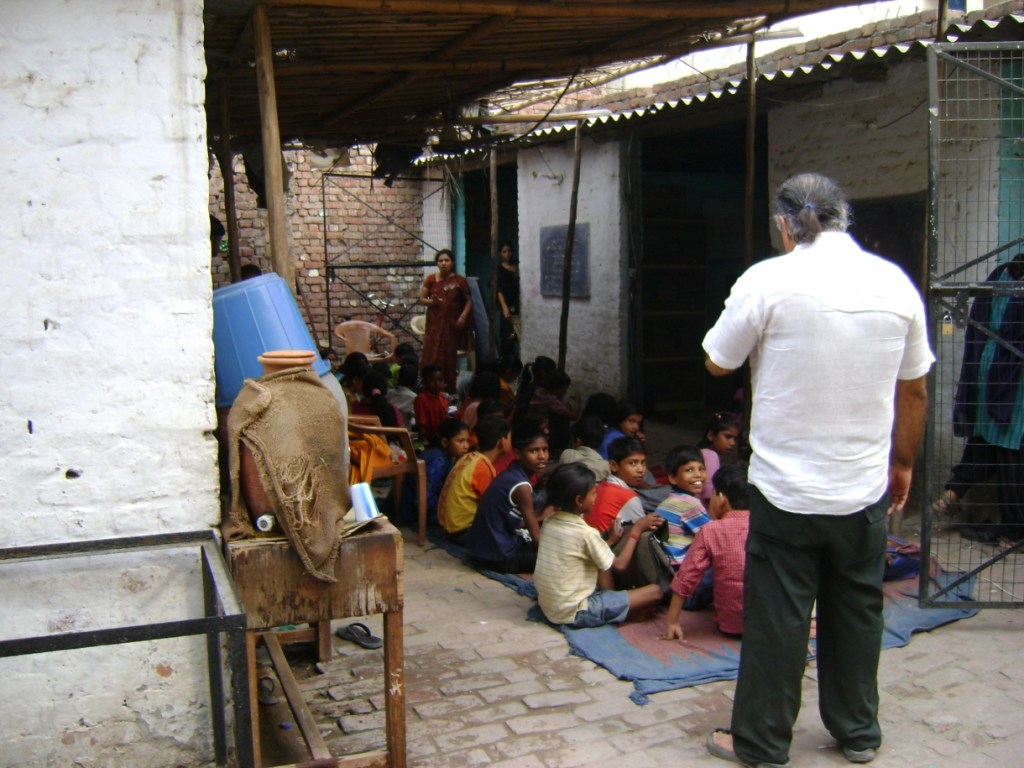
The late Sanjay Kumar (1961-2025), founder of pandies’, creating a story collective at a workshop being conducted for the children at Nithari. Photo provided by the late Sanjay Kumar
Tanvir was first introduced to pandies’ theatre in 2012 as a student at their theatre workshop in Saksham School, Nithari village. After finishing his studies, Tanvir continued to volunteer at the Saksham School till 2019 as a teacher.
How we wish you were here...
This party would have brought more cheer.
A sight so dear --
Could you imagine, friends,
His sense of peace and no fear?
How we wish you were here...
This party, this eve, would have more cheer...

The breeze would seem perfumed with myrrh.
Our best moments were with you right here.
No broken heart, no wounds are as severe --
How we wish you were here...
This party, this eve, would have more cheer...

Even the moon and the stars would appear
Among the thousand dreams gathered here
To hear a single speech by you.
Oh! A scene so sincere--
One more happy day with you here...
How we wish you were here...
This party, this eve, would have more cheer...

It’s only been a few days...
How much can we weep?
The pain is immense Sanjay Sir--
Come back, we cannot walk alone on a road this steep.
Missing your laughter, your voice, and all your ways,
How do we carry on without you? How can we be joyous?
How we wish you were here...
This party, this eve, would have more cheer...

Lourdes M Surpiya is a filmmaker, editor, and theatre practitioner who has been associated with pandies’ theatre since 2015. 

.

PLEASE NOTE: ARTICLES CAN ONLY BE REPRODUCED IN OTHER SITES WITH DUE ACKNOWLEDGEMENT TO BORDERLESS JOURNAL

Click here to access the Borderless anthology, Monalisa No Longer Smiles

Click here to access Monalisa No Longer Smiles on Kindle Amazon International
Categories
pandies' corner

Songs of Freedom: Dear Me…

Story by Ilma Khan, translated from Hindustani by Janees

Songs of Freedom bring stories from women — certainly not victims, not even survivors but fighters against the patriarchal status quo with support from the organisation Shaktishalini

–Sanjay Kumar, founder, pandies1

Dr.Ilma Khan is 24 years old, was born and brought up in Rampur, Uttar Pradesh, India. She is studying BUMS (Bachelor of Unani Medicine & Surgery) and currently practising in the same field. Ilma loves to describe herself as ambitious, flawless and fearless, believing in ‘good vibes’, big dreams, and self-love always.

Dear Me . . .

2023

This year I met the most broken version of me, but also the strongest…

24 years ago…

Wednesday, 11 November 1998,

I was born into a family where when a woman is pregnant, she was expected to deliver a baby boy, but I was born…

I do not remember my childhood, but I do remember my family always wanting a boy. And so here we are with seven sisters now and one brother. I always wonder why they always wanted a son? What would have changed in their lives if they had a male child?

This greatly impacted my life and I decided to take matters in hand. I decided to do all the work which a boy could do. That didn’t seem to help much because I was constantly reminded of my ‘disabilities’, that ‘physically I was a girl and I should know my limits’, that I ‘should remember that one day when I would turn eighteen and I would get married. My parents’ house was just another impermanent motel’.

So, I started believing that this is my parents’ house and after marriage I would go to my husband’s house. But what if … they tell me someday that, ‘this is NOT YOUR home!’.

THEN WHERE EXACTLY IS MY HOME?

— LETTER TO MYSELF —

Dear Ilma,
I am meeting you after so long. You know it's been six years since we talked…
Just wanted to tell you that you were so genuine and innocent. I remember you always worried about little things, but you know this time it's different -- as in a ‘good different’. The Ilma I know now is strong enough to face her own journey. She has faith that she can always stand up for herself. The only things that haven't changed are the fact that she still likes to chill like you, she loves the rain, she does everything which is full of madness and enjoys every little moment of her life, she loves snow too…Though you were quieter than her you know. This Ilma -- she is aggressive, bold -- unlike your shy and scared self…
Oh yes and her nails have finally grown. She doesn't gnaw her nails like you. She loves to put paint on these. Can you imagine that?

Since that time, I started dreaming of having my home, a life full of adventures and freedom. But as I grew older, my family and relatives started asking about marriage. I was studying in college at that time.

I was completely shattered that I was very close to my career goals, but all this will stop me from achieving my dreams. Religion of course played a very important role in my life, as I was allowed to do things under ‘some limits’ because my family believed so.

I was just sixteen years old when my engagement was fixed with one of my cousins while my heart cried out in loud protest. But I was not able to express this to anyone. I decided that I would do something for myself — so that I could respond to all that was happening to me in which family members were complicit.

I had studied hard. When I completed school. I gave entrance exams and got selected for the medical profession. Since that time, I have been trying to tell my family members that I do not want to marry the person they choose.

Everything was going fine. I was living my life, but one call changed everything.

— LETTER TO MYSELF —

Dear Ilma,

I know you always wonder how you will pursue your career, how you will live your life if allowed to live on your own terms, about how smooth things will go if a person or your family will let you go or just abandon you or not want you to live by their rules.
But don't worry now because time has changed things, she is doing every single thing step by step, the way you thought it would be in future.
She is here to fulfill your dreams. I know you love to help the one in need. You know she has got a platform where she learns these things and is helping other ‘survivors’.
I promise when you will see this Ilma, you will be amazed because she is exactly the way you wanted her to be.

My mother called me, and said, “We are coming to pick you up after 3 days. You are getting married. Resign and come back with us. We have to do the preparations.”

I was silent. I could not utter a single word during the call. A feeling of hopelessness and helplessness mauled at me.

Somehow, I managed to muster the courage, assemble my shattered self together and called my mother –

“I don’t want to resign. I want to work. I want to be financially independent. I can’t marry now. This is not the right time.”

“No! You are 23 now and this is the right age. We have made the decision!”

“I don’t want to marry that person. He is annoying and this is final! I am not coming home!”

“How dare you talk like this?  We are coming now to get you and you have to come with us. There’s nothing you can do about it.”

I was thinking about my next step. I took help from an NGO2 and they helped me. When my parents came, they promised that they would not ask me to marry any person and they would allow me to study. Somehow, they managed to convince me emotionally, and I decided to go back home with them to celebrate the festival of Eid.

When we were home, suddenly the behaviour of my mother changed, she snatched my phone and said, “Now do whatever you can? We will see how you will say no to marriage. There, we were helpless because of that NGO but now it’s all our say.”

REMEMBER THAT HEIGHT OF FEAR WHEN…

Her parents abused her physically with a belt, blood was coming out from her nose and head.
After all those arguments her parents finally decided to take her life and locked her in a room.
She was locked up in a room, with no hope of light in the darkest time. She was afraid, they were talking outside the room – planning and plotting. Her uncle was fighting with her family members to let her live. He was asking them not to kill her – to spare her. She lost all hope. Every second she was breathing, thinking this could be the last, this could be the last… this could… be the… last.
It was difficult to control her emotions. Her nose was bleeding, her tears were not coming out, her lips were dry with fear, she was shivering that this could be her last day and she could do nothing to save herself.
You’re alive today, Ilma. You lived through that time. The peak of fear.

But somehow, I was saved… and then I was screaming, crying… I wanted to disappear.

The next day I decided to do anything and everything to save myself, my life. I contacted many NGOs and left my home…and never looked back. How did it all happen? I am yet to make sense of it. One moment, I was trapped and hopeless, and the next moment, I was running for life.

Since then, I have been independently living on my own. I am currently studying, and at some point, I think that everything needs to be left alone – your past, even your pain.

But, yes, I remember when I was young, I thought that I would be helping poor people and I would do something through which I could be the person who would make others happy…

I decided to be a doctor and today it gives me hope and happiness which I cannot define in words. The very first time when I went to the gynaecology department and my duty was in the labour room. When I went there regularly for one month, I used to practice how to deliver a baby. After a few months, I learnt to do that on my own and when I helped one of my patients in delivering her baby, that was the best thing that ever happened to me in life…

The smiles on their faces were precious. Her mother-in-law gave me her blessings and all of them were just so happy.

So many times, I have tried to save the lives of people, pushing through to give them hope even if the situations are not in their favour.

Today when I go to the hospital and my patients, who are very ill and are in pain, give their blessings placing their trust in me, I realise what I’m living for.

YOU SHOULD KNOW --

You were in a toxic relationship, you know, you should know about red flags now. Why do you chase such people who don't value you, who don't care about the efforts you put into everything? You know she wants to be valued and respected by every individual she has in her life.
Things are very different now, but those memories of you with your family, she misses that.
Tell everyone in the past that she has moved on from things and no one can make her feel inferior.
And at last, I just want to say that I am so proud of everything you’ve done. Because of you, she discovered that she is fierce, and strong, and full of fire, and that not even she could hold herself back because her passion burned brighter than her fears.
Will meet you soon. Love and only love.
ME. YOU. US.

I faced a lot of hardships in life – mentally, physically, verbally, and socially. Despite being triggered by those memories I chose to live… I chose to live freely, I chose to love myself, I chose to owe myself a life which I dreamt of from an early age.

I was scared, but I realised that I am my own power. On certain days, when self-doubts creep in, I tell myself that I am worth every great thing. All that I have done till now. I am capable of reaching my dreams even if they’re beyond the stars. It’s only a matter of time. You look back and thank yourself for not giving up and for treating yourself with respect and kindness.

Now I am manifesting my life, my dream and everything I have wanted. I am becoming the best version of myself, and I deserve good things. This moment is always precious to me, the most satisfying moment of my life.

And I think once you choose HOPE, everything is possible in life…

  1.  “Establishing itself as a premier women’s organisation in India from 1987, Shaktishalini has spread out and deals with all kinds of gender based violence. A shelter home, a helpline and more than that a stunning activist passion are the hallmarks of this organisation. 
    pandies and Shaktishalini – different in terms of the work they do but firmly aligned in terms of ideological beliefs and where they stand and  speak from. It goes back to 1996 when members of the theatre group went to the Shaktishalini office to research on (Dayan Hatya) witch burning for a production and got the chance to learn from the iconic leaders of Shaktishalini, Apa Shahjahan and Satya Rani Chadha. And collaborative theatre and theatre therapy goes back there. It is a mutual learning space that has survived over 25 years. Collaborative and interactive, this space creates anti-patriarchal and anti-communal street and proscenium performances and provides engaging workshop theatre with survivors of domestic and societal patriarchal violence. Many times we have sat together till late night, in small or large groups debating what constitutes violence? Or what would be gender equality in practical, real terms? These and many such questions will be raised in the stories that follow.” — Sanjay Kumar ↩︎
  2. Non-governement Organisation ↩︎

Janees is an independent researcher and theatre practitioner associated with Pandies’ for quite some time.

PLEASE NOTE: ARTICLES CAN ONLY BE REPRODUCED IN OTHER SITES WITH DUE ACKNOWLEDGEMENT TO BORDERLESS JOURNAL

Click here to access the Borderless anthology, Monalisa No Longer Smiles

Click here to access Monalisa No Longer Smiles on Kindle Amazon International
Categories
pandies' corner

Songs of Freedom: What are the Options?

By Jyoti[1], translated from Hindustani by Lourdes M Supriya

Songs of Freedom bring stories from women — certainly not victims, not even survivors but fighters against the patriarchal status quo with support from the organisation Shaktishalini[2].

–Sanjay Kumar, founder, pandies

Painting by Amrita Shergil (1913-1941)
What are the Options?

“So then what happened?”

Nothing. My father came and took me back to his house. My nana-nani [3] didn’t stop him. He put me in a good school though, so this time I didn’t mind going back there. Last time he took me, I hated it.

“Why did you hate it?”

He wasn’t a nice man. I think that’s why my grandparents took me in. They knew what kind of a man he was. I loved being at my grandparents’. My mama, mother’s brother, he would take me shopping during holidays. I could pick anything in the entire shop, he’d never say no. Whenever I wanted new clothes, my masi, mother’s sister, took me to the markets\. She was like my mother. I was so loved there. But then my father took me away…

He had too many restrictions. My mother and I weren’t allowed to leave the house. I couldn’t leave after I came back from school. He kept an eye on us from his shop, it was down the street. Then the drinking got too much, the yelling, the swearing. I was afraid of his footsteps. I could tell from the sound of them what the night was going to be like. My mother was very scared of him, she couldn’t protect me from him. She felt helpless, I felt really bad for her. Then I was sent away again to my grandparents. I liked it there. I was studying in a government school. I did well in studies. I liked it. But then he came and took me back to the village. I had to repeat my third standard[4] there. I cried a lot at first, but it was a private school, better than the government one in Delhi.

“So this was the second time you were going there?”

Yes. I’ve lived at my father’s a couple of times. Sometimes I ran away and came back to my grandparents’, sometimes my mother brought me with her and stayed. But she always went back pretty soon. The first time he took me, I used to cry to my grandparents every night to take me back. I had to repeat classes so many times, I’m really behind on my studies. This has ruined my education. That’s why I hate it.

“What about the last time you were there? What happened then?”

Nothing. The same. But worse. He was more violent. My mother herself asked me to go with her to my grandparent’s. But I had exams in a month. I was a good student. I’d worked so hard. That year was especially bad at home; I’d put all my energy into school. I didn’t want to just drop it all and repeat the class again. I begged my mother to stay till the end of the term. He would beat her over everything. So I had to beg her. I promised her I would support her if she’d just let me give those exams. I was 14. I was old enough to start working.

“So did she stay?”

Yes. And then I came back to my grandparents’. But she went back the second day. Then she stopped taking my calls. Finally, I called her from someone else’s phone. She recognised my voice. I could tell. She didn’t say anything for a long time. I kept asking her to come. Then she said, “Aaj se tera mera rishta khatam; you’re not my daughter anymore. Don’t call again.”

I felt very alone. Things at my grandparents’ were also changing. My aunt was getting married. Everyone was busy with the preparations.

Nana[5] used to drive the auto 15 hours a day to save up for it. But he first had to pay back the loan he took out for the auto before he could save for the wedding. It was his last installment and they were really breathing down on him. One day he came home and told us he was short of 1000 bucks and it was time to make the payment. He asked my uncle, who was married by then, but his wife said they couldn’t spare it since they were also paying for the wedding and saving for the baby they planned to have next year. My uncle didn’t even have the balls to refuse his father himself. His wife had to do it. My grandfather turned to my mother, but she said, she couldn’t spare it either, she’d spent it all on me.

“Wait, your mother was there?”

Yes. She’d come eventually, some two months after me. She was working as a cook. It was really nice. For the first time, it felt like she was there. But that day she had used me as an excuse. I didn’t see any of that money. She wasn’t even paying for my school fees. I took tuitions and paid for it. I was starting to resent her too, I could see why the rest of them hated her.

“Wait, who hated her? Why did you resent her, you just said she was there for you.”

She was. When she came. She got a job. She got offs on Sunday and she would spend those with me. On Sundays, I didn’t have to cook for the family, she did. She even gave me money for school supplies, like new copies or pens, whenever I asked for it. She got me a small phone too. But this didn’t last long. She met someone. She used to take the same rickshaw to work everyday. He’d take her from one place to the next, they used to talk, then she’d talk to him at night too. She kept to herself. She started spending her Sundays with him. He wasn’t a good man. One day, he went to the village.

I thought it would end but her late-night conversations continued. They hated her, my grandparents and my uncle, his wife, even my mother’s sister. She knew her sister was to get married soon but she was roaming around with a man. All the neighborhood knew about it. What would they think? And then she stopped contributing to the house. How much could my grandfather do? She didn’t even give me any money anymore. Not even for notebooks. I had to work. And it was so difficult. I had to make breakfast for everyone in the house in the mornings, pack my lunch, rush back and do all the cleaning of the house, make lunch for everyone, then clean up the kitchen and wash the vessels. Then my kids would come. But everyone was selfish then. They were angry with my mother, and then with me. I gave my grandmother a part of my earnings, and I paid for my school. I did everything. She’d stopped staying home on Sundays too, so I had to do the work. That day, when my grandfather asked for money, she said she didn’t have any. He got so angry with her, he called her a slut, a leach, a parasite, draining him, killing him slowly, he slapped her. She ran away. I noticed that he didn’t react the same way when his daughter-in-law had refused to give him the money. But he was just so upset, he started crying. I couldn’t bear it. So I took one thousand from the money I’d saved for all those months and gave it to him. My grandmother took me aside and told me I shouldn’t have done it, that she could have dipped into the money I gave her. I told her that was for her. She didn’t have any money at all. And she’d been so kind to me. She was the only one who didn’t resent me. But she respected my grandfather too much to contradict him when he called me names.

“I thought your grandparents were supportive, that you’d felt safe in their house?”

I did. But my aunt was getting married, that changed everything. And I understand why they were angry with my mother. She brought us so much shame. One day, that man that she’d been having an affair with, he went to her workplace and started beating her up. He forced her onto his rickshaw, holding her hair throughout, and then brought her to our neighborhood and dragged her through the streets by her hair to his friend’s house. She’d started an affair with his friend when he’d gone to his village, and he found out about it. All the people heard him that day. She was so scratched up when he finally let her go. I took her to the police station but they didn’t file a complaint. My grandparents also encouraged her to file a complaint. But she didn’t. The new man she was seeing told her he was going to help her. So she listened to him, trusted that he would get her justice. I’ve never seen him, none of us had. But she really trusted him.

One day my aunt was really anxious. She came into the room when I was taking a class, and she asked me to go to the terrace because she needed the room. I had to move all the kids upstairs, take all the chairs. When I came back after the class, she started yelling at me, telling me I’m a burden, then she started beating me, abusing my mother too. I didn’t say anything to her when she was beating me; she left me in the room. I waited for my mother to come and comfort me. But she didn’t come. So I went looking for her, thinking this could bring us together. But I found her on the terrace, talking to her new boyfriend, telling him about all this. I felt really abandoned. She couldn’t even bother to check on me but she wanted his sympathy. Then they got into a fight. At one point, I overheard her begging him not to leave her or she’d kill herself. It made me so angry, I felt like I could break something.  I didn’t like this man at all. One day, she just got up left. I asked my grandparents to file a missing person’s report but they didn’t want to do it because it would bring shame to the family and my aunt was getting married. So they waited till it was over and then filed it, three years later. But I haven’t seen her since. I think she’s missing, we need to find her.

“How long ago was this?”

I don’t know. I can’t tell.

“What happened after your mother left?”

They all blamed me, they said I drove her to do it, that I hated her, that I was like her. They asked me to start contributing to the house, to stop living like a freeloader. I started giving all my tuition money home. I couldn’t continue school anymore. But they were so angry. One day, after my aunty’s marriage, the police came to our house in response to the missing person’s complaint I’d made them file. They wanted to ask questions about my mother and her boyfriend. I think she planned her escape. She’d been staying overnight at his house 2-3 times a week, and slowly taking her clothes there. The police pointed this out,  how she couldn’t have taken a big bag when she escaped, or we’d have seen her packing. I think they’re right. She abandoned me.

“Do your grandparents believe she’s okay, living somewhere else?”

Yes. It makes sense. She didn’t like it at home. They felt so ashamed by the police visit. They were angry that I’d made them file the complaint only to find out that their daughter had run away willingly. My grandfather was livid that day. He beat me up, then tried to drag me down the stairs. But I fell down at the 3rd floor landing so he started kicking me. Then he left me lying there. My grandmother didn’t come to help me. I was so distraught. I couldn’t even go to school, everyone hated me. What future did I have? No one wanted to help me, I didn’t know anyone who could help me or even who to turn to. I jumped off the landing there. I tried to commit suicide. That’s why I’m here now. Now I go to school.

[1] Note: Loosely based on the writer’s lived experiences

[2]  “Establishing itself as a premier women’s organisation in India from 1987, Shaktishalini has spread out and deals with all kinds of gender based violence. A shelter home, a helpline and more than that a stunning activist passion are the hallmarks of this organisation. 

pandies and Shaktishalini – different in terms of the work they do but firmly aligned in terms of ideological beliefs and where they stand and  speak from. It goes back to 1996 when members of the theatre group went to the Shaktishalini office to research on (Dayan Hatya) witch burning for a production and got the chance to learn from the iconic leaders of Shaktishalini, Apa Shahjahan and Satya Rani Chadha. And collaborative theatre and theatre therapy goes back there. It is a mutual learning space that has survived over 25 years. Collaborative and interactive, this space creates anti-patriarchal and anti-communal street and proscenium performances and provides engaging workshop theatre with survivors of domestic and societal patriarchal violence. Many times we have sat together till late night, in small or large groups debating what constitutes violence? Or what would be gender equality in practical, real terms? These and many such questions will be raised in the stories that follow.” — Sanjay Kumar

[3] Maternal grandparents

[4] Grade. Third grade

[5] Maternal grandfather

Jyoti Kaur is a 19-year-old from Delhi, currently pursuing her 10th grade studies. She likes to dance, read books and loves to travel at night.

Lourdes M Supriya is a Delhi based filmmaker, editor, and theatre practitioner who has been associated with pandies’ theatre since 2015.

PLEASE NOTE: ARTICLES CAN ONLY BE REPRODUCED IN OTHER SITES WITH DUE ACKNOWLEDGEMENT TO BORDERLESS JOURNAL

Click here to access the Borderless anthology, Monalisa No Longer Smiles

Click here to access Monalisa No Longer Smiles on Kindle Amazon International
Categories
pandies' corner

Songs of Freedom: An Ordinary Tale

Story by Nandani, translated from Hindustani by Janees

Songs of Freedom bring stories from women — certainly not victims, not even survivors but fighters against the patriarchal status quo with support from the organisation Shaktishalini[1]

–Sanjay Kumar, founder, pandies


Nandani is an 18 year-old from Delhi, currently studying in the 10th grade. In her free time, she loves to read biographies, hang out with her friends, dancing and singing. She calls books as good friends of hers and looks forward to travelling across the world once in her lifetime. 

An Ordinary Tale

A story set in the year 2002. An ordinary story I must tell.

When a girl child is born in a Panditfamily, the mother welcomes Goddess Lakshmi. But the mother-in-law is unable to fathom bahu’s [2] joy over the girl baby. Call it outdated, archaic, outmoded. For the saas[3], a son would have proven to be a boon, a blessing straight from the heavens, a support to the family’s genes. She, like many others, was of the belief that a girl born is nothing but a burden who must be ‘disposed’ off to another family at the earliest. What are women but estranged wealth?! The world is run by men, their divine masculinities, their valour, by their being. Women are absolute subordinates to men. She failed to understand that being born a ‘male’ is simply a matter of – birth.

But bahu was not ready to give up. She would put in efforts to make her family think otherwise. She named her daughter Avantika. When Avantikahad grown up a bit, the saas one day cunningly said, “Bahu! See I like to put forward things as they are, no sugar-coating. I want you to focus on giving birth to my grandson now. I hope I will not be disappointed this time.”

The poor bahu was busy attending household chores. She tended to ignore the otherwise outrageous demands the mother-in-law burdened her with. Meanwhile the saas thought to herself, “Now that I have explicitly expressed my wish to bahu, maybe it’s better to let my raja beta[4] know of my justified desire.” So, she made sure she had her wish conveyed to her son. “My dear son, I have expressed my wish to Bahu – for a grandson, with whom I can enjoy the joys of grandmotherhood.” For the son, the mother’s wish was as good as a divine decree.

The bahu, who has overheard their conversation, felt betrayed and outraged. “How could you say yes on my behalf? What about my consent? I am not ready for another child. You don’t have a job. You don’t let me go out and work. You are living off your mother’s expenses… drinking, beating me to death every night! I don’t want to traumatise another child the way Avantikahas been traumatised.”

Her husband retorted, “How dare you? Who are you to stop me from taking decisions?” Basically, what he meant was that she was his slave and had no authority in deciding how many kids she wanted, when to have and so on and so forth.

The saas interfered in the matter and somehow convinced, or rather forcibly convinced the bahu to bear a child. We will not go into the details of this.

2005

Another girl child was born! The saas, was not just disappointed this time. She experesses her intolerance of this development. “All I ever wanted was one grandson! Not five or eight. Bahu is deliberately depriving me of this privilege. It was wrong of me to trust her.” Again, she simply failed to comprehend how sex and science works!

With the birth of Nira, the bahu’s life became hell … rather was made hell by her mother-in-law and husband. Violence grew. “Ever since this girl has taken birth, a curse has taken over the joys and prosperity of our home. I refuse to accept her.  Her arrival is a time of tribulation for us.”

The contempt and disgust if the saas towards the bahu and her daughters were echoed by the husband and father, who had turned more violent than before, and why not ? He had all the more reason to inflict pain on his wife. Backed by his mother, he started beating his wife every day, cursed her all day. When Niraturned one-and-a-half, the hostility worsened. The bahu turned numb. A wish as simple as wanting a decent life was out of her reach. “Because of you I live a miserable life despite being a man. You are the reason my brothers and mother don’t respect me. You and your daughters have ruined my relations with them….”

One day something changed. She mustered the courage to say ‘no’ despite the routine beatings. She was not willing to take it anymore and so, with her two little daughters, she decided to leave the house.

“I have not sinned. I have given birth to daughters and that is no sin. There is not a single defect in me or my daughters. It is you, your intentions, and your mentality that is defective…I reject living a life like this.”

She sought refuge at her paternal home and soon began working to support her daughters. Now, she had a life that promised, to all intents and purposes, a relief from the darkness of the past. A few months later, she fell in love with a colleague at work. Nobody knew what occurred to her, but leaving her two daughters behind, the mother eloped with the lover to start a new life. She turned blind to the plight of her own daughters who were just starting out with the promise of a fresh start.

Avantika and Nira, unaware that another calamity had befallen them, adapted to the new life under the shadow of their maternal grandmother, their nani. Unable to look after the girls with growing time, nani took a difficult call due to her ailing health. “Can you look after the girls when I die? Can you take care of them?” she asked her other daughter (the girls’ aunt). “I wish I could…but in today’s time managing two more children… It’s beyond my capacity…I understand what they mean to you…so for you maybe I can look after Avantika, the elder one…however, something must be done about Nira

A few weeks later, the nani sent for their aunt and said, “I am here today, but who knows about tomorrow? We must take final decisions with regards to Avantika and Nira. All they have is me. I am glad you took charge of one of them. But something must be thought about the other as well. I am sure God will send help.”

“Mother, I have an acquaintance who is associated with a shelter home. Sending Nirato a girls’ hostel should take care of our worries. Let me get in touch with her.”

Little Nirawas sent to a girls shelter home. She cried a lot on separation from sister and nani. A year later the news of nani’s death upended the girls’ lives. Trying to cope with the grief, they adapted to their new lives – one day at a time, one goal at a time.

2023

Both Avantika and Nira are growing up at their own pace – finding new goals to focus on. They are not together, nor are they in touch. But they are fighters and survivors. And this is how this story has end for the time being. However, certain questions continue to haunt me…

Do you discriminate between a son and a daughter? What would Avantika and Nira’s mother do if her parents did not offer to support her? Can women discriminate against other women? Why is it that a woman often finds it difficult to find solidarities from fellow women?

It is quite difficult to single out the oppressor and the oppressed in this story, however, that does not spare us from rejecting to inflict this age-old atrocity on our women. This has to stop with our generation.

.

[1] “Establishing itself as a premier women’s organisation in India from 1987, Shaktishalini has spread out and deals with all kinds of gender based violence. A shelter home, a helpline and more than that a stunning activist passion are the hallmarks of this organisation. 

pandies and Shaktishalini – different in terms of the work they do but firmly aligned in terms of ideological beliefs and where they stand and  speak from. It goes back to 1996 when members of the theatre group went to the Shaktishalini office to research on (Dayan Hatya) witch burning for a production and got the chance to learn from the iconic leaders of Shaktishalini, Apa Shahjahan and Satya Rani Chadha. And collaborative theatre and theatre therapy goes back there. It is a mutual learning space that has survived over 25 years. Collaborative and interactive, this space creates anti-patriarchal and anti-communal street and proscenium performances and provides engaging workshop theatre with survivors of domestic and societal patriarchal violence. Many times we have sat together till late night, in small or large groups debating what constitutes violence? Or what would be gender equality in practical, real terms? These and many such questions will be raised in the stories that follow.” — Sanjay Kumar

[2] Daughter-in-law

[3] Mother-in-law

[4] Beta is son and raja is king

Janees is an independent researcher and theatre-practitioner who has been associated with Pandies for the past six years.

PLEASE NOTE: ARTICLES CAN ONLY BE REPRODUCED IN OTHER SITES WITH DUE ACKNOWLEDGEMENT TO BORDERLESS JOURNAL

Click here to access the Borderless anthology, Monalisa No Longer Smiles

Click here to access Monalisa No Longer Smiles on Kindle Amazon International
Categories
pandies' corner

Songs of Freedom: ‘Viklangta’ or Disability

Story by Kajal, translated from Hindustani by Janees

Songs of Freedom bring stories from women — certainly not victims, not even survivors but fighters against the patriarchal status quo with support from the organisation Shaktishalini[1].

–Sanjay Kumar, founder, pandies

Kajal is from Ghaziabad, Uttar Pradesh. She is 24 years old and has completed her bachelors in Hindi. She is currently pursuing master’s in social work through distance education. She has found her voice in writing activist stories around the theme of gender violence and disability. She is currently working at an NGO as a special educator and wishes to fight for the specially-abled community’s right to education.

Viklangta or Disability

Is there no one who could see through my tears? Anyone who could hear the tumult my silence has put me in? Someone who could acknowledge if not accept my bare feelings? None I could talk to?

Everyone is known by their name and their profession, but my disability is my very identity. At least that’s what the whole world has always made me feel. Who am I? I shall choose to remain anonymous here just like many others who are rendered nameless owing to the ‘fact’ that they are considered ‘disabled’.

The house is filled with chirpings of joy and excitement today. Bahu (daughter-in-law) is expecting her first child. “Hey, it will be a boy for sure,” the mother-in-law remarked, “Although there is no harm if a girl child is born either…umm… all I pray is for a healthy mother and a healthy child…” But deep down the grandmother-to-be prayed for a son, “Dear Lord, I shall adorn your temple with numerous offerings if you bless this house with a son…”

The day had arrived. The entire family eagerly waited to hear of the outcome. The nurse came out of the delivery room, “Congratulations! It’s a girl! Goddess Lakshmi has blessed your household with her presence.” It seemed as if everyone in the family was struck with lightning. “Well, who can meddle with God’s affairs?” the grandmother frowned. It was coming from the same woman who was busy pampering the pregnant Bahu just a few months back. With every passing day, Bahu and the baby were being showered with taunts and disgust.

Wasn’t being born a female enough for one to be in hell, that soon the calamity of ‘disability’ struck the child. “We are being punished for our sins! God why us?! Now all life-long we have to cater to her special needs — expenses, treatment, care and God knows what all. What an awful misfortune has struck my son?” grandmother would go on uttering.

‘I’ who was de trop[2]right from the time of birth, had been disowned on many grounds by my own family. Troubled with a question – “What was my role in my plight? How was it my fault?”

As time passed by, the jibes thrown at me turned more spiteful. ‘Disabled’, ‘Lame’ and ‘Who will marry a disabled woman?’. From ‘Ton of dowry will have to be paid to get rid of this woman’ to ‘She should have died the moment she was born!’. I would yearn for someone to understand me, befriend me, and chase away my agony. It must be wonderful to be a reason for joy in someone’s life. Could I ever be one? Every night I would cry myself to sleep in painful hopes.

Since a young age, I have loved studying. I believed and still do that fulfilling a meaningful career through studies is the only way to stun them. Maybe my father and grandmother both will start loving me then. “What use is education to you?” or “Your ultimate place is the house of the man you will marry. Why waste time pursuing education?” — such taunts haunted my existence.

“Anyway, your education won’t come to save you or your parents from the humiliation of finding a boy for you.”

“Look for a boy with a disability for her or bribe a normal boy to marry her.”

“It’s time to get rid of her.”

I would keep going back to my thoughts — is there anyone who, with all their love and honestly, would move mountains for me? Just for me! Adorn a river with my name…

Amidst all the agony, I only had one person by my side – my Maa, my mother. It aches to admit that she couldn’t keep her stand firm for long, she too fell for what was being fed to her. I was a burden to her now. To my own mother. But I understand – she was not fully in command. She was never respected in that house. It must have been so tough for her to face them all, so much so that she was convinced to get rid of me at any cost. A mother is the one who loves her child unconditionally, the same mother was now cursing me for being in her life. I have come to a point in life where not a single moment passes without my blaming myself for existing. In fact, I am sure it must be karma – my mother’s sins that have put me in this state and are now haunting her in my form.

This never-ending dejection has started to make me weak… I feel weak… this mental fatigue seems to have physically manifested itself in me… my one and only support had left me. Mother tried to emotionally convince me for acquiring skills in household chores, after all that would make me a good fit for marriage. She believed I had gained enough education and needed to divert my attention to master home-making skills. One day Maa came to me and said, “I have endured so much because of you, can’t you consider my helplessness and give up on your resilience?” I wanted to ask her how she could turn a blind eye to my skills? Couldn’t she see how well I was doing at school, how extraordinarily well I was doing in the whole class?

When the one who gave birth to me has expressed dismay at my being, there remains no room for any other expectations. I must decide. I must fight this battle, alone! I have just myself to trust. I must help my own self because no one else will. That without having ‘able’ feet, I still need to stand on my own. And with this thought and courage, I set out on a journey to carve my own identity. The climb is long and arduous. It’s the fight to be. The fight for my identity– of ‘viklangta[3]’. And of leaving an imprint on this ugly society’s hypocrisy.

Million-dollar revelation — losing hope is worse than losing legs/arm. That was the first lesson. That one step of making my own decisions and here I am – on my own ‘feet’, without the debt of anyone’s support. I am self-sufficient, a burden to no one. My source of power is my soul, and souls are never ‘viklang’.

And just as you fall, you shall stand as well
If you falter, hold onto yourself
For when you seek strength within
The mountains promise a rendezvous

Is there no one who could see through my tears? Anyone who could hear the tumult my silence has put me in? Someone who could acknowledge if not accept my bare feelings. None I could talk to? It took me a long, difficult time to accept that ‘someone’ as ‘myself’ – the only one who knows my potential and who respects my struggles, who accepts this ‘disability’ and yet doesn’t let it take her down. Everyone is able and the only condition to that is one must keep moving forward with whatever resources in hand.

Don’t wait for miracles. Be your own miracle!

[1] “Establishing itself as a premier women’s organisation in India from 1987, Shaktishalini has spread out and deals with all kinds of gender based violence. A shelter home, a helpline and more than that a stunning activist passion are the hallmarks of this organisation. 

pandies and Shaktishalini – different in terms of the work they do but firmly aligned in terms of ideological beliefs and where they stand and  speak from. It goes back to 1996 when members of the theatre group went to the Shaktishalini office to research on (Dayan Hatya) witch burning for a production and got the chance to learn from the iconic leaders of Shaktishalini, Apa Shahjahan and Satya Rani Chadha. And collaborative theatre and theatre therapy goes back there. It is a mutual learning space that has survived over 25 years. Collaborative and interactive, this space creates anti-patriarchal and anti-communal street and proscenium performances and provides engaging workshop theatre with survivors of domestic and societal patriarchal violence. Many times we have sat together till late night, in small or large groups debating what constitutes violence? Or what would be gender equality in practical, real terms? These and many such questions will be raised in the stories that follow.” — Sanjay Kumar

[2] French for superfluous or unwanted

[3] Disability

Janees is an independent researcher and theatre-practitioner who has been associated with Pandies for the past six years.

PLEASE NOTE: ARTICLES CAN ONLY BE REPRODUCED IN OTHER SITES WITH DUE ACKNOWLEDGEMENT TO BORDERLESS JOURNAL

Click here to access the Borderless anthology, Monalisa No Longer Smiles

Categories
pandies' corner

Songs of Freedom: Moh-Reen

Story by Amreen, translated from Hindustani by Janees

Songs of Freedom bring stories from women — certainly not victims, not even survivors but fighters against the patriarchal status quo with support from the organisation Shaktishalini.[1]

–Sanjay Kumar, founder, pandies

Amreen hails from Khadoli village in Uttar Pradesh. She is 22 and currently pursuing distance education to complete her high school. She courageously braves writing down a peek of her life’s challenges as a survivor/fighter of gender and religion-based abuse with the intention of providing support and solidarity to underprivileged and disadvantaged women around the world.

Moh-Reen

How am I at fault Ammi? Abbu?

Are you upset that I am alive? (Does my being alive upset you to the core?)

You never tried to reach me, even for once!

You have never asked me how I was doing, never enquired whether Amreen was even alive….

I want to ask who gets to decide my worth?

Why have I been rendered helpless to make my own decisions?

Why is the conflict between humanity and religion forced upon us time and again? Are you telling me they cannot go hand-in-hand in harmony?

There always had been huge sermons on the unity of religions…of how all paths lead to the same God (Ishwar)…then why wasn’t my marriage with Mohit acceptable? Were we not in sync with our God who is the same, just called by different names?

Amreen hails from a small village, ‘Khadoli’ in the Meerut district of India’s largest state, Uttar Pradesh (UP). She is currently living in Delhi…but in fear…She has fled home.

Year 2005

Amreen, lovingly called ‘Lalli’, had a pleasant childhood…She would even go on describing it as happy and beautiful. Getting dressed for school early morning, then school, followed by a wave of excitement as the clock struck 3 and she was home. At home, she would have lunch in a rush only to catch up with her friends. Lalli loved her friends, what she loved more was spending time with them. After a long day of play and fun, Lalli would go back home and refuse to help with chores. After all, she had worked so hard at playing.

She loved wandering in the alleys of her village and wouldn’t trade anything in this world for that freedom.

Year 2010

Lalli’s life suddenly took a turn. Her elder sister got married as a virtue of which Lalli dropped out of school. Now her days were mostly marked with helping her Ammi with never-ending household chores. She lost touch with friends. Lalli had to grow up  at a tender age.

Amreen would get lost in her desperation and sing to herself: “The darkness has set foot on our path for a long time, come what may the sun must rise now…”

Year 2019

This is the year Mohit took their companionship and love a step ahead and proposed to Amreen.

“Put your hand in mine, with a promise of a love lifelong, I shall stand by your side.”

“I yearn to walk all my life with you. Let’s embark on this journey hand in hand, faith in souls.”

Year 2020

Amreen mustered the courage and disclosed her decision of marrying Mohit. She put in everything to convince her family. But is there a bigger sin in this world than loving/marrying someone from a different faith or caste? It turns out it’s a sin bigger than murdering entire humankind.

The moment Amreen disclosed her yearning to be with Mohit to her family, she understood what she had signed up for. All the mental and physical abuse on one side and now, her marriage was fixed with a man from her community. Yet she braved the decision to keep on trying to convince them, only to be met with pain and despair. Where else does one go with expectations and burdens other than to a family?

There seemed no other way, but the one Amreen dreaded the most. She never wanted to elope. In fact, she was hopeful that as parents, her Ammi and Abbu would understand her, or at least prioritise her happiness over all else. But alas, to fit into a society!

March 16, 2020

Amreen and Mohit left their respective homes. They embarked on a journey to make a home to be called theirs. They reached Delhi where a new hardship was awaiting their arrival. Due to the outbreak of Covid-19, a nation-wide lockdown was announced. As a result, all the courts were suspended indefinitely. Amreen needed a place to stay in the new city. She couldn’t live with Mohit. They feared the reactions of their families.  What if the police were after them and Mohit would be framed falsely in the case? What if the patriarchs of both the families were on their way to kill them? What if their village was being torn apart by communal violence because of what they had done?

Amidst this, the lockdown!

During this time, Dhanka Sanstha (an organisation for interfaith couples) and Shakti Shalini (an NGO that supports victims of gender and sexual violence) came to Amreen’s rescue. For the first time in her life, Amreen felt cared for, supported for her decision-making ability, and came to know what solidarity feels like.

July 29, 2020

After all the hardships and agony that Moh-Reen went through, the day they had been desperately seeking finally arrived. Amreen and Mohit tied the knot.

Year 2021

Moh-Reen were blessed with a little angel, whom they named, ‘Tamanna’ — a wish. It was their wish to have a daughter, a wish fulfilled. But it seemed Mohit’s family were upset with the sex of the child. They wanted a son – a son they would call theirs, not Muslim woman’s daughter.

It had only been five days after Tamanna was born and Amreen was brought home, that Mohit’s family started mistreating her. She was denied food. For days Amreen was only able to have tea and biscuits, which was also the time Tamanna was being breast fed by her famished mother. Amreen patched up with her elder sister, the only family member who was considerate enough to stay in contact. Her elder sister couldn’t bear to look at Amreen’s plight and took her home along with Tamanna, where they looked after the mother and child for almost two months.

The mistreatment continued even after Amreen moved back with Mohit’s family. She was verbally abused by her mother-in-law and sister-in-law for giving birth to a girl.

February 10, 2022

The previous year’s series of agonising events finally made Moh-Reen move out and rent a place of their own. Mohit, Amreen, and Tamanna live here peacefully. Amreen hopes her story is not confined within the frame of a short story but goes beyond touching lives of many people…even if it means changing a single woman’s life for good.

Mohit wants to fulfil Amreen’s dreams. Amreen is currently enrolled in tenth standard [grade] to catch up on her studies. She is on her to become someone – somebody known for her own self, where she will be known by her name and not just as someone’s wife, daughter, or mother.

Are we going to end this story with the same questions as asked in the beginning? Or are there questions that need to be asked from your side as well? There’s one definite question for sure – whom will you hold accountable?

.

Janees is an independent researcher and theatre-practitioner who has been associated with Pandies for the past five years.


[1] “Establishing itself as a premier women’s organisation in India from 1987, Shaktishalini has spread out and deals with all kinds of gender based violence. A shelter home, a helpline and more than that a stunning activist passion are the hallmarks of this organisation. 

pandies and Shaktishalini – different in terms of the work they do but firmly aligned in terms of ideological beliefs and where they stand and  speak from. It goes back to 1996 when members of the theatre group went to the Shaktishalini office to research on (Dayan Hatya) witch burning for a production and got the chance to learn from the iconic leaders of Shaktishalini, Apa Shahjahan and Satya Rani Chadha. And collaborative theatre and theatre therapy goes back there. It is a mutual learning space that has survived over 25 years. Collaborative and interactive, this space creates anti-patriarchal and anti-communal street and proscenium performances and provides engaging workshop theatre with survivors of domestic and societal patriarchal violence. Many times we have sat together till late night, in small or large groups debating what constitutes violence? Or what would be gender equality in practical, real terms? These and many such questions will be raised in the stories that follow.” — Sanjay Kumar

.

PLEASE NOTE: ARTICLES CAN ONLY BE REPRODUCED IN OTHER SITES WITH DUE ACKNOWLEDGEMENT TO BORDERLESS JOURNAL

Categories
pandies' corner

Children of Nithari: Lockdown

Written by Jishan in Hindustani, translated by Grace M Sukanya

Jishan is a 23-year-old final year student of B.A Political Science, working as a receptionist at a dental clinic to support himself and his family. A curious person, he likes travelling, and football. He is a fan of the Liverpool Football Club. He has been associated with pandies’ for 12 years. Having participated in Nithari productions, he seeks pandies’ to further train himself as an actor and a facilitator of workshop theatre.

Lockdown

I was a 24-year-old happy-go-lucky guy, always searching for the silver lining. Because of the poor financial condition of my family and admittedly, also a lack of interest, I could not finish school. A lot of people from my village were working in the city. I decided to join them and try my luck. One of my uncles found me a job in an export factory.

Everyone at the factory was quite friendly, so I did not miss my family too much. The salary was okay too; I was able to rent a small room, and even after spending on food, I managed to save a little money to send home. My daily routine was fixed: I woke up early, made rotis to pack for lunch, and then got ready quickly to reach the factory on time.

That day, the sun felt a bit harsh in the sky. It was Holi[1] a few days ago and people say the weather does get a little warmer after that.

I packed my lunch, got ready and left for work as usual. Many people had started wearing masks. There are some masked people in the bus too. Apparently, there is some new disease called ‘corona’ and this mask helped defend us from it.

When I reached work, everyone was talking about corona. I didn’t know much about it, so I asked my friend Rohit, “Brother, what is this corona everyone keeps talking about?”

“Haven’t you seen the news on your phone? In China, people walking down the street are suddenly just dropping dead from it. It’s very dangerous, and now they are saying that it may have entered our country too,” he told me.

“You know I only use my phone to listen to songs and watch films, I don’t use it to keep up with the news,” I responded. 

“Okay but be careful from now on. To protect yourself from this disease, don’t go to crowded places, wash your hands frequently and well, and generally keep yourself and your surroundings clean,” he said.

I found this disconcerting, but I got back to my work quietly.

*

Talk about the disease had been increasing daily.

I had never before been as scared as I was by the thought of this new disease.

One evening, while still at work, I found out that the government could announce a lockdown to deal with this illness. Rohit said that in case of lockdown, we would not be able to leave our houses or even come to work.

The company informed us that since it would have to close and work would get stalled, our salaries would also be reduced.

I told myself it would soon be fine. It would only last a few days, and everything would go back to normal. And I would have enough money saved to afford food for a few days without work.

After work that day, I returned home and quickly went to the grocery to get rations. I didn’t know if the shops would be open during lockdown in case it happened. While making dinner that night, I started thinking: “If the lockdown happens, how will I survive alone in this tiny room all by myself, for 8 – 10 days?”

That night, the government ordered a complete lockdown for three weeks.

It’s the first morning of the lockdown. I woke up late because I don’t have to go work. The weather was pleasant – not too hot, not too cold. But everything felt deserted and empty. There was no one to be seen outside, none of the usual sounds.

I had tea and biscuits for breakfast, washed my clothes and did some chores around the house.

It had been 7-8 days since the lockdown was announced, but they were saying in the news that the number of infections were still increasing. I heard that even the lockdown may be extended by a few more days.

On top of that, my landlord and neighbours thought I was part of a religious sect that was being held responsible for the spread of the disease. My landlord told me the other day, “It’s because of people like you that this disease has taken root in our country. Clear out of this room as soon as you can and leave!”

My neighbours also looked at me with suspicion. But I had never been a part of any religious sect. If this lockdown went on for a few more days, where would I stay, how would I eat?

The ration I had would last only another 3-4 days. The government said they would be providing ration for everyone but when I went to the government run ration shop, they asked for my ration card, which I didn’t have.

I was feeling very alone. I want to return home. But how would I go? Train, bus — all transportation had shut down.

Some people had started off for their villages on foot. But my village was so far, how would I walk to it? And I saw on the news that many people who were walking couldn’t even make it to their homes – they died of hunger on the way or were crushed to death by the overloaded trucks.

I could not walk back home.

*

I had spoken to a few people from my village on the phone. They too were in the city. They said they were planning to cycle back home, and I could accompany them. But I didn’t have a cycle.

There was a tailor who lived nearby, I used to go to his place quite often. He was a kind person. Maybe I could ask if I could borrow his cycle…

The tailor gave me his cycle for half its price, and I told him I wold pay him the other half when I returned.

Now that I had figured out how to go home, I bought snacks for the road, and gave my leftover ration to someone else. I had only three or four hundred rupees left and a couple days of ration. I might or might not have died of this disease, but I would definitely have died of hunger if I had to stay on in this city. 

I was leaving with Ali, one of the other men from my village who worked in the city. He told me to be ready by 7 pm.

It was almost evening. My bags were packed. I was feeling much better now that I knew I was going back to my village and would soon be meeting my parents.

At 7 pm, all of us had gathered at the meeting point on the main road. Including Ali and me, there were four of us leaving together, and each had his own cycle. Night was looming, and all the roads looked abandoned as we started off.

We had been riding for some 20-25 km, slowly going towards the highway, when a police car approached us and asked us to stop.

We show them our IDs. They too started accusing us of being part of the religious sect that everyone was blaming for the spread of the disease.

You know the reputation of the police in India; you give a little money and they let you off… So, we said to him, “Brother, tell us what we can do for you, and let us go?”

He said, “No way, brother, I don’t want any part of your corona.”

We plead with him to let us go, because we had no more ration left to survive in the city but he said, “If I let you go, you will spread corona in your villages too. You’re going there to spread this disease only, no? Hunger may or may not kill you, but we definitely will.”

*

You can imagine what else happened to that poor boy. This was not my story — this was the story of all of us from challenged backgrounds who suffered during the lockdown.

Thank you.

Grace M Sukanya is a 28-year-old filmmaker based in Delhi, India. She is interested in creating arts-based educational interventions for children that respond to socio-political issues. She has been associated with pandies’ theatre since 2020. This is her second translation in the series.


[1] Indian festival of colours

.

PLEASE NOTE: ARTICLES CAN ONLY BE REPRODUCED IN OTHER SITES WITH DUE ACKNOWLEDGEMENT TO BORDERLESS JOURNAL

Categories
pandies' corner

Children of the Nithari: Dhaani

Written in Hindustani and translated to English by Kiran Mishra

Kiran Mishra is 22 years old. She was just 7 when she started coming for pandies’ workshops immediately after the Nithari pogrom. A fabulous performer in all senses of the word she has been in all Saksham productions with pandies’, including a lead role in the performance at The American Center, Delhi. She has done her MA in political science. Aspiring to be a teacher, she is currently doing her B.Ed. She also has a senior diploma in Bharatnatyam dance. Central to the teaching programme at Saksham, she started teaching there after high school and currently she is both a teacher and the Co-ordinator at Saksham. She says, “I love to teach these kids specially those who want to get educated but are unable to because of different reasons. I think when we teach one kid, we teach one whole generation.”

Dhaani

I had come to Kota, Rajasthan for some company work but suddenly I had to leave for Delhi for an urgent meeting in office. Train tickets were not available and so I decided to take the inter-state bus to Delhi.

A small box like ticket house had been constructed at the bus stand from where I bought the ticket and boarded the bus to Delhi. The bus was full, people had left their belongings on the seats and not even one seat was without something on it. The next bus was at 4 am, too late. So, I knew there was no choice but to take this one, the last one that night. I entered the driver’s cabin thinking I will ask him where the earliest seat would get vacant. I was surprised that the seat next to the conductor was empty, nobody had noticed it. I quickly occupied that seat.

Settling I realised that the condition of the bus was bad, really bad. But well, I had no choice. Soon the driver started blowing the horn to indicate the bus was ready to leave. Hearing that people rushed to occupy their seats. The bus started moving. It sounded like a bronchitis patient. A girl aged 24-25 came and stood beside me. I started to ignore her, thinking I might be asked to give my seat to her as she was a woman. And as a man, it was only courteous to offer my seat. Without looking at her I could feel her staring at me, she kept doing that for a while and slowly she said, “This seat is mine.” I finally turned to her and raised my head and saw that her face was covered with a dupatta. She repeated, “This seat is mine.”

The bus was moving at a hesitant speed. I kept looking at her, the dupatta slipped a bit and half her face became visible. I could see she was beautiful. Though only her nose and lips were visible, I could estimate her beauty. I was still staring trying to estimate her face when she repeated that that was her seat.

“Now I can’t see how it is your seat when I am sitting in it”? I retorted finally. She continued in a very polite and sweet voice, “Yes this seat is mine since I kept a handkerchief on it and went to the washroom.”

I looked carefully at the seat, and yes there was a hanky, a white hanky, lurking in the corner. Irritated but conceding her point, I took a long breath and stood up to give her the seat. It felt like she grabbed my arm and then she said, “Hey, why are you getting up? Just shift a little and we can both sit together, any way there is no vacant seat in the bus.” And with that, she sat down next to me. I felt slightly embarrassed at the closeness, but she was seated quite comfortably.

The bus was moving slowly, as if protecting itself from the big potholes on the road.

It was November, and the chilly wind was blowing through the broken glass window. But the touch of her body started to thrill me to the core of my being. We sat on the single seat, clinging together lest we fall off the seat. I felt we were merging together. Her dupatta was raised more now, and I could see her whole face. This is what they call an “apsara[1]”. She was unbelievably beautiful, her nose, her eyes and her lips were like rose petals and the teeth like pearls between. Travel with such a beautiful girl was double fun and there I had been cursing the ride and the bus.

Every road bump would propel us in the air and then we would land almost on top of each other. A couple of times we almost fell off but in a second, she would be sitting, fully composed as if nothing had happened. Looking at me, she enquired, “Are you uncomfortable? Are you experiencing any trouble?”

“No, no, not at all,” I said reassuring. She started looking straight into my eyes and asked: “I think you have not recognised me”.

Now it was my turn to be surprised. I looked at her carefully. Her face clicked somewhere. And I was wondering where I had seen this face. She said in a very soft tone, “You have forgotten me.”

She said this in a way that I felt heartbroken and kept staring at her and thinking for some time but could not remember her. Avoiding her, I looked at my wristwatch. It was 10 pm, an hour since we started. She had turned the other way. Angry and upset at my not giving an answer? She was looking outside, and my mind was all in a mess.

Suddenly a word jumped into my mind: “Dhaani.”

I suddenly blurted out: “Dhaani?”

As soon as I said that the glow returned to her face, her eyes were happy, and a beautiful smile floated on her lips. “Too late,” she said, “But at least you have recognised me.”

“Hey, how are you here Dhaani?” I asked.

“Just understand,” she said, “I have come here to this bus only to meet you.”

“So, you have learnt how to joke too,” I remarked. “I still remember how you would get irritated over small things.” She looked at me with imploring eyes. Her eyes were raising questions and the four years she was in my life came across me.

This is about the time I was staying in Delhi to study. I needed money. So, along with studying, I wanted to give tuitions. A friend, who did tuitions, gave me her address and asked me to go to her home. I met Dhaani the first time there. I was giving tuitions to her younger brother in the 8th grade. Both her parents were working and she had done her graduation and was preparing to study further. There was a servant, but he was usually missing. Three of us would be in the house and Dhaani would give me tea and sometimes some breakfast. We became friends and I advised her with her preparations too. I did not realise when Dhaani fell in love with me. Dhaani was not her real name but she wanted me to call her that. Things were going fine but then something happened, and we could not meet again.

Dhaani was from a Rajasthani family. And one day, her maternal uncle arranged a marriage proposal for her and I too reached at the same time. Her family members were talking among themselves, so I went to another room and started teaching her brother. After a while, I was feeling thirsty. As usual I called out to Dhaani by name, and asked her for a glass of water. This created the trouble. Dhaani’s uncle came and glared at me. I could not understand. He roared, “Who did you call Dhaani?”

I pointed at her.

“Do you know the meaning?” he asked.

“No”, I said, “Maybe a nickname.”

Realising I was innocent, her uncle backed off, and the elders explained to me that the word meant “wife” and is used as an intimate address for one’s spouse. I could only stare at Dhaani who had tears in her eyes. Her father told me firmly that my services were not required anymore.

Four years later, I had never thought I would ever meet Dhaani in this rickety old bus in the middle of the dark night. Dhaani was shaking my shoulders, “Where are you lost?”

I blurted a series of questions: “Just remembering the old times. You got married, didn’t you? What does your husband do? Why are you travelling alone?”

She asked me “Did you get married?”

“No,”I answered.

“Why? You should have,” she responded.

We had left the town behind. We were in the jungle. Trees and sand. It was dark, the lights of the bus were weak and the visibility was poor. People were asleep in the bus. Maybe to keep awake, the driver started singing aloud a film song. His voice broke the silence.

I asked her again, “Why are you travelling alone?”

She said with a heavy heart, “I am on a journey that never ends, just one wish to see you and meet you once.”

“What nonsense!” I said, “Please answer my question.”

“You want to know where is my husband? Husband is one a girl like me falls in love with once, I am his Dhaani and never again will anyone settle in my heart. But you will not understand these things.” She took my hand in both her hands, “Swear to me that you will get married and have a family and a home.” With that she got up to leave.

I said, “Where are you going to go in this forest?”

“It’s a forest for you,”she said in a low voice, “For us it is our new home, we’ll never meet again but keep your promise.”

Saying this she got off the moving bus. I was stunned and stopped the driver, “A girl just got off the moving bus and you did not stop for her?”

The driver looked amused, a bit irritated, “Which girl?” he asked.

“The one sitting next to me, the one who I was talking to,” I was almost shouting.

He chuckled, “Near you. You were sitting all by yourself and yes you have been talking loudly to yourself but we get people like you, it doesn’t bother me.”

I craned my neck out of the bus and saw a smiling Dhaani waving to me. I was sweating despite the chill. “Dhaani, why did you do this?” I looked at the handkerchief in the corner, picked it, it had Dhaani written in the corner. Squeezing it tight, I cried. The bumpy potholes could not measure up to the pits in my heart.


[1] nymph

.

PLEASE NOTE: ARTICLES CAN ONLY BE REPRODUCED IN OTHER SITES WITH DUE ACKNOWLEDGEMENT TO BORDERLESS JOURNAL. 

Categories
pandies' corner

Children of Nithari: The story of Rajesh

Written in a mix of English and Hindi  by Yogesh Uniyal, translated fully to English by Nirbhay Bhogal

Yogesh Uniyal is now a banking professional, currently working with Kotak Mahindra Bank, and has a Masters in Finance. He joined workshops lead by pandies’ theatre in 2006 and has performed in all the shows put up by the youth associated with Saksham, Nithari, including at the American Center, Delhi in 2010. A consistent performer and singer, he performs with the pandies’ besides doing street plays with Nithari friends and like-minded people on women’s education, cancer, and many other themes.

The Story of Rajesh

Somewhere in this wide, wide world, lived an eighteen-year-old boy (quite sensible and honest) going by the name of Rajesh,  in a small village, where he had a family with his  parents. Since childhood, Rajesh had always liked watching movies. Despite not having a television at home, he would commute a kilometre within their village, to the home of his paternal uncle ( being a good friend of his father’s) to watch movies on that uncle-by-sentiment’s TV. While watching a film at his uncle’s, one day Rajesh made a plan to venture outside their village after finishing his intermediate education. Rajesh had no idea that there was a huge gap, between this real world and the fictional world of movies, almost as if one were Purgatory and the other Heaven.

Rajesh’s Decision to go to Delhi

This is the story of that boy from an underprivileged family who came with big dreams to Delhi – “The City of Hearts, Brimming with Living and Giving” – leaving behind his village, his home, his parents, his everything. Rajesh had come to this city after completing his schooling with a great hope kindled in his heart – a desire to earn buckets of cash. But little did he imagine what he would lose while trying to fulfil that dream.

Living in their village home were Rajesh’s elderly parents. Leaving them behind and coming here wasn’t easy for him. But he left them and moved  nevertheless, for his happiness and theirs, which revolved around his attaining a higher standard of living.

Rajesh’s life in Delhi

He started lodging in a room that he rented in “The City of Hearts, Brimming with Living and Giving, also The Capital of India”. He stumbled wandered around the city for two to three months, looking for a decent job. But he did not get any employment. Then he came across a person who promised to get him a job, in return for Rs 20,000[1].

Rajesh, gathered the money from multiple sources – including some remitted by his parents from the village on his request. He paid the agent an advance of Rs 15,000, and promised to pay the remainder after securing the job.

After waiting for many days, Rajesh secured this job in a company that would pay him Rs 9,000 a month, at a workplace that was 4 kms from his room in the city. This salary certainly sounded small as Rajesh had to pay for his lodgings, food, water…and also send some money home.

Every morning, he would walk to the company where he was employed. And, every evening, he would walk from there to his neighbourhood. He knew that every expense, such as commuting by vehicles in a city like Delhi, wasn’t possible on just Rs 9,000.

He threw himself with all his heart and mind into his nine-hour job. Many times, however, he was made to stay back and work for ten to twelve hours a day. That earned him Rs 70 for every extra hour. He continued to work with dedication. What he didn’t know was that you needed to be street smart to compound your dedication to get a raise in such a place. Even after working so hard, he wasn’t getting the increment or promotion that he was worthy of. He brought this up many times, in conversation with his manager, but the manager would keep evading him on this. After one year, Rajesh decided to leave the company. After quitting his job, he gave job interviews at many other companies, and eventually did get hired. He joined this other company on 1st January 2020.

In the new company, he was paid more than double his last salary, and he was happy that he could manage all his expenses. But his struggle had just started.

For two months, everything was fine. Then, suddenly, a disease called Corona started to fester and spread. Cases of its transmission were quickly increasing in India. Observing this COVID-outbreak, the Central Government declared a lockdown in all of India on 22nd March 2020. Rajesh and all other employees of his company were kicked out of their jobs.

When the fired employees protested, the company said, “Whoever have their own computers can work from home.” But employees who’d been hired only in the past two months, how were they supposed to afford a personal computer? Some of the employees still managed to arrange computers for themselves, and they were re-hired. But what about people like Rajesh?

Eventually, Rajesh too was fired, which was a huge blow for him. He had no means of livelihood. His monthly expenses were piling up, and the spectre of groceries loaned from his regular shops kept looming over him.

After losing his job, Rajesh sat in his room, spending time on the same old TV news channels. But none of these channels gave the truth: about how the pandemic was hurting families like his, how they were living, what was the solution, and what were the safeguards that were being put in place?

Who knows how many families had people like Rajesh, who lost their jobs? What on earth was Rajesh going to do now?

For ten days, Rajesh kept brooding over the job he’d lost. Rajesh asked a neighbouring Uncleji[2], “Would any of the nearby bungalows have need of car-cleaning personnel?” Uncleji was moved to tears by seeing him in such a state. He said to Rajesh, “Why would you…a computer-operating professional…be doing such work?” And he started providing Rajesh food from his own domestic kitchen.

But how long was he supposed to feed Rajesh? Uncleji’s wife would taunt every now and then. This eventually became too much for Rajesh to bear, and he decided once again to clean cars for a living.

Rajesh had been reduced to the condition of one who belonged neither here nor there. And he was worried about his parents. He was managing to arrange two meals’ worth on certain days, and not even one meal’s worth on other days. Some evenings he would line up, for a meal at food stalls, set up by anyone wishing to feed the poor. Other evenings, he would scrape together a meal in other ways. What else was he supposed to do? Borne to the City by Hopes, and Buoying Himself Against the Blows He Received, He Was Still Not Able to Get Enough Food.

A person contracted Corona in the neighbourhood. This cast a spell of fear over all the residents. Now all of them, including Rajesh, were taken to a hospital and tested in isolation. Rajesh tested negative, but he still had to suffer his neighbourhood being barricaded. Now nobody could either go out or come in. This meant Rajesh couldn’t go to clean cars in the morning. He had no means of arranging food for himself. For seven days, he subsisted on water and one meal a day.

He then somehow got permission for resuming cleaning cars for the rich. But back home in his village, his parents both contracted the virus, and they were soon in a critical condition.

Rajesh had no means of going back to his village, which was 700 kilometres away. He didn’t know what to do. He began to recall his old life in the village, when he lived without any tension, amidst the warmth and safety of his home. Whatever presumptions he’d had about Delhi, and big cities in general, were proving to be opposite of what he had hoped and dreamt. All he could think of was going back to living with his parents in the village. He wished to rid himself of his current situation come-what-may.

Initially, he couldn’t come up with a plan, since he didn’t know any route back to his village, even if he started back on foot. Finally, he decided that he would follow the rail track to reach his village. He started on this path, hungry and thirsty.

On the way, some people were handing out food to migrants like Rajesh, who were journeying back home. For two days, Rajesh kept walking like this, surviving on such charitable provisions somewhere or the other, and thus he would store food for breakfast as well at dinner.

One such night, after eating and storing the food for the next meal, he resumed walking along the railway line. That night, he felt very tired, so he lay down on the track. Exhausted, he drifted off to sleep.

That very night, a train passed by on those tracks. And, after that, his eyes never opened.


[1] Indian Currency rupees: $1= Rs76

[2] An elderly gentleman in often referred to as uncleji in North India, ji being an honorific title

Nirbhay Bhogal is a 32-year-old amateur actor, with pandies’ theatre since late 2014, when she first experienced with them an altogether improvisational mode of workshopping a script chosen by the group. She’s currently pursuing a Bachelors in English Literature and hopes to make a career out of translating literary and non-literary works from Hindi into English, and vice versa. She was involved with the tail end of pandies’ workshop theatre at pre-pandemic Saksham school in Nithari and has also co-facilitated Zoom-based workshop theatre with Shakti Shalini’s shelter for women survivors of gender-based violence.

.

PLEASE NOTE: ARTICLES CAN ONLY BE REPRODUCED IN OTHER SITES WITH DUE ACKNOWLEDGEMENT TO BORDERLESS JOURNAL. 

Categories
pandies' corner

Children of Nithari: A Will To Be Human

Based on a real life story by Sachin Sharma, translated from Hindustani by Diksha Lamba

Sachin Sharma joined the pandies’ workshops when they started there in 2006 and has been among the most consistent ‘performers’ there. He calls himself a dreamer who harboured a secret desire to be an actor as a child. He found an English word to describe his shyness when he joined the school run by the NGO, Saksham, in 2003 — “introvert”. The support of the two organisations helped him survive the difficult times following the Nithari pogrom. He resolved to not give up on his passion for the arts while doing what was necessary, financially, to aid his family. His family also encouraged and supported his interest in acting and singing. The onset of the pandemic left him unemployed as the company he worked for shut down under economic losses brought on by the lockdowns. He used that time to finish a Masters’ degree in English Literature. He sings Haryanavi songs along with his elder brother and works for a multi-national company at present. He is also pursuing a course in Event Management as that area would combine his passion for acting and entertainment with the capability to earn for the family. 

A Will To Be Human

In this world brimming with desires, humans have high expectations from life. Some look up to others, some to God and some look within to find the human strength and courage to achieve those. All of us do know that in this world full of hopes and desires no one has it all. 

This is a story of the human will to resolve to find happiness and purpose in life despite many hardships. Here we have a boy who was dealt a bad fate, you could say, because of a disease but it was made worse by a human error, yet he refused to accept defeat.

Ankit was born in a small village called Nithari in Uttar Pradesh to a middle class family. In this village, which sat uncomfortably as a necessary evil in the heart of Noida City, children are born with desires higher than the skyscrapers and malls towering on top of their village and desires deeper than the overflowing drains and sewage pipes under their feet. 

The fragrance of freshly made sweets greeted the guests who had visited the family to welcome Ankit into this hardened world. Ankit’s family could not stop smiling and distributed gifts and clothes to near and dear ones. These smiles would be wiped off their faces soon. Small villages like Nithari are treated as necessary evil by the encircling city.  The children born here have as precarious an existence as the village itself. They may or may not find the right kind of medical care at the right time. 

At the height of festivities and celebrations, Ankit’s body started to burn with high fever. He was immediately rushed to Mandiki hospital where the doctor, unfortunately or just out of sheer habit, was not on duty. A compounder (close to quacks with no medical education) gave Ankit the wrong injection in doctor’s absence. Polio preyed upon Ankit’s small body and he lost the use of both his legs. This resulted in a lifelong dependency on crutches. 

The family felt crushed with helplessness. The government’s polio awareness campaign had not yet crossed the residential complex across the street to this village yet. The cramped lanes and the aroma of overflowing drains make it harder for public awareness campaigns to reach such small places. This smallness was not to define who Ankit would become as he grew up. Such is the strength and power of the human desire to live and to live with dignity. 

When Ankit started school, he made many friends. They were supportive and sympathetic about his situation. The thought that he could not jump around and play like other kids in school kept nagging Ankit. He gradually resigned to what fate had in store for him. Something else – that was more powerful – also grew out of his handicap. He started focusing on the talents he did have. His heart and mind took up the challenges life had strewn in his path. 

Even when he was just a child, Ankit had a sharp mind and a keen interest in sports and education. Unable to play with friends, he spent most of his time studying. He earned a postgraduate degree and simultaneously started to work harder on his interest in music.

He made it a point to spare enough time from his hectic coursework to practice music at home with his younger siblings. With a desire to establish himself an artist, he picked up musical instruments like dholak (drums) and harmonium, and started singing. 

He managed to take long strides ahead with his brothers by his side. He made considerable progress day by day and released his first Haryanavi song on YouTube along with his younger brother in 2018. The song received much love and appreciation online. Ankit has never looked back since that day. He carries on singing. Many of his songs are played during wedding festivities and are famous on YouTube.

Ankit’s will power had the courage to change his weakness into his strength. This story is about all those people who find their inner strength when life gets tough. People who accept defeat should take inspiration from Ankit’s story. If you are willing to work hard, it is possible to make a mark in this world. 

This is my elder brother’s story. You can find this name, Titu Sharma Nithariya, on any social media platform today. The boy fought against hopelessness and followed his passion against many odds to start his own company, TSN Records. I write in the hope that, like me, you will find inspiration to dream big even in moments of crisis. My brother has been my inspiration and both of us have decided to contribute to the world of singing. We hope to inspire others through our art.

Diksha Lamba is among the senior members of pandies’, having over 15 years of experience of performing (acting and workshopping) for the group. Coming from a background of studying and teaching English Literature, Diksha is now pursuing Law and teaching a course module of Theatre and Law at NLSIU, Bangalore.  She has been associated with Saksham, Nithari from the time that pandies’ started working there and has a 15 year association with the place and with Sachin.

.

PLEASE NOTE: ARTICLES CAN ONLY BE REPRODUCED IN OTHER SITES WITH DUE ACKNOWLEDGEMENT TO BORDERLESS JOURNAL