What exactly is a prose poem? It seems to be a very short story, but not quite. It isn’t a flash fiction. I mean, it almost is, but it isn’t. I realised that I don’t really know what a prose poem is, but I do know that I like them.
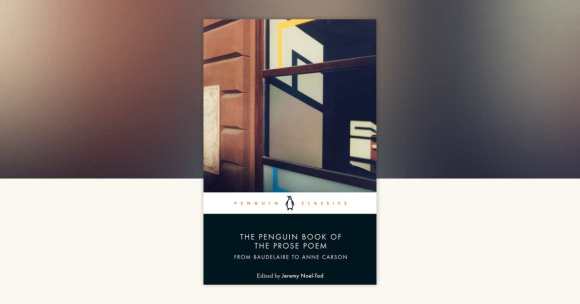
A few years ago, I read The Penguin Book of the Prose Poem. I picked it from a library shelf without any great expectations. I don’t mean that the library shelf didn’t have Great Expectations. I am sure it had that book and plenty of other volumes by Dickens. No, I mean that I wasn’t anticipating much. And let’s be clear: not every piece in that Penguin anthology was excellent or even good. Far from it! There was a lot of pretentious nonsense and word salad gibberish, and some of the best-known writers represented in the pages were responsible for some of the worst contributions. But there was enough brilliance to elevate the entire collection, and in fact I even came to the conclusion that the gems were set off to better effect because of the presence of the duds.
According to the chronology of the contents of that anthology, the prose poem first became a viable mode of artistic expression in the 1840s. I have no idea how true this is. I can only be sure of my own prose poems. Maybe ‘sure’ is too strong a word. I still wonder if they are true prose poems and not flash fictions that are simply more condensed and intense than most flash fictions. All I can do is offer a small sample of my own, four of them from various stages of my 35 year-long writing career. And let me say that I can envisage a day when I stop writing short stories, novels, plays, articles and poems, but still write prose poems (if that’s what these are) because I love the form so much.
            The Landscape Player

At first he played music on his instruments, reaching his audience through the purest melodies. His music washed over them, elevating them, burning their eyelids with tears or else trembling their lips with a dozen different kinds of smile. And when the vast wall of sound he had created had died away, there would be a silence more moving than any applause.
In time, he noticed that listeners were describing his music in terms of feelings. They spoke not of harmony and rhythm but of sadness and joy. They spoke not of keys and modes, but of elation and despair. The music was merely an interface. Accordingly, he started making instruments that played emotions instead of notes.
His scheme worked well; the critics were enraptured. His harps were threaded with heartstrings and plucked with plectrums made from the fingernails of dead lovers. His Miserychords and Tromgroans explored the outer limits of tragedy, a lugubrious drone agitated by the pounding Kettle Glums. While on a different level, the Mirthophone, Memory Gongs and rasp of the Double Bliss provided a counterpoint of cautious hope and nostalgia.
The reviews were extremely favourable. People came from all over the land to hear him. But once again, they took refuge in metaphor. Now they spoke not of sadness and joy, elation and despair, but of a sea of tears dotted with misty islands, of evil vales of shadow and rosy mountains bathed in light, of dank, gnarled forests webbed on mossy floors by a thousand cheerful babbling brooks. They explained their emotions in terms of landscape.
Deeply troubled and filled with rage, he took apart his instruments and reassembled them into something new. Now he could play landscapes. In seven minutes, he could play out his own Creation there on the stage, before them all. With his fingers on middle-sea and various salt flats, he stood them ankle-deep in puddles where an angry sun had dried up a prehistoric ocean. Salt on their shoes, they kicked sand in a purple cloud, sliding across the desert toward a ruined amphitheatre.
On and on they travelled, over the craggy sharps of unknown ranges that lacerated the sky. His brazen scales swung them in the balance; they ascended the crackling walls of icebergs and toppled over the other side. His miner chords took them deep beneath the Earth, under the drifting continents through a molten sea. And then, emerging from the depths of a volcano, they wove through a jungle of semi-quavers, trampled a tundra of tones.
The crashing crescendo became an enormous tidal wave bearing down on their heads, sweeping them onto the rolling steppes of the Coda. They suddenly realised that they were witnessing every sight that had ever existed and others that never would exist. They were exhausted, they were jaded. This was his revenge.
And yet, he had overlooked one detail. As he played the final chord, ready to storm off the stage, the final landscape shimmered into view. It was the landscape of the Concert Hall itself, complete with musician and instruments. He saw himself begin the piece afresh, from the overture. He guessed that he had condemned himself to an endless cycle of craters, sand dunes and rivers.
The audience grew restless. They yawned and fanned themselves. When he came around to the Jurassic again, most of them stood up and left. By the end of the Ice Age, the auditorium was empty. He had tried too hard to connect directly with other people. He had forgotten that only in the act of love can the gap between desire and outcome be truly bridged.
Some say that he is still there, multiplying himself forever, squeezing himself into the mouth of eternity like a snake that swallows its own tail, or like a raconteur who swallows his own tale. Others maintain that he has already reached infinity and has been set free to play a penny whistle on street corners. Either way, it is generally agreed that, in the world of music, he managed to create something of a scene.


                 Rumpledoodle Dandy

I went to the loan shark but they were out of hammerheads. I don’t know how I am going to drive my nails back onto my fingers. I guess I don’t have to drive them, they can always walk or cycle. They can even cycle back afterwards, but that counts as recycling and all the counts are at an aristocrats’ meeting at the moment. How many counts are there? I didn’t keep note. The best kept note is G#, the others tend to go off faster. They positively fly. Fly? Those flies were thick on the ground. When they took off, they were cleverer. They took off their smocks and berets. Why they wore fruit on their heads is anyone’s guess. Straw berets rot rapidly in the rain, that’s true. But the reign is over. Over where? Over there! Where Rumpledoodle Dandy sits on a throne and wears a crown that is the talk of the town. Strange king! He has fitted wheels to his palace and now he’s the torque of the town too.


               A Man on Stilts

There was a man on stilts and his stilts kept growing taller. He might have been an acrobat or fool, a visionary or scoundrel, nobody knew. At first, he just stood on stilts that were as high as telegraph poles, and he strode about the city with a perspiring face. But under the sheen of his sweat, he was smiling. The following day his stilts had already doubled in height. And now he stepped over trams and trains with an ease that bordered on the obscene, as if the traffic was beneath his notice, as if those vehicles were discarded toys or slices of dropped cake. Within a week his stilts were so high he could step over any building in any city of the nation or indeed of any other country.
What can be said to such a man? How can anyone communicate with him? No crane could reach him, no ladder. A helicopter was sent up to negotiate, but the clatter of the rotors drowned out the conversation. An aeronaut in a balloon managed to float beside him for several hours. They discussed many topics but whether the exchange was cordial or heated is uncertain. A gust of wind puffed the aeronaut away over the ocean and he vanished. Long after we had given up hope of speaking with him, of learning his name and intentions, a sheet of paper floated gently down to street level. It was a letter he had written to us. When we read it, we were compelled to grimace.
His handwriting was clear and his message unambiguous. His stilts would keep growing longer forever, he said. There was nothing we could do about the situation. There was nothing he could do. His destiny was an elevated one. Why fret about his altitude? Why worry about the ethics of his movements, the purity of his motives? Higher and higher he would go, his ersatz legs lengthening each day by a significant percentage. Soon enough, he would be able to stride from continent to continent. Then he would circumnavigate the globe in two or three quick steps. Finally he would be able to bridge the gap between this planet and the moon or even stand on other worlds.
We accepted this, some of us. Others argued for the cutting down of those monstrous stilts, for the burning of them, for the introduction of woodworm or woodpeckers. Anything to bring him back, to stop him striding about like the god of storks. We waited in vain for more letters to float down. At last it seems he rose up through the atmosphere until his head protruded beyond the bubble of air that permits life. His face was in space and he suffocated there. His body toppled and fell and burned up like a meteor. But a rumour began that he is still falling and this rumour has turned into a modern myth. People wait to be struck by his cadaver, to be grotesquely blessed.
The stilts themselves did not fall. They have grown so heavy that they are driving themselves slowly into the ground. They will push through the crust of our planet and ignite in the magma far below. In the meantime, we harness their sliding motion, connecting both stilts to a series of cogs and crankshafts, and we congratulate ourselves on our ingenuity. We might even find a practical use one day for the rotating toothed wheels. The letter from the sky has been obtained by the museum and it can be viewed in a glass case in one of the rooms, I have no idea which one. I never visit the museum. My grandmother is there, pickled in a jar, and I prefer to avoid gazing at her.


               Ocean of Words

They were separated by a vast body of water, the ocean, and they longed to press their own bodies together, but it was not possible. When would it be permitted? Only when distance was abolished. They wrote letters to express their love and yearning and these letters passed back and forth between them. So many words did they write that they had to continually dip the nibs of their pens into the inkwell. When each letter was ready to be sent there was a lurching sensation inside them. What could this mean? They each stood on the shore and gazed over the black waters but the horizon prevented visual contact. Only the letters could pass that taut line, sliding under it the same way a postman can push an envelope under a door. But the more letters they wrote, the closer the horizon seemed. Was this an illusion? No, the landmasses on which they lived had broken free and were floating like ships, moving to a point in the middle of the ocean. How strange and marvellous! They wrote letters to express their feelings on this subject. Then one morning they both understood what had happened. The ocean was made of ink. They had dipped their pens into it so many times that now it was dry. They were grounded. And so, they jumped lightly down onto the seabed and ran the few remaining steps into each other’s arms.
Rhys Hughes has lived in many countries. He graduated as an engineer but currently works as a tutor of mathematics. Since his first book was published in 1995 he has had fifty other books published and his work has been translated into ten languages.
.
PLEASE NOTE: ARTICLES CAN ONLY BE REPRODUCED IN OTHER SITES WITH DUE ACKNOWLEDGEMENT TO BORDERLESS JOURNAL
Click here to access the Borderless anthology, Monalisa No Longer Smiles
Click here to access Monalisa No Longer Smiles on Kindle Amazon International
 Borderless