Book Review by Rakhi Dalal
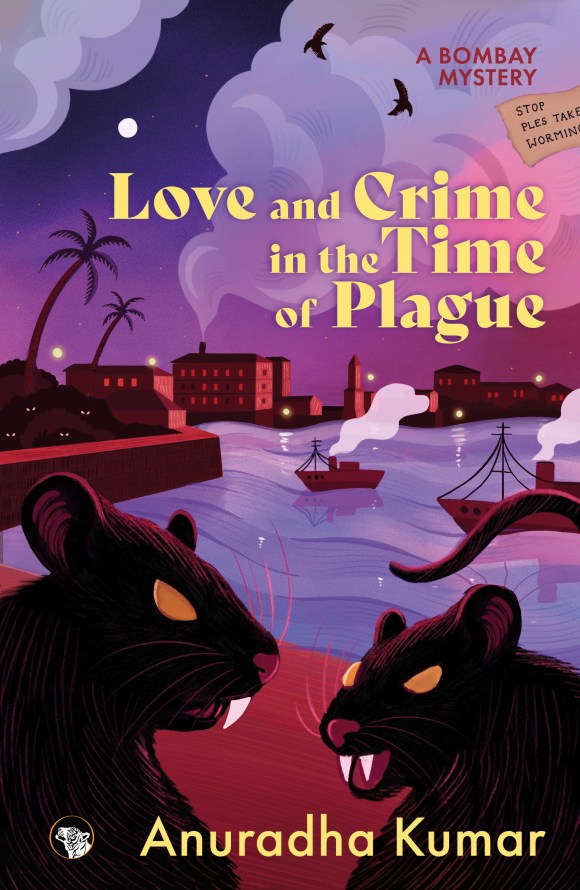
Book Title: Love and Crime in the Time of Plague: A Bombay Mystery
Author: Anuradha Kumar
Publisher: Speaking Tiger Books
With Love and Crime in the Time of Plague, a sequel to her first Bombay mystery novel, The Kidnapping of Mark Twain, Anuradha Kumar brings historical fiction and moral inquiry into a gripping, imaginative dialogue. Placed in 1896 Bombay during the plague, the book begins with an image of visceral dread — a rabid rat biting a dock-worker — and from that moment on, the city is portrayed as a place where anxiety, illness and suspicion trickle into every crack of public and private life. The author, while successfully evoking an image of a city under siege, also makes a reader wonder whether epidemics, when they arrive, also expose deeper social and ethical contagions long embedded in a society.
The novel reconstructs the atmosphere of late nineteenth-century Bombay. The city, the colonial bungalows, the horses, the streets and the just added bicycles to the streets. Along with unnerving coexistence with science and superstition, it comes palpably alive in the pages. The plague is handled with restraint. Hospitals and the quarantine measures take the hue of resented interventions which provoke resistance from communities that view them as assaults on religious customs and social autonomy.
At the centre of the narrative is Maya Barton, a character whose quiet determination and curiosity anchors the novel. Alongside her is Henry Baker, an American trade official who figured in Kumar’s earlier novel, The Kidnapping of Mark Twain. The prequel had introduced both characters in a different historical and emotional register, foregrounding adventure, transnational intrigue, and the unsettling proximity between colonial India and the American literary celebrity. In Love and Crime in the Time of Plague, Maya and Henry reappear, seemingly shaped by prior experience. The relationship between the two books is subtle rather than overt. The second does not really depend upon the first for comprehension. Yet, the readers familiar with The Kidnapping of Mark Twain will sense a continuity of temperament, trust, and shared ethical curiosity between the protagonists.
This continuity is substantial indeed. Where the prequel revolved around kidnapping and spectacle, Love and Crime in the Time of Plague turns inward, replacing dramatic motion with moral gravity. Maya emerges as an introspective figure, troubled by unanswered questions about her lineage and identity. Her own search reflects the wider inquiry that shapes the book — what realities lie hidden beneath official narratives, and who bears the cost of their concealment? The discovery of some mysterious sketches further draws Maya into an investigation which links private memory with public disorder.
Kumar here renders institutions as sites of ethical strain. Offices, hospitals and private societies are shown not as abstract systems but as fragile human constructs, susceptible to fear, bias, and ambition. A secret organisation which opposes plague-control measures shows the darker side of communal solidarity, revealing how traditions can be mobilised to validate coercion and violence. Where colonial authority is shown without romanticisation, scientific rationality is depicted entangled with coercion and indifference.
Stylistically, the prose is austere and restrained. The unhurried pacing permits atmosphere and character to come together steadily. Although the narrative may appear deliberately slow, but this slowness mirrors the creeping, inescapable nature of the plague itself. The revealing of conspiracies does not erase loss, nor does the waning of the epidemic reinstate moral balance. Trauma lingers, relationships are changed, and the city remains marked by what it has borne. In this sense, the novel extends the thematic concerns of The Kidnapping of Mark Twain. It moves from the excitement of historical adventure to a more sobering contemplation on accountability, memory, and subsistence.
This book is historically immersive and yet quietly unsettling. Reflecting upon how societies perform under intense pressure, and how crime often emerges not from evil but from fear and silence. It stands as a richly imagined historical mystery can be read on its own. When read alongside its prequel, it divulges the steady evolution of a fictional world—and of characters—who keep searching for truth in times when certainty itself is under threat.
Click here to read an excerpt from the novel.
Rakhi Dalal is an educator by profession. When not working, she can usually be found reading books or writing about reading them. She writes at https://rakhidalal.blogspot.com/ .
.
PLEASE NOTE: ARTICLES CAN ONLY BE REPRODUCED IN OTHER SITES WITH DUE ACKNOWLEDGEMENT TO BORDERLESS JOURNAL
Click here to access the Borderless anthology, Monalisa No Longer Smiles
Click here to access Monalisa No Longer Smiles on Kindle Amazon International
 Borderless