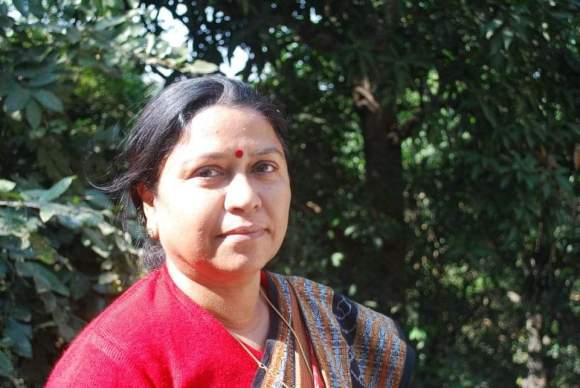
Five poems by Aparna Mohanty have been translated from Odia by Snehaprava Das
STAR

A tiny star watched me
As I groped my way in a blinding darkness
Nudged to tears.
It sparkled white
Exactly the way my mother’s face did.
The tiny star was about to climb down
When I saw it and waved, stopping it.
I knew it could easily understand
My unvoiced pleading.
So, I closed my eyes and beseeched,
“Go back! This is no place
For a star that holds such
 Pure whiteness in its soul.
 See, how pride and ego here
Hiss and howl
Cloaked in a guise of false modesty.
 ‘Selfishness’ is brokering deals
 In the trade-fair of power
 Pretending redressal and help.
 Truth is ineffectual here,
 So is love!
Go back, dear
My little lodestar
Because I can’t bear to see them
Smudge your serene whiteness,
Defile you and seat you
On a dazzling platform of deceit,
And announce
‘Here is one of our bright ancestors
We borrow our light from!’”

IN JUST AN INSTANT

Do not hold her
in your devouring desire.
Hold her in your soul
Let the woman be safe.

Do not take her as a prize won,
Treasure her with love.
Let the woman be happy.

Make her not a commodity.
Treat her as a virtue.
Let the woman feel elevated.

Just as much—
Assure her of
Security, happiness
And elevation,
A vast world of love and compassion.
Free from terror and savagery, she
Thrives on just that much assurance!
Wombs await great souls
And there is a promise of
A healthy, wholesome future
That carries pictures of a million hearts
Steeped in love.

Just for once,
Unfetter a woman’s body
From the scaffold of lust
And put it on the altar of worship.
You will then see
How in more than half of the world,
Shrines of love will come up in
just an instant.

FEAR

Too many restraints,
Numerous forbiddances.
“Do not sit here
Do not laugh like this
Don’t ever dare enter the forest
To taste the mangos,
There the tiger sits stalking,
 Fear the tiger!”

I wonder if ever my movements
Were easy and unrestricted
Like nature.
I wonder if the constraints
Were ever chosen by
An individual autonomy.
 I am a soul deprived, and
Defined in obedience.
I drag myself on by your will
Slouching under the load of your
Approval and disapproval.
I lie burning on an untimely pyre
At every intersection of the streets,
At every city center,
Where animal-howls echo
day and night.
Who knows better than you
The trick of championing self-interest
Through a pretense of love?
You lock me in your embrace
To mould me in a pliable shape,
Render me spineless,
Leaving no strength in
My arms to protest.
You gift me a heart that wallows
In fear and defeat every moment.
Why do you hold my
Easy growth in check?
What are you afraid of?
Do you fear that the arms of
All the Dusshasanas*
will be attracted
once I let my hair loose?
Do you fear that the spear will pierce
the chest of many a Mahishasura*
once I let my clothing drop?
Do you fear that many a ‘Lanka’ of gold
will burn to cinders
once I step beyond the
‘Lakshaman Rekha’?

*Dusshasana was Kaurava from Mahabharata who disrobed Draupadi, the wife of the Pandavas.
*Mahisasura is an Asura or demon who was killed by Durga
*Lakshman Rekha(line) in Ramayan was the circular border drawn by Lakshmana to keep Sita safe. Once she stepped beyond the border, she was kidnapped by Ravana.

THE WOMAN IN THE LAST ROW

The woman sits in the last row
lost in some strange
unhoped for possibilities.
Light and shadow
play hide and seek on her face
like scenes shifting alternately between
a verdant paddy field of Bhadrav*
and a gloomy Ashwina* sky.

The lines of mirrors in her front
never catch her reflection
inside their gilded frames.

Neither has she the time nor the wish
to adjust her image in varying postures
at every little maneuvering of her body,
She just sits there lowering her face,
her eyes downcast,
speaking to herself,
playing with herself,
contented in her own company.
The woman
who sits at the extreme back row
could hold anyone’s hand and
pull that person to
the delicate loneliness of her playhouse.

And, when the meeting disperses
amidst accolades and applauses,
the great ones stand up
weaved in blandishments
like mountains tangled in the
creepers of Malati*
raising their proud heads.
Not a single glance is flicked
at the last row.
No one would know when
the woman in the last row
had disappeared,
stealing the silence from there.
 No one might believe
a river flowed there
just a while before.

*Bhadrav—August-September
*Ashwina – September -October
*Malati – a creeper with pink and white flowers

A SONG FOR THE LITTLE GIRL

The day my little girl
Climbed the steps to her green age
And reached out to pluck
The loveliest flower of Phalguna*
And the sweetest berry of Chaitra*,
I cried out “Don’t” from below,
Stopping her.
She heard me and came down
To where I stood.
Since that day, questions
Like the swelling waves
Of an unseasonal flood
Crash at the edges of her eyes --
Why such prohibitions, why?
 And I thought, why indeed…
 My movements would be
Held in check.
Why must always pain and forbearance
 Come in my lot?

I am a mother, after all
Like all mothers,
The spells of Sravana*-showers
In her eyes
Swept me away in its current…
But, will it do if I let myself be tossed away
In the rushing flow
 Of her questions?

I am not a little girl like her.
I am rather trapped perpetually
In the role of a culinarian
That cooks on a holy hearth to
Feed the custodians of morals.
So now,
It is the time to cut and dress my little girl,
Cook her to a savoury dish
Of her father and her husband’s choice
And serve them on a gold plate!

 *Phalguna – February-March
*Chaitra – March-April
*Sravana – July August
Aparna Mohanty(1952) is a conspicuous voice in modern Odia poetry. Her poetry, with its feminist overtone, boldly asserts the significance a woman’s role in the family as well as in the society. They strongly defend the woman against the derogations perpetrated on her by a male-dominated society and defy the societal restraints imposed on her that curb her freedom. Aparna Mohanty has received several accolades for her contribution to Odia literature including the prestigious Odisha Sahitya Akademi Award.
Dr.Snehaprava Das, is a noted writer and a translator from Bhubaneswar, Odisha. She has five books of poems, three of stories and thirteen collections of translated texts (from Odia to English), to her credit.
PLEASE NOTE: ARTICLES CAN ONLY BE REPRODUCED IN OTHER SITES WITH DUE ACKNOWLEDGEMENT TO BORDERLESS JOURNAL
Click here to access the Borderless anthology, Monalisa No Longer Smiles
 Borderless