By Meredith Stephens
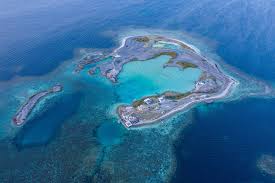
We sail into Turtle Bay on East Wallabi Island. I make my way barefoot to the bow. Then I hold the boat hook and crouch at the edge, extending it towards the buoy. I loop the hook under the thick slimy rope covered in algae and yank it upwards.
“It’s too heavy!” I yell, my voice disappearing into the wind.
Alex must have heard because he abandons the helm and races to the bow. He grabs the boat hook from my hands and pulls up the rope, securing the buoy to the cleat.
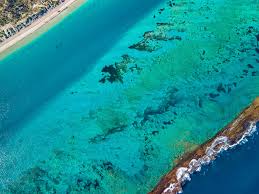
Turtle Bay is a wide horseshoe. The waters are glistening turquoise and are surrounded by white sands. It’s uninhabited but small planes of tourists regularly fly in and out to walk and dive. Night is descending and it’s too late to disembark, so we look longingly at the shore and wait for the morning.
Once day breaks, we head ashore on the stand-up paddleboard. Alex places his phone in a waterproof bag. He alights from the stern and kneels on the back of the paddleboard. I kneel at the stern and carefully slide over to kneel at the front of the paddleboard. Alex paddles to shore behind me and I try to remain as still as I can, unresponsive to the moving water beneath me, retrieving the muscle memory of riding wayward horses in my youth. Once we arrive, we alight as quickly as we can and drag the paddleboard away from the water’s edge.
A shaft of light catches my eye, and I reach down to pick up the object. It’s a small purple shell lined with brown flecks. As the sun is blinding, I am forced to continue casting my eyes downward. Never have I seen such an array of shells on a beach. Alex, on the other hand, finds his attention caught by even brighter hues than the shells. A blue plastic wrapping. A broken glass bottle. An aluminium-insert from boxed water. He retrieves these items unflinchingly. We continue to walk around this uninhabited island and find yet more rubbish washed up ashore. Most of it is plastic bottles and brightly coloured bottle tops. Then we spot a large blue plastic tub. Alex picks it up and places the rubble within. I respond with strong disgust, so am ashamed to say that I do not help him. Alex does not chide me for this, and I am grateful that he withholds judgement. I continue to admire the multi-coloured shells washed up by the tide.
We beat our way back through the fierce heat to the section of beach where the paddleboard is waiting. Alex affixes the bucket of rubbish to the stretchy cords at the front of the paddleboard. Spray surges as each wave hits the shore. He waits for a lull between the swell. After several more waves hit the shore there is a momentary calm, and he pushes the board forward. I climb on and crouch behind the rubbish. Alex mounts the board behind me and paddles towards the boat. I’m no longer a retiree, but a teenager at the beach with her boyfriend. I close my eyes and now I am keeping balance on my lively horse. Suddenly, when we have nearly reached the boat, I sense Alex is worried. The tide is pushing us away from the boat and he paddles harder. Will the wind push us into the vast empty seas out of the range of mobile devices? Just as we reach the stern Alex thrusts his paddle into the water to do a U-turn. I find myself parallel with the boat, grab the steel handle, and slide onto the boat without tipping Alex and the rubbish into the depths.
All is secure, and now it’s time to sail back to the mainland. We head north-east to the tiny township of Port Gregory, with its population of eighty, renowned for a submarine shelling in 1943, and a vast pink salt lake. After anchoring in the bay, we again secure the rubbish to the front of the paddleboard and kneel behind it. Once on the shore, we are reassured by the sight of multiple rubbish bins. Port Gregory is too remote for recycle bins, so we reluctantly place the island rubbish into one of the general bins, and trudge through the heat to explore the town.
Meredith Stephens is an applied linguist from South Australia. Her recent work has appeared in Syncopation Literary Journal, Continue the Voice, MickingOwl Roost blog, The Font – A Literary Journal for Language Teachers, and Mind, Brain & Education Think Tank. In 2024, her story Safari was chosen as the Editor’s Choice for the June edition of All Your Stories.
PLEASE NOTE: ARTICLES CAN ONLY BE REPRODUCED IN OTHER SITES WITH DUE ACKNOWLEDGEMENT TO BORDERLESS JOURNAL
Click here to access the Borderless anthology, Monalisa No Longer Smiles
Click here to access Monalisa No Longer Smiles on Amazon International
 Borderless