
By Tanika Rajeswari V.
April came with an unfamiliar quiet, a hollow in the air. This was the first Vishu [1] without my grandfather.
He was a tall, quiet man, his words few but carefully chosen. His once fair skin had grown shrivelled and cracked with age, weathered by the years. I can still picture him, absently scratching his arms, his brows furrowed in meek annoyance as he would ask, “Why does it itch so much, even after all the oils I’ve used?”
I used to tease him playfully, “No amount of oil can save that skin, it’s gotten too old!” . . . He would chuckle softly, his laugh a low, comforting rumble.
It was customary for us to gather at our ancestral home to celebrate Vishu, the Malayali [2] New Year. My grandfather meticulously decorated the house. Even as his body grew frail and his movements slowed, he insisted on preparing the Vishu Kani [3]—a sacred arrangement of flowers, fruits, and other items as symbols of prosperity.
After we had all gone to sleep, he would go about his task, moving through the dimly lit house. I can still see him in the flicker of my mind’s eye, carefully arranging the Kani in the little pooja[4] room, his hands steady despite the years that had worn him down. In the centre, he would place a small idol of Lord Krishna, draped in a yellow cloth. Around Krishna’s neck, a garland of jasmine flowers, freshly picked, would hang delicately, its fragrance nourishing the air.
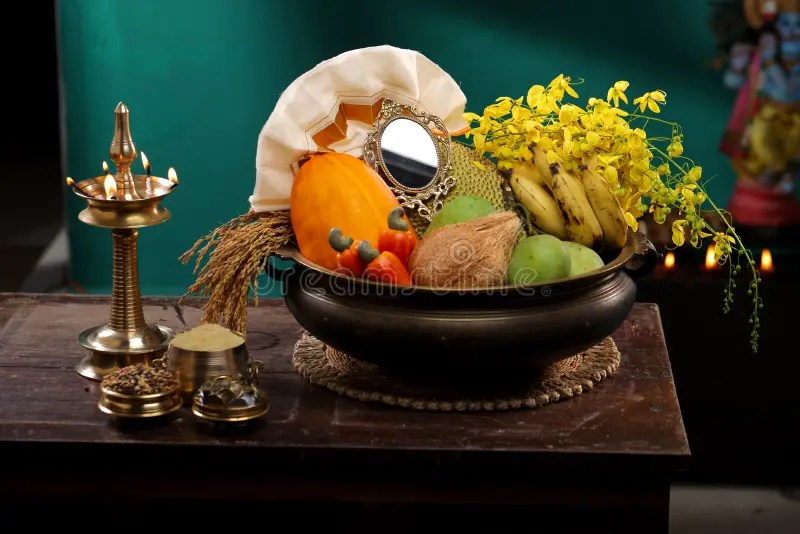
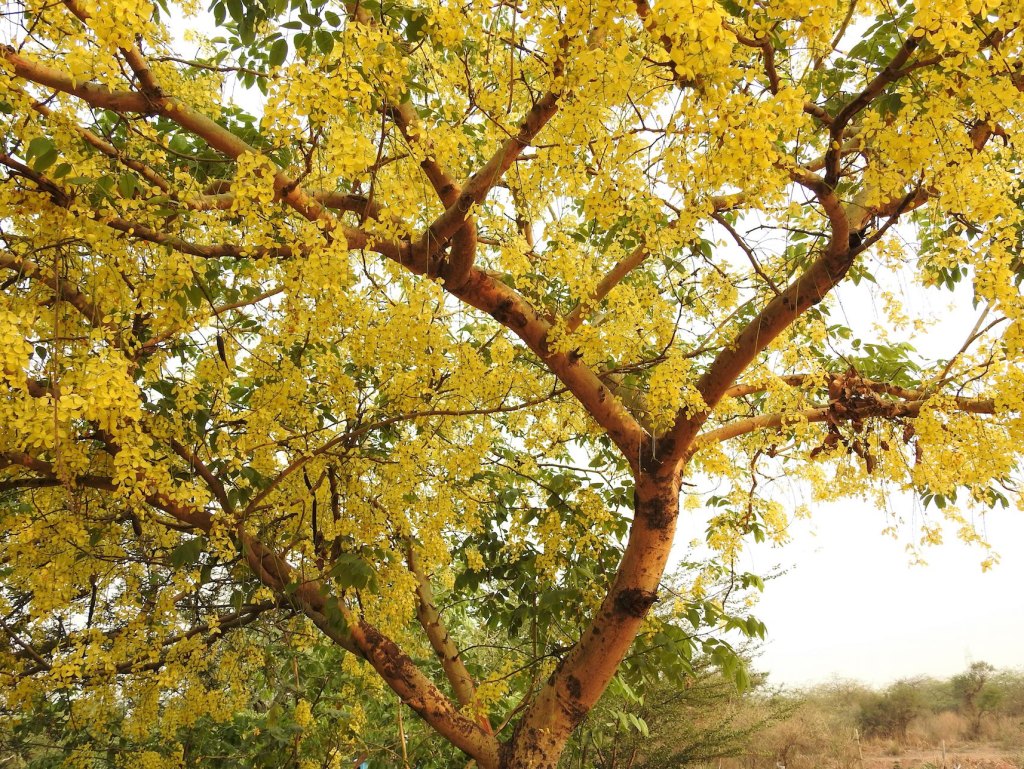
He would arrange kanikkonna[5] flowers —the golden confetti of the Gods—on a golden plate. He always plucked them himself from the tree in our courtyard—no matter how tired his bones were, he would collect them with care. Then came the fruits and vegetables—bananas, jackfruit, cucumber—all laid out. In another plate, he would place pulses, grains, and a few coins. He would carefully add gold jewellery and cash, all arranged just so, a display of hope for the year to come. An ornate brass hand mirror was the final touch.
For him, this was more than tradition—an act of piety, a warm tenderness that was passed onto us. Once everything was set, he would go to bed, only to rise before the break of dawn. I can still hear his voice, gentle but insistent, as he would wake me, whispering, “Come, get up, my little one… it’s time”.
And so, we would begin Vishu every year with that first glimpse of the Kani. It wasn’t just a sight; it was a feeling, like stepping into something timeless, something sacred. My grandfather was the heart of all of it. His presence, his careful hands, his simple joys—they were woven into the very essence of those mornings.
I couldn’t bring myself to celebrate Vishu without my grandfather. I decided to drive to down my ancestral home. . .
When I arrived at my destination, it felt as if time itself had slowed, as though the house had grown old with my grandfather. The courtyard, once brimmed with the lively hum of family gatherings, now lay quiet, strewn with dry leaves from the kanikkonna[6]tree. The golden flowers that once sparkled in the sunlight were now dulled, forgotten on the ground.
Stepping inside, I was greeted by a heavy stillness. The air felt thick, holding the scent of old wood and memories that had lurked too long in the shadows. The floors, once neat under my grandfather’s care, were now covered with a film of dust, untouched. The once vibrant home felt like a forgotten relic. The warmth that had always enveloped me now replaced by an eerie quiet. It was as though the house was mourning too. I grabbed a broom and began to clean. With every bit of dust I cleared, I found fragments of the home I remembered —the laughter, the smell of spices from the kitchen, the soft murmur of voices late into the night…everything circled around me.
That night, sleep evaded me. I lay awake, staring at the ceiling. Turning my head to the left, I peered out the window into the faint glow of the streetlight. My gaze planted on the place where his earthly form had been transformed into ashes. The memories surged back—his final farewell…
A sense of loss washed over me, mingled with an uncanny chill. Suddenly, a noise broke the silence— like someone shuffling through the halls. My heart leapt. I sat up, straining to listen. The sound came again from the direction of the pooja room.
I moved slowly, my feet silent on the wooden floor. The air felt suffocated, like it was holding its breath. As I approached, a familiar scent reached me—the sweet fragrance of jasmine, fresh and unmistakable. My pulse quickened. I pushed open the door.
There, standing in the glow of the moonlight filtering through the window, was my grandfather.
He was just as I remembered—his hands steady, arranging the Vishu Kani with the same care he had every year. The kanikkonna blossoms, the jasmine garland, the mirror—everything was in its place.
I stood frozen; my breath caught in my throat. My mind raced to make sense of what I was seeing, but I couldn’t move. I couldn’t speak. I could only watch as he worked in silence. Then, as quickly as it had appeared, the vision faded. I was left standing alone in the doorway, the scent of jasmine lingering in the air, heavy and real.
In a panic, I ran. My feet barely touched the ground as I rushed into the kitchen. I fumbled with the light switch, my hands shaking. I turned on the lights, as if plunging the house into light would erase what I had seen.
The night was unbearable after that—every creak of the house made me flinch, every gust of wind felt like it carried whispers from another world. I barely slept, my mind replaying the sight of him again and again.
The next morning, I drove back home and sat with my family at the breakfast table, the words pressing at my throat, desperate to escape. I had to tell them.
“I saw him,” I blurted out, my voice trembling.
“Last night, in the pooja room.”
“Grandfather… he was there. . .”
“He was preparing the kani like he used to. I saw him. I swear.”
The room fell quiet. My mother was the first to respond. She reached across the table and placed her hand on mine, her face soft with concern. “Dear, you must’ve been dreaming. It’s been a hard year for all of us. Sometimes, grief can make us see things that aren’t there.”
“No, Amma[7], I wasn’t dreaming. The kani— when I woke up this morning, it was perfect. . . the flowers were fresh! The jasmine… the kanikkonna… everything was just like how he used to arrange it.”
My uncle shook his head, giving me a sad smile. “You were alone in the house. Your mind probably hallucinated. It’s common, especially around Vishu when we are more nostalgic. We want to feel his presence so badly that our mind creates it for us.”
“But the flowers—” I started, but my mother shushed gently.
“Dear,” she said, “grief does strange things to us. You might’ve arranged the kani yourself, without realising it, lost in memory. And the scent of jasmine… it’s everywhere this time of year.”
I looked at my younger cousin, hoping for some sign of belief, but she just shrugged. “It happens, chechi,” [8] she said “When Achachan[9] passed, I thought I heard him talking to me once. But it was just a dream.”
No one believed me.
I sat back in my chair, my chest tightening.
“But the kani,” I whispered again, almost to myself. “It was real.”
“Dear,” my mother said, “he’s with us, always. Maybe that’s what you felt. His love, his presence… but it’s time to let him rest.”
I nodded, unable to argue anymore. What was the point?
I sat there, their voices becoming distant, I could still smell the trace of jasmine clinging to my clothes, like a secret only I could sense.
- Vishu: The Malayali New Year festival celebrated in Kerala, marked by the preparation of the Vishu Kani, fireworks, and family gatherings. It signifies the start of the new harvest year.
- Malayali: A person from Kerala, an Indian state on the southwestern coast, known for its rich culture, history, and traditions
- Vishu Kani: A traditional arrangement of items placed in the pooja room at dawn on Vishu. It typically includes fruits, vegetables, flowers, and an idol of Lord Krishna, signifying abundance and good fortune for the coming year.
- Pooja Room: A family prayer room
- Kanikkonna: A flowering tree, known as Cassia fistula, which blooms during the Vishu festival. Its vibrant yellow flowers symbolise prosperity.
- Amma: The Malayalam word for ‘mother.’
- Chechi: A term used to refer to an older sister or female cousin in Malayalam, often used to show affection and camaraderie among siblings or relatives.
- Achachan: A term used to refer to a grandfather in Malayalam, conveying respect and affection.
.
Tanika Rajeswari V. is a Ph.D. student at the University of Sheffield specialising in Modernist Poetry.
PLEASE NOTE: ARTICLES CAN ONLY BE REPRODUCED IN OTHER SITES WITH DUE ACKNOWLEDGEMENT TO BORDERLESS JOURNAL
Click here to access the Borderless anthology, Monalisa No Longer Smiles
Click here to access Monalisa No Longer Smiles on Amazon International
 Borderless