By Rebecca Klassen
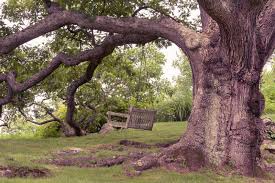
The oak stood in the field at the end of their parallel gardens, just over the fence. The branch stretching out over Orla’s lawn creaked like a rocking chair as she swung back and forth on the rope swing her mum had made years ago. The creak had grown louder since she’d turned nine. She watched her mum talk to their neighbour Ray over the fence, which had once come up to his chin. Since he’d walked with a cane and his wife had died, he could just about see over it on tiptoes. When her mum folded her arms, Orla stopped swinging and listened to them talk.
“I can’t get out there anymore.” Ray’s voice was strained. “I’ve only managed the trip twice since I scattered Hetty’s ashes.”
“I’ll take you out there on Sundays, Ray. I’m more than happy to drive you.”
“I couldn’t be a burden to you like that, Tamara. It would be easier if we just cut it down. England has millions of oaks.”
Orla’s mum looked over at her, noticing the creaking had stopped. Orla began to swing again, the branch speaking over the rest of her mum and Ray’s conversation. She looked up at the pistachio-coloured leaves whispering above her, some yellowing at their tips.
.
After lunch, Orla took her crayons into the garden and peeled the papers off them like sweet wrappers. Gathering some of the oak’s fallen leaves, she rested them on a paving slab near the swing and placed sheets of paper over them. Rhythmically, she rubbed the crayons back and forth, the spines and veins blooming on the paper.
“You’re a big girl now, aren’t you? Too big for that swing.”
Ray’s white fingers gripped the top of the fence, knuckles peaked, watching her beneath crêpe eyelids.
Orla had liked Ray’s wife, Hetty. She’d regularly made Orla biscuits, given in a biscuit tin with robins on it. Whenever Hetty went on a trip, she’d always bought Orla a little present; a magnet of an ‘O’ for Orla from Blackpool, a bottle of multi-coloured sand from the Isle of Wight, a keyring with a plastic wedge of cheese on it from Cheddar Gorge. They were always wrapped and sealed in bright tissue paper. Once, Hetty had brought back a red kite’s feather from her Sunday walk. Even that, she’d wrapped in pink tissue paper and brown twine before giving it to Orla.
Sometimes, when Orla played with the oak, she would hear Hetty humming in the garden, and she’d stare at the trunk, imagining Hetty’s song was fairies’ singing as they worked.
Orla guessed that all these beautiful things about Hetty were why she had barely noticed Ray until the day she’d seen him crying in her kitchen, her mum patting his papery hand as he clutched his handkerchief. Orla had lined up all the trinkets from Hetty on her windowsill. That had been over six months ago.
“A swing is for tiny ones. You’re all grown up now.” The effort to make his voice singsong made Ray cough.
Orla watched the swing’s wooden seat pendulum in the breeze, her leaf rubbings fluttering on the ground.
“I like my swing. Even Mum goes on it sometimes. I don’t think you can be too grown up for a swing.”
Ray sank behind the fence momentarily, muttered something, then pulled himself back onto his toes. “You remember my lovely Hetty? Her ashes are scattered up on the hill over there.” He lifted a shaky finger from the fence towards the hill beyond the field. Orla had seen the hill in winter through the oak’s spiny boughs. “I want to see my Hetty every day from the window. I can’t see the hill with this great thing in the way.”
Orla continued pushing the crayons across the paper, her eyes down. She imagined Hetty on the hilltop and opening the robin biscuit tin, letting Orla take some lemon shortbread, fresh slithers of zest zinging on her tongue as Hetty smiled at her. Orla felt a knot in her chest and squeezed her crayon. She knew the knot in Ray’s chest was bigger and tighter, so she didn’t mention that he wouldn’t see Hetty up on the hill, tree or no tree in the way.
Ray coughed again. ‘I need to get this tree out of the way.’
Orla didn’t hear him, the leaves shushing in the wind, drowning out his voice.
“Pardon?”
“I said the tree needs to go!” His voice bounced off their houses, and birds flew from the treetop.
“What about the squirrels?” Orla asked.
“I put nuts out for them.”
“They can’t live in a dish of nuts.”
She knew she had been cheeky, so she didn’t look up until his tapping cane faded away.
.
The next day Orla took some paint pens to the end of the garden. She harvested twelve acorns from the grass and slotted them into her front dungarees pocket. Laying them in a line on her paving slab, she coloured them in pastel shades. Then she turned them upside-down and drew faces on them, their cupules acting as jaunty hats. Herby scents from the greenhouse behind her made her hungry, and she wondered what an acorn tasted like, even though she knew they were poisonous. Finding one in the grass without paint, she rolled its smoothness across her lips, the tip of her tongue licking it. Orla felt a sharp smack on her head. A twig with a cluster of leaves and acorns had fallen, reprimanding her. She tossed the acorn, shiny with her spit, over the back fence into the field.
Footsteps came down the path, accompanied by a familiar beat. It was Mum, followed by Ray with his cane. Her mum looked weary.
“Orla, Ray has said he’s going to buy you a present. A swing set. Isn’t that kind?”
Ray rested on his cane with a clownish grin.
“Yes, that’s kind. Thank you,” Orla said as enthusiastically as possible. “I can still keep my tree swing, though?”
Her mum sighed. “I told you she’d want to keep it, Ray. Honestly, it’s no bother to drive you up the hill every week. Besides, having that tree felled will cost you a lot more than a swing set, and I’m not convinced the council will give you permission anyway.” She looked up at the tree, and Orla watched the dappled sunlight flash across her mum’s face. “It would be a shame to see it go. Don’t you think it’s beautiful?”
“Hetty was beautiful!”
Ray threw his cane to the ground. It hit the path, making Orla jump, a couple of her acorn people rolling away. Ray took his handkerchief from his pocket and covered his face.
.
Orla dreamed she was aboard a boat on a rough sea, a pirate ship chasing her vessel through a dark night. Relentless rain pummelled the creaking deck, and the sails whined against the fierce gusts. The chasers fired a single cannon shot – a crack and wail in the night. Her ship had sunk, icy waves pulling her down as the groaning boat went under with her.
Morning brought peace and land as she awoke in her bed. A storm and a lethal shot had been true. Orla’s swing branch had ripped from the trunk and landed on her paving slab, splitting it in two. The splintered swing lay under the branch’s body, sodden rope snaking across the puddled grass. The branch’s crown had shattered the greenhouse. Glass shards and acorns sprinkled over toppled tomato vines and pots of mint, basil, and thyme. The back fence of Orla and Ray’s gardens had been thrown down, the trunk base and roots exposed for all to see.
Orla watched the two men with their chainsaws from her bedroom window, their woodchipper spraying bark fragments like snow. She traced the spine of the red kite feather from Hetty with her finger as she heard her mum talking with workmen. “That branch could’ve fallen on my daughter. What if the whole damn thing comes down?”
One of the men said, “It’s a strong tree; it just needs proper maintenance, regular pruning.” Her mum had sounded uncertain. When they left, Orla heard Ray at the front door. He sounded cross and mentioned the fallen fence several times.
“I’ve filled in the council application to have it felled. I just need your signature too, Tamara.”
“Fine, Ray,” her mum said. “It can go.”
When her mum came to her room later, Orla wouldn’t remove the pillow from her face.
Ray was impatient for the repairman to arrive. He didn’t like the idea of walkers gawking into his garden or dogs darting in and peeing on his flowerbeds. The repairman couldn’t make it until next week, suddenly overwhelmed with work delivered by the storm. Ray surveyed the fallen panels. Two of the fenceposts had snapped at the bottom, clearly rotten. He wondered if he could prop some panels up on the remaining posts to give himself some privacy. Holding his cane with one hand, he bent down and grabbed a fallen panel. The weight was unexpected, but he anticipated the fall, managing to roll and land on his back in the grass. He panted, waiting for pain, but it didn’t come.
“Stupid fool!”
His cane had gone one way, and he’d gone the other. He tried to turn and bring his hands under him.
“I’m like a bloody capsized tortoise!”
He called for help, shouting for Tamara before he remembered seeing them go out in their car earlier. He kept shouting, hoping a passing walker might hear him from the field. His throat began to hurt, and he knew he should slow his heart rate down.
It was a grey day, and the news had forecast showers. The freshness in the air told him they were on their way. Oak leaves trembled above him. Hetty had often admired the tree. He didn’t think she’d have wanted it gone, but he knew she’d understand why he would.
“I know I’m right. You’ve got to go. Supposing the branch had fallen on the girl.”
He heard the rain pattering above, but he didn’t feel it, the oak sheltering him. Two squirrels rushed up the trunk and screeched at a wood pigeon who took flight, sending acorns to the ground. Ray shielded his face, but none of them hit him. A single leaf landed on his chest, and he ran his thumb repetitively along its crinkled edges. Dots of honeybees explored the oak’s limbs, and bluetits hopped about at its crown.
“You’re a busy tree, aren’t you. So big. You’re still huge even looking at you from far away up on that hill.”
He remembered standing on the hill with Hetty on their Sunday walks, roast gammon and apple crumble heavy in their stomachs. Shielding their eyes from the sun’s glare, Hetty would point to the oak and say, “The perfect beacon to find our way home.” They’d walk back across the field, the oak guiding them home.
A red kite soared above the oak into the field to search for mice and voles. Remembering Hetty giving Orla the feather, he ripped the leaf in his hand again and again until it was mulch in his fingertips.
.
When Orla and her mum found Ray, it was getting dark. They warmed him up and fed him tomato soup, bread and butter, and tea and biscuits. Her mum called the paramedics. They came and said his stats were normal. As they left, Orla heard her mum speak quietly to them at the door.
“He doesn’t seem himself. He’s barely said a word.”
They said he was in shock, he’d had a long afternoon, and he’d recover.
Orla sat with Ray while her mum washed up.
“I’m sorry you fell,” she said. Ray kept his eyes on the newsreader on the television, and she wasn’t sure if he’d heard her. “The tree didn’t mean to drop the branch.”
He stroked the hot water bottle in his lap like a cat. Orla spotted the council form on the coffee table. She stood up.
“You don’t need to get me a swing set.”
She waited by the front door until her mum was ready to go.
.
At midnight, Ray couldn’t sleep. The soup and bread had made him feel stronger. Taking his cane with him, he went out into his dark garden. The clouds covered the stars, and the earlier rain soaked his slippers. He went to the shed and got a length of rope and a small step ladder. Draping the rope around his shoulders, he dragged the step ladder to the tree, dropping his cane.
.
The next morning was Sunday. Orla got up early to watch television while her mum lay in. Something caught her eye through the patio doors.
The base of the oak’s trunk shimmered with silver.
Orla put her wellies on and went outside. Foil was wrapped around the trunk’s bottom half and lashed down with a spiral of rope. It had been tied off in a bow at the centre of the wrappings. She ran to it. The foil chimed against the tree bark in the wind as though the tree approved of its new attire.
Tucked into the rope was an envelope with Orla’s name on it. Inside it were confetti-sized shreds of paper. She pieced some together and recognised the print, saw the word council. It was the felling application torn into scraps.
Rebecca Klassen is from the Cotswolds and is co-editor of The Phare. She has had over forty publications in journals and anthologies, and recently won the London Independent Story Prize. The Gift was shortlisted for this year’s Laurie Lee Prize.
 Borderless