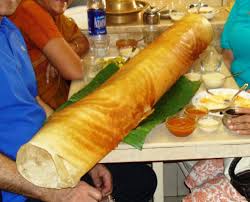
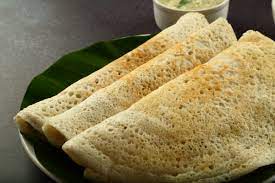
I went to Sri Lanka before I travelled to India. I wanted to travel to India but it turned out to be easier to go to Sri Lanka first. I supposed the countries would be similar, and in many ways they are, but there are significant differences too. Obviously, I only learned about the differences after I departed Sri Lanka and reached India. The first difference I noted is that dosas are better in India, or to be more accurate they are better in South India. I have no idea what dosas are like in the northern parts of the subcontinent. But in Sri Lanka I didn’t care for them very much. They were spongy, soggy and filled with cold mashed potato, almost as if the very notion of ‘crisp’ had been expunged from the minds of the cooks who made it. In India, conversely, I found the magnificent ‘paper dosa’, so crispy I only had to glance at it to make it crackle. Thick green chutney and filter coffee and paradise is near at hand.
In Sri Lanka the tuk-tuks are called tuk-tuks, as they are in Africa, but in India they are called autos, which is short for auto rickshaw. I don’t suppose it’s much of a difference, really. When I was in Sri Lanka I was told that drivers in India never stop for pedestrians who are crossing the road but deliberately try to run them over, so that they will be reincarnated as higher beings. In Sri Lanka, drivers are willing to wait for Nature to take its course. No point being reborn as an elephant or dolphin prematurely. What I actually found was traffic chaos on the highways of both countries, but India being much bigger has more chaos, of course. Nobody tried to deliberately run me over in either country, at least not to any noticeable degree, but I won’t make light of the dangers of walking along a road without a pavement. It is harrowing.


At least for me it is. I have always taken pavements for granted. I wonder if they have taken me for granted in return? Never again. Whenever I happen to catch sight of a pavement now, I feel like I am greeting a long-lost friend. “My dear flattened sir! Where have you been? And where are you going? Would you object to me walking with you for a spell, perhaps as far as the bookshop or the restaurant or the metro station? My, but you are looking well. And how are your little potholes? Off to college soon, no doubt! Ah, they grow fast. It seems only a week ago they were tiny cracks in the concrete and already they are yawning chasms. Good heavens, what is this? Motorcycles appear to believe you are an extension of the highway. How improper!”
Pavements are like paper dosas, they shatter at a glance. But this is true in both countries equally, India and Sri Lanka, and doesn’t constitute a difference. I am on the lookout for differences, not overlaps. Monitor lizards. Now that’s a thing! In Sri Lanka there are monitor lizards and although there may be monitor lizards in India too, in Sri Lanka, I saw them by the hundreds and none in India so far. Saree styles too. I don’t mean that monitor lizards wear sarees differently in these countries but that women do. I only know this because I was told it. To my untrained eye, they looked exactly the same, lengths of cloth wound around the body, somewhat complicated, like an ancient toga but more colourful. The existence of ginger biscuits is another difference. They are plentiful in Sri Lanka, but I haven’t located a single packet in India. Ginger biscuits shatter like paper dosas on pavements, so crispy are they.


India won its independence in 1947, Sri Lanka in 1948, which means that for about six months Sri Lanka was a part of the British Empire when India was free. Could those six strange months have had any lasting impact? Probably not but how can I be sure? Sri Lanka has squarish electrical socket holes, India has roundish ones. Sri Lanka has roundish ginger biscuits, India has none, probably because they don’t constitute a ‘square meal’. In India, ‘milk’ is a liquid that is derived from a cow, in Sri Lanka it comes from a coconut. A cow is a mammal, a coconut is not. However, milk was created by Mother Nature to feed infants. Cow’s milk was originally intended for calves while coconut milk was intended for baby coconuts. In India there are many festivals, in Sri Lanka fewer. In fact, there are so many festivals in India that I own a calendar which marks the days of the year that aren’t festivals. It’s easier.
Bookshops. There are many great Sri Lankan writers and I have been told that there are many bookshops on the island, but I didn’t see one. I searched for them in vain. Not a single bookshop anywhere! I must have been looking in the wrong places, but all the same it seemed mighty strange. I did find shops calling themselves bookshops that turned out to sell bottle openers or corkscrews, but I never found a place selling those flippable cuboids filled with words that one is pleased to read in the evenings. In India the opposite situation prevailed. There are so many bookshops that it is difficult to find anywhere selling corkscrews or bottle openers. There are shops that claim to sell corkscrews and bottle openers but in fact they sold books, highbrow literature mostly, none of it doubling up as a tool to uncork wine or give access to beer.
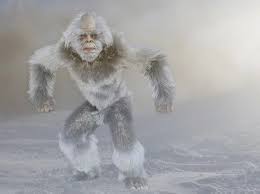
The final difference I wish to mention is one that is somewhat unfair to the phenomenon known as ‘temperature’. Let me explain. In Sri Lanka I boiled, it was hot all day, every day, and even at night it was very warm. The ceiling fans kept me comfortable and without them I should have turned into a human kettle with steam coming out of my nose and ears. In India I found the climate perfect, warm but not hot, and the ceiling fans were allowed to take the day off. Yet the reason for this marvellously cool India is simply that I was based in Bangalore, which lies at a fairly high altitude. Altitude makes all the difference, a truth that I learned in many countries along the equator. Roast on the coast, cool off in the hills. Go up, keep going, and you will eventually have snow on your brow, no matter your latitude. This is the philosophy of Yetis. And if anyone thinks I am obsessed with Yetis, I will admit it. Yes, I am.

Rhys Hughes has lived in many countries. He graduated as an engineer but currently works as a tutor of mathematics. Since his first book was published in 1995 he has had fifty other books published and his work has been translated into ten languages.
.
PLEASE NOTE: ARTICLES CAN ONLY BE REPRODUCED IN OTHER SITES WITH DUE ACKNOWLEDGEMENT TO BORDERLESS JOURNAL
Click here to access the Borderless anthology, Monalisa No Longer Smiles
Click here to access Monalisa No Longer Smiles on Kindle Amazon International
 Borderless
7 replies on “Some Differences Between India and Sri Lanka”
I’ve heard that Indian scientists are working on a hybrid, which will be called the COWCONUT. This will be especially useful when India establishes its moon base, because coconuts will be part plant and part mammal, and the plant part will flourish in the mammal parts generous amounts of poo.
LikeLiked by 3 people
That’s funny 😊
LikeLike
They are working on much more!
LikeLiked by 1 person
Wrt to Tuk Tuks, in fact Sri Lankans usually do not use the term that much. We refer to them as either Trishaws (adapted from Rickshaws I believe), or simply Three Wheelers! Tuk tuk is a word popular in places like Thailand particularly Bangkok, which is bigger tourist attraction. Hence lot of tourists who visits Sri Lanka use the term tuk tuk, thus locals when talking to tourists use the term tuk tuk often, but among themselves not so much, but its kind of changing now slightly as locals too are catching up with the word tuk tuk. For example if I am talking to my aunt from the previous generation I’d say get a three wheeler and come, but if it were a friend I am talking to from a younger generation, I might say get a tuk! Nevertheless still the former ‘three wheeler’ is in my experience is the commonly used word among locals!
LikeLike
Traffick: that was hillarious!
But jokes aside in my experience there’s a significant difference though in both countries the traffic is chaotic. In India even in large roads drivers do not seem to have the habit of stopping for pedestrians to cross the road even at zeebra crossongs with or without lights. This could be quite an issue as the traffic flow is insanely continuous there. In Sri Lanka its not that worse, quite a lot of drivers still honor zeebra crossings and definitely more so if there are lights too in addition.
In addition in smaller lanes where the road isn’t partitioned to left and right you might even find some taxis just disregard the sticking to the left side of the road rule completely, which could be a daunting experience for passengers, as you often find vehicles stop head to head just short of colliding on one side of the road. I have not come across such bad driving here. Of course there are unruly drivers that unduely occupy the other side of the road when it comes to over-taking etc, but it is not as bad as some of the experiences I’ve personally had in India – but that was more than 25 years ago and So things may have changed by now, and my last trip to India was 15 years ago so overall conditions could be better nowadays.
Anyway according at least one other traveller who is widely travelled, Egypt is the only other country where traffic, driving and general conditions on roads could be considered worse than in India!
LikeLike
That’s an interesting observation about bookshops, that had me thinking and taking me back to my childhood.
My first impression was are you nuts – we’ve got plenty of bookshops!? Which is true! I mean there’s M D. Gunasena, Vijitha Yapa, Sarasavi, Expographic, just to name a few off top of my head, but they are large scale bookshops and I realized you nay not be referring to such big bookstores but small boutique types one that could be found on the side of the road in aby town!
That’s true. We did have such book shops lets say about 30 to 40 years ago. They were essentially stationery shops that also sold books and toys etc etc. How I know when I was young we lived in the outskirts of Colombo, and where I lived there were two such book shops not just one! These are the places that we went to buy books when the school gives the list of things required for a new year! They invariably had books from novels to non fiction.
One such bookstore had an interesting thing going. You could deposit the price of the book with them and take the book home for a few days. Can’t remember the duration but not longer than a week I think. Then read it and return. At the point of returning the shop would give you the deposit money back minus I think about 10% the charge for the service. This way you could read a book without buying it for the fraction of the cost! And the book store might earn more than the price of a book by renting it this way. I can remember reading at least one book this way.
Yes you seem to be right we don’t have such book shops nowadays. I now live in closer to Colombo near a bigger city in what could be considered suburbs and the stationery shop we have sell exclusively stationery and run by serious looking people!
Gone are those small book shops where owners perhaps just enjoyed seeing others read books in addition to making a living out of selling them!
That’s quite an insightful observation I’d say!
LikeLike
Before I wind up for now, whoever told you about the differences in Sarees hasn’t told you enough.
Sri Lankans wear the Saree in two different ways. (01) Kandyan Saree or the “Osariya” in Sinhalese; (02) Indian Saree!
Your photograp of the Sri Lankan woman wearing a saree depicts the first – the Kandyan Saree.
This is because Sri Lankan Sinhalese Buddhists mainly divide themselves as Up-Country Sinhalese Buddhists and Low-Country Sinhalese Buddhists, based on the geographical region they are originally from in Sri Lanka! Kandyan is used interchangeably with up-country.
There’s some casteist and classists undertones to this division which I would not get into the details here as the focus is the saree.
So the up-country people wear the Kandyan Saree or Osariya, but the low-country people wear what you in fact literaly referred to as the Indian Saree, as it is worn more or less the same way as the Indians wear the Saree, that you have portrayed in your photo.
There in fact nothing called a Sri Lankan Saree, even though the Kandyan (Up-country) Saree is often considered as the Natnalal costume of Sri Lankan women. This however is a little tricky as most Sri Lankan women wear the Indian Saree which means it is worn in the same manner they wear it in India! Only a handful wears the Kandyan Saree. This is mainly due to where thet hail from. For example my mother wore Indian Saree like many other women from low-country. It is not only not customary for low country women to wear the Kandyan Saree, it is simply not done as a practice, as the way you wear your saree is part of your identity. Thus a low country woman to wear a Kandyan Saree is like trying to give a false impression about your roots. I don’t think there are hard and fast rules but in my understanding Kandyan Sarees are reserved to be worn by Up-country people!
Let me clarify Up and Low country people. Central Sri Lanka is geographically mountainous thus people originally coming from these regions are referred to as Up-country folks and the prople coming originally from rest of the low lying areas, and particularly the coastal areas are referred to as Low-country people. There’s some unwritten unspoken notion that Up-country folks are generally aristocratic but again lets not go there here.
So calling the Kandyan Saree the National costume of Sri Lankan women is a little scandalous in my personal view but then again that’s not the only scandal that our histories harbour!
Anyways for the purpose of this blog post tradutionally Sri Lankans wear the Sari in two main types – Kandyan (or Osariya) and Indian (similar to how they wear the saree in India)
Few more things to say, including this whole up-country low-country saga (that’s why I said you do not seemed to be adequately informed) perhaps later.
Till then…
Cheers!
LikeLike