Nonsense poems consist of nonsense without choice. You may choose to read or not read them, true enough, but once you have embarked on the journey you are helpless in the rushing of the raging word-torrent. Your reading mind becomes a canoe, sturdy enough but lacking a rudder or paddle. There are no alternatives to the direction in which you are rushing. You are committed, at least as much as the writer of the poem was, and the act of abandoning the work is equivalent to throwing yourself out of the canoe, immersing yourself in the foaming liquid, scraping your soul on the submerged rocks of the dangerous passage. Your inner being will experience this, even if it appears on the surface that you have simply ceased reading a few bewildering verses.
Therefore, I have decided, with some rhymes and a little reason, to create a nonsense poem that gives the reader rather more latitude in the way it develops. As an absurdist piece, the freedom of choice is limited to different meaningless outcomes, but my hope is that some of the permutations will be musical enough and sufficiently evocative to make the procedure worthwhile. The total number of combinations of lines is astronomical. This means that a reader who chooses a particular path through the poem will probably be the first to have done so. It is also likely he or she will be the last. The chances of someone else choosing the same route are vanishingly small. It can therefore be said that the poem was written entirely for you and nobody else. To navigate this ‘Do It Yourself Nonsense Poem’ simply choose a first line from the first grid, followed by a second line from the second grid, then a third line from the third grid, a fourth line from the fourth grid, and so on. There are twelve grids. The end result, if you persist, will be a twelve-line nonsense poem. It might be the case that a poem produced using this method makes some sort of sense. If this happens, I will be happy to offer you my condolences. But I think it is very unlikely a sensible poem will be found from this exercise, even if one really is hiding within the combined grids.

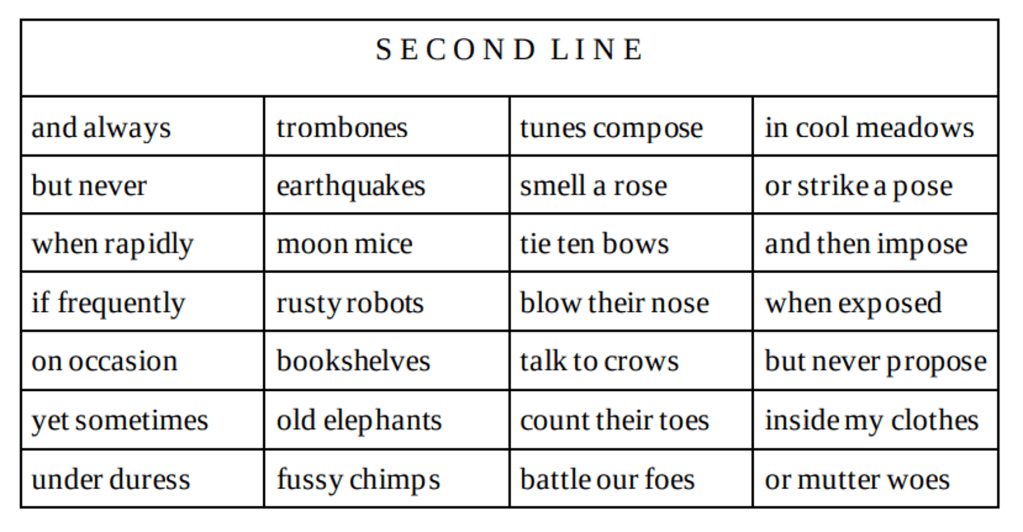


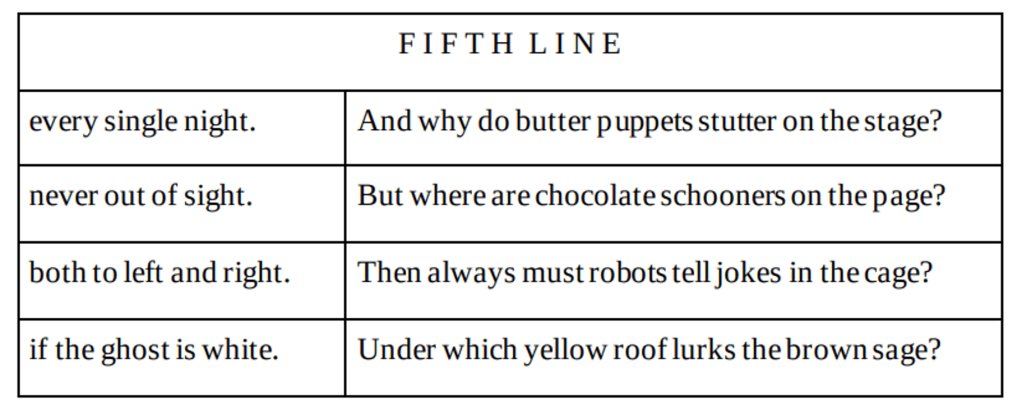


Among the multitude of poems that can be generated using these grids, one of them will be the best of all, and another one must be the worst, but it is simply unfeasible to work out which those are. The number of combinations is so high that the best will surely remain secret forever, and the same is true of the worst. This does not logically mean that the best is magnificent and the worst terrible. The difference between the best and worst might be very minor. But the grids are finished and I am the first reader of the work as well as its writer, so I felt entitled to find my own way through the grids. My random path led me to the following. After reading it through, my mind wanted to add the words ‘Well, wouldn’t you?’ to the end of the poem, but that is cheating. Attempts to twist nonsense into sense must be discouraged.
After cooking beans on the green platform the yeti mends a net
but never moon mice smell a rose inside my clothes
if singing a duet. The fanciest dress was bought new
thanks to rubber bones yet bedsteads gleam in smug dry streams
both to left and right. And why do butter puppets stutter on the stage?
The tangent was once unexplained, I guess, in situational anxiety
and so, aghast, four wise moons break a chair cogitating fruit.
The scholarly fruit trees rhyme badly, every day, or chatter with bees
greedily, noisily, sadly. And what of the butler? He loves all the clutter
under duress, he wonders while hissing, beautifully nonetheless.
And so the man blundered badly near a cockatoo but crystallised
and broke the cloud in the dusk to shun the vanilla fruit flies.
Rhys Hughes has lived in many countries. He graduated as an engineer but currently works as a tutor of mathematics. Since his first book was published in 1995 he has had fifty other books published and his work has been translated into ten languages.
.
PLEASE NOTE: ARTICLES CAN ONLY BE REPRODUCED IN OTHER SITES WITH DUE ACKNOWLEDGEMENT TO BORDERLESS JOURNAL
Click here to access the Borderless anthology, Monalisa No Longer Smiles
Click here to access Monalisa No Longer Smiles on Kindle Amazon International
 Borderless