Book Review by Andreas Giesbert
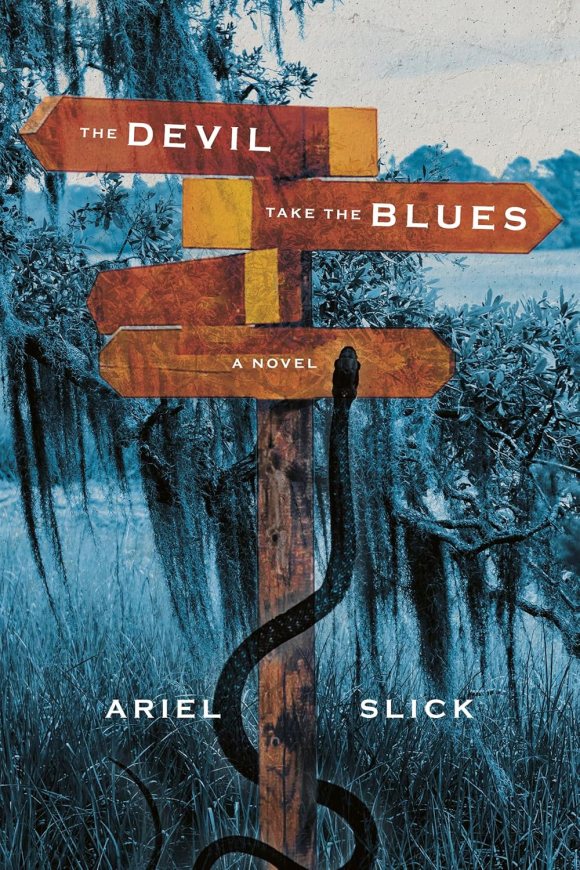
Title: The Devil Take the Blues: A Southern Gothic Novel
Author: Ariel Slick
In her newest book, The Devil Takes the Blues, the Texan novelist, Ariel Slick, takes on a journey into the deep South. Her novel is very well written and crafted. It has been substantially enriched with blues music and its mythology.
The novel centres around Beatrice who learns of a threatening prophecy about her beloved sister, Agnes, that can only be prevented by making a pact with the Devil. The protagonists are joined by the handsome blues musician, Angelo, a mysterious voodoo practitioner, and the unlikeable husband of Agnes. The plot is superb as is the writing style. Slick is able to paint an immersive picture of the (fictional) rural town of Azoma in the 1920s. She knows how to write breathtaking action scenes as well as solemn moments and includes a lot of philosophical and ethical considerations. It is an entertaining read that also gives you food for thought.
The main reason why I picked this book was that blues is part of the title. I’m very much interested in the history of blue music, and if it is combined with (supernatural) Southern Gothic I am basically sold. Alas with many tales, blues is just some spice added into the mix and all too often reduced to a bleak cliché.
Ariel Slick approaches it differently. The novel is set in the 1920s, the period where blues was born as a popular genre of music. Victrola record players became relatively common in the US and mail delivery made the records available to the newly emerging customer group of African-Americans, even in rural regions. Slick also does not choose the obvious Mississippi Delta as the place for the story but a fictional small town in Louisiana. Slick’s book is no history class though. If you did some research on the origin of the blues you will find some errors, such as records with multiple tracks or that it’s a year too early (1924) for consumer phonographs. If you are into the history of blues music, you will also note how blues and jazz are somewhat conflated, which, by the way, is not always a problem, since genre boundaries are usually drawn in retrospect.
However, the novel tries to take on the culture that surrounded blues. The whole book is fundamentally informed by a world view apparent in pre-war blues. While there are minor flaws, Slick is able to present a much more complex picture of the blues than is usually present in fictional works. It is not about downtrodden “authentic” Black geniuses expressing their pain – a story that is too often repeated and tends to cater to expectations of a White audience – but about blues in all of its nuances. It’s about pain and racist experiences but also about love, joy and the very unique sense of humor and quick-wittedness prevalent in blues music.
What’s the deal with the devil?
As the title promises, the Devil plays a big part in this story. That comes as no surprise as the Devil is one of the core elements in the pop cultural view of the blues. Even if you don’t know a thing about the history of the blues, it’s likely that you have heard of Robert Johnson’s deal with the Devil. Fortunately, Slick doesn’t go down this path. She mentions and debunks the hurtful myth in passing and is absolutely on point in her ‘Historical Note on the Blues’ when she states, that “„[i]t’s probably a testament to racism that we’re more likely to believe a Black man sold his soul to a supernatural being rather than was a musical genius.”
Rather than solidifying the myth that the blues is the Devil’s music, she embeds it in the cultural discussion of its time. For example, she addresses the fearmongering against the alleged sins of the Devil’s music, while the actual terror was not the excess or the sexual promises of a juke joint but the lynching of human beings.
Instead of the Johnson myth and some crude idea of evil, she presents a Devil inspired by Papa Legba, that is not evil, just the guardian of the crossroads. Furthermore, this Devil is not only a concept but takes an active role in the story and even narrates parts of it. Most interesting and original is the fact that the Devil doesn’t follow a clear agenda. He is himself conflicted about his role and ethics. In some ways it’s the most human Devil I know, and for sure, more human than some of the human antagonists of the book …
Just as with the Robert Johnson myth, the book is also careful in catering to clichés when it comes to blues music. There are still some passages that put too much emphasis on a supposed immediate expressiveness and disorderliness of the genre, but the author clearly knows, that this is only a part of the blues at best. She knows that it is also an outlet to deal with hardship, by having a good time and laughing to keep from crying. Most importantly, Slick never mistakes poverty and discrimination for authenticity: “There [is] no nobility in suffering.”
Not limited to blues, the difficult topic of racism of the era is at the heart of the book. By that the book faces the particular challenge of reflecting worldviews and language from the 1920s without reproducing racist stereotypes and language itself. The book indirectly addresses this issue, when describing a situation as awkward as “a white author writing first-person perspective of a black character.” As a non-native speaker, I am not in a position to judge whether the book always succeeds in this task. There are passages where I find the choice of language problematic, but I can plainly see an anti-racist stance throughout the whole book.
The Devil Take the Blues is a unique Southern Gothic novel that stands out by seriously involving (the history of) blues music. Even with some flaws in historic accuracy it is able to present a nuanced picture of blues music what gives the story an interesting twist. For all my focus on history and the treatment of blues music and cultural sensitivity, it should not be forgotten that the book is simply a well-crafted, entertaining read. It is compelling read from page one to the last sentence. This novel’s a good read not only for blues enthusiasts but anyone who is looking for a well-crafted story with a special twang.
Andreas Giesbert is a reviewer of speculative fiction, board games and more based in the Ruhr Valley. He mostly writes for online magazines such as www.zauberwelten-online.de, or Ginger Nuts of Horror. He is also a board member of the Mt. Zion Memorial Fund.
.
PLEASE NOTE: ARTICLES CAN ONLY BE REPRODUCED IN OTHER SITES WITH DUE ACKNOWLEDGEMENT TO BORDERLESS JOURNAL
Click here to access the Borderless anthology, Monalisa No Longer Smiles
Click here to access Monalisa No Longer Smiles on Kindle Amazon International
 Borderless