"You're so beautiful?"
No, I’m not. At least, not the way I see myself.
Scrolling through my own pictures on social media I don't find myself lacking grace, always.

On screen, I can almost believe I’m fine.
In reality, I can’t.

They say beauty comes from within.
And I am kind,
So why doesn’t that kindness ever shine through me?

They say beauty is all about your heart.
Then is it a scam?
A colorful fabrication of a socially validated lie by which all our lives have been painted?

They say, feel confident,
embrace your flaws,
own your scars,
then you’ll be beautiful.
But is that really true?

Is it really possible for anyone to feel beautiful
when all they see are scars, acne, self-doubt,
insecurities and fear stitched into their face, their eyes, their thoughts,
woven into the core of their very being?

So, whose fault is it?
Theirs?
Or is it the society that carved rigid standards into us,
teaching us to feel never beautiful enough?

If I don’t feel beautiful, is it really me who’s broken,
or the mirror I’ve been given?
Maria Alam is an undergrad student, currently pursuing her Bachelor’s in English and Cultural Studies at University of Liberal Arts Bangladesh [ULAB].
.
PLEASE NOTE: ARTICLES CAN ONLY BE REPRODUCED IN OTHER SITES WITH DUE ACKNOWLEDGEMENT TO BORDERLESS JOURNAL
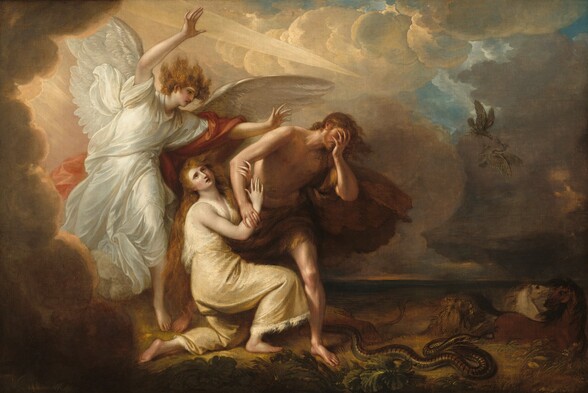
Nusrat Jahan Esa muses on human nature keeping in mind Milton’s Paradise Lost
The Expulsion of Adam and Eve from Paradise by Benjamin West (1738-1820)
Just as dance unveils step by step moving each step towards a new movement to tell a story, so too does the forbidden thoughts. They dance like a flicker of shadow at the edge of our consciousness. They call us, not always with words, but with whispers that tempt, tantalise and stir the mind. To step closer is to cross a line, but is it not also inherently human? Do you think it is possible to categorise humans as purely good or evil?
I was struck by a sudden realisation, one that is not uncanny to my musings. Yet I had never tried to pose to myself. I was exploring the nexus between Satan’s allurement and criminal psychology with Paradise Lost (1677). But why were Adam and Eve ensnared by the temptation of Satan rather than the guidance offered by God? What is it that Satan bestows, and that God misses?
Human beings are frequently pigeonholed into two distinct categories: Good or Evil. To some extent, we may add nuances like “not-so-good” or “not-so-bad”. Yet can we truly define an individual as purely good or purely evil based on their face value? What if one nurtured the attraction of or bore malice, while concealing such tendencies from the world? How do we classify them, good, evil or somewhere in between? Do they forever exist somewhere in the shadowed space?
For instance, there exist a considerable number of individuals who are avid admirers of psychological thriller films, fictions, and documentary series. They appear to be not distasteful to scenes or words of bloodshed, dead bodies, and acts driven by vengeance. They find enjoyment from such scenes and words, and the visual or imagery feels entirely natural to them which astonishes me. So, why would these individuals refrain from imitating these actions in reality? If driven by vengeance, one of the seven deadly sins, why do not they resort to murder? It’s because they are confined with morality. These morals work as a barrier. It stops humans from evoking the sense of their inner darkness or denied feelings.
If one can suppress their repressed and dark desires, how then can they be lured by Satan’s allurement? Let’s say that we are constantly drawn to invitations. Why, then, do we not enthusiastically respond to God’s call? What is it that God fails to offer, while Satan has already taken the lead in his temptations? What thoughts crossed Eve’s mind before eating the forbidden fruit? Is it merely the word “no” that beckons us and draws us with irresistible allure? Or does Satan possess a unique technique to draw us in his magical world?
More importantly, can we truly call those who suppress their dark insides “good”? Or do we dare to believe that a person can possess completely good intentions both outside and inside, without any shadow lurking within?
Nusrat Jahan Esa is currently an undergraduate majoring in English literature at the University of Liberal Arts Bangladesh (ULAB). She writes on criminology, psychology, and education.
.
PLEASE NOTE: ARTICLES CAN ONLY BE REPRODUCED IN OTHER SITES WITH DUE ACKNOWLEDGEMENT TO BORDERLESS JOURNAL
As I count the years,
something changes and I do notice that.
If I tell you about --
One to five,
I named my little doll ‘tuktuki’.
Six to ten,
red lipstick was my escape,
and I played with my friends and neighbours.
Eleven to fifteen,
Everything seemed beautiful.
butterflies, flowers, poetry, cats, and the ocean.
Sixteen to twenty,
I am drawn to memories now.
It’s habit to collect pieces of everything,
and paste them in my scrapbook.

It is a process of telling me that I am now older,
but my heart says something else.
Why do I still like butterflies?
and why does red make my heart beat faster?

I often write letters to myself.
It is indeed an art --
there are flowers stamped, poetry in cursive.
They cherish a piece of my childhood.
Reading my own letters,
feels like,
touching a different soul,
re-discovering the inner child.
I’m telling you --

Being twenty is also being a child at heart.
Nusrat Jahan Esa is a BA English Literature student at the University of Liberal Arts Bangladesh (ULAB). Writing Poetry is her way of expressing herself and embracing her inner child.
.
PLEASE NOTE: ARTICLES CAN ONLY BE REPRODUCED IN OTHER SITES WITH DUE ACKNOWLEDGEMENT TO BORDERLESS JOURNAL

 Borderless