Book Review by Rakhi Dalal
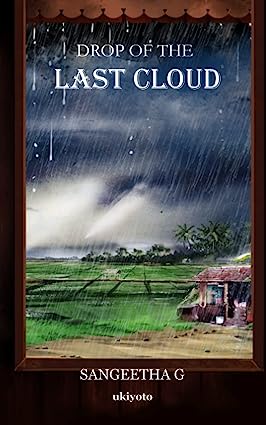
Title: Drop of the Last Cloud
Author: Sangeetha G
Publisher: Ukiyoto Publishing
Sangeetha G’s debut novel, Drop of the Last Cloud, portrays through the life of its protagonist, the decline of matrilineal system and its influence on the prominent Nair community in Travancore from the period 1920s onwards. This system started collapsing with the arrival of colonial morality and was later abolished to make way for the patriarchal system.
The description of this transition is compelling at the hands of its author who has been a senior business journalist and part of the mainstream media in India for more than 20 years. She has worked with various visual media, news agencies and newspapers. Her flash fiction and short stories have been published by various magazines and journals and her work ‘Burning flesh’ won the first prize in Himalayan Writing Retreat flash fiction contest 2022.
The story examines complexities arising in the turbulent period of the said transition which traumatises and affects behavioural changes in a girl at the cusp of adulthood. It lays bare the generational attributes, seeping down and permanently altering the character of the woman the young girl grows into. At the centre however, it is the story of unrequited love which haunts the mind of its protagonist, Gomathy, influencing her life and her relationship with her own children.
Gomathy, born to one of the three sisters of a feudal Nair family, is labelled unlucky at birth by the family astrologer and is sent to her father’s house for her upbringing. Bereft of mother’s affection and brought up by an imposing paternal grandmother, the child Gomathy is set on a course diverse from her siblings and cousins. As she grows into a beautiful and demure young woman, her life is dictated by the choices she makes in order to please her elders and to prove herself morally dignified in the society which has begun to be influenced by the ideas of patriarchy. It is Gomathy’s irresoluteness which makes her accept Govindan as her husband, despite her awareness of his deception and of his manipulative ways which he used to persuade her grandmother to let him marry her. Her decision to not marry Madhavan, the person she loves, and his subsequent death becomes a nightmare from which she never recovers.
The conscious and subconscious self of Gomathy is laid bare through her everyday life with her family, including her children whom she despises, as well as through her dreams of the man she loved but did not marry. Dissimilar in demeanour to the women of her family in her initial growing years, Gomathy as she ages, becomes like her paternal grandmother – daunting and inadequate to love those closer to her.
Through the description of the lifestyles of two households at Kakasherry and Madathil, the author presents a commentary on the societal ways prevailing in the era. In the three sisters of Kakasherry Nair household — Narayani (Gomathy’s mother), Karthiyayani and Parvathy — we find independent women making their own decisions on one hand, while on the other hand we also have the same household absorbed in practicing deep-seated ideas of caste superiority and untouchability. The men, trying to find a strong foothold in changing times, are either manipulative, like Govindan, or vulnerable, like Madhavan. It also hints at the ritual of polyandry as an accepted norm in the matriarchal society.
The book is a critique on the collapse of matrilineal system in Kerala, on the ramifications of succeeding partitions in affluent Nair families, on the hardships of running nuclear families and on the adopting of patriarchal systems. However, intertwined within the narrative are also the themes of blatant caste discrimination, curbing of women’s rights, freedom and the hollowness of wars that not only deaden human sensitivity and empathy but essentially devalue human life and humanity.
Sangeetha’s laidback writing style achieves what the novel misses out in narration. It evolves into a moving account of a woman’s trials and tribulations resulting from her inescapable circumstances, of her helplessness and disquiet which not only turns her into her worst self but also makes her unperceptive of love and compassion. This is an account, whose closure manages to provoke thoughts on the worthlessness of deliberately wasting away a precious life.
Rakhi Dalal is an educator by profession. When not working, she can usually be found reading books or writing about reading them. She writes at https://rakhidalal.blogspot.com/ .
.
PLEASE NOTE: ARTICLES CAN ONLY BE REPRODUCED IN OTHER SITES WITH DUE ACKNOWLEDGEMENT TO BORDERLESS JOURNAL
Click here to access the Borderless anthology, Monalisa No Longer Smiles
Click here to access Monalisa No Longer Smiles on Kindle Amazon International
 Borderless