Book Review by Rakhi Dalal
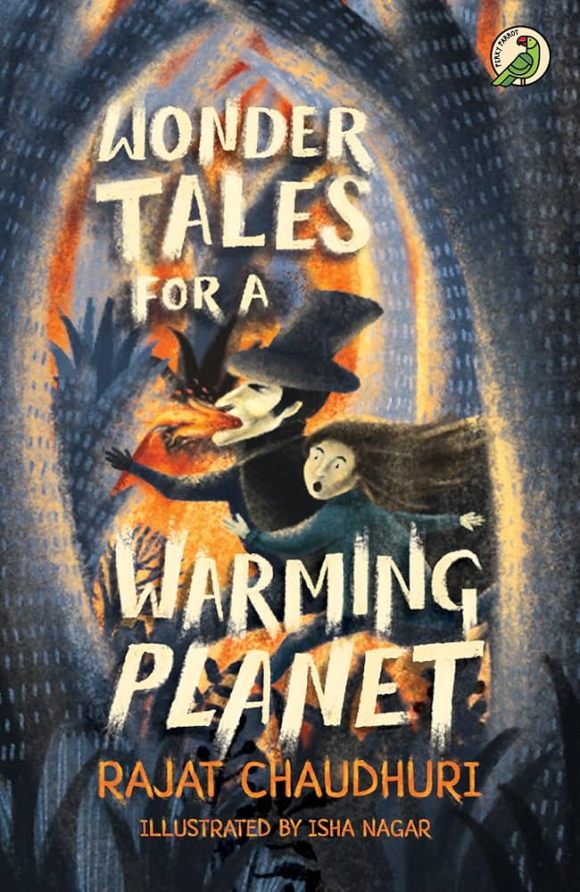
Title: Wonder Tales for a Warming Planet
Author: Rajat Chaudhuri
Publisher: Niyogi Books
In a world teetering on the edge of ecological collapse, it’s often children who inherit the burden of our choices. But what if they could also inherit the tools to re-imagine the future? In Wonder Tales for a Warming Planet, Rajat Chaudhuri doesn’t simply tell stories—he offers blueprints for curiosity, resistance, and wonder. This collection of three speculative tales—’Tina and the Light of the World’, ‘The Seventh Sense’, and‘How Did the Oceans Vanish’—invites young readers to explore climate change not as a distant apocalypse, but as an unfolding narrative in which they are already key players.
Chaudhuri, author of acclaimed climate novels like The Butterfly Effect and Spellcasters, and short story collection like Hotel Calcutta, does not offer didactic lessons to children here. Instead he channels the age-old power of storytelling—immersive, imaginative, and intimate—to speak directly to children. His tales empower children not by shielding them from the truth, but by equipping them with imaginative tools to face it.
The first story, ‘Tina and the Light of the World’, revolves around a young girl’s encounter with a solar-powered future. In a town gripped by blackouts and crumbling infrastructure, where the rich have access to energy while the nights of those poor are engulfed in darkness, Tina meets Stoker who takes her to light but vanishes after sometime. Then Tina meets Anu who accompanies her for a while but soon she leaves her too. Finally, Tina meets sun-catcher in a place where people use solar panels to trap sun’s energy. Tina’s journey—from darkness to a solar-powered community—unfolds like a fable of illumination, both literal and symbolic. The characters she encounters—Stoker, Anu, and the sun-catcher—each represent stages in her awakening to the possibility of decentralised, sustainable energy. Chaudhuri while suggesting the alternate sources of energy other than those used earlier, cleverly weaves together issues of energy access, decentralised power, and the democratisation of technology. But the story also touches something deeper: the notion that light—both electric and symbolic—can emerge not from grand solutions, but from the small, often overlooked spaces where ingenuity persists.
In ‘The Seventh Sense’, Chaudhuri turns inward, weaving a delicate tale around Gogol, a neuro-divergent boy who develops an extra sense—one attuned to ecological shifts. What initially feels like a fantasy premise soon unfolds into a sophisticated meditation on sensory perception and ecological empathy. This “seventh sense” allows its young bearer to understand the impact of forest cutting to make way for an urban city. The brilliance of this story lies in its central metaphor: that saving the planet may not be about creating more infrastructures mindlessly in the name of fulfilling the needs of people but about cultivating an intuitive, affective connection to the non-human world. The writing is delicate, almost lyrical, yet grounded in a chilling recognition of the precarity the present world seems to now inhabit.
The final tale, ‘How Did the Oceans Vanish’, moves from the speculative to the cautionary. Told as an oral history in a distant future where seas have dried up, the story is framed as a conversation between a grandmother and her grandchild of a different evolved species. Through anecdotal fragments we piece together a slow-motion disaster — brought about by different methods of geo-engineering ushered without considerable testing — that no one tried hard enough to stop. This retrospective mode of storytelling is effective; it avoids heavy-handedness while building a quiet, cumulative sorrow. But even here, Chaudhuri resists fatalism. The tale ends not with despair, but with a question, almost whispered: What will you do differently now?
Across all three stories, Chaudhuri’s prose remains crisp and fluid. He avoids the pitfall of jargon while subtly integrating scientific ideas— alternate energy, sustainable living, geo-engineering, and more. What binds the collection is not only its thematic concern with climate but its faith in the moral imagination of children. These are not just tales about the future; they are invitations to imagine alternate presents.
That said, the book does not attempt to be everything. The storytelling is intentionally restrained. There are no dramatic twists or action-packed sequences. The stakes are emotional and ethical, rather than physical. Young readers who’ve already begun to sense the ambient anxiety of climate discussions—will find in this collection recognition, reassurance, and a language to speak about what they feel but cannot yet articulate.
Wonder Tales for a Warming Planet deserves a place not just in classrooms or children’s libraries, but in dinner table conversations. It dares to approach the climate crisis through the lens of empathy and imagination rather than panic or guilt. In doing so, Rajat Chaudhuri gives us what many adult climate narratives fail to deliver—a reason to believe that another world is not only possible but already being imagined by the young. All we need to do is listen.
Rakhi Dalal is an educator by profession. When not working, she can usually be found reading books or writing about reading them. She writes at https://rakhidalal.blogspot.com/ .
.
PLEASE NOTE: ARTICLES CAN ONLY BE REPRODUCED IN OTHER SITES WITH DUE ACKNOWLEDGEMENT TO BORDERLESS JOURNAL
Click here to access the Borderless anthology, Monalisa No Longer Smiles
Click here to access Monalisa No Longer Smiles on Kindle Amazon International
 Borderless