Categories
Review

Thorns in My Quilt

Book Review by Rakhi Dalal
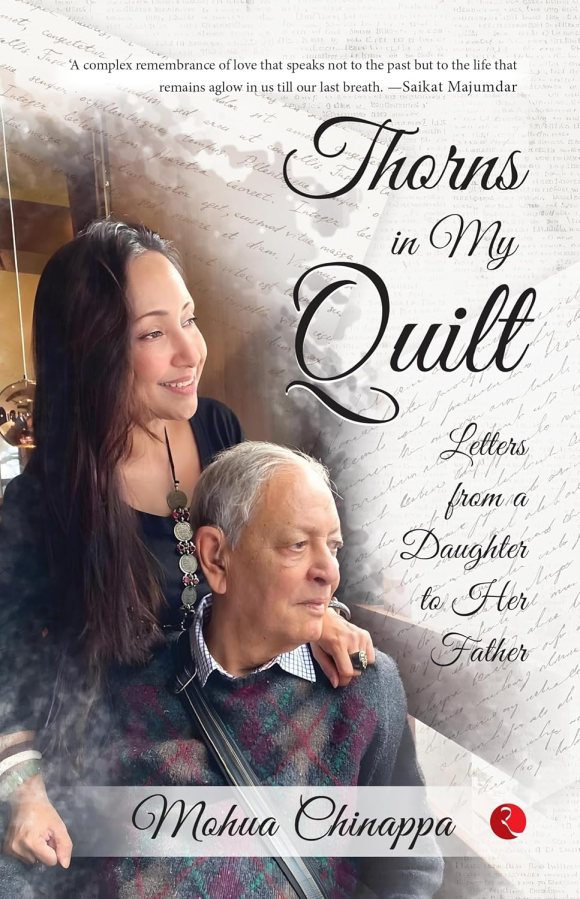
Title: Thorns in My Quilt: Letters from a Daughter to her Father

Author: Mohua Chinappa

Publisher: Rupa Publications

Mohua Chinappa’s Thorns in My Quilt: Letters from a Daughter to Her Father is a quiet and visceral exploration of memory, grief, and the often-fraught space between love and silence. Drafted in the form of a collection of letters to her late father, the book is less about resolution than about reckoning – more an attempt to articulate what remained unsaid while he was alive. Chinappa, through this profoundly personal lens, not only offers a portrait of a relationship but also a reflection on absence, yearning, and the emotional inheritance that we all carry forward sometimes.

Mohua Chinappa is an author, a columnist, a renowned podcaster in India, a TEDx speaker, a former journalist and a corporate communications specialist. Her other initiative—NARI: The Homemakers Community—provides a platform for homemakers to voice their everyday challenges.

The letters in this book, seamlessly weave together fragments of childhood and adulthood, moving fluidly between time and place. One moment, Manu the daughter, beckons the warmth of her early years in Shillong — vanilla flavoured butter cookies and the hush of rain-soaked afternoons, then the shelter of a harsingar[1] tree in their government house in Delhi, while in the next, she confronts the frailty of her marriage, the weight of her Baba’s illness, or the sting of words that sometimes remained unsaid. The form of writing echoes the workings of memory. Not linear, but recursive, continually turning back to moments that remain unresolved. Each letter seems like an appliqué sewn into the fabric of remembrance, creating a quilt with seams held together by both tenderness and pain.

At the centre of the book is the paradoxical figure of her Baba, portrayed with candour as a man who is loving yet aloof, erudite yet impractical and admired yet sometimes resented. Manu longs for his approval but also grapples with the ways his criticism and aloofness diminishes her. The letters vacillate from affection to accusation and from gratitude to grievance. In the acceptance of these contradictions, there seems a resistance to recall the memory of a father in an idealised tone. Instead, Chinappa manages to present a figure whose complexity remains inseparable from her own. The portrait revealed, thus, appears all the more moving.

The narrative also reverberates with a strong theme of displacement. The family’s history of migration, the shifts between Shillong, Delhi, and Bengaluru, create a sense of being both rooted and uprooted at once. Places do not act merely as backdrops but are living repositories of memory, holding within them the sweetness of belonging and the ache of estrangement. This sense of dislocation extends inward in the narrative. Chinappa captures not only her alienation from her father but also the broader struggle of carving an identity in a world shaped by expectation and silence.

The language of the narrative is lucid, and doesn’t tip into ornamentation. Everyday details—trees, rain, food, household objects—become charged with metaphorical weight, carrying emotional resonance far beyond their surface. The letters are suffused with sensory detail, grounding the reader in the textures of lived experience while also opening space for reflection. The writing exercises restraint. Even at its most poignant, it doesn’t spill into melodrama.

The emotional honesty of the book is equally striking. Manu does not shy away from confessing anger or disappointment; nor does she smooth over her father’s failings in the name of filial devotion. She admits to her vulnerabilities—the yearning for acceptance, the bitterness of abandonment, the pain of reinvention when life’s foundations collapse. These allow the readers to relate with the story. Though the particulars may differ, but the longing for parental approval, the hurt of unspoken words, and the struggle to reconcile love with resentment are universal.

However, some constraints in the narrative cannot be overlooked. The epistolary form, while effective in evoking intimacy, also narrows the perspective. Baba appears only through Manu’s voice, his presence mediated entirely by her memories and emotions. At some places, the narrative shifts abruptly, from addressing second person (father) to third which makes the reading a bit disconcerting. At times, the absence of other perspectives leaves the figure of father more shadow than substance, defined by what he was to her rather than who he was in himself. The letters also occasionally return to the same emotional terrain, circling around familiar grievances and sorrows. While this mirrors the looping nature of grief, the repetition creates a sense of exhaustion.

These reservations, however, do not diminish the book’s overall appeal. Its power lies not in neatness but in its willingness to dwell in ambiguity. It does not offer easy closure, nor does it attempt to tidy grief into a narrative of redemption. Instead, it embraces complexity, acknowledging that love is rarely unblemished, that absence can wound as much as presence, and that the act of writing itself can become a form of survival.

Thorns in My Quilt resonates because it is both deeply particular and quietly universal. While grounded in Chinappa’s personal history, it speaks to the wider human experience of fractured relationships, cultural displacement, and the longing to be heard. In cataloguing both the thorns and the blossoms of her bond with her Baba, Chinappa creates a testament that is as much about resilience as it is about grief.

[1] harsingar: Night Jasmine

Rakhi Dalal is an educator by profession. When not working, she can usually be found reading books or writing about reading them. She writes at https://rakhidalal.blogspot.com/ .

.

PLEASE NOTE: ARTICLES CAN ONLY BE REPRODUCED IN OTHER SITES WITH DUE ACKNOWLEDGEMENT TO BORDERLESS JOURNAL

Click here to access the Borderless anthology, Monalisa No Longer Smiles

Click here to access Monalisa No Longer Smiles on Kindle Amazon International
Categories
Excerpt

Letters from a Daughter to Her Father

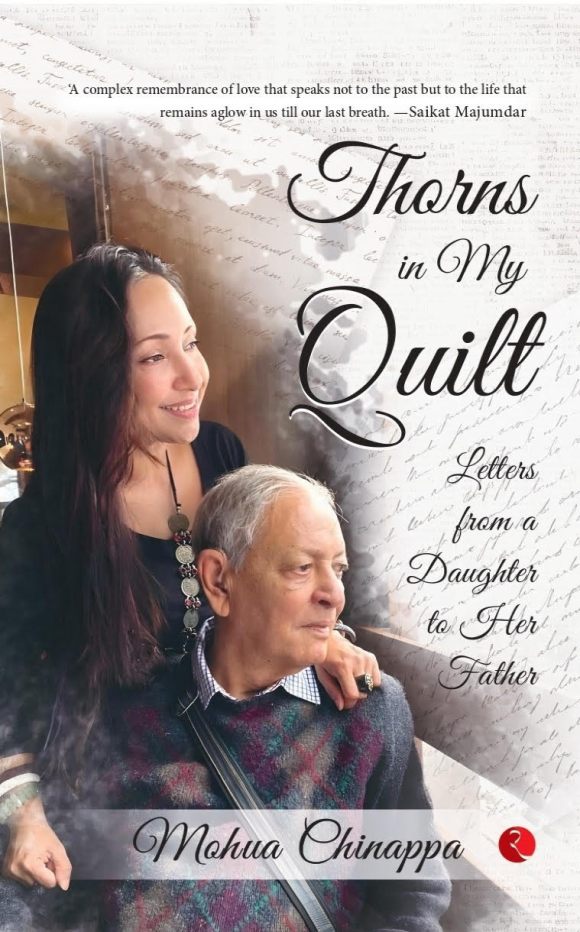
Title: Thorns in My Quilt: Letters from a Daughter to Her Father

Author: Mohua Chinappa

Publisher: Rupa Publications India

LOSS

4 August 2022

Living Room, Bengaluru

Dear Baba, Today is your shraddho, the puja for your departed soul. Referring to you as a soul seems so distant. Calling you anything but ‘Baba’ seems like two strangers speaking to one another. The purohit is here to do the rituals. The atmosphere is sedate. The room is lit and the flowers in the vases are in full bloom. I am glad we have cousins in the city; otherwise, it would be very lonely for Ma and me. We know very few people who would make the effort to attend a staid function like a shraddho. How does one end a tie so deep with a mere ritual? One can’t. It does feel surreal to watch your photograph with a jasmine garland around the lifeless frame. The sandalwood phonta or tika on your forehead makes you look different. The living room has been cleared. The large antique box has been covered with a white cloth, and your photograph is placed on it in such a way that you are facing the direction that will lead you to the other world. The shraddho among Bengali Hindus is a ceremony that is performed to ensure a passage for the recently deceased to the other world. The rite is both social and religious and is meant to be conducted by the son. But you have no male heir. So I defy tradition and lead the puja.  I follow the rites dutifully and chant the mantras, which don’t mean much to me. You are gone. There is no mantra that can soothe my heart. On the floor is a bed, laid out with a pillow and an umbrella for your onward journey to God-knows-where. I follow the purohit. Neel joins me in the ceremony. I feel so anchored, having him next to me. What a loving child he is. He makes life so much simpler for me. After the puja, we put out a plate of your favourite food so that a crow can come and eat it. Leaving the food in the corner of a lane seems ridiculous, but I have decided not to question any of the rituals, for I don’t want Ma to feel that I didn’t do my best. I leave the plate on the ground. There are bottles strewn around, and the ground is not very clean. I don’t turn back for another look. Your photo has now been removed and stands on my marble corner table. I put out the burning incense sticks and remove the flower garlands. It is still sinking in that I won’t be able to hear your voice ever again, calling out to me, asking me for something or the other. As we sit down to eat, Neel reminds me how you discussed Left politics and he argued with you on capitalism, just to rile you up in jest. You had such a wonderful bond with my child. I smile as I hear Neel mimic you and your quintessential Bengali ways of reacting to situations. Those debates between you both. I loved the way you both called each other Dadu. Baba would say, ‘Dadu, you must read about the world and its magnificent history. The great idea of how civilizations emerged, and how revolutions took place in protest against tyranny and oppression. As you read, you will learn that the world is a beautiful study of humanity and historical events.’ And Neel would say, ‘Na, Dadu, I will only read books that emphasize the profit and loss of capitalist businesses. Whoever cares about art and philosophy?’ Neel knew how you would go red in the face. And you would say, ‘No businessman ever built a nation; it is the thinkers and the dreamers who created a world of equal opportunities.’ This camaraderie you both shared remains the most beautifully preserved and poignantly pure memory of you with your grandson. I remember those days when you constantly waited to hear from Neel, and how the Sundays were marked aside to have your long-awaited conversations with him. You truly were a wonderful grandfather to my son. I feel empty as the furniture in the living room is rearranged to how it was before. Like nothing has happened, and no one is now gone forever. It looks as if you will come back in a minute, ask for a cup of tea and brood with your arms crossed over your chest. I think just being there to watch me do everyday things made you feel calmer. I don’t know. But I hope someday, I will understand the silence between us. Comfortable spells of silence, and some very terrifying ones. Like your death.

Love

Manu

*

5 August 2022

Bengaluru

Dear Baba, The vermilion has been removed now. The parting is stark white the hair oiled tied into a braid of acceptance. The grey mixed with the leftover black strands falling carelessly on her shoulder. I had seen her one lonely noon take a pair of scissors cut off her locks Like Samson and Delilah. She was at war A war with her own existence Her identity has been shaken Her oar is cracking open along with her broken sail. She sets to the seas but the land is far away on the horizon shining like the crystals found on a crown lost in a war lying forlorn for the head of the right king but now Samson is dead the Philistines have left too the palace has been torn down but parts are intact. Her locks sheared from guilt for being alive. Will she find her shore with her broken boat and tattered sail hoping the seas take her in or the fire of her breath is gutted before it becomes wild like a forest fire burning the little birds coloured kites stuck between branches and her capsizing boat too lost in the new world!

Love,

Manu

About the book:

Thorns in My Quilt: Letters from a Daughter to Her Father is a series of letters written by a daughter to her father after he passed away. Unspoken thoughts, unshared memories and unsaid words combine in this searing and poignant account of a relationship filled with joy, but with equal moments of sorrow.

Mohua Chinappa (Manu) loved her Baba, who was as kind as he was cruel, as well-read as he was unworldly, as loved as he was unloved. His dearest Manu recollects her childhood in Shillong, infused with the aroma of vanilla essence that went into the butter cookies he baked. She reminisces about her father holding her little hand while helping her through the undulating, rain-drenched roads. Mohua returns to Delhi, where she spent a part of her growing-up years, and revels in the memory of a government house with a harsingar tree. She writes to him about her broken marriage, recalls how her parents left her side, and how she reinvented herself. The letters are often selfish yet strangely cathartic.

Her father’s kidney failure prompted a daughter to confront the demons within—the loss, the doubts, the emptiness, the guilt of saying things, and the angst of not saying things.

About the author:

Mohua Chinappa is an author, a columnist, a renowned podcaster in India, a TEDx speaker, a former journalist and a corporate communications specialist.

The Mohua Show, a podcast she started in 2020, has close to 2 million downloads. She contributes regularly to various national dailies and magazines, including The Telegraph, Deccan Herald and Outlook. She is regularly invited as a speaker on TEDx and Josh Talks.

Mohua’s other initiative—NARI: The Homemakers Community—provides a platform for homemakers to voice their everyday challenges.

Her book—Nautanki Saala and Other Stories—was awarded the PVLF Best Debut Non-Fiction (in English) Award 2023. She also has two poetry collections to her credit—If Only It Were Spring Every day and Dragonflies of My Dreams.

PLEASE NOTE: ARTICLES CAN ONLY BE REPRODUCED IN OTHER SITES WITH DUE ACKNOWLEDGEMENT TO BORDERLESS JOURNAL

Categories
Poetry

Three Dimensions

By Kashiana Singh

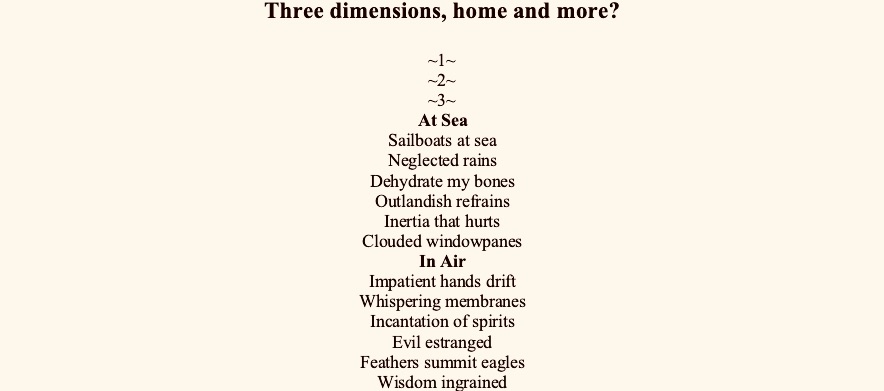
Three dimensions, home and more?

~1~
~2~
~3~
At Sea
Sailboats at sea
Neglected rains
Dehydrate my bones
Outlandish refrains
Inertia that hurts
Clouded windowpanes
In Air
Impatient hands drift
Whispering membranes
Incantation of spirits
Evil estranged
Feathers summit eagles
Wisdom ingrained
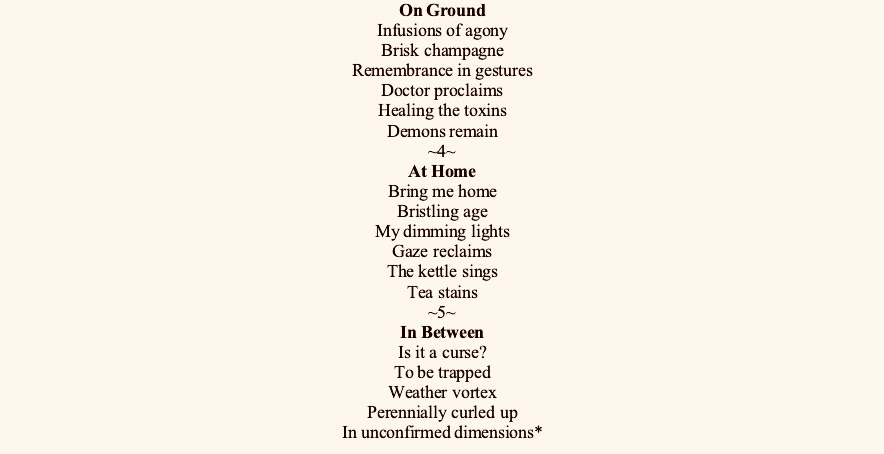
On Ground
Infusions of agony
Brisk champagne
Remembrance in gestures
Doctor proclaims
Healing the toxins
Demons remain
~4~
At Home
Bring me home
Bristling age
My dimming lights
Gaze reclaims
The kettle sings
Tea stains
~5~
In Between
Is it a curse?
To be trapped 
Weather vortex
Perennially curled up
In unconfirmed dimensions*


*Klein theory says that the fourth dimension likely exists, but unlike longitude, latitude and altitude which are extended dimensions, the fourth is a curled dimension – it stays retracted


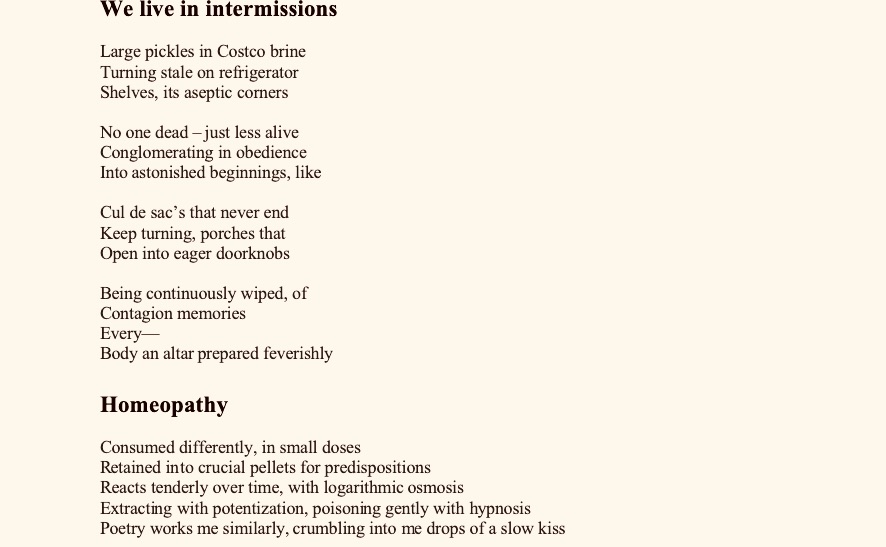
We live in intermissions

Large pickles in Costco brine
Turning stale on refrigerator
Shelves, its aseptic corners

No one dead – just less alive
Conglomerating in obedience
Into astonished beginnings, like

Cul de sac’s that never end
Keep turning, porches that
Open into eager doorknobs

Being continuously wiped, of
Contagion memories
Every—
Body an altar prepared feverishly

Homeopathy

Consumed differently, in small doses
Retained into crucial pellets for predispositions 
Reacts tenderly over time, with logarithmic osmosis
Extracting with potentization, poisoning gently with hypnosis
Poetry works me similarly, crumbling into me drops of a slow kiss


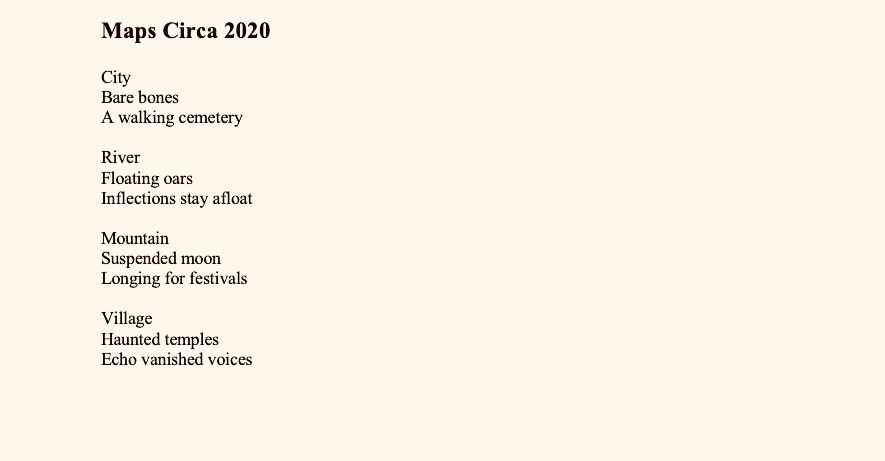
Maps Circa 2020

City
Bare bones
A walking cemetery

River
Floating oars
Inflections stay afloat

Mountain
Suspended moon
Longing for festivals

Village
Haunted temples
Echo vanished voices

*Klein theory says that the fourth dimension likely exists, but unlike longitude, latitude and altitude which are extended dimensions, the fourth is a curled dimension – it stays retracted

Kashiana Singh is a management professional by job classification and a work practitioner by personal preference. Kashiana’s TEDx talk was dedicated to Work as Worship. Her poetry collection, Shelling Peanuts and Stringing Words presents her voice as a participant and an observer. Her poems have been published on various platforms including Poets Reading the News, Visual Verse, Oddball Magazine, Café Dissensus, TurnPike Magazine, Dissident Voice, Feminine Collective, Spillwords, Poetry Super Highway. You can listen to her reciting her work on Rattle Open Mic sessions, Songs of Selah podcast and Poetry Super Highway episodes. Kashiana lives in Chicago and carries her various geographical homes within her poetry.