Categories
Review

Needle at the Bottom of the Sea

Book Review by Gracy Samjetsabam
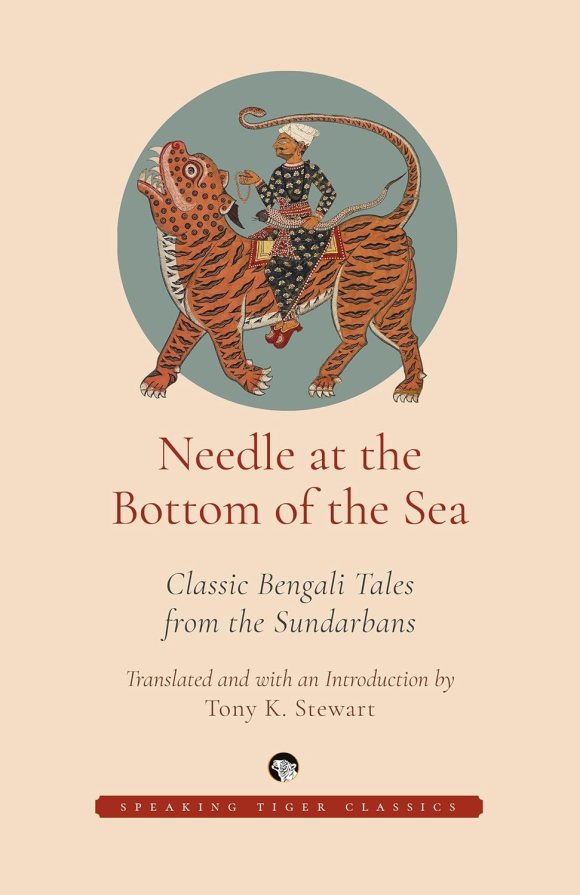
Title: Needle at the Bottom of the Sea: Classic Bengali Tales from the Sundarbans

Translator: Tony K. Stewart

Publisher: Speaking Tiger Books

What comes to mind when we think of the Sundarbans? Verdant mangroves, elusive Bengal tigers, and the mystique of the Bay of Bengal. But the late Tony K. Stewart’s Needle at the Bottom of the Sea reminds us of another legacy—its rich cultural heritage. Stewart, a Gertrude Conway Vanderbilt Chair who did pioneering work in Bengali narratives, passed on in October 2024. This vivid collection of five timeless kathas (stories), one co-translated with Ayesha A. Irani, a scholar from University of Massachusetts, starts with a compelling introduction to the diverse syncretic traditions of the region.

The anthology has five stories that are translated lyrically in the form of story poems filled with suspense and surprises. The opening verse from the first translated katha “The Auspicious Tale of the Lord of the Southern Regions — the Rāy Maṅgal of Kṛṣṇarām Dās” poetically sets the mood of the genre and gracefully takes the reader to familiar and unfamiliar grounds and it goes as follows —

With palms pressed together in respect,
I praise the lotus feet and magnificent girth of
the Lord Dakṣiṇ Rāy, Master of the Southern Regions, …
Against Baḍa Khān Gāji, the Great Sufi Warrior,
You waged war throughout the territory’s canals and channels,
but in the end you became close, fast friends.

The narrative depicts the incredible sophistication of the diversity in India with relatable characters and compelling themes, evoking emotions that we feel at different junctures of life, between life and death irrespective of religion, caste, culture or creed. Stewart uses vivid imagery and figurative enhanced with rhyme and rhythm to bring just enough for the reader in English without diluting the beauty of the language or history and culture of the original work. The beauty and quality of the literature is translation set in the beginning is maintained throughout the five sections. The rich mystical and spiritual spirit of the region is evoked in the coming together of the cultural elements in Hinduism and Sufism. As the introduction is named, the book is truly a unique flavour that brings “Bengali Tales from the Land of Eighteen Tides”      

In these tales, the mythic meets the moral. Demigod Daksin Ray and Sufi warrior Bada Khan Gaji clash on the battlefield, commanding armies of tigers, until God intervenes as Satya Pir to mediate peace. They cross paths again when Gaji battles for his beloved Princess Campavati, and once more during Ray’s confrontation with Bonbibi, the forest’s matron-protector—each time with Gaji or Satya Pir stepping in to guide or save. Other stories follow Madansundar’s search for his lost brothers with Satya Pir’s help, while Khwaja Khizr aids Gaji in retrieving a needle from the sea, affirming his identity as a living saint, or “jinda pir”.

Stewart’s translation is a triumph of linguistic artistry. He brings alive a world of talking tigers, floating rocks, flying trees, giants, miracle-working saints, and more. These fantastical elements coexist with deeply human struggles, as the characters strive for honor and morality in a corrupt and chaotic world. The stories, drawn from 16th- and 17th-century oral traditions, are richly interwoven with both Hindu and Muslim worldviews, offering a textured portrayal of a pluralistic Bengali society.

The tales are full of romance and adventure—unlikely heroes and heroines, ocean-faring merchants, whimsical gods, revered prophets, and powerful zamindars. They reflect familiar events and cultural motifs of the Bangla-speaking world, infused with imaginative solutions and heroic feats. Stewart captures the emotional and linguistic nuance of the original Bangla, carefully preserving idioms and explaining cultural references to ensure resonance with an English-speaking audience.

The result is not just a literary collection, but a vital cultural document. It offers anglophone readers insight into the everyday lives, beliefs, and spiritual practices of the Sundarbans’ inhabitants, where Islam and Hinduism blend in creative harmony. These tales situate the Sundarbans within the broader currents of South Asian and Indian Ocean history, illustrating how Islamic narratives became integral to the Bengali literary imagination.

Needle at the Bottom of the Sea is a scholarly feat and a literary delight. Stewart’s careful and rich translations open a portal to a fantastical world grounded in real human values. These stories resonate across boundaries, blending chaos with compassion, conflict with harmony, and myth with morality. A remarkable contribution to Bengali literary studies and interreligious history, this book is essential reading for anyone interested in Translation Studies, South Asian literature, folklore, or cultural syncretism.

.

Gracy Samjetsabam  is a freelance writer and copy editor. Her interest is in Indian English Writings, Comparative Literature, Gender Studies, Culture Studies, and World Literature. 

.

PLEASE NOTE: ARTICLES CAN ONLY BE REPRODUCED IN OTHER SITES WITH DUE ACKNOWLEDGEMENT TO BORDERLESS JOURNAL

Click here to access the Borderless anthology, Monalisa No Longer Smiles

Click here to access Monalisa No Longer Smiles on Amazon International

Categories
Essay

Potable Water Crisis & the Sunderbans

By Camellia Biswas

Many projected climate change impacts, including sea-level rise, temperature increase, heavy rainfall, drought and cyclone intensity, is increasing yearly flooding, riverbank erosion, salinity intrusion, etc. These pose severe impediments to the socio-economic development of India, especially the coastal areas. The coastal area of India, especially the Bay of Bengal, is located at the tip of the northern Indian Ocean. It is frequently hit by severe cyclonic storms, generating long tidal waves aggravated by the shallow bay.

At least one major tropical cyclone strikes the Eastern/south-eastern coast each year with powerful tidal surges. The Chakraborty et al (2016, 13-19) report states almost 2.3 million people were affected by Cyclone Aila more than a decade ago in May 2009. Many people were stranded in flooded villages. The tidal surge was about 10-13metres in height. It washed away enormous number of households, lives, livestock, crops and all other resources of the affected region. Aila was not a powerful storm, but its heavy incessant rains and storm surges were enough to swamp the mouths of the Ganges in both Bangladesh and India (Biswas 2017).

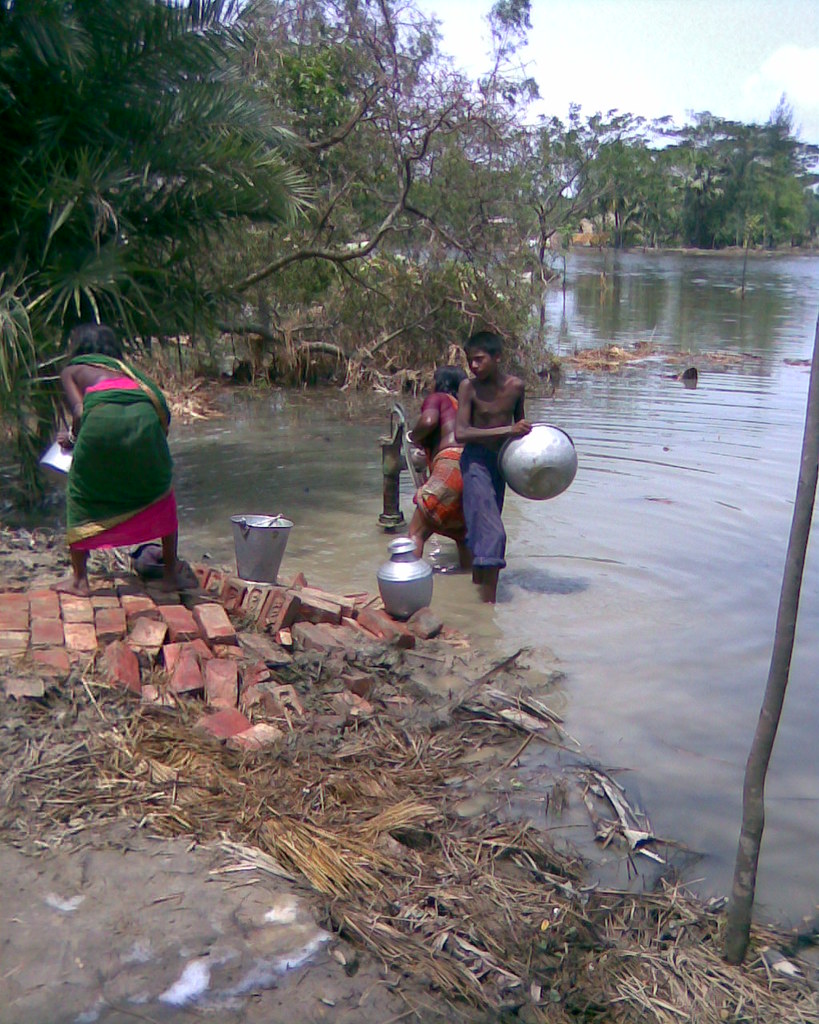
Some islands in the Bay of Bengal and the mangrove forests of the Sundarbans region were wholly submerged underwater. This catastrophe happened within a brief period, which resulted in people becoming homeless, leaving their assets in the households. A tiny percentage of the affected people could take shelter in the nearby cyclone shelter or schools during the cyclonic event. However, in several discussions, the affected people criticised that most cyclone shelters were built post-Aila and schools had only ground floors, which was anyways inundated. Most people thus took refuge on elevated roads. The extreme flooding also resulted in thousands of people losing access to safe drinking water and exposure to floodwaters containing untreated wastewater, dead animals and fish.

Impacts on water systems and water quality are often not visualised as chronic damage to property or the landscape. And thus, most treatments to these problems are temporary and short-lived. Potable water scarcity is a cumulative problem in the coastal region of India, especially Sundarbans, as it is revolving saline water slowly. Climate-induced disasters like rainfall, cyclone and storm surge, flood etc., are making the situation worse. Coastal people gradually depend on groundwater due to surface water salinity. As a result, groundwater extraction is increasing day by day. For that reason, the shallow aquifer has also been contaminated by salinity intrusion.

I have witnessed the horrific situation of women and children wailing for drinking water and waiting for relief distribution while spending my summer holidays at my native house in Sundarbans. The 14-year-old me then was horrified by the helpless situation of my own people, my kin and kept wondering whether disaster management conditions would be better or worse in due course of time especially when it concerns marginal communities of Dalits and Adivasis.

The memories of Aila keep flashing back to these Sundarban islanders every time they are hit by a cyclone or post-cyclone flood. Some of the stories they shared with me during my doctoral fieldwork made me revisit my Aila memories. As a native researcher, it gave a new stance towards the importance of water beyond its economic value and enhancing communities’ socio-cultural ties. Water, which has often served as an agency to conflict and dispute, during Aila it stimulated the sense of brotherhood and togetherness among the Samsernagar village residents.

Flood Friendship Between India-Bangladesh

Samsernagar is the last village in West Bengal’s Sundarban, bordering Bangladesh by river Kalindi. During Aila, the embankments of Samsernagar broke, resulting in the inundation of the village with the high tide influx from Kalindi. It led to total ruination of the settlement in just a couple of minutes. Samsernagar was submerged in the water, and so were the tube-wells and ponds, which were the only source of drinking water. It is where the villagers from Bangladesh came as harbingers of help.

In the political map, Bangladesh and India are demarcated as two separate nations. However, for people in Samsernagar, their neighboring village will still be the Village Koikhali of Bangladesh. To better understand, I phoned one of my respondent’s relatives who lived on the other side and asked about their experience during Aila regarding the help they provided to the Samsernagar residents. Koikhali residents came to Samsernagar rowing on their boat with barrels of potable water and other essential aids like food, clothes and mats. From several discussion and information interaction, it can be inferred that Samsernagar still recognises their international neighbour’s gesture which didn’t let them die of drinking polluted water. This act showed how, on the one hand, the water acted as a demon to the villagers through flooding and on the other, the barrels of drinking water brought by the neighbouring villages of Bangladesh became a sign of camaraderie and community interest. It went beyond just a mere necessity to live. It showed us how two villages come together, ignoring the human-made international boundary.

The Dilemma of Drinking water Crisis

That this acute drinking water problem can turn into a chronic issue in events like Aila and similar flooding situations is given credence by the fact that underground water also becomes saline due to leaching and seepage. Even after the floodwater recedes, the tube well water remains undrinkable. Sittler (2017), in her study on ‘Floodwater and stormwater can contaminate your water well’ argues that regardless of where storm-water runoff occurs, like floods, it can carry harmful contaminants such as soil, animal waste, salt, pesticides, and oil, potentially impacting drinking water wells and water quality. When discussed these challenges with groundwater experts at Sundarbans, they pointed out that in the Hingalganj Block, where Samsernagar village is situated, many deep tube well weren’t rightly maintained. Excessive contaminant-laden run-off infiltrated these drinking water wells through and assessed that the well casings or caps may not have been completely watertight. Moreover, any potential contaminants into the well can pose at least a short-term risk to water quality and human health.

In 2009, many families in Sundarbans, out of desperation, consumed pond water undergoing some basic filtration, knowing that the pond water stank from carcasses of dead animals. As farmlands remain filled with saline water, paddy yield became meagre the same and following year. Affected people when interviewed spoke of the mismanagement of the state’s relief supply and its lack of providing safe water, on how the local administrations would run some basic filtration like boiling the contaminated water and distributing it. As a result, hundreds of villagers suffered from diarrhea two weeks after drinking contaminated water. According to UNICEF, 28 diarrheal deaths were registered, and over 85,000 cases were reported from the Aila-hit districts of West Bengal.

Water can be considered a symbolic element, a resource, a commercial product, or a service. The interconnections established and the value attributed to water usage serves to build norms and references that influence the decision-making process from individuals to higher levels of social organisation. When considering it a resource for life, its interests and values vary and change across cultures, communities, states, space and time. One may raise an inquiry that spaces like Sundarbans is surrounded by rivers and seas, and that’s presumably the reason why Sundarban locals might not feel impacted by the presence of noble metals in the water.

However, as Sundarban landscape has a mangrove ecosystem, the water quality in and around the area has been found to be of inferior quality (CGWB report, 2014-15). If also, post-Aila most deep wells that were reconstructed at the height of 8-10ft above flood level so that the runoff was less likely to introduce contaminants into these wells, slight amount of saline water still managed to seep into the groundwater. However, it is the persistent presences of high iron and arsenic in the wells within that should raise alarm. So, even though the region is surrounded by water, most of it is toxic. Thus, for the Sundarban islanders, continuous access to safe and potable water is an aspiration that continues a dream for the whole community.

REFERENCES:

.

Camellia Biswas is a doctoral candidate at the discipline of Humanities & Social science, IIT Gandhinagar. She is an Inlaks-RS conservation grantee for the year 2021-22. Her research specialises in Environmental anthropology, focusing on human- Nature Interaction in Indian Sundarban under the larger discourse of Climate disaster.

.

PLEASE NOTE: ARTICLES CAN ONLY BE REPRODUCED IN OTHER SITES WITH DUE ACKNOWLEDGEMENT TO BORDERLESS JOURNAL