Book Review by Bhaskar Parichha
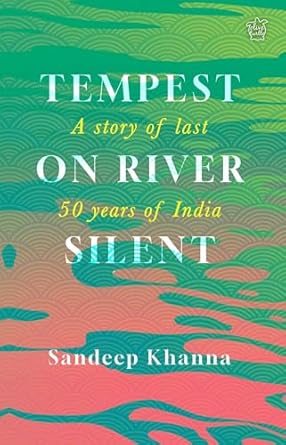
Title: Tempest on River Silent: A Story of Last 50 Years of India
Author: Sandeep Khanna
Publisher: Niyogi Books
From sipping Campa-Cola to buying only half a loaf of bread from TV serials like Hum Log [1]to the phenomenon of Tendulkar[2], Tempest on River Silent – A story of Last 50 Years of India, takes you on a nostalgic and exhilarating journey through India’s transformative decades.
Sandeep Khanna, a graduate of the Faculty of Management Studies and Shri Ram College of Commerce at the University of Delhi, conceived the idea for this novel during his extensive travels. His trips allowed him to explore the captivating socio-cultural diversity of India and the world while also recognising the commonalities that unite humanity.
Devavratt and his companions embark on a remarkable journey through the swiftly evolving landscape of their native land, a journey that encapsulates the essence of a nation in transition. Their story begins in the vibrant hallways of schools and colleges during the 1970s and 1980s, a time marked by youthful idealism and a burgeoning sense of identity. In these formative years, the group, full of dreams and ambitions, navigate the complexities of education, friendships, and the socio-political climate of India. The classrooms buzz with discussions about the future as they grapple with the ideals of nationalism and cultural pride, often inspired by the rich tapestry of their heritage.
As they move into the 21st century, the energetic corporate workplaces becomes the backdrop for their evolving aspirations. The transition from the academic environment to the corporate world is both exhilarating and daunting. Devavratt and his friends find themselves at the intersection of tradition and modernity, where the values instilled in them during their school days clash with the fast-paced demands of contemporary life. The corporate landscape is rife with opportunities, yet it also presents challenges that test their resolve and redefine their understanding of success.
Throughout their journey, the characters engage in sincere discussions and lively debates that reflect the socio-economic transformations sweeping across India. They explore the impact of globalization, the rise of technology, and the shifting dynamics of class and privilege. These conversations are not merely academic; they are deeply personal, as each character grapples with their place in this changing world. The weight of their aspirations is often lightened by light-hearted antics and fond reunions, moments that remind them of the bonds forged in their youth and the importance of friendship amidst the chaos of adult life.
As they navigate the complexities of love and relationships, the characters also delve into themes of spirituality and self-discovery. The pressures of the corporate world often lead them to seek solace in their cultural roots, prompting reflections on what it means to be truly fulfilled. Through their experiences, they learn that success is not solely defined by professional achievements but also by the depth of their connections with one another and their commitment to their values.
In this rich narrative tapestry, Devavratt and his companions embody the spirit of a generation that is both proud of its heritage and eager to embrace the future. Their journey is a microcosm of India’s evolution, a story of resilience, hope, and the enduring power of friendship in the face of change.
Khanna writes in the preface: “Tempest on the River Silent is a story of India as I have seen since the 1970s till present day. Overlaid on this factual story of India is a fictional account of a few imaginary characters, some of whom are portrayed as my friends. The third thread of the book is the spiritual lessons that I draw from the socio-economic changes in India and the tumultuous journey of my ‘friends’. Perhaps the word ‘spiritual’ is too big for me to use; it would be more appropriate to describe them as lessons of life that I have tried to unravel alongside the growth of a nation and the life stories of my ‘friends. The three threads hang off each other, and I narrate the book in the first person. Thus, the book is both a story of India and a story from India’s last 50 years.”
It’s a captivating work of fiction!
.
[1] We People, an Indian TV serial, 1984-85
[2] Sachin Tendulker, Indian Cricketeer and Parliamentarian
Bhaskar Parichha is a journalist and author of Cyclones in Odisha: Landfall, Wreckage and Resilience, Unbiased, No Strings Attached: Writings on Odisha and Biju Patnaik – A Political Biography. He lives in Bhubaneswar and writes bilingually. Besides writing for newspapers, he also reviews books on various media platforms.
.
PLEASE NOTE: ARTICLES CAN ONLY BE REPRODUCED IN OTHER SITES WITH DUE ACKNOWLEDGEMENT TO BORDERLESS JOURNAL
Click here to access the Borderless anthology, Monalisa No Longer Smiles
Click here to access Monalisa No Longer Smiles on Amazon International
 Borderless