Book Review by Malashri Lal
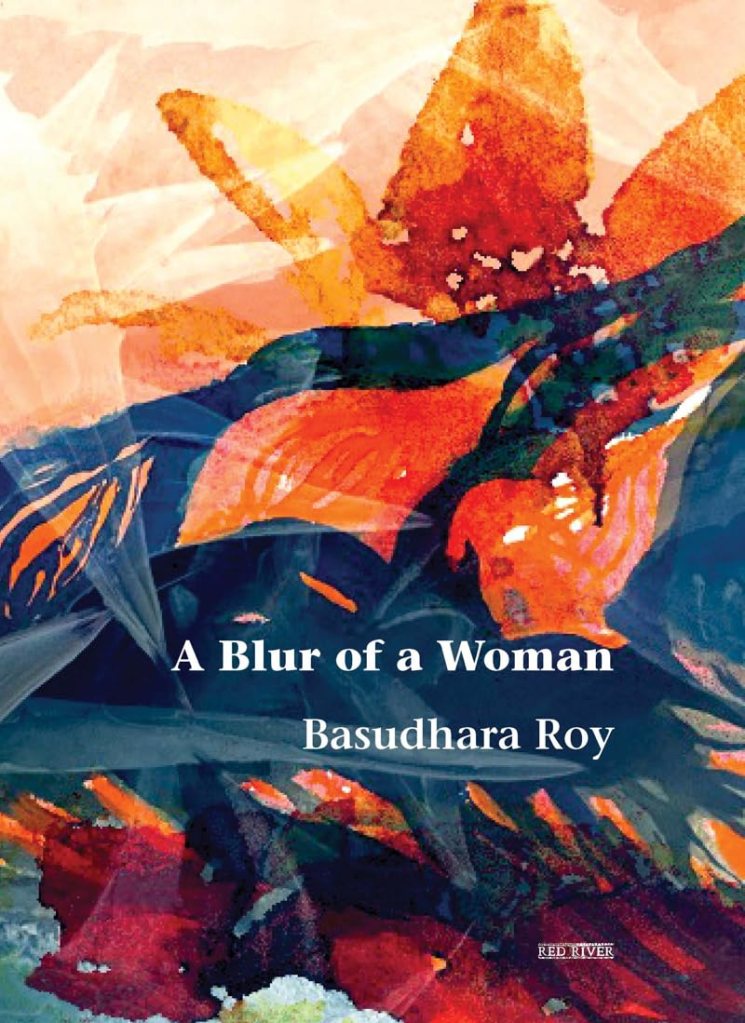
Title: A Blur of a Woman
Author: Basudhara Roy
Publisher: Red River
The feminine mystique has defied every attempt to capture its attributes. If clusters of stories surround a goddess, dilemmas are embedded in them. If the pavement-dwelling mother with children clinging to her skirt images economic deprivation, there are stories hidden in her grey-flecked eyes. Basudhara Roy recognises this amorphous, protean aspect of the feminine and titles her collection A Blur of a Woman, poetically declaring; “she owns the place/and the little magic she has earned…she will use it someday to unbuild herself/disappear dissolve/ become a blur”.
This collection is a subtle attack on patriarchy as it encompasses the history and socio-cultural conditions that have moulded women into being mercurial yet tangible, pliant as well as resistive, buoyant but also vulnerable. As the poems flow in a drumroll of many contexts, vignettes of the journey are captured, symbolically strong and offering a plethora of layered meanings. The lines encourage a dialogic exchange whether with the poet, or with one’s own half-acknowledged self that is suddenly confronted by Medusa’s mirror.
The first two sections begin with poems titled ‘Duhkha’ and ‘Soka’[1], directing us towards the Buddhist principle of inevitable mutability and the need for acceptance.
I have seen hearts shut and bolt doors
from within, their windows walled while
on love the mold of ingratitude thrives
With such adaptations, the contemporary takes precedence over the philosophical teachings, and the identification with thwarted expectations, social discord, betrayal and helpless sorrow is almost immediate. If solace is to be found it is now individual—and, in this instance, by turning to the gnarled trunks of trees where tears have watered the serrated bark. Speaking of the imagistic density of Roy’s phrases, this kind of interlinking through poetic shorthand is perceived in much of her narrativisation. The ‘betrayal’ that causes sorrow and also the maturity of recovery is a process resonant through the history of women’s writing. ‘Soka: A Triptych’ strings this further through contemplating the elegiac notes of death and mourning—yet birth and death are twins: “If life alone can be seen/all this emptiness must surely be death.”
A sizeable section of the book charts a trajectory of feminist fables, gleaning references from Rabindranath Tagore, Jayadev’s Geet Govinda, Philomela’s story, Virgo’s distress, and others. In Roy’s hands, irony becomes a viable and effective tool of social critique as in the poem
‘In Which Bimala Agrees to an Interview for a Special Issue of Post-Text Feminism’. Tagore’s popular novel Ghare Baire/ The Home and the World presents Bimala as the conventional woman who is persuaded to discover the turmoil of the world outside the threshold. Basudhara devises an imaginary conversation, some of which is quoted:
Where, then, would you locate yourself?
Here. Now.
Come on! I am hardly lost
and need no GPS of theory to find myself!
Such a startling reinvention of a canonical text subverts many assumptions with sharp, clear strokes: the jargon of literary theory, the leap into digital alignments, the confidence of the liberated woman, and the time travel that feminism has enabled.
My other favourite piece is about ‘Lalita’, a sakhi or friend of the beauteous Radha who is always the heroine in the traditional tale. In Lalita’s version of the mysterious raas leela where Krishna is perceived by each woman as her partner, she is jubilant about her societal escape and physical abandon;
limbs supple like vines we danced,
thrilled to be
where love was recklessly returned.
This may be the right time to refer to the Author’s Note which is titled ‘I Write from the Body’ and seems to carry forward the feminist discourse of theorists such as Hélène Cixous who invented the term écriture feminine, or Julia Kristevawho perceived the chora as a specially maternal zone. According to Roy, “In the earth-bed of this woman’s life that I live, poetry runs as a river, its plenitude being both a lesson and an antidote to the prosaic borders of my world.” In which case, “Blur” is the right metaphor for attempting to break the boundaries through word-play and subversive themes expanded in poems such ‘Aid to Forgetting’, ‘Praise for the Subaltern’, ‘Dis/enfranchised’—and several other poems are expressions of resistance to the bastions of control. Philomela’s severed tongue has again learned to speak– but it’s a new language of assertion and intertextuality.
The semiotic breakthrough in Roy’s poems is accompanied by stylist experiments too, the Ghazal section being one such. The transcreated use of the Urdu structure allows for couplets on a variety of subjects—for example, the seasons in the manner of the Baramasa (songs of the twelve months) with a twist that the woman is no longer the bereft, perpetually waiting figure uttering her woes to the firmament. She says confidently now:
You etch every constellation on your  palm
Yet secrets line the arcane of the body
In all, A Blur of a Woman, offers poems for the intellect and the heart which are indivisible aspects of a woman’s existence. That she is mercurial and evasive is once again a reminder of a fascinating mystery that has prevailed over time — and perhaps its more exciting to keep it that way.
[1] Both Dukha and Soka are forms of grief
Malashri Lal, writer and academic, with twenty one books, retired as Professor, English Department, University of Delhi. Publications include Tagore and the Feminine, and the ‘goddess trilogy’ (co-edited with Namita Gokhale) In Search of Sita, Finding Radha, and Treasures of Lakshmi. Betrayed by Hope: A Play on the Life of Michael Madhusudan Dutt received the Kalinga Fiction Award. Lal’s poems Mandalas of Time has recently been translated into Hindi as Mandal Dhwani. She is currently Convener, English Advisory Board of the Sahitya Akademi.
.
PLEASE NOTE: ARTICLES CAN ONLY BE REPRODUCED IN OTHER SITES WITH DUE ACKNOWLEDGEMENT TO BORDERLESS JOURNAL
Click here to access the Borderless anthology, Monalisa No Longer Smiles
Click here to access Monalisa No Longer Smiles on Kindle Amazon International
 Borderless