Book Review by Jagari Mukherjee
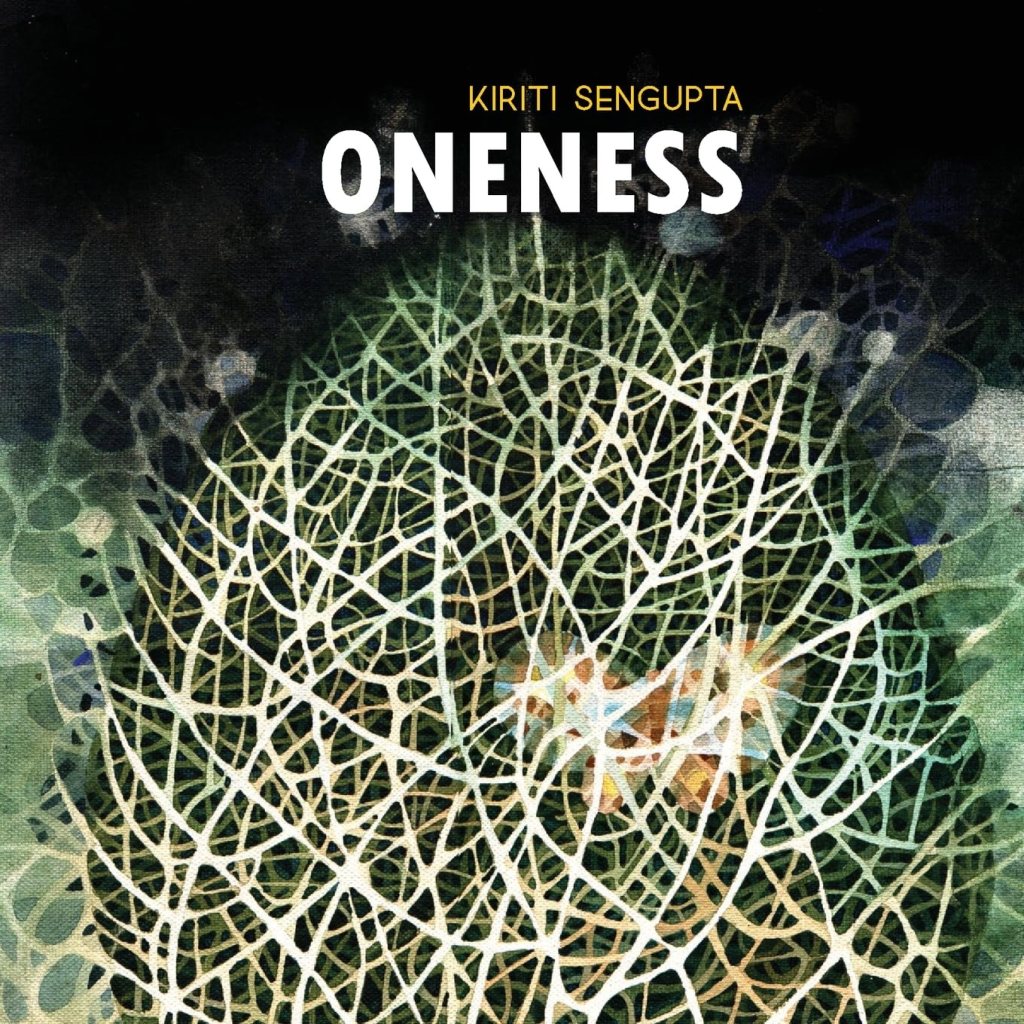
Title: Oneness
Author: Kiriti Sengupta
Publisher: Transcendent Zero Press
Oneness by Kiriti Sengupta, an established writer and publisher, is the paean of a poet in love with life. This thin volume has the gorgeousness of a Rajasthani miniature: The poems are accompanied by colourful paintings by Pintu Biswas and Samir Mondal. The artwork adds to the magic of the experience that is Oneness. Exploring the pieces, the reader, too, is drawn by the poet into embracing life like an affectionate lover who accepts the highs and lows of our existence or a relationship. The bright tapestry (literal and metaphorical) presented in the little tableau of a book entrances us to appreciate the romance of oneness in the midst of our teeming variety of happenings over time.
The title “Oneness” recalls to mind John Donne’s[1] immortal sermon, delivered after he healed from a prolonged bout of illness, titled ‘No Man is an Island’. Donne’s illness was so severe that he was considered to be on his deathbed, but defying all odds, he survived. And, then, he wrote:
No man is an island,
Entire of itself;
Every man is a piece of the continent,
A part of the main.
Oneness is a celebration of life as much as the start of ‘No Man is an Island’. It expresses an all-encompassing love for other human beings, the realisation that the hues of blood, joys and griefs are same for everyone, that death and sorrow are common to all. Oneness is an eternal feeling captured well in this collection.
Oneness homes haikus, short verses and prose poems. The haikus reflect profoundness with the brevity of words, typical of Sengupta’s style. For instance:
full moon
across the landscape
fireflies.
One would imagine a dark night sky and a full, flowery golden moon, illuminating the black landscape and the pinpricks of lights from the insects. Instead, the accompanying artwork surprises with a canvas awash in swirling cobalt blues a large blazing red moon, and fireflies like bright flames. It forms an interesting contrast.
Some haikus are beautiful and poignant with subtle decadent sadness:
the post box
recedes to rust
the lost art
A post box is part of the past in the twenty-first century with the advent of online communication. The painting shows a cherry-red post box, with two crows frequenting the scene. The crows, presumably, communicate with each other at the site of the letterbox. The visual and the art bring to mind Donne’s lines, “Any man’s death diminishes me / Because I am involved in mankind”. Perhaps there is a need to mourn the metaphorical death of letter writing, a form of genuine, soulful exchange which would wean away from loneliness and the impersonality of online interactions.
Taking other poems into consideration, it is difficult to choose favourites. In ‘Primordial Leaning’, Sengupta begins with an assertive statement, compelling the reader to accept that they define women as Durga or Kali. The rest of the poem intersperses questions and one more statement. The poet questions the attitude adopted by ‘pop feminists’ to ask whether it is ‘kind’ to compare women to these warrior goddesses, and should men, in turn, behave like Shiva, who is the Destroyer in the Hindu Trinity. It is an interesting take that would be of great value to scholars of Gender and Masculinity Studies. There are no easy answers to this interrogative, but Sengupta packs in a punch in his fiery inimitable style.
You define women as Durga
or Kali. Are you a believer? Are you
being kind? You could have convinced
them to fight the evil.
Instead, when you imply the goddess,
do you illustrate
sisterhood with many limbs? Would you
like men to act as Shiva—the destroyer?
The poem ‘Tenure: Early Years’ asserts that one never outgrows one’s early life when he or she is around a parent. Even when the child becomes an adult, a guardian keeps the memories of their wards’ childhood alive through stories and reminiscences. Thus, for a parent, juvenescence lasts forever.
What role do guardians play
when their wards grow up?
They feed lived experiences,
keep childhood alive.
Juvenescence spans the length
of the parent’s life.
In ‘Separation’, man and nature experience alienation, a state prevalent in postmodern times. However, in the artwork facing the poem, the “worn-out tree” is the reflection of the narrator. Perhaps it is a case of pathetic fallacy where nature echoes the loneliness faced by twenty-first century man. Yet, one can always ask: are trees and men, thus, not united in their separation from the rest of the kaleidoscope?
Only a little needs to be invested
in sketching the worn-out tree.
A charcoal or two, canvas, and span.
I place myself amid the landscape
to explain the prevailing isolation.
John Donne’s sermon ends with the idea of the inevitability of Death: “And therefore never send to know for whom the bell tolls;/ It tolls for thee.” The poems in Oneness, on the other hand, create an eternal algorithm of the unity and universality of human existence. Each written piece, with its companion artwork, form an unforgettable vignette; each is a resplendent unveiling of the beauty and truth of life.
.
[1] John Donne (1572-1631), major poet of metaphysical school
.
Jagari Mukherjee is the Editor-in-chief of Narrow Road Literary Journal and the Chief Executive Editor of EKL Review. Jagari has three full-length poetry collections and two chapbooks and a bestselling ebook to her credit.
PLEASE NOTE: ARTICLES CAN ONLY BE REPRODUCED IN OTHER SITES WITH DUE ACKNOWLEDGEMENT TO BORDERLESS JOURNAL
Click here to access the Borderless anthology, Monalisa No Longer Smiles
Click here to access Monalisa No Longer Smiles on Amazon International
 Borderless