Categories
Review

Unraveling Odisha

Book Review by Bijaya Kumar Mohanty

Title: No Strings Attached: Writings on Odisha

Author: Bhaskar Parichha

In No Strings Attached: Writings on Odisha, Bhaskar Parichha brings together some of his earlier published essays, primarily written for The Political and Business Daily and other newspapers. The well-known journalist and author begins with a preface in which he quotes Oscar Wilde: “Journalism is unreadable and literature is not read.” I would rather begin by inserting a slight modification to Wilde’s quotation, ‘Journalism is certainly readable and literature is not widely read’. I have inserted this modification, keeping Philip L. Graham’s quote in mind. He states: “Journalism is the first rough draft of history”.

Parichcha’s book ably presents the author’s long bilingual career in the field of journalism. He primarily writes in Odia and English. The wide variety of essays in the book is intended to create a yearning to know more on the subject. This book would attract all those who are interested in a brief understanding of modern Odisha in general and post-millennial political narratives in particular. It fills a void in the field of political economy of contemporary Odisha.

The book is divided into four parts: ‘Portraits’, ‘Politics and Beyond’, ‘Conflict Zone’ and ‘Odds and Ends’. And concludes with a postscript on “what to expect from Naveen Patnaik’s fifth term as Odisha Chief Minister”.

‘Portraits’ consists of six essays. It starts with Madhusudan das aka Madhubabu, the architect of modern Odisha as ‘the global Indian’.  In Odisha, when children are first introduced to the world of education, they get to learn a widely popular Odia rhyme:

Patha Padhibi, Okila Hebi,

Kalia Ghoda re Chadhibi,

Madhu Babu sange Ladhibi…

A rough translation of the popular memory is: ‘I will study with all the commitment, will achieve all the success and will fight for the nation like Madhubabu’. Madhubabu was one of the earlier institutional builders in the context of colonial inter-region specific cultural and economic conflicts. As rightly concluded by the author, Madhubabu “had a practical sense of realism and fought fearlessly against the ‘mental’ darkness of early twentieth century Odisha”. 

The other five essays are on the maverick Biju Patnaik; the legendary Harish Chandra Bakshipatra; the arrival of astute Naveen Patniak along with two cultural icons of post-colonial Odisha, Pandit Raghunath Panigrahi and the noted film scholar/maker Nirad Mohapatra and his world of Maya Miriga.

This section concluded with Nirad Mohaptra’s Maya Miriga (The Mirage). This was one of the few new wave regional films ever produced in India, as observed by C.S. Venkiteswaran, the noted Kerala based film critic, academic, documentary film-maker, who contended: “There are two kinds of film-makers — those who create an oeuvre of their own and leave a personal imprint on their field, and those who not only want to explore the medium and create a body of work, but also want to communicate and connect with society of their time”. Nirad Mohapatra belonged to the latter kind, by quoting Mohapatra’s words, the author argues that “the making of Maya Miriga was an exciting experience of improvisation within the broad framework of a written story”.

The beauty of Maya Miriga lay in shooting almost the entire film in a single house, which was renovated beforehand by the filmmaker to portray the characters as realistically as possible. To Parichha, Nirad Mohapatra’s kind of cinema truly “sought after truth, didn’t obey convention, and certainly didn’t become subservient to common notions of what was good and palatable”.

The second part, is called ‘Politics and Beyond’. This part accommodates sixteen essays written on issues related to the rise of BJD ( Biju Janata Dal). The strength of these essays revolves around the BJD’s immediate rivalry with parties in context of everyday governance and its electoral prospects in the state.

The third part of the book has some exciting pieces on the issues titled under the sub-section name: ‘Conflict Zone’. Essays written in the context of ‘Polavaram Tangle’ and ‘Make in Odisha Conclave 2016’ are impressive. These have comparative analysis with neighbouring states, like Andhra Pradesh and Chhattisgarh, or with richer states, like Gujarat, for attracting foreign direct investments. They even address issues of rehabilitating displaced people as a result of Andhra Pradesh’s unilateral actions with regard to Polavaram Project.

Finally, the last part of the book, has 16 essays titled ‘Odds and Ends’. This section hosts governance issues that range from chit fund scams to a news item on the terror attack in the state capital, Puri; safety issues in the world of Odisha’s industrial corridors; the big confusion around the so-called – India’s single-largest foreign direct investment by the POSCO (Korea) and the aftermath issues of Phailin (a book on Odisha without touching the issues of natural disasters is indeed an incomplete one).

 In ‘Is Odisha a litigant State’, Parichha justifiably contends: “It is high time the Odisha government comes up with a litigation policy on the lines of the Haryana government in order to bring about a visible, qualitative and quantitative improvement in the manner in which litigations are pursued and managed by the state.” ‘How healthy is Odisha?’ brings out the dismal state of public health care as well as private health sector. He urges for an increase in the outlay for public health expenditure from the annual budget.

In ‘Baina, Itishree and Nirbhayas’, Parichha highlights the issues of widespread domestic violence, discrimination against women at the workplace etc. Towards end of the essay, he mentions the introduction of Gender Inequality index (GII) in 2010 as a result of the UNDP (United Nations Development Programme) report. The quality of having such an index, according to the author, can be put to use by the public sectors to address the existing anomalies of “poor distribution of resources and opportunities amongst male and female”. He rightly says, “Acknowledging the presence of a problem will lead to solutions sooner or later”.

Parichha’s book is an open ended one. The author’s wide array of interest on the issues related to Odisha would be of interest to both lay persons and researchers.


Mr. Bijaya Kumar Mohanty, teaches Development Process and Social Movements. He is an Assistant Professor in Political Science, Ramjas College, University of Delhi. Email Id: bijaya@ramjas.du.ac.in

.

PLEASE NOTE: ARTICLES CAN ONLY BE REPRODUCED IN OTHER SITES WITH DUE ACKNOWLEDGEMENT TO BORDERLESS JOURNAL

Categories
Review

Gandhi & Aesthetics

A review by Bhaskar Parichha

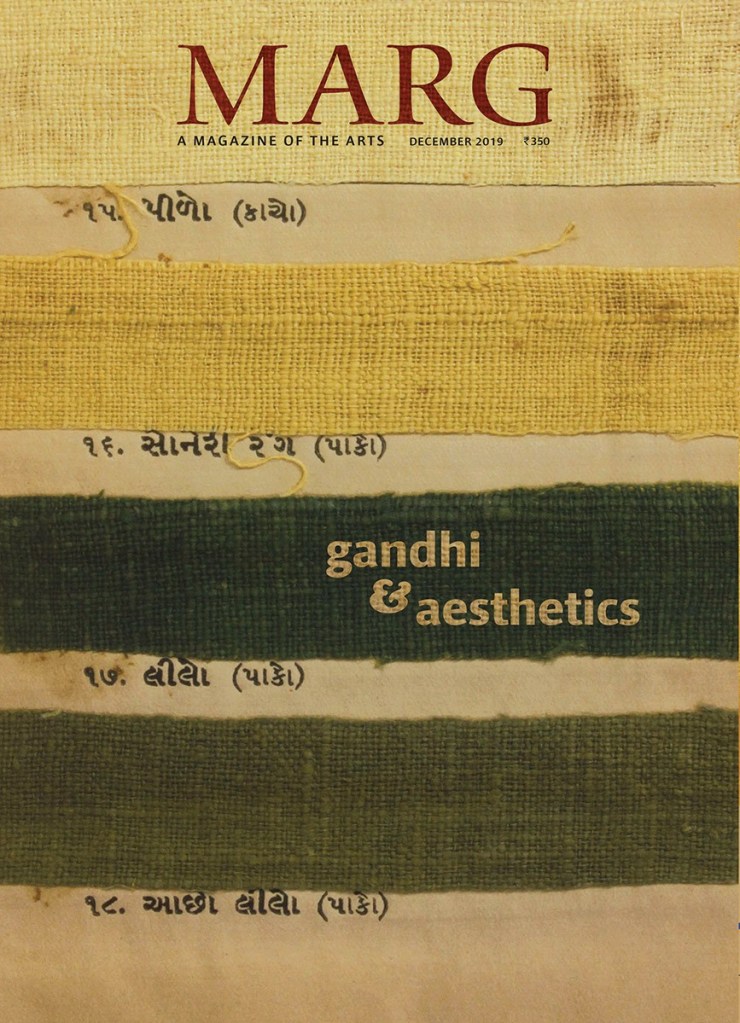
As India celebrated the sesquicentennial of MK Gandhi last year, Marg had come out with a special issue on the lesser-known aspects of Gandhi’s engagement with aesthetics.

Gandhiji’s aesthetics was two-fold: one, it was a quest for exquisiteness and two; it was a set of principles fundamental to the personal practice. Edited by Tridip Suhrud, the nine essays are a fitting tribute to the inventive beauty of Gandhiji and its wide-ranging applicability in present-day society.

In an art project organised by Sahmat in 1994–95 as a continuation of a program called Artists Against Communalism that emerged in response to the Babri Masjid demolition in Ayodhya and as a part of a year-long series of events, artists — from KG Subramanyan to Atul Dodiya, from NS Harsha to Nilima Sheikh, A Ramachandran to Vivan Sundaram, Nalini Malani, PT Reddy, Nand Katyal, Shamshad Hussain, Orijit Sen, Parthiv Shah — were invited to create postcards that could later be displayed as artworks in galleries and also be circulated among the general public as boxed sets. Ram Rahman’s essay   ‘Thematic Ad-Portfolio: Postcards for Gandhi’ deals with these postcards.

In the editorial note, associate editor, Latika Gupta, gives an overview of the underlying themes of this volume and how they explore Gandhi’s conceptual understanding of art which combined the ideas of truth, beauty, and utility. The Mahatma is also placed in the context of the current times when his legacy is being put to different political uses.

It is a widely held belief that the Mahatma had no place for art, music, and literature in his ascetic life and ideas about national regeneration. In the introductory essay ‘Art as Namasmaran: The Aesthetics of Gandhi’, Tridip Suhrud unravels the various human and natural artistic elements that moved and influenced Gandhi, the concepts and patterns that guided and came to be reflected in his choice of attire, living spaces, and discipline.

‘In the Footsteps of Spectres: The Aesthetics of Gandhi’s Walks’ by Harmony Siganporia, we get to see how walking was an integral part of Gandhi’s private and public engagements with politics and truth. Gandhi embarked on several important walks throughout his life. They served as forms of pilgrimage, mass agitation, and individual protest. This essay explores various aspects of Gandhi’s walks by revisiting his writings and the photographs of these historic events.

Sudhir Chandra in his article ‘Gandhi’s Hindi and His Aesthetics of Poverty’ dissects Gandhi’s appreciation of minimalism and purity, which is evident not just in his sartorial style but also in his use of language. Convinced that Hindi alone could be India’s national language, Gandhi attempted to transform it into a more inclusive language, incorporating certain words from regional languages and others of Urdu-Persian origins.

‘Music for the Congregation: Assembling an Aesthetic for Prayer’ by Lakshmi Subramanian explores Gandhi’s adoption of musical prayer as an important tool for shaping ashram life and community at Sabarmati. For Gandhi, music was a useful prop to make prayer a joyful experience and prayer was crucial for character-building among satyagrahis. His taste for music was shaped by his exposure to the church choirs of England, and the larger repertoire of devotional recitation and music that had been popularized by V.D. Paluskar and the Gita Press. These influences eventually guided his choices as he approached Pandit N.M. Khare to lead the prayer sessions and public meetings at his ashram and created a collection of songs — Ashram Bhajanavali.

In ‘Architecture as Weak Thought: Gandhi Inhabits Nothingness’. Venugopal Maddipati looks at two houses inhabited by Gandhi in Segaon (Sevagram), Wardha —Adi Niwas and Bapu Kuti. While the former is very simple and minimalist, the latter is more elaborate in design with clearly partitioned rooms. Though it would seem that architecture played a secondary role in Gandhi’s life and was relegated to the marginal spaces of domesticity and interiority, Maddipati has an alternative viewpoint.

‘The Long Walk to Freedom’ by Jutta Jain-Neubauer brings into focus a lesser-known aspect of Gandhi’s personality as a designer and maker of chappals. Gandhi saw in handmade sandals an aesthetic route to eradicate the stigma that had been associated with the communities of skinners, tanners and leather workers. Inspired by the Trappist Roman Catholic monastic order who were staunch believers in austerity and manual labor, Gandhi set up a shoemaking unit at the Tolstoy Farm and later replicated the model at Sabarmati Ashram in Ahmedabad. Made from the skin of animals that had died a natural death, this iconic ashram Patti Chappals also came to be known as ahimsa slippers.

‘A Biography in Prints: Gandhi and the Visual Imaginary’ by Vinay Lal studies the evolution of the representations through a range of prints that offer a chronological rendering of his life, charting his transformation from a law student in England to a satyagrahi in South Africa and finally the architect of India’s independence. Lal discusses the subtler meanings and politics conveyed in the compositions.

Throughout his long political and spiritual career, Mahatma Gandhi frequently stated that his life goal was to reduce himself to zero. This was a goal that he variously pursued by shedding worldly attachments, declaring celibacy, adopting abstinence, and periodically undertaking to punish bodily fasts, all for the sake of meeting his ideal of aparigraha or “non-possession”. ‘Reducing Myself to Zero: The Art of Aparigraha’ by Sumathi Ramaswamy reflects on the aesthetic dimension of this key Gandhian aspiration.

‘Ark, Saint, City, Cipher: The Gandhi of Gulam Mohammed Sheikh’ by Ananya Vajpeyi focuses on the Baroda-based artist’s engagement with the Mahatma and his ideals. Looking at a series of paintings made by the artist from 2000 to 2019, the writer analyses how Sheikh draws on references from various older texts and images and places Gandhi as an interlocutor across different periods and philosophies.

A fitting tribute by the Marg foundation to the father of the nation.

.

Bhaskar Parichha is a Bhubaneswar-based  journalist and author. He writes on a broad spectrum of  subjects , but more focused on art ,culture and biographies. His recent book ‘No Strings Attached’ has been published by Dhauli Books. 

.

PLEASE NOTE: ARTICLES CAN ONLY BE REPRODUCED IN OTHER SITES WITH DUE ACKNOWLEDGEMENT TO BORDERLESS JOURNAL.