By Prithvijeet Sinha
Samridh had always dreamt of standing atop the mound of Moosa Bagh for the last four years. His good friend Kabir had so animatedly filled his head with its haunting, almost transcendent images that Sam was engrossed by its structure, its history and the sheer fact that it was located in the most “silent parts of the city’s outer realm”. This made the place seem unattainable but also something to hold close to memory.
Kabir filled Samridh with the essence of Lucknow’s quintessential wonders and took him to a few of these “outposts”, sturdy sentinels who had seen decay and ruin and could even possibly be forgotten by the city’s dazzling archive that only focused on the centre. Sam now wanted to visit Moosa Bagh at any cost. He even expressed the desire to explore it all alone. Something about a mostly ruined but still beautiful archeological anamoly was deeply attractive to him.
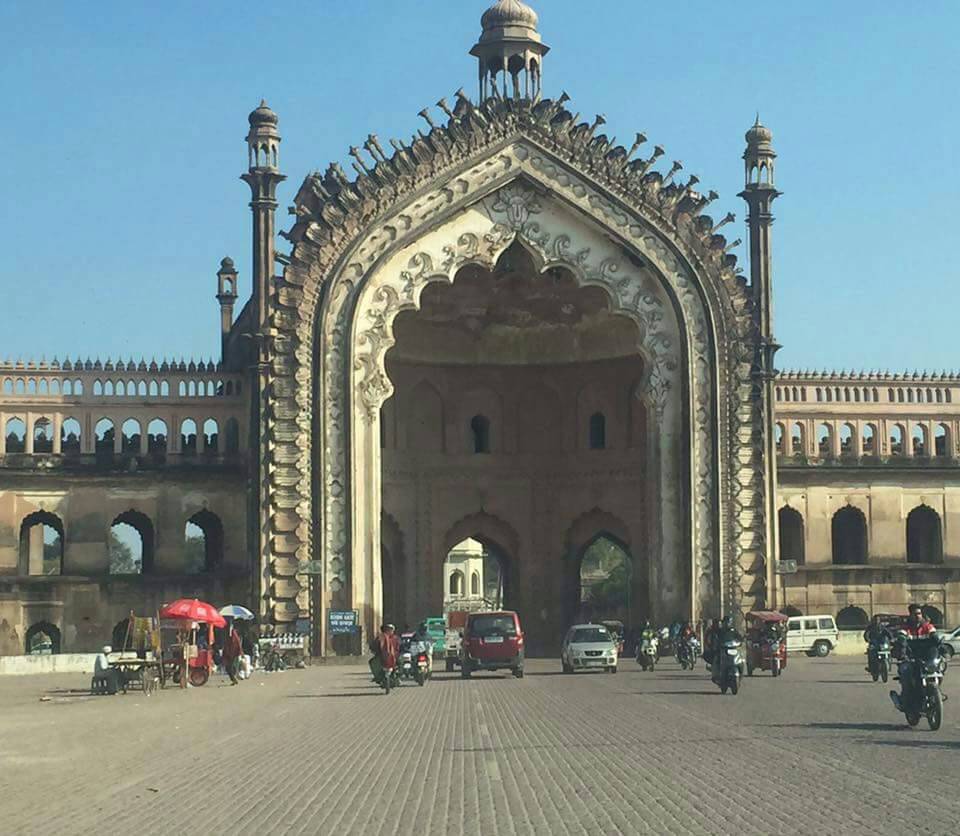
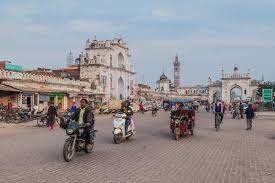
It was the first week of August. It was an inclement day. Kabir was accompanying Sam. As soon as they took the left turn from Hussainabad ahead of the Bara Imambara and Rumi Darwaza, the sea of classically constructed mansions as old as Time’s curves and twitches, shops spanning the panorama of generations, mosques, temples and commotion that could be intercepted from the flanks of the new flyover made him giddy. If this was a quiet expanse, it wouldn’t be the same. The mass of humanity was the bloodline of the old city and nobody could truly fall prey to anodyne loneliness within these streets and lanes, not one angle bereft of sound and sights. No other place could make him inhale the aroma of sheermaals, kababs and biryani from the sea of eateries. No foreword could prepare him for the colours and shapes of the vegetables being hauled and taken out of the Dubagga Sabzi Mandi[1]— not one crackle of feet and wheels on the road or the cacophony of voices seemed to bother him. He was looking at it all for the first time, taking in the splendour of an area he had never set foot in before. Most impressive was the electrical tower which was almost shaped like an ubiquitous monument in Paris.
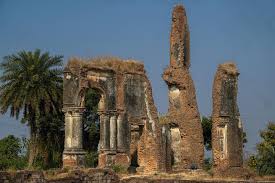
But soon the commotion cleared and the roads became more accommodative. They breathed in fragrance of the fresh air. The disappearing outline of buildings suggested that Moosa Bagh was near. Sam saw the open land in front of him as the car slowly made its way towards the mound. There was no human presence here except a young man on a bicycle. The land was mostly barren but little growths of plants and grass were still everywhere. It was the monsoon that kept its promise of verdure. Sam took a deep breath because as soon as he shifted his gaze to his left, he saw a dark red, earthy brown texture. Moosa Bagh was a beauty, a theatre of visuals that truly unveiled itself under the hazy sky so that the black stilts on its remaining mossy walls with overgrowth narrated its own saga, not of pain or destruction but something enduring, like Dali’s melting clocks or the moors in Wuthering Heights, or the solitary hills in Anita Desai’s Fire on the Mountain.
Sam gasped, beholding its outer ramparts that had holes like eyes; they could look into a visitor’s soul and read the signs of storm that had been delayed. It was just Samridh and Kabir looking over an ancient well in the compound, feeling the strength in the bricks that had seen glorious times when this was a haven. A spiritual poem seemed to grow out of the structure.
This was exactly how Kabir had come to accept it as the unheralded silent sentinel that perhaps allowed true believers to visit the place, finding in the process that it was not a ghost of the past or an architectural aberration. It was once a palace disseminating pleasure and leisurely journeys. On that day, two men deeply in love with Lucknow touched the tangle of leaves and the heft of twains, their appearance like an elderly person’s head full of grey river currents.
Kabir nodded. Samridh looked at the field of freedom that surrounded this mound, a place up there under inclement skies and reaching the upper realms of open reality with the shapes and contours of an unusual reprieve.
We discard secrets at the end of the line. We keep grinding on whetstones of popular appeal. But there are places and the feelings they evoke that don’t surrender to overestimated beauty or courting excitable crowds. In our world, a city can be oblivious to one sight and can still have the maganimity to send two introverts to its most treasured corners so that they salvage the essence of its history anew. Moosa Bagh is a beneficiary of these second chances. It is a place of charm and exquisite freedom to sensitive young men like Kabir and Samridh. Visits at the end of every month here have solidified their friendship into something greater than the sum of their parts.
At nights, Sam comes to his senses and initiates the same wondrous raptures that came to him on a gusty August afternoon. He is thankful for a storyteller like Lucknow. He feels it in his bones how Moosa Bagh is a symbol of the depths that he had never charted within his little lifetime, so far finding places close to his feet and repeating the same cycle of familiarity. But now going to an outer realm is no longer about being a traveller out of breath or time. He still dreams of Moosa Bagh almost every night, asleep on its mound, kissed by the moon and keeping its eyes in its walls open, telepathically conveying its deepest mysteries to him. Moosa Bagh is a sentinel taking him towards the perpetual road to his beloved city’s inner soul.
*Note: Sam and Kabir are persona taken on by the author and his friend.
[1] Vegetable market
.
Prithvijeet Sinha is an MPhil from the University of Lucknow, having launched his prolific writing career by self-publishing on the worldwide community Wattpad since 2015 and on his WordPress blog An Awadh Boy’s Panorama. Besides that, his works have been published in several journals and anthologies.
.
PLEASE NOTE: ARTICLES CAN ONLY BE REPRODUCED IN OTHER SITES WITH DUE ACKNOWLEDGEMENT TO BORDERLESS JOURNAL
Click here to access the Borderless anthology, Monalisa No Longer Smiles
Click here to access Monalisa No Longer Smiles on Kindle Amazon International
 Borderless