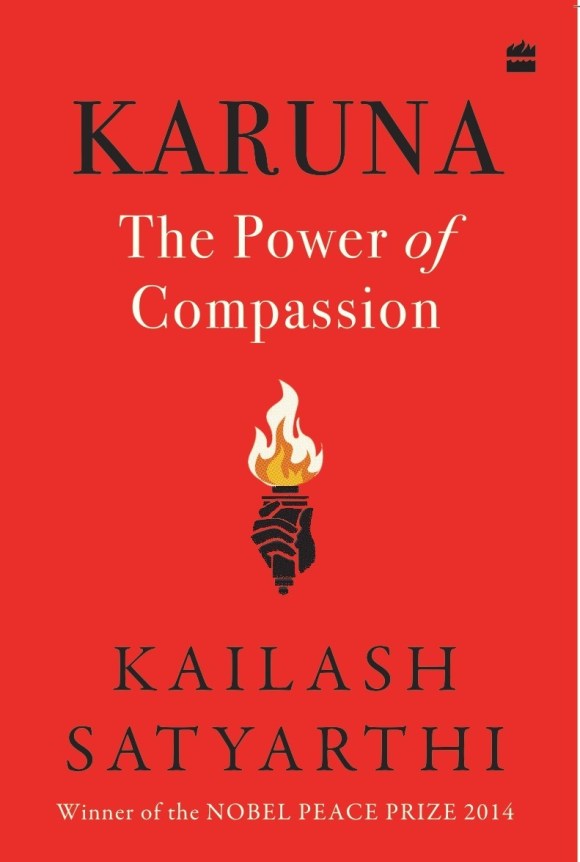
Title: Karuna: The Power of Compassion
Author: Kailash Satyarthi
Publisher: HarperCollins India
What Is Compassion?
Who are we? What are we doing here? What is the purpose of life? These complex existential questions are best left to thinkers and philosophers. We could instead begin with a more straightforward query: What do we want from life? Though our aspirations are countless and various, the desire for happiness, contentment and peace is familiar to all of us. None of us seek sadness, pain or trouble. But life invariably acquaints us with these negative feelings and experiences.
Our ability to feel the suffering of others as our own and our consequent efforts to alleviate it are integral to the human experience. This has led to the creation of families, communities and organisations. If we were all to look away from the pain of others, none of us would have a shot at happiness. The stories of Chirag and a group of teenagers from Sweden help illustrate the true meaning of compassion.
The word ‘chirag’ means ‘lamp’ and, true to his name, Chirag brought light to corners that were once shrouded in darkness. After being rescued from slavery, Chirag had been brought years ago to Bal Ashram in Rajasthan, our long-term rehabilitation centre for children rescued from child labour, trafficking and slavery.
In 2015, an eleven-year-old boy called Mithun was rescued by my organisation, Bachpan Bachao Andolan[1], and also brought to Bal Ashram. He had been trafficked from his village and taken to the city, where he was forced into begging. When we asked him where he was from, he could only say ‘Bengal’. A case was registered with the West Bengal police, but without adequate details they failed to find his home. So, Mithun continued living and pursuing his education at Bal Ashram.
In 2020, the children at Bal Ashram were celebrating Chhath, a Hindu festival native to the state of Bihar. Mithun remembered that people in his village would also celebrate this festival with great pomp and show. He also said there was a bus stand and market near his home that his elder brother would visit often. Since Chirag was from Bihar, he guessed that Mithun’s village might also be in his state. Chirag then began showing a keen interest in Mithun’s story and could often be seen jogging his friend’s memory for more information. Borrowing a teacher’s phone, Chirag scoured the internet and—after many months of Google searches—found Mithun’s village, a place called Borna in Bihar’s Khagaria district.
When Chirag learnt that Google Earth renders three-dimensional representations of places with satellite imagery, he began using the software to find the bus stand and market Mithun had described. Looking at one of the images Chirag showed him, Mithun’s face lit up. He was convinced this was the bus stand near his village. Mithun also identified a shop he’d often visited with his elder brother. Chirag zoomed in and found a phone number on a board above the shop. When he called that number, the shop owner confirmed that years ago he had heard of a child being kidnapped from a village some 20 km away. He promised to look for Mithun’s brother and bring him to his shop.
The next day, Mithun finally spoke to his elder brother after five years of separation. Bal Ashram burst into celebration. The children lifted Chirag onto their shoulders and showered him with praise. A few days later, Mithun went back to Borna with his brother, who had come to get him. When I asked Chirag why he had tried so hard to find Mithun’s family, he said, ‘If my younger brother or I were lost like this, would I not have done the same thing?’ Today, Chirag is pursuing a management degree in Chennai, while Mithun is studying at a school near his village.
The following story is of a group of students from Sweden. They, accompanied by their teacher Ula Asberg, had come to visit Mukti Ashram several years ago. Mukti Ashram in Delhi is our short stay rehabilitation home for boys who have been rescued from child slavery and child labour. After the students returned home, they discussed among themselves how it was unfair that there was no such home for girls. At the time, the number of boys being rescued was more than girls and we did not have the funds for homes for both. The Swedish students felt it was necessary that girls who faced exploitation should have access to the same kind of help and support the boys did. They shared their intentions with their teachers, and not only did they collect a large amount by pooling their own pocket money and savings, but they also mobilised the teachers to contribute.
A few months later, when I was on a trip to Sweden, the students invited me to their school. They shared with me their wonderful initiative, telling me that they wished the money they had collected could be used to set up a rehabilitation home for girls. When I asked them what had made them do such a thing, they said, ‘Of what value are these krona to us? A few extra treats? But for the girls who are stuck in exploitation, this sum of money means life and freedom.’
I was spellbound by their compassion. After I returned to India, their contribution was used to set up a large rehabilitation home—including dormitories, classrooms, medical care and other rehabilitative facilities—for girls.
The actions of Chirag and the students from Sweden show that compassion exists all around us and that it is not a mythical force to be found only in legends and folktales. The spark of compassion lies within us all.
Think of what connects you and others in a manner that is both pure and profound. Oftentimes, you find the connection is so deep that it not only makes you responsible for another person but also creates an irrepressible desire to alleviate their suffering. This connection can also transcend human boundaries and extend to nature—to the climate, mountains, rivers, oceans, trees and animals. That intuitive expression is compassion.
Compassion is the force borne from feeling the suffering of others as one’s own that drives mindful action to end that suffering.
(Excerpted from Chapter 1 of Karuna: The Power of Compassion by Kailash Satyarthi, Published by HarperCollins India)
About the Book:
I see a world where compassion is the only solution. Do you see what I see?
Never before has our world been so wealthy, well-informed and technologically advanced. Yet we are facing an unprecedented crisis: humanity is plagued by conflict, inequality and indifference. It is imperative, therefore, that we rethink our approach to life and society, and that we do so now. The answer lies in karuna, compassion.
Compassion is not a soft emotion but a powerful force for transformation. It transcends borders, ideologies, religions and politics. And it asks only this: Act mindfully, as if the world is all one family—because it is.
Nobel Peace Prize awardee Kailash Satyarthi has fought for the rights and dignity of millions of marginalized people across the globe for the past five decades. For him, compassion is a way of life. In this new book, he shows us how karuna is the answer to our individual, social and global problems, and the key to a better future.
The Author
Kailash Satyarthi, awarded the Nobel Peace Prize in 2014, has dedicated more than five decades to defending the rights and dignity of marginalized children and communities around the world. He believes Karuna—compassion—is the most powerful force for building a just, equitable, peaceful and sustainable world, and one that must guide how individuals, institutions and societies think and act.
[1] Save Childhood Campaign
.
PLEASE NOTE: ARTICLES CAN ONLY BE REPRODUCED IN OTHER SITES WITH DUE ACKNOWLEDGEMENT TO BORDERLESS JOURNAL
 Borderless